
🚨Social ties, this health determinant that we have forgotten to protect
🔍💡 Social ties & public health: a brief from the INSPQ shows that the breakdown of social ties often precedes the deterioration of mental health, addiction and homelessness — and that the tipping point towards the street remains modifiable by housing and income. Guidelines for proactive action. 🧩
📌 📌 This brief equips anyone intervening at the intersection of mental health, addictions and homelessness: it demonstrates, with supporting data, that these three issues share common roots and that the breakdown of social ties is the common thread. It provides guidelines for proactive action — on housing, income, isolation — rather than just coordinating services once problems are established. Valuable for building an advocacy argument, framing a local diagnosis or justifying a structural prevention action to decision-makers.
Source :📒 Weaving social ties for a renewed, integrated and coherent vision of mental health, homelessness and addiction
✍️ National Institute of Public Health of Quebec (INSPQ). Brief submitted to the Ministry of Health and Social Services of Quebec, under the coordination of Pierre-Gerlier Forest📜🔗LINK to the source
Audio Capsules of Health Practices 🎙️🎥 https://www.youtube.com/watch?v=2B2Hlmju8fI
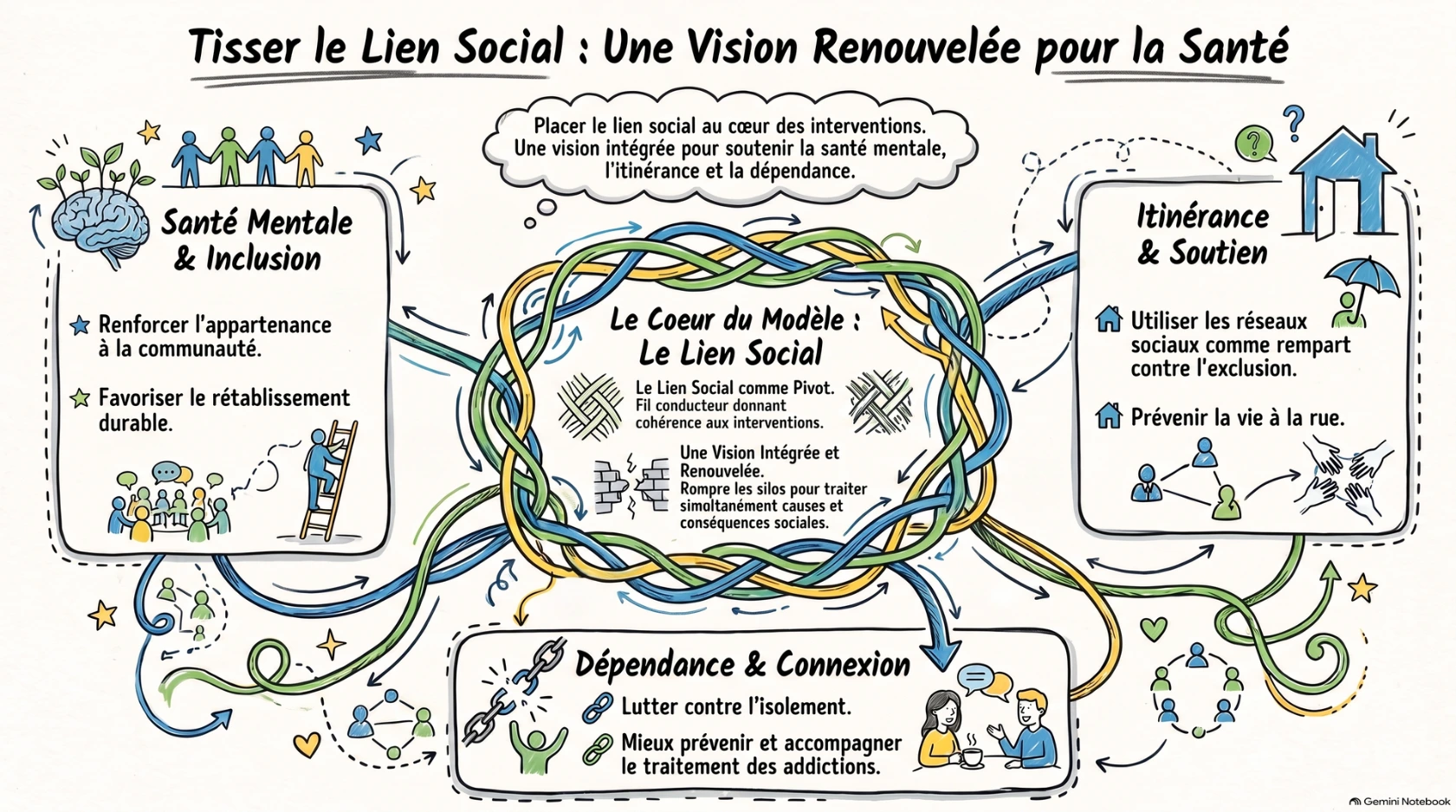
1️⃣ ANALYTICAL SUMMARY
Social connection as an overlooked determinant. The report starts from a surveillance finding: in Quebec, 27% of the population feels isolated sometimes or often, rising to nearly 43% among 18-24 year olds (p. 3). The INSPQ mobilises the notion of "social health" — the third dimension of the WHO definition, alongside physical and mental health (p. 3) — to connect three issues that have long been treated separately. Mental health, addiction, and homelessness each have their own dynamics but common roots; when trajectories converge, it is often the degradation or rupture of social connection that is at fault (p. 1). Two major trends exacerbate the phenomenon: the rise in socioeconomic disparities and digital transformation (p. 1).
A population-based and preventive response. Rather than commenting on the integration of services — which it does not consider within its remit — the INSPQ advocates for upstream action on social determinants (p. 4). It documents the deterioration of mental health among young girls (p. 9), the persistence of substance-related harms despite a decrease in consumption (p. 14), and homelessness as the culmination of adversity trajectories modifiable by housing and income policies (p. 24-25). Its central proposal: to extend the "Health in all policies" approach to a variant of "social connection in all policies" (p. 6, 26).
2️⃣ KEY POINTS OF THE DOCUMENT
1️⃣ A four-dimensional framework for analysing social connection — structure (number and frequency of links), function (forms of support), quality (nurturing vs toxic relationships) and, at the collective level, community and societal connectivity added by the OECD (p. 5-6). This framework is directly transferable to equip a territorial diagnosis of isolation.
2️⃣ The comorbidity of mental health / substances is massive and lethal : between April 2024 and March 2025, 65,815 Quebecers aged 12 and over received a diagnosis of substance use disorder; three-quarters (74%) also had a mental disorder, and the risk of death by suicide is 9.4 times higher among these individuals (p. 13).
3️⃣ Harm is increasing even as consumption decreases : mortality from suspected drug overdose averages 591 deaths/year between 2023 and 2025, compared to 424 in 2018, due to the unpredictability of the unregulated market (p. 14). A notable field fact: more than half of the users monitored consume alone, which increases the risk of death (p. 15).
4️⃣ Homelessness is on a sustained rise and is underreported : over 12,000 people experiencing visible homelessness in the 2025 count (+1,873 since 2022), with an annual growth of about 7-8% since 2018 (p. 19-20). Hidden homelessness would affect more than 300,000 people who have previously experienced an episode (4.2% of the population aged 15+) (p. 20).
5️⃣ The "tipping point" towards homelessness is quantified and modifiable : below a critical income threshold (£16,223 for a single adult in Montreal in 2023), networks contract, access to employment weakens, and mental health deteriorates (p. 24-25). This threshold "is not fixed": it shifts according to choices in income and housing policies (p. 25).
3️⃣ ACTION PATHS FOR LOCAL ACTORS
1️⃣ Integrate social connection into local diagnosis by relying on the four dimensions of the framework (structure, function, quality, community connectivity, p. 5-6) to map isolation and protective factors in a territory, rather than reasoning by siloed target groups.
2️⃣ Deploy a continuum of promotion-prevention-services-recovery by prioritising transition periods (school transitions, parenthood, leaving systems, retirement) and reducing negative childhood experiences (p. 10). In France, this is linked to CLS, CPTS, and territorial mental health projects (PTSM).
3️⃣ Strengthen the geographical and temporal accessibility of harm reduction services : users report a lack of proximity, limited hours, unawareness of service points, and the impossibility of inhaling on-site — increasing barriers with the progression of inhalation (p. 17). Remind the importance of not consuming alone and raise awareness of remote supervised consumption services, which are largely unknown (p. 15, 17).
4️⃣ Act to prevent evictions and maintain housing, eviction and repossession by the owner being the primary reasons for loss of housing (p. 18, 23); develop a varied range (emergency, transition, supervised, social, community) rather than just new construction, which is often inaccessible to modest households (p. 25).
5️⃣ Target housing discrimination and stigma as health levers: 28% of people in poverty report at least one discrimination over 12 months, generating anxiety and distress (p. 24). Integrate specific attention to female homelessness, largely undercounted due to violence and hidden homelessness (p. 20-21).
6️⃣ Document locally to pilot : similar to the Quebec drug analysis project, establish or mobilise observation mechanisms (counts, medico-administrative data + population data) to anticipate emerging needs (p. 8, 15). Identified unmet need : the document remains silent on the concrete modalities of service integration, which it explicitly refers to other stakeholders (p. 4).
4️⃣ ADDITIONAL REFERENCES
🔍➕ For more information, see the articles referenced by "Health Practices" on the theme of MENTAL health ➡️🔗 https://pratiquesensante.odoo.com/4-2-sante-mentale-et-psychique
1️⃣ CNSA — Build a public policy to combat the isolation of elderly people. Thematic and methodological guide (September 2025). Direct methodological supplement on detection, the 'outreach' and territorial cooperation against isolation — the operational dimension absent from the Quebec report.
🔗 https://www.cnsa.fr/sites/default/files/2025-11/PUB-Guide-lutte-contre-isolement_VF.pdf
2️⃣ Dihal — Preventing and identifying mental health issues among tenants in social housing (2025), collection "Acting against homelessness" #10. Transpose to the French framework "Housing First" the central intersection of housing / mental health in the report.
3️⃣ Health Promotion Auvergne-Rhône-Alpes — Health literacy and Easy-to-Read, Focus No. 33 (February 2025). Directly mobilisable support for the production of Easy-to-Read materials and adaptation for low literacy audiences, in line with § 6 below.
5️⃣ FREQUENTLY ASKED QUESTIONS (FAQ)
1️⃣ What is "social health" and why treat it as a public health issue?
It is the adequate quantity and quality of social connections that satisfy the need for meaningful relationships. The WHO considers it the 3rd dimension of health, interdependent with physical and mental health (p. 3).
2️⃣ Do the three issues always lead to homelessness?
No. The majority of people with mental health or addiction issues will not experience homelessness; however, these phenomena share common sources and can interconnect throughout the life course (p. 5).
3️⃣ Is alcohol consumption increasing?
It is decreasing (7.3 L of pure alcohol per capita in 2024-2025 compared to 8.0-8.9 in the previous two decades) but remains above the Canadian average. Nearly one in four people report monthly binge drinking; the burden is estimated at $4.1 billion/year (p. 13).
4️⃣ Why are overdoses increasing despite a decrease in drug consumption?
Mainly due to the unpredictability of the composition of drugs on the unregulated market: new substances are added without the users' knowledge (p. 14-15).
5️⃣ Who are the people experiencing homelessness?
A very diverse population: in 2022, 6.5% were 65 years and older, ~1 in 10 identified as Indigenous (5× more than in the general population), 29% had previously been placed in youth protection, 29% were cisgender women (p. 20).
6️⃣ What is the "tipping point" to homelessness?
A critical income threshold ($16,223 for a single adult in Montreal in 2023) below which material constraints gradually break relational, professional, and institutional ties. It is sensitive to income and housing policies (p. 24-25).
7️⃣ What is the main recommendation of the report?
To generalise a "social connection in all policies" approach and to act on social determinants (employment, income, housing, literacy, combating discrimination), on par with access to care (p. 6, 26-27).
6️⃣ REWRITING IN PLAIN LANGUAGE
What is this document about?
This text discusses 3 issues: mental health, addiction, and living on the streets.
These 3 issues are often interconnected.
They have a common cause: the loss of connections with others.
Connections with others are important for health.
Having friends and family helps to stay healthy.
Many people feel lonely.
In Quebec, almost 1 in 2 young people (18 to 24 years) feel lonely.
What the document found:
- Many people who take drugs or alcohol also have a mental health problem.
- There are more and more overdose deaths. The drugs sold are dangerous. We do not know what is in them.
- More and more people are living on the streets. There will be over 12,000 people in 2025.
- The mental health of young girls is worse than before.
How to help?
- We need to help people before they end up on the streets.
- We need more affordable housing.
- We need enough money to live.
- We need to maintain connections with others. At school, at work, in the neighbourhood.
- We should not judge people who have these problems.
7️⃣ CROSS-ANALYSIS — VALUES OF HEALTH PRACTICES
- Literacy: the report explicitly promotes mental health literacy as a lever to recognise distress, seek help, and deconstruct prejudices (p. 10).
- Empowerment: weak in itself — a positioning document that speaks about the public rather than describing their involvement; it does, however, value the power to act through access to income and housing.
- Participation: the co-construction mechanisms are not described; the PSADUQ project relies on voluntary users but remains a monitoring device, not a decision-making participation (p. 15).
- Community health: strong collective dimension — social cohesion, community connectivity, inclusive living environments and harmonious cohabitation are at the heart of the discussion (p. 6, 17-18).
- Ethics : the document rigorously distinguishes established facts and unpublished sources, and notes the conservative nature of certain data (p. 19); the biases of undercounting are explained (p. 20).
- Human rights : the approach through social determinants and equity (social gradient of harms, alcohol-harm paradox) reflects a reading through social health inequalities (p. 12, 21-22).
- Intersectorality : central — the approach "Health / social link in all policies" mobilises housing, income, employment, school, justice (p. 6, 26).
- Partnership : mentioned at the level of government action plans (mental health, addiction, homelessness, PNSP, SNPS) but without a formalised model of local collaboration (p. 10-11, 25).
- Fight against discrimination : addressed head-on — discrimination in housing based on origin, gender, health status or disability; stigmatisation of harm reduction services; non-judgement affirmed in conclusion (p. 23-24, 26).
8️⃣ EVALUATION OF THE RELIABILITY OF THE RESOURCE
Scientific relevance — high. Reference producer (INSPQ), substantial reference apparatus (p. 28-35), recent surveillance data (2024-2026) and international (WHO, OECD). Reserve to document, without correction : several structuring sources are "forthcoming" or "unpublished" (Langlois et al.; Blouin and Brisson), thus not independently verifiable to date.
Point of attention on a series of data : the deaths of people experiencing homelessness recorded by the Coroner rise from ‘approximately 20 per year between 2019 and 2022’ to 88 (2023) then 108 (2024) (p. 19). This considerable gap, which the report itself describes as ‘conservative’, suggests a possible evolution in coverage or counting method rather than a single real explosion — to be interpreted with caution.
Operational relevance — average for direct use. The document is a strategic advocacy: it sheds light on the why and the where to intervene, not the how operationally. Its transferability to the French field requires converting the Quebec frameworks (Santé Québec, ministerial plans, income thresholds, harm reduction measures) to their hexagonal equivalents (ARS, Housing First, PTSM, CAARUD/CSAPA).
9️⃣ STRATEGIC HASHTAGS
#HealthPractices #SocialLink #MentalHealth #HarmReduction #Homelessness #SocialDeterminants #HousingFirst #StructuralPrevention
This article was developed in accordance with the Charter
of the use of artificial intelligence of Health Practices.
Click on the image