
🚨 The prefect enters the game of health funding — what changes for you
🔍💡 FIR Funding: the prefect gains oversight over significant decisions of the ARS, with a suspensive re-examination at stake. Circuit, departmental allocations, thresholds to come — what every project holder must anticipate before 2027. 🏛️ #FIR #ARS
📌 🎯 This decree subtly redraws who has control over the money that finances your projects. The FIR is the flexible envelope of the ARS that pays for prevention, coordination of pathways, medico-social services, and access to care for vulnerable individuals. From 2027, part will be allocated by department, and the prefect may be consulted — or even request a suspensive re-examination — on ‘significant’ funding to a local actor. For any structure submitting an FIR application, this changes the decision-making circuit, adds an actor, and potentially delays. Knowing it means anticipating who really decides on your grant.
Source :📒 Decree No. 2026-649 of 22 July 2026 concerning the intervention of the prefect in the payment of the regional intervention fund of the regional health agencies✍️ Official Journal No. 0170 of 23 July 2026 (text 24 of 201). Signed on 22 July 2026.
1️⃣ ANALYTICAL SUMMARY
A rebalancing of decentralised state / health agencies
The decree inserts four new articles into the public health code (p. 1). It reflects a political movement of "restructuring local government": bringing health decisions closer to the ground and strengthening the prefect against the ARS, which are sometimes seen as distant from local realities. Two mechanisms are created. On one hand, the general director of the ARS will have to allocate each year a portion of the FIR credits in restrictive departmental allocations, upon proposal from the departmental directors (p. 1). On the other hand, the prefect is informed before any significant financial decision in favour of a health establishment, and consulted beforehand for any other local actor — associations, local authorities, social-medical (p. 1). The affected public is broad: ARS, prefects, establishments, professionals, associations, users.
A right of review with suspensive effect, but still undefined thresholds
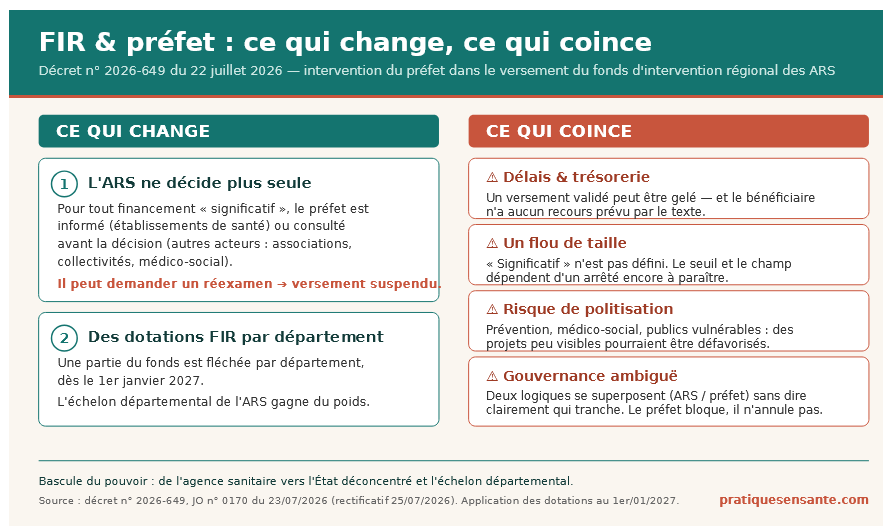
The most consequential provision: the prefect can request the general director to review a decision, and the ARS must then suspend execution until the review (p. 1). The regional prefect decides on decisions with regional or multi-departmental scope, the departmental prefect for local decisions (p. 2). The decisive point remains open: it is a forthcoming ministerial order (health, health insurance, elderly people, disabled people, interior) that will set the exact scope of the decisions concerned and the threshold of "significant" (p. 2). As long as this order is not published, the system remains incomplete. The allocation in departmental allocations applies from 1 January 2027 (p. 2).
2️⃣ KEY POINTS OF THE DOCUMENT
1️⃣ Creation of limiting departmental allocations. The DG of the ARS allocates each year a portion of the FIR credits by department, based on proposals from departmental directors, in accordance with the guidelines of the National Steering Council (new art. R. 1435-28-1, p. 1). Applicable from 1 January 2027 (art. 2, p. 2).
2️⃣ Mandatory information for the prefect regarding healthcare establishments. By derogation from the 2004 decree on the powers of prefects, the DG informs the departmental prefect of any significant financial intervention decision in favour of a healthcare establishment (art. R*. 1435-28-2, p. 1).
3️⃣ Prior consultation for all other local actors. For significant funding to a local actor other than a healthcare establishment (associations, local authorities, medico-social structures…), the prefect is consulted before the decision (art. R*. 1435-28-3, p. 1). This is the most sensitive point for the associative and medico-social fabric.
4️⃣ Re-examination with suspensive effect. The prefect may request the re-examination of a decision; the ARS then suspends its execution until the re-examination (art. R*. 1435-28-3, p. 1). In practice, a payment may be frozen during the procedure.
5️⃣ The actual scope referred to a subsequent order. The threshold of "significant" and the list of relevant decisions are not in the decree: they will be set by inter-ministerial order taking into account the nature of the decisions and the category of beneficiaries (art. R*. 1435-28-4, p. 2). Specific adaptations are planned for Saint-Barthélemy and Saint-Martin (art. R. 1442-1-2 and 1442-1-3, p. 2).
3️⃣ ACTION TRACKS FOR LOCAL ACTORS
1️⃣ Map your FIR funding circuit. Identify whether your funding falls under a "health establishment" (information regime, art. R*. 1435-28-2, p. 1) or an "other local actor" (prior consultation regime, more stringent, art. R*. 1435-28-3, p. 1). The applicable regime changes according to your legal status.
2️⃣ Anticipate a possible extension of deadlines. The prior consultation and any potential suspensive re-examination (p. 1) may delay a payment. For cash-strapped structures, incorporate this risk into the 2027 cash flow plan and do not incur expenses before firm notification.
3️⃣ Monitor the publication of the threshold decree. The actual impact entirely depends on the forthcoming decree (art. R*. 1435-28-4, p. 2). Keep an eye on the Official Journal and the publications from your ARS to know the threshold of "significant" that will concern you.
4️⃣ Strengthen the link with the departmental delegation of the ARS. Since departmental allocations are proposed by departmental directors (p. 1), the departmental level of the ARS becomes a key interlocutor to communicate field needs ahead of distribution.
5️⃣ Document the local scope of your project. Since the departmental prefect intervenes in decisions with departmental scope (p. 2), a file that clearly demonstrates its grounding and local utility better secures the prefectural opinion.
6️⃣ Unmet need to report. The decree does not provide any mechanism for information or appeal for the beneficiary whose funding would be suspended by a prefectural review. The heads of associative networks and federations in the medico-social sector have an interest in raising this issue during the consultation on the implementing order.
4️⃣ ADDITIONAL REFERENCES
- IGAS-IGF — Analysis of the regional intervention fund: actions, employment doctrine, steering and management by the ARS, June 2026. The report that laid the groundwork for this reform: it documents the growth of the FIR (+53% between 2019 and 2025), the inequalities in funding per capita, and the limited scope for territorial adaptation.
🔗 https://www.igas.gouv.fr/analyse-du-fonds-dintervention-regional-actions-doctrine-demploi-pilotage-et-gestion-par-les-ars - Senate — Information report no. 657 (2025-2026), Reform of the Regional Health Agencies: building proximity, 26 May 2026. Frames the debate on the departmentalisation of the actions of the ARS and the strengthening of the local level of which this decree is a translation.
🔗 https://www.senat.fr/notice-rapport/2025/r25-657-notice.html - ARS Hauts-de-France — FIR Report 2025 (published 2026). Concrete operational document: shows what the FIR actually finances in a territory (prevention, pathways, access to care for vulnerable people) and allows one to situate their own project within the envelope.
🔗 https://www.hauts-de-france.ars.sante.fr/fonds-dintervention-regional-le-rapport-2025-est-paru
5️⃣ FREQUENTLY ASKED QUESTIONS (FAQ)
1️⃣ Is the decree already in effect? The text comes into force the day after its publication (i.e. 24 July 2026), but the distribution of departmental allocations only applies from 1 January 2027 (art. 2, p. 2). The information/consultation system of the prefect is immediate.
2️⃣ What is a “significant” decision? The decree does not specify. The threshold and scope will be set by an upcoming inter-ministerial order (art. R*. 1435-28-4, p. 2). Until it is published, the actual extent of the system remains undetermined.
3️⃣ Will my association be affected by the prefect's consultation? If you are not a healthcare establishment, you fall under the regime of prior consultation of the prefect (art. R*. 1435-28-3, p. 1), which is more stringent than the simple information reserved for healthcare establishments.
4️⃣ Can a payment be blocked? Yes. If the prefect requests a review, the ARS suspends the execution of the decision until this review (p. 1). A validated funding can therefore be temporarily frozen.
5️⃣ Who is the competent prefect? The regional prefect for decisions with regional scope or concerning several departments; the departmental prefect for those concerning only their department (p. 2).
6️⃣ Can the prefect annul the decision of the ARS? The decree gives them the power of request for review with suspensive effect, not a power of direct annulment (p. 1). The final decision remains with the director general of the ARS after review.
7️⃣ Does the text provide anything for overseas territories? Yes, adaptations for Saint-Barthélemy and Saint-Martin: the allocation becomes "territorial", the director "territorial", and the prefect is replaced by the representative of the State in these communities (art. R. 1442-1-2 and 1442-1-3, p. 2).
6️⃣ REWRITING IN EASY TO READ LANGUAGE
What is this text?
The FIR is a budget of the ARS. The ARS is the agency that manages health in your region. This budget pays for prevention and care projects. It also helps associations and the medico-social.
What is changing
Before, the ARS decided almost alone. Now, the prefect has a role. The prefect is the representative of the State in the department.
Here are the new rules:
- The ARS shares part of the budget by department. This starts on 1st January 2027.
- For significant funding to a hospital, the ARS informs the prefect.
- For significant funding to an association, the ARS seeks the opinion of the prefect before deciding.
- The prefect can request a review of a decision. In this case, the ARS stops paying. It waits to have reviewed the decision.
An important point
We do not yet know the amount that counts as "significant funding". Another text will state this later. This text is called a decree.
What you can do
- Check if your structure is a hospital or an association. The rules are not the same.
- Wait for the written decision before spending the money.
- Speak with the ARS of your department early. Explain your needs.
7️⃣ CROSS-ANALYSIS — VALUES OF HEALTH PRACTICES
- Literacy : The decree is a technical legal text, without an accessible version; no comprehension tools are provided for the public or project leaders.
- Empowerment : No involvement of end beneficiaries is planned; the text is purely institutional and top-down.
- Participation : No co-construction mechanism with users or associations is described; the circuit remains between ARS, departmental directors, and prefects.
- Community health : The collective dimension is only addressed through the lens of the "territorial proximity" of the decision, not through community action.
- Ethics : The text does not address cultural or social biases; however, it raises an implicit issue of territorial equity in access to funding.
- Human rights : The absence of a remedy provided for the beneficiary of a suspended decision constitutes a blind spot regarding the principles of legal security.
- Intersectorality : The decree explicitly organizes coordination between the health authority (ARS) and the prefectural authority — a form of institutional intersectorality.
- Partnership : A formalized collaboration model is created (information / consultation / review), but between administrations, not with field actors.
- Fight against discrimination : The text does not mention any discrimination issues; the subject is absent.
8️⃣ EVALUATION OF THE RELIABILITY OF THE RESOURCE
Scientific / legal relevance : Maximum reliability in terms of sources — official text published in the Official Journal, adopted by the Council of State and the Council of Ministers, verified on Légifrance (JORFTEXT000054457312). The legal foundations (art. L. 1435-8 and L. 1435-11 of the Public Health Code) and the amended decree of 2004 are accurate.
Point of caution to note : A correction to decree no. 2026-649 has been published in the Official Journal no. 0172 of 25 July 2026. Check the consolidated version on Légifrance before any legal use — the text provided here is the initial version of 23 July.
Operational relevance : Moderate and deferred. The decree sets the framework but its concrete impact entirely depends on the forthcoming implementing order (thresholds, scope of decisions). No internal inconsistencies noted in the text itself; the main limitation is structural (incomplete provision in the absence of the order) and not contradictory.
9️⃣ STRATEGIC HASHTAGS
#healthcarepractice #FIR #ARS #HealthFunding #LocalState #TerritorialHealth #Prevention #MedicoSocial