
AI is already in your children's homework. What if we helped them stay free?
It is 8 PM. Emma, 10 years old, finished her homework in five minutes thanks to an AI. Lucas, 15 years old, has been glued to a video for four hours that the algorithm chose for him. Léa, 14 years old, shares a medical piece of information entirely fabricated by an AI, without knowing it.
These scenarios are not exceptions. They are the new normal.
In France, 90% of Year 10 students are already using AI for their homework, but schools still lack a framework to support them [1]. Meanwhile, China, India, and Finland are making great strides. The question is no longer whether we should educate about AI, but how and at what speed.
One observation is clear: learning to use AI is not enough. Most existing programmes in France and abroad (the European AILit frameworks, UNESCO, PISA 2029) focus on the technique and usage. But none truly prepare students to remain in control of themselves, to protect their attention, their mental health and their freedom against machines designed to capture them.
This is what an emerging project proposes: a continuous curriculum, from nursery to high school, and a training plan for teachers, to learn to "remain subject" in a world of AI.
This project is not a fixed document. It is an open proposal, a framework that we want to co-construct with citizens, teachers, parents, experts. Your voice can help it progress.
Download the white paper - write to Daniel Oberlé - pratiquesensante@pm.me - the document will be sent to you free of charge
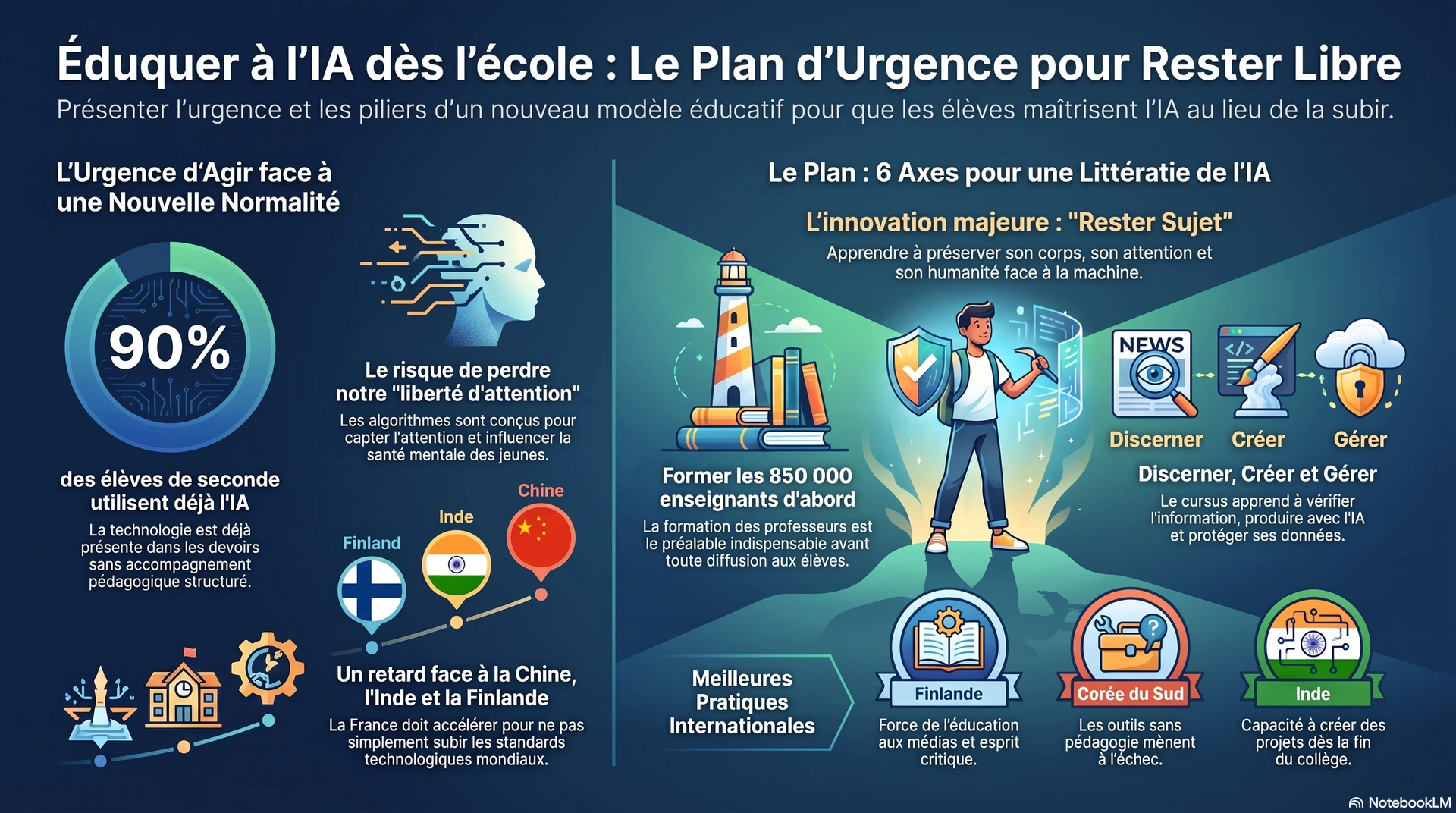
The heart of the project: six axes for digital freedom
The project revolves around six axes, addressed at each age with increasing depth. The first five follow international standards. The sixth, however, is the true innovation:
Understanding AI : How does it work?
Creating with AI : What to produce and how to verify it?
Discerning : Is it true? Who is speaking? With what intention?
Managing : What is the cost for my data, equity, the planet?
Acting on AI : Who decides and how to weigh in?
Remaining subject : How to preserve my attention, my body, my freedom? (The project's unique contribution)
This approach, centred on health and emancipation, aims to address the dilemma of the century: skills or exposure? The school must not only prepare students for world of AI, it must preserve their ability to remain fully human in this world.
An action plan to avoid suffering
The project draws inspiration from the best and worst international examples. It takes concrete lessons from:
China and India : the continuity. No isolated modules, but teaching from the first year of primary school, which strengthens each year.
From India : the creation. Not just stopping at usage, but going as far as designing projects from the end of middle school.
From South Korea : that tools without pedagogy lead to failure. Teacher training is the prerequisite for everything.
From Estonia : that massive access to tools without critical thinking is a major risk.
From Finland : the strength of media education, naturally extended towards AI literacy.
The key idea is simple: teachers first, students next. Without massive and continuous training, the most beautiful curriculum will remain a dead letter. The project therefore proposes a cascading training: a body of expert trainers → an AI referent per establishment → all of the teachers.
How can you contribute to advancing this text?
We need you to nourish it, critique it, enrich it. Here are five concrete ways to contribute:
Share your field experience :
Are you a teacher? Have you ever tried activities around AI in the classroom? What worked? What were the difficulties?
Are you a parent? How do you manage the use of screens and AI at home? What do you expect from the school on this subject?
Help us build the “Stay on topic Thread” : We have outlined paths for each cycle (nursery, primary, secondary, high school). But this is the heart of the project. We are looking for activity ideas, reflections, resources to enrich this axis.
Identify the blind spots : In your opinion, what have we forgotten? What issues related to AI and the health of young people should be further developed? The relationship to truth? Cyberbullying? The impact on social relationships?
Join the discussion on teacher training : How to train 850,000 teachers in five years without overwhelming them? What modalities (in-person, remote, peer-to-peer) seem the most relevant to you? How to enhance the role of “AI referent”?
Help with the concrete implementation : The project proposes “establishment scenarios” (rural college, urban high school, vocational high school). We need your perspective to adapt them to other contexts. How could this translate into an elementary school, a college in REP+, an agricultural high school?
Time is running out. Every year without a framework leaves an entire generation to train themselves in AI, at the mercy of algorithms and their commercial interests.
Acting now means choosing the content and values of this education. Waiting means enduring them.
So, what do you think? What are you going to add to this project?
Download the white paper - write to Daniel Oberlé - pratiquesensante@pm.me - the document will be sent to you for free
Your questions and suggestions
Please contact me if you have any questions