
🔍💡 Violence in institutions: a report details how a Catholic school could become a system of terror… and especially what concrete reforms to implement to ensure this does not happen again. #ChildProtection #TransitionalJustice🛑🧩 Bétharram: sexual violence, beatings, silences, impunity… but also 25 very practical recommendations to repair, compensate, listen to, and sustainably transform educational and religious institutions. #VictimSupport #ViolencePrevention
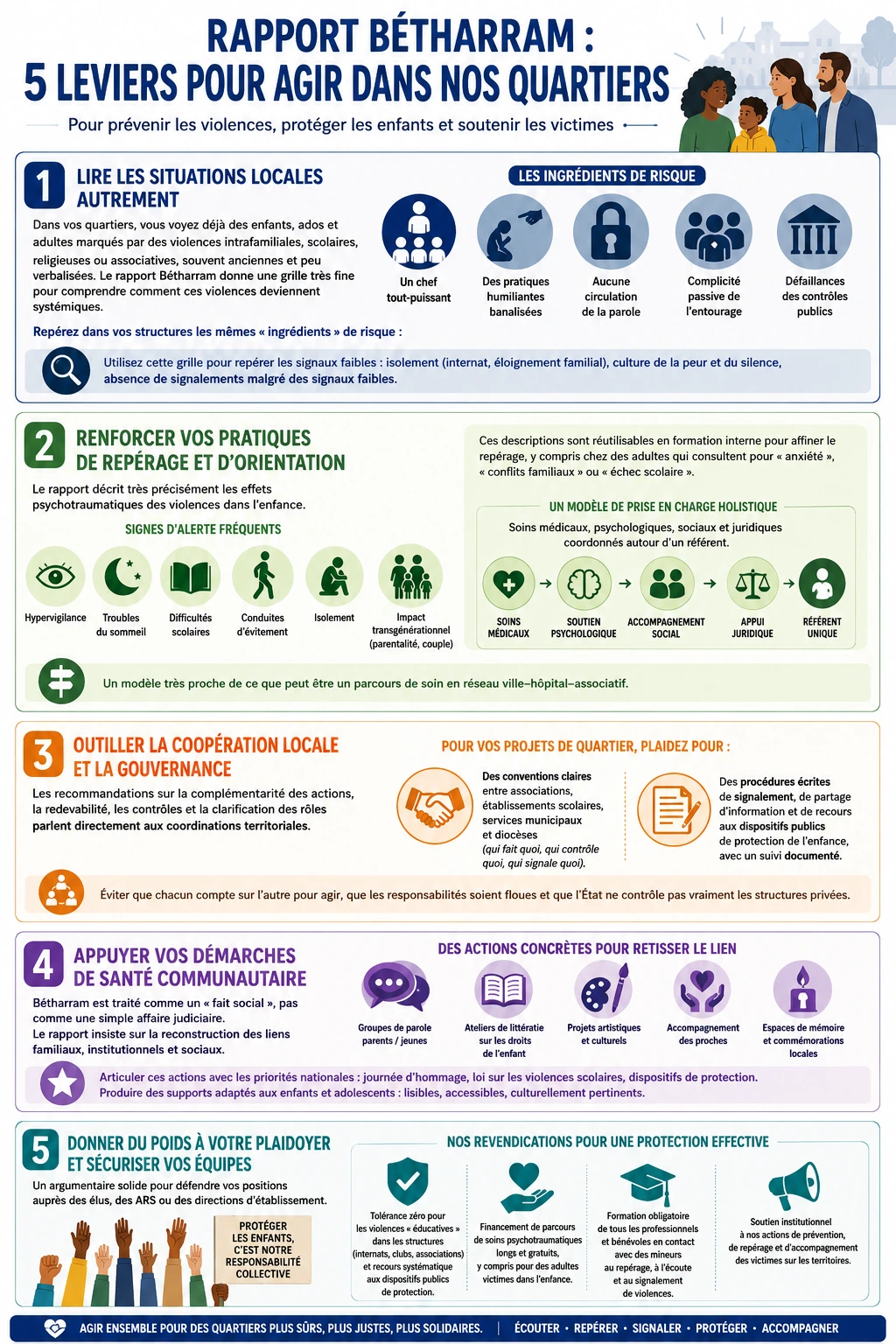
📌For professionals and community volunteers, this document helps to read situations already encountered in the field differently: historical violence that is rarely verbalised, control, silences, normalisation of humiliations, lack of alertness, and isolation of children or families. It provides a concrete framework to better identify the lasting effects of childhood violence — psychotrauma, avoidance, relational difficulties, family suffering — and to more accurately direct towards coordinated responses. It is also useful for structuring local cooperation between associations, public services, institutions, health actors, and child protection, by clarifying roles, reporting procedures, and responsibilities. Finally, it strengthens the advocacy of field teams in favour of tailored care pathways, mandatory training, and real institutional vigilance against violence towards minors.
Source:
BÉTHARRAM : TERROR AND SILENCE(S). Listen, recognise, repair and protect » – Report of the Independent Inquiry Commission on sexual and physical violence at Notre-Dame-de-Bétharram (CEIB). LINK
« BÉTHARRAM : TERROR AND SILENCE(S). Listen, recognise, repair and protect. The recommendations » LINK
See infographic at the bottom of the article on the levers to act in the neighbourhoods
and the additional points on the feasibility of the recommendations
🎥 https://www.youtube.com/watch?v=zHLFbtwm-YU
1. ANALYTICAL SUMMARY
Understanding what the teams are already seeing
The report shows that the violence against children does not only involve isolated perpetrators, but systems where the concentration of power, fear, silence, lack of control, and protection of the institution combine. This reading is very useful for community professionals, as it resonates with situations already encountered in families, educational structures, leisure groups, certain religious or associative institutions, often without clear qualification at the outset. In this sense, Bétharram acts as a revealer: it helps to identify contexts where communication is poor, where the absence of reporting is misleading, and where the most vulnerable children remain the least protected.
Transforming detection, orientation and coordination
The document is particularly useful because it articulates the clinical consequences of violence in childhood and the institutional responses to be implemented: psychotrauma care, social support, legal assistance, support for relatives, speaking groups, and sustainable coordination of pathways. For health and social care actors, it provides a solid foundation for improving the identification of situations, avoiding wandering between systems, and building more coherent interprofessional responses. It also provides a clear argument for demanding formalised procedures, training, identified intermediaries, and a genuine recourse to public child protection systems.
2. KEY POINTS OF THE DOCUMENT
The report allows violence to be viewed as a systemic phenomenon, not as a succession of “cases” : it describes how control, fear, normalisation, and silence are constructed over time, with institutional and social effects identifiable by field actors (p. 76‑80; p. 122‑222).
It documents in great detail the lasting effects of violence in childhood : hypervigilance, sleep disorders, cognitive difficulties, isolation, impacts on parenting, emotional relationships, and social life, with consequences throughout life (p. 237‑267; p. 77‑79).
It proposes a holistic approach that is directly inspiring for local networks : coordination between medical, psychological, social, and legal aspects, coordination by a reference person, continuity of the pathway, consideration of consent and relatives (p. 313‑333; recommendation 6, p. 9‑10).
It emphasises the complementarity of actors and the end of siloed work : the protection of children cannot rely on a single actor or a few whistleblowers; it requires formalised procedures, controls, relays, and effective cooperation (p. 334‑345; recommendations 1, 3, 17 to 21, p. 13‑15 and 11‑13).
It provides an advocacy framework for neighbourhood teams : right to compensation, right to care, need for training, strengthening of alert mechanisms, support for victims and their families, adaptation of materials for children and adolescents (p. 78‑80; recommendations 5, 6, 8, 21, 22, p. 9‑13).
Several recommendations from the report raise significant questions of concrete feasibility for implementation:
1. Funding and governance of compensation
The creation of an independent compensation mechanism for serious physical and psychological violence, whether linked to a future national fund for compensation for violence in schools or not, raises questions of funding, management, and equity. Who contributes to this fund (Congregation, State, Catholic education, other actors) and how to ensure equal treatment between victims of Bétharram, other Catholic institutions, and other contexts (public, associative, sport) remains uncertain.
2. Building a real holistic care approach
The proposed model (central platform, network of partner structures, pathway referent, multidisciplinary team) is ambitious and very relevant… but complex to implement. It requires professionals trained in psychotrauma, solid hospital and outpatient partnerships, effective coordination between health, social, and legal sectors, and sustainable funding for long-term follow-ups, which is already lacking in many areas.
3. Participation of victims and management of tensions
The creation of a Victims' Council, the implementation of the project "Weaving the Link" and the role given to victims in the follow-up of recommendations are necessary but delicate to organise. How to ensure legitimate representation, manage conflicts and rivalries between groups, prevent revictimisation, articulate these spaces with existing associations and with the Commission itself is not entirely clarified.
4. Citizens' tribunal and risks of drift
The Citizens' Tribunal is a symbolically strong tool, but it raises questions: who leads it, with what procedural guarantees, what status of the "decisions", and how to avoid it becoming an illusory substitute for criminal justice or a place for staging institutions rather than a place of truth. The report mentions the need for guarantees (rights of the defence, publicity of debates, voluntariness), but the practical translation remains open, especially in a highly publicised context.
5. Real coordination between actors and combating the "silo"
The recommendations on complementarity and accountability assume that Congregation, diocese, Catholic education, State, local authorities, justice, associations and health actors agree to clarify their responsibilities and share power. However, past experiences (CIIVISE, CIASE, parliamentary commissions) show that the translation into practices (regular controls, sanctions, transparency) is slow and uneven, and depends greatly on local willingness.
6. Archiving policies and effective access to documents
Strengthening archiving, designating referents, digitising collections and ensuring independent access to archives for victims and researchers requires resources and a profound cultural change in many structures. Practical questions (who funds, who controls, how to arbitrate between secrecy and the right to truth, how to handle 'sensitive' archives) are only partially addressed.
7. Cultural change on alertness and 'zero tolerance'.
Breaking out of the culture of silence, considering the low number of reports as a sign of inefficiency, genuinely applying the offence of non-reporting and professionalising listening cells involves a strong break with decades of institutional protection reflexes. The key question is: who will effectively control these mechanisms, with what concrete effects on the careers and responsibilities of leaders who do not play by the rules?.
3. ACTION PATHS FOR LOCAL ACTORS
Use Bétharram as a framework for identifying 'at-risk situations'. : in a social centre, a specialised prevention team, a CMPP, a community centre or a youth service, identify signs of control, unbalanced power, normalised humiliations, organised silence or suspicious absence of reports (p. 76-80; recommendations 18, 19, 21, p. 11-13).
Train teams to identify psychotrauma and delayed effects. : rely on clinical chapters to better understand late manifestations in adolescents and adults — anxiety, avoidance, school dropout, family conflicts, isolation behaviours — and avoid misinterpretation errors (p. 237-267; recommendation 6, p. 29-33).
Organise more coordinated pathways locally. : formalise stable links between health structures, social workers, victim associations, child protection, justice, schools and psychological support systems, with an identified referent when a complex situation requires it (p. 325‑333; recommendations 1, 6, 8, p. 13, 29‑33).
Strengthen alert and referral procedures : remind that the absence of revelations proves nothing, develop written reporting protocols, clarify to whom to transmit concerning information, and not allow internal systems to replace the competent authorities (recommendation 21, p. 39‑40; p. 11‑13).
Support community health initiatives around violence : speaking groups, support for relatives, workshops on children's rights, accessible tools for teenagers, work on memory, artistic expression and prevention of institutional violence at the neighbourhood level (recommendations 7, 8, 22, p. 30‑33 and 40‑42).
4. ADDITIONAL REFERENCES
Analysis of the implementation of the CIIVISE recommendations The implementation report of the 82 recommendations - https://www.pratiquesensante.com/blog/pratiques-15/analyse-de-la-mise-en-%C5%93uvre-des-recommandations-de-la-ciivise-le-bilan-de-mise-en-oeuvre-des-82-recommandations-5986
🔍➕ For more information, see the articles referenced by "Health Practices" on the theme of Child Protection ➡️🔗 https://pratiquesensante.odoo.com/3-7-protection-de-l-enfance
5. FREQUENTLY ASKED QUESTIONS (FAQ)
Why does this document concern local actors when it talks about a Catholic school?
Because the Commission shows that the mechanisms observed at Bétharram — control, silencing, trivialisation, weakness of controls, difficulty in hearing children — far exceed this single establishment and cross other social, educational, religious or associative contexts.
Pages : p. 79‑80 ; p. 334‑345.
How does this report assist in field identification?
It describes the effects of complex trauma and historical violence on mental health, learning, social and family relationships, which helps to link certain symptoms or pathways of disruption to past violence.
Pages : p. 237‑267.
What does it contribute to orientation practices?
It proposes a model of coordinated holistic care, with integration of medical, psychological, social, and legal care, pathway reference, and support for relatives.
Pages : p. 325‑333 ; recommendation 6, p. 29‑30.
What does it say about alert mechanisms?
It reminds us that a low number of reports can be a sign of inefficiency in the system, rather than safety; it recommends formalising procedures and systematically using public child protection systems.
Pages : recommendation 21, p. 39‑40.
Is the document useful for working with families?
Yes. The report shows that the consequences go beyond just the direct victims and affect relatives, parenting, couples, family ties, and intergenerational transmission. The recommendations document explicitly provides for the support of relatives and discussion groups.
Pages : p. 78‑79 ; p. 331‑332 ; recommendation 8, p. 32‑33.
How does it serve local cooperation?
It emphasises the complementarity of structures, the clarification of roles, the formalisation of responsibilities, control and accountability, which is directly useful for territorial coordination and neighbourhood partnerships.
Pages: p. 2‑5; recommendations 19 to 21, p. 37‑40.
What can health prevention teams do with it?
Use it to strengthen literacy on violence, train practitioners in psychotraumatology, develop community actions around speech, children's rights and care pathways, and support local advocacy on the needs for long-term and coordinated care.
Pages: p. 325‑333; recommendation 22, p. 40‑42.
6. REWRITING IN EASY TO READ LANGUAGE
Why this document is useful
This document talks about violence against children.
It shows how adults have been able to harm for a long time.
It also explains why no one has adequately protected children.
What professionals can do with it
Better recognise the signs of violence in a child or an adult.
Understand that silence does not mean there is no problem.
Better direct towards care, social assistance or legal aid.
Work together between associations, health, schools and child protection.
Request clear rules for reporting and protecting.
What the document teaches
Violence is not just 'isolated cases'.
It can persist when an institution protects its image.
The effects last a very long time in people's lives.
Loved ones can also suffer.
Coordinated care and long-term support are needed.
What this changes for the field
Listen earlier.
Better identify weak signs.
Work with written procedures.
Train all professionals and volunteers.
Do not let a single person have all the power.
7. CROSS-ANALYSIS — VALUES OF HEALTH PRACTICES
Literacy : the report remains dense, but it recommends creating materials suitable for children and adolescents, which aligns with the needs of community actions.
Empowerment : victims are recognised as experts of their experience and called to participate in the implementation of measures.
Participation : Victims' Council, support groups and the project "Weaving Connections" formalise a logic of real participation.
Community health : violence is analysed as a social fact with effects on families, loved ones, territories and institutions.
Ethics : the report explicitly addresses revictimisation, respect for pace, consent and the need for a secure framework.
Human rights : the whole is structured around the rights to truth, justice, reparation and non-repetition.
Intersectorality : health, social, justice, state, local authorities, research, associations and institutions are considered together.
Partnership : the text calls for a sustainable, coordinated and complementary mobilisation of all actors.
Fight against discrimination : it highlights the impact of social inequalities, the relational capital of families and the increased vulnerability of certain children in relation to institutions.
8. EVALUATION OF THE RELIABILITY OF THE RESOURCE
The resource is strong scientifically : it is based on an explicit mandate, hearings, archives, cross-checking, a detailed methodology and a dialogue with the work of the CIASE, the CIIVISE and other recent public reports. It is also very strong operationally because it transforms its findings into 25 prioritised recommendations, with concrete implementation measures, making it particularly usable by local networks, even outside the strictly Catholic or educational context.
Several recommendations from the report raise significant questions of concrete feasibility for implementation:
1. Funding and governance of reparations
The creation of an independent mechanism for redress for serious physical and psychological violence, whether linked to a future national compensation fund for violence in schools or not, raises questions of funding, governance, and equity. Who contributes to this fund (Congregation, State, Catholic education, other actors) and how to ensure equal treatment between victims of Bétharram, other Catholic institutions, and other contexts (public, associative, sport) remains uncertain.
2. Construction of a genuine holistic care
The proposed model (central platform, network of partner structures, pathway referent, multidisciplinary team) is ambitious and very relevant… but complex to implement. It requires professionals trained in psychotraumatology, solid hospital and outpatient partnerships, effective coordination between health, social, and legal sectors, and sustainable funding for long-term follow-ups, which is already lacking in many areas.
3. Participation of victims and management of tensions
The creation of a Victims' Council, the implementation of the project "Weaving the Link Again" and the role given to victims in the follow-up of recommendations are necessary but delicate to organise. How to ensure legitimate representation, manage conflicts and rivalries between groups, prevent revictimisation, articulate these spaces with existing associations and with the Commission itself is not fully clarified.
4. Citizens' tribunal and risks of drift
The Citizen Tribunal is a symbolically strong tool, but it raises questions: who leads it, with what procedural guarantees, what is the status of the “decisions”, and how to prevent it from becoming an illusory substitute for criminal justice or a stage for institutions rather than a place of truth. The report mentions the need for guarantees (rights of defence, publicity of debates, voluntariness), but the practical translation remains open, especially in a highly publicised context.
5. Real coordination between actors and combating the “silo”
The recommendations on complementarity and accountability assume that Congregation, diocese, Catholic education, State, local authorities, justice, associations, and health actors agree to clarify their responsibilities and share power. However, past experiences (CIIVISE, CIASE, parliamentary commissions) show that the translation into practices (regular controls, sanctions, transparency) is slow and uneven, and depends heavily on local willingness.
6. Archiving policies and effective access to documents
Strengthening archiving, designating referents, digitising funds, and ensuring independent access to archives for victims and researchers requires resources and a profound cultural change in many structures. Practical questions (who finances, who controls, how to arbitrate between secrecy and the right to truth, how to handle “sensitive” archives) are only partially addressed.
7. Cultural change on alert and “zero tolerance”
Breaking out of the culture of silence, considering the low number of reports as a sign of inefficiency, effectively applying the offence of non-reporting, and professionalising the listening cells involve a strong break with decades of institutional protection reflexes. The key question is: who will effectively control these mechanisms, with what concrete effects on the careers and responsibilities of leaders who do not play by the rules.