
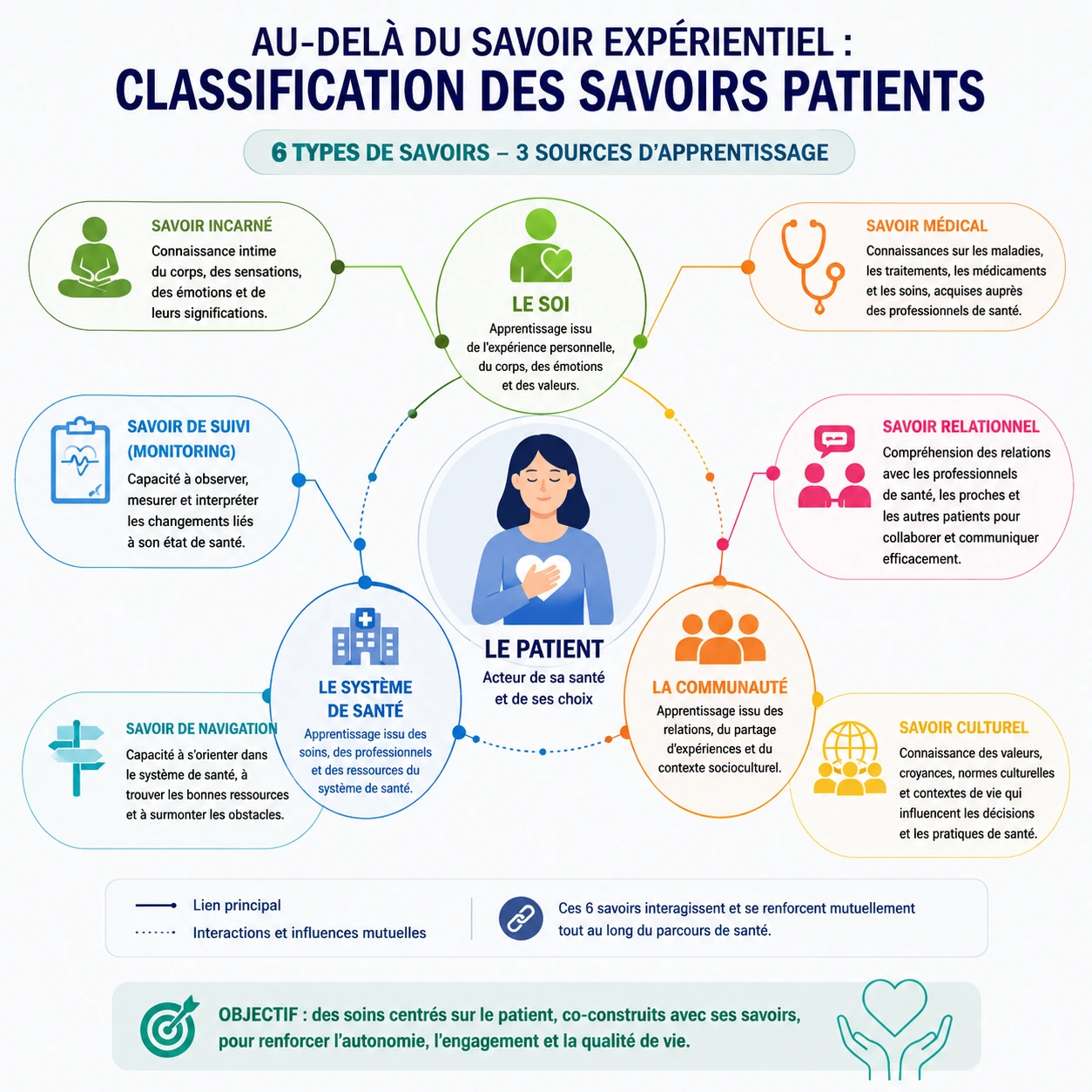
🔍💡 What if we stopped talking vaguely about 'experiential knowledge'? This framework of 6 types of patient knowledge provides teams with a common language to co-construct care with the individuals involved.🤝📊 From listening to the body to navigating the system, this model shows how patient knowledge becomes a strategic resource for the quality, safety, and equity of care.📌 This text provides a clear framework of 6 types of patient knowledge (embodied, monitoring, navigation, medical, relational, cultural) and 3 sources of learning (self, system, community).
It enables caregivers, care coordinators, therapeutic education leaders, social workers, and peer supporters to better identify, value, and mobilise patient knowledge in decision-making and organisations.It offers concrete avenues for transforming the care relationship into a partnership, redistributing the responsibility for learning between patients and professionals.Source: 📒 Beyond experiential knowledge: a classification of patient knowledge
✍️ Beyond experiential knowledge: a classification of patient knowledge - Vincent Dumez, Audrey L’Espérance. Social Theory & Health, 2024, volume 22, pages 173–186
📜🔗LINK to the source
Number of pages: 14
1. Analytical summary
Context, issues, and conceptual framework
The article starts from the observation that patients' 'experiential knowledge' is increasingly recognised, butremains vague, poorly defined and not very operational for both caregivers and patients themselves. The authors place this vagueness in a context ofepistemic injustice and epistemic oppression, where patients' narratives and interpretations are systematically undervalued in the face of dominant biomedical knowledge. They remind us that both patients and professionals possess expert and experiential knowledge, but that medicine continues to overvalue scientific knowledge to the detriment of knowledge derived from living with illness. Drawing on a narrative review of the literature in health sciences and social sciences, they demonstrate the diversity of concepts used (embodied knowledge, 'lay expertise', biomedical knowledge, situated knowledge...), and the difficulty in navigating these to build truly 'patient-centred' and partnership-based practices. Their challenge is tomake this knowledge more visible, more nameable and more shareable, in order to reconfigure power relations in care.
Operational contributions: 6 types of knowledge, 3 sources, and implications for partnership
The authors propose apragmatic classification of six types of patient knowledge— embodied, monitoring, navigation, medical, relational, cultural — linked tothree sources of learning: the self, the system, the community. They finely describe each type of knowledge, its modes of acquisition, its concrete uses in self-care, the relationship with professionals, and social life. This framework allows teams to identify where and how patients learn (through bodily experience, the use of services, collectives, etc.) and to identify“learning spaces” where professionals can support, develop, and recognise this knowledge. The article explicitly invites toredistribute the responsibility of learning: it is no longer about expecting the patient to “educate themselves”, but about considering institutions and professionals as co-responsible for the mobilisation and development of these six types of knowledge in the care pathways. The goal is a care relationship structured arounddialogue, the exchange of knowledge, and partnership, and no longer solely around scientific evidence or individual preferences.
2. Key points of the document
Epistemic injustice as a critical framework for care relationships (pp. 174–176)
The article shows how the healthcare system grants lower credibility to patients' narratives, interpretations of symptoms, and therapeutic preferences, which the authors link to the concepts of “epistemic injustice” (Fricker) and “epistemic oppression” (Dotson). This devaluation of patient knowledge leads to less certain, less appropriate care decisions, and maintains a power imbalance unfavourable to sick individuals.
Three sources of learning: self, system, community (pp. 178–179)
Patients learn fromtheir body and mind (the self), oftheir use of the structures and rules of the healthcare system (the system), and oftheir relationships with peers, relatives, collectives, and professionals (the community). This tripartition allows us to visualise where knowledge is constructed and to highlight the massive learning work carried out outside formal healthcare settings.
Six clearly defined categories of patient knowledge (pp. 179–182)
The narrative review leads to the following classification:embodied knowledge, monitoring knowledge, navigation knowledge, medical knowledge, relational knowledge, cultural knowledge. Each type is described with examples (blood pressure measurement, dose adjustment, choice of words in consultations, identification of care locations, management of trust relationships…), making it a usable tool in field practices and training.
Monitoring as precision knowledge for self-care and crisis management (p. 180)
Monitoring knowledge relies on the ability to finely identify physical, psychological, and emotional signs, through formal monitoring (devices, notebooks) or self-observation. The authors show that patients develop a personal semiology (e.g. in the role of 'sentinel patient') that they mobilise to adjust doses, actions, behaviours, often beyond standard protocols.
Recognising and developing patient knowledge as a lever for value and equity (pp. 182–183)
The classification opens up three uses:recognising each type of knowledge as a pillar of partnership, identifyingpedagogical strategies by source of acquisition, andmobilise patient knowledge as a resource for creating clinical, organisational, and political value. The authors emphasise the need to develop this knowledge early, including before any diagnosis, to strengthen citizens' capacity to be involved in the care team and to rebalance power relations.
3. Action points for local stakeholders
Map the six types of patient knowledge in your current practices (pp. 179–182)
In teams, identify for a type of pathology (e.g. diabetes, mental health issues, cancer) how patients mobilise each of the six types of knowledge in their daily lives: what they already know about their bodies, how they monitor their condition, how they navigate services, what relational codes they use, what cultural norms influence their choices. This mapping can serve as a basis for shared diagnosis and co-designing therapeutic education or health mediation actions.
Transform consultations into explicit spaces for mutual learning (pp. 178–181)
From the three sources (self, system, community), structure medical, nursing, or social interviews around questions that bring forth this knowledge (how do you sense warning signs? how do you go about getting an appointment? who do you surround yourself with?). This allows professionals to recognise the adjustment work already done by patients and to build care plans that integrate these skills, rather than making them invisible.
Integrate the six types of knowledge into therapeutic education and peer support programmes (pp. 180–183)
Programs can be designed toexplicitly strengtheneach type of knowledge (for example, 'body listening' workshops for embodied knowledge, simulations of calls or administrative procedures for navigation, role-playing for relational knowledge). Peer supporters can be mobilised as specific trainers on monitoring, navigation, and cultural knowledge, demonstrating their adjustment and work-around strategies within the system.
Adapt the organisation of services to support navigation and relational aspects (pp. 181–182)
The authors emphasise that repeated use of the system allows patients to understand 'the rules of the game' and learn to navigate around barriers. Structures can rely on this knowledge by co-constructing orientation tools with users (typical pathways, appointment scripts, navigation devices) and simplifying procedures that generate inequalities in access.
Train teams in the analysis of cultural knowledge and epistemic injustice (pp. 174–176 and 182)
The text stresses the weight of norms, values, and power relations (gender, age, kinship, etc.) in what can or cannot be said in health. Design training sessions where teams work on their own assumptions, identify situations of epistemic injustice, and learn to explicitly question the cultural knowledge of patients (who has the right to speak? what language registers? what conceptions of illness?).
4. Recent supplementary references
🔍➕ For more information, see the articles referenced by "Health Practices" / Health Partnerships and Partner Patients -https://pratiquesensante.odoo.com/blog/pratiques-15/partenariats-en-sante-et-patients-partenaires-5929
5. Frequently Asked Questions (FAQ) – for the field
How is this text different from generic discourses on 'experiential knowledge'? (p. 174–177, 179)
The authors criticise the vague use of the term 'experiential knowledge' and propose a detailed classification into six types of knowledge, each with distinct sources and uses. This avoids lumping everything into a vague category in relation to biomedical knowledge.
What are the three main sources of patient knowledge that I should keep in mind in practice? (p. 178–179)
The text distinguishes theself(body, mind, reflections), thesystem(rules, procedures, interactions with institutions) and thecommunity(peers, relatives, networks, living spaces). Each is a 'learning space' where patients build specific skills.
What does monitoring knowledge precisely cover for a chronic patient? (p. 180)
It is the ability to identify subtle signs (physical, emotional, cognitive), to use tools (glucometer, blood pressure monitor, etc.) and to adjust one's behaviour or treatment on a daily basis. The authors emphasise personal semiology and the role of the 'sentinel patient' developed through experience.
How can navigation knowledge be mobilised within social and medico-social structures? (p. 180–181)
It involves knowledge of the workings of the system, access procedures, the right contacts, and how to present one's situation to be heard. Social actors can use this knowledge to co-develop guidance tools, simplify pathways, and identify hidden barriers.
Do patients really have a 'medical knowledge' or is it reserved for professionals? (p. 177–181)
The authors show that many patients actively appropriate biomedical knowledge (physiological mechanisms, therapeutic options, side effects) through consultations or personal research. This knowledge is used to make sense of symptoms, negotiate treatments, and seek social and medical recognition of their condition.
How do social inequalities influence the ability to develop and mobilise these six types of knowledge? (p. 182–183)
The article highlights that social inequalities and systems of oppression limit access to certain learning spaces (forums, associations, time, educational capital, digital resources). The authors advocate for targeted interventions (support groups, forums, patient-partners) to reduce these gaps and support collective empowerment.
What can I do, as a professional, to reduce epistemic injustice in my practice? (p. 174–176, 182–183)
It is about recognising from the outset that patients hold essential knowledge, explicitly asking for their analyses and preferences, and giving these contributions a resource status in decision-making. The authors also invite the design of 'knowledge-based' interventions in partnership with patients, to develop their knowledge while changing the norms of credibility within teams.
6. Rewriting in Easy-to-Read Language
Easy-to-Read Title
Understanding the 6 types of knowledge of patients
A. Simple Context
Caregivers mainly believe in the medical knowledge learned in school.
Patients also have important knowledge, thanks to their life with the illness.
This knowledge is often looked down upon or not taken seriously.
The authors want to better explain this knowledge of patients.
This helps to make better joint decisions about care.
B. Main idea
Patients learn in three ways: with their body, with the healthcare system, with others.
They develop six different types of knowledge.
This knowledge is useful for self-care and for communicating with caregivers.
Caregivers must recognise this knowledge.
They must also help patients to develop it.
The 6 types of knowledge explained simply
Embodied knowledge (from the body)
The patient knows their pain, fatigue, and energy.
They feel what is normal or not in their body.
Monitoring knowledge
The patient monitors their health every day.
For example, they check their blood pressure or blood sugar.
They know how to recognise warning signs to act quickly.
Navigational knowledge (within the system)
The patient learns how to make an appointment.
They know who to call and what documents to provide.
They know how to present themselves to be heard.
Medical knowledge
The patient learns medical terms about their illness.
They better understand treatments and examinations.
They can ask questions and discuss choices.
Relational knowledge
The patient knows whom to trust for help.
He knows how to talk to healthcare providers and his loved ones.
He builds a team around him.
Cultural knowledge
The patient knows the rules of his family and culture.
These rules dictate who can speak about health or not.
They influence his choices of care and treatment.
7. Cross-sectional analysis – Values of Health Practices
Literacy: the document remains theoretical but offers a clear framework of the six types of knowledge, useful for adapting information and support to different levels of understanding.
Empowerment: it views the patient as an active learner, a producer of knowledge, and advocates for developing his abilities in monitoring, navigation, and negotiation within the system.
Participation: it centres on the co-construction of decisions and interventions, based on the formal recognition of patient knowledge.
Community health: the 'community' is identified as a major source of learning (support groups, peers, associations), which legitimises collective approaches.
Ethics: the analysis in terms of epistemic injustice and oppression shows an explicit concern for credibility biases and power relations in care.
Human rights: the article emphasises equity of voice, consideration of preferences and experiences, and the redistribution of the responsibility for learning, consistent with a rights-based approach.
Intersectorality: without detailing the sectors, taking into account the system and the community opens up health, social, associative, and educational partnerships.
Partnership: it clearly aligns with the 'Montreal model', formalising the role of the patient as a training partner and co-decision maker.
Fight against discrimination: by naming the effects of social and cultural inequalities on access to knowledge and speech, it provides a framework to identify and reduce discrimination in care pathways.
8. Assessment of the reliability of the resource
Scientific relevance: peer-reviewed article, published in 2024 in a recognised international journal in health sociology; the narrative review is widely referenced (Anglo-Saxon and Francophone works, concepts of lay expertise, epistemic injustice, patient partnership). The approach is theoretical but firmly grounded in classical references and recent works.
Operational relevance: the classification into six types of knowledge and three sources offers an immediately usable tool for training, patient education, peer support, the design of partnership arrangements, and health policies. The resource does not provide detailed protocols but offers a shared language and a very useful cross-analysis framework for field teams.