
🔦 🔍💡 Prevention and scientific independence: removing prevention from the agency that produces the data cuts the message from its source. Nirsevimab (against bronchiolitis), measles, Tobacco-Free Month — three demonstrations that the surveillance-prevention continuum is not an organisational chart, it is a method. 📊
📌 📌 Based on the 2025 annual report of Public Health France, this article offers a cross-sectional reading of the ongoing reform and shows, with three concrete cases (nirsevimab, measles, vaccination obligation), what breaking the continuum surveillance‑prevention would cost public health. It compares the returns on investment of the initiatives (Tobacco-Free Month, VigilanS, Unplugged) and the budget actually dedicated to expertise (around €200 million for 600 agents), to respond to the budgetary arguments of the reform. By relying on the international PHEPA evaluation and the positions taken by civil society, it shows that France has a tool deemed robust by its peers, whose restructuring poses a challenge to scientific and democratic credibility. To be read by field actors and decision-makers who want to have, in a few minutes, a quantified argument to defend a prevention based on data, independent of lobbies and capable of truly reducing health inequalities
The annual report of Public Health France stands out as much more than an inventory of administrative activities. It arrives in the debate on the restructuring of the agency as a doctrinal piece major, likely to reconfigure the terms of the political and union conflict. It opposes facts, figures and independent assessments to the three pillars of the reform project: the separation of professions, the budgetary argument and the trial for "lack of evaluation" Source:
📜🔗LINK to the source
These two sentences are the key to understanding the entire document:
- Sylvie Lemmet mentions "the challenges and uncertainty that the agency has been facing for over a year" and concludes with the wish for "a positive reform" (p. 4). The word is chosen.
- Caroline Semaille: "The challenge remains to preserve this model," based on "a continuum from surveillance to prevention and action" (p. 5)
1. The surveillance–prevention continuum, demonstrated in practice
The reform is based on a simple and appealing idea on paper: to separate surveillance, which would remain the agency's responsibility, from prevention, which would go back to the ministry. The report shows, with supporting evidence, that this division is an operational misunderstanding. Effective prevention is not an additional communication effort, but the final link in an integrated chain of knowledge production, analysis and decision-making.
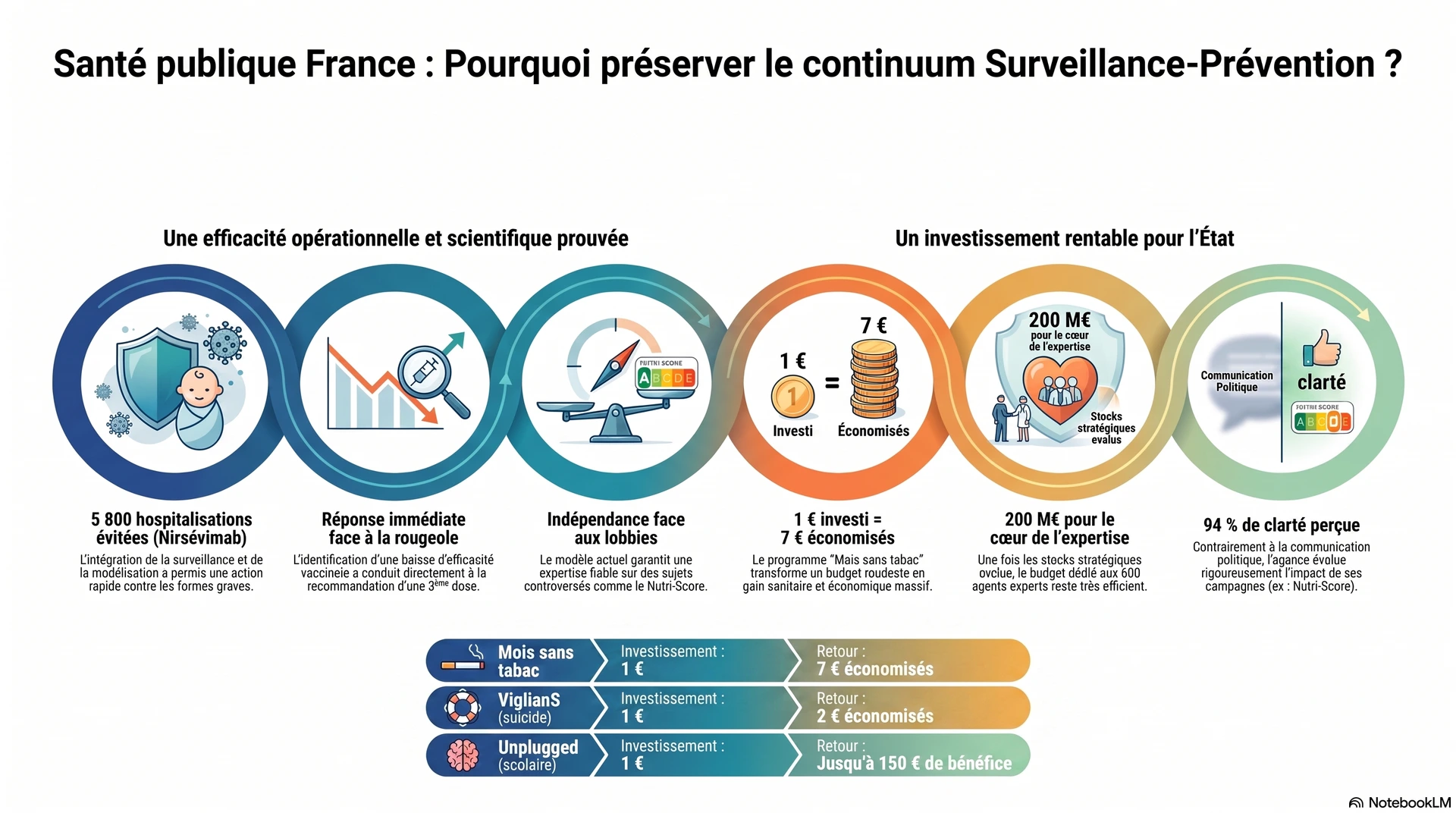
Nirsevimab (Beyfortus): the agency mobilises its surveillance network (OSCOUR®, CNR), collaborates with the Pasteur Institute to model real-life effectiveness (76–81% against severe forms, approximately 5,800 hospitalisations avoided), and then transmits these results to the authorities to guide public decision-making. Surveillance, evaluation and action fall under the same professional gesture.
Measles: an epidemiological investigation in a college in Auvergne–Rhône-Alpes identifies a decrease in vaccine effectiveness among children vaccinated before one year, directly leading the HAS to recommend a third dose for these groups.
Mandatory vaccination with 11 valences: the report explicitly presents it as an "illustration of the continuum of professions" of the agency, where epidemiological monitoring, support for families, and assistance to professionals are inseparable.
The key argument for advocacy is clear: the prevention message only makes sense if it is produced where data is collected, analysed, and discussed. Removing prevention from the agency breaks a chain of scientific and operational value that has proven itself.
2. The budget framing: an expertise of €200 million for 600 agents
On the financial front, the report provides quantified ammunition to defenders of the expertise of Public Health France, while revealing a paradox useful for understanding the reform.
High returns on investment: 'Mois sans tabac' (1 € invested = 7 € saved), VigilanS (1 € = 2 € saved and 38% fewer suicide attempts), the Unplugged school programme (up to €150 of societal benefit per euro invested) illustrate the agency's ability to transform modest budgets into considerable health and economic gains.
A misleading overall budget: of a total budget of €685 million, €469 million (68%) are neutralised by an exclusive allocation to the State's strategic stocks and crisis management, via the pharmaceutical establishment.
Strategic consequence: once the stocks are transferred to the DGS, the "true" budget dedicated to expertise (surveillance, studies, prevention) is around €200 million for nearly 600 agents. The report thus provides a double argument: it shows that prevention costs little in relation to its impact, which supports the agency's defence, but it also lends credibility to the idea that removing stock management does not undermine the scientific core. The budgetary debate can no longer be conducted on raw figures: it must focus on the value created by these €200 million.
3. An agency scrutinised by an independent international evaluation
In response to the assertion that the reform would be conducted without a serious assessment of the existing system, the report presents a key piece: an international evaluation, conducted by peers and made public at the very moment the reform was announced.
PHEPA Mission (January 2026): led by the ECDC, WHO and European experts, it qualifies the French system for monitoring respiratory infections as "highly automated, comprehensive and robust".
International standards (IANPHI): the agency, which hosted the general secretariat of the global association of public health institutes until 2025, contributed to drafting the profession's standards, the first criterion of which is scientific independence.
Advocacy message: France has a tool deemed robust by its international peers. Undertaking a profound restructuring without relying on the conclusions of the PHEPA report amounts to ignoring the only available scientific and independent evaluation. The debate is no longer merely administrative: it becomes an issue of international credibility.
4. Evidence culture versus political communication
The report documents a form of "post-test culture" at odds with unassessed institutional campaigns, such as the inter-ministerial campaign "The Price of Drugs" criticised by the associative sector. Where political communication often remains at the display level, the agency highlights impact indicators and agrees to make its blind spots public.
Evaluated campaigns: the youth campaign #JenParleA shows 93% perceived usefulness; the one on the new Nutri-Score reaches 94% clarity, based on structured evaluation devices.
Transparency on the limits: for Sexosafe, a device dedicated to MSM, the ERAS survey (over 19,000 respondents) is used not to boast about a notoriety of 32%, but to identify under-reached audiences (young people, rural areas, people born abroad) and highlight the need to strengthen targeted actions.
The key argument is powerful in an advocacy register: the agency agrees to publish what is not yet working, to name the missed audiences, and to correct its trajectory. This transparency, typical of a scientific and clinical approach, contrasts with ministerial communication that largely remains without outcome indicators.
5. A clear alert against capture by lobbies
The report does not just rely on numbers. It gives a voice to scientists and field partners who all warn against the risk of dilution of independence if expertise is too directly tied to political power.
Nutri-Score: Serge Hercberg reminds us of the need to "overcome many political and economic obstacles related to industrial interests," pointing out the constant pressure exerted on nutritional regulation tools.
Environmental issues (ZFE): Sébastien Denys emphasises that the role of the scientist is also to stand firm against "the questioning of scientific integrity" when evidence challenges contested political decisions.
Voice of local authorities: the French Network of Health Cities (121 local authorities) asserts that the partnership with the agency guarantees "reliable scientific expertise independent of lobbies on often controversial themes."
Underlying this, a strong line emerges: field actors like the agency's experts remind us that public health has social value only if it remains impervious to economic interests and political pressures. Elevating prevention within a structure more directly controlled by power thus undermines this immunity.
Interventions on the subject
French Society of Public Health (echo via the Senate)
Title (mentioned in a written question): Tribune of the French Society of Public Health on the reorganisation of Public Health France.
Summary: Tribune signed by around 350 public health actors warning of the risk of near dismantling of the agency's prevention activities.
URL (question to the Senate, citing the tribune): https://www.senat.fr/questions/base/2026/qSEQ260307990.html
National Assembly (written question)
Title: Restructuring of the Public Health France agency.
Summary: Written question from a deputy questioning the government on the consequences of the restructuring of SPF and the clarification of retained or transferred missions.questions.assemblee-nationale
AIDS / Remains
Title: The News as Seen by Remaides: Public Health France under Political Supervision: Prevention in Danger.
Summary: Detailed analysis article on the transfer of missions from SPF to the ministry, describing the consequences for prevention and relaying the reactions of field actors and civil society.
URL: https://www.aides.org/actualite/lactu-remaides-sante-publique-france-prevention-danger
Sidaction
Title: Reform of the ARS and Public Health France.
Summary: Interview on the key role of SPF in HIV prevention and the possible effects of transferring its missions to the Ministry of Health.sidaction
URL: https://www.sidaction.org/transversal/vih-la-sante-publique-sous-tension/
Le Monde
Title: Several missions of Public Health France are to be transferred to the Ministry of Health.
Summary: Article explaining the restructuring of SPF, the list of transferred missions, and the criticisms raised among professionals and public health researchers.
Libération
Title: Reform of Public Health France: prevention comes under the ministry's control, professionals are alarmed.
Summary: Article describing the transition of major prevention campaigns under the direct supervision of the ministry and Health Insurance, giving voice to professionals who denounce a risk of politicisation.
To Go Further
- Public Health France — Strategy 2025-2030 to Address Major Public Health Challenges (published on 10 December 2025). Previous framing document prior to the controversy: it outlines the triple mission (monitor, protect, prevent) that the reform would split. Useful for objectifying what “continuum” means in the agency's own terms. Verified URL: https://www.santepubliquefrance.fr/docs/rapportsynthese/strategie-2025-2030-pour-repondre-aux-grands-enjeux-de-sante-publique
- ECDC — Public Health Emergency Preparedness Assessments (PHEPA). Methodological page of the evaluation framework mentioned in section 3, with the published country reports. Allows you to verify for yourself the scope and limits of the cited evaluation. Verified URL: https://www.ecdc.europa.eu/en/about-ecdc/what-we-do/public-health-emergency-preparedness-assessments
You can respond in the comments