
🚨 Two laws, two timelines: what your care home or home service must do TODAY🔍💡 Legal framework end of life: what is already required of your structure (training, EMSP, PPA) vs. what is still pending from the Constitutional Council. 🧭 The grid to avoid confusing obligation and anticipation. #PalliativeCare #ESSMS
📌 This text clarifies a costly confusion: it separates the palliative care law of 26 May 2026, already in force and creating obligations, from the assisted dying law, adopted but suspended by the Constitutional Council. It translates each enforceable article (training, EMSP agreement, establishment project, personalised plan) into concrete expectations for care homes, disability ESSMS and home services. It especially links these obligations to the imperative criterion 2.7.1 of the HAS evaluation, making it a directly usable tool to prepare for a Synaé visit. Concrete use: framing an action plan for compliance without pre-empting an unpromulgated text.
The evolution of the legislative framework regarding end of life and accompanying care marks a major step for the social and medico-social sector. It concerns not only hospitals or health professionals: it has direct repercussions on care homes for dependent elderly people (EHPAD), structures supporting people with disabilities and home autonomy services (SAD). All will need to adapt their organisations, professional practices and traceability tools.
It is also necessary, to properly situate the obligations that actually apply to the structures, to distinguish two texts of different nature and timing, too often confused in a “new legal framework” presented in the singular. This is the subject of the first part of this article.
Two laws, two timelines: what the “new framework” really covers
The two texts have a common ancestor: the Claeys-Leonetti law of 2 February 2016, which enshrined the right to a dignified end of life, deep and continuous sedation until death, as well as advance directives and the trusted person. It is on this foundation that the legislator built, in 2026, two distinct responses.
The law on support and palliative care: in force
The law no. 2026-404 of 26 May 2026 aimed at guaranteeing equal access for all to support and palliative care [1] was definitively adopted by Parliament on 11 May 2026, then promulgated on 26 May 2026 and published in the Official Journal on 27 May [2]. It translates into law the ten-year strategy for support care presented by the government in April 2024. Its structural contributions are as follows:
- it redefines the notion of palliative care by replacing it with the more encompassing concept of “support and palliative care”, which aims for a holistic approach to the sick person to preserve their dignity, quality of life, and well-being [2];
- it entrusts to the regional health agencies (ARS) the establishment of dedicated territorial organisations, responsible in particular for strengthening effective access to home palliative care [2][4] ;
- it creates a new category of medico-social establishment, the palliative care and support homes, intermediate structures between home and hospital, which take over from home when it is no longer tenable and also welcome relatives, including those in mourning [2][6] ;
- it establishes a personalised support plan (PPA) from the announcement of a serious illness [4] ;
- it improves the access and use of advance directives and strengthens the support for relatives and caregivers, up to bereavement [2] ;
- it sets out a multi-year national strategy whose funding has been doubled for the period 2026-2034 by the Senate [2].
An important point of clarification, often misreported: the enforceable right to palliative care, present in the initial text of the National Assembly, has been removed by the Senate, which estimated that it would mainly lead to compensatory judgments against the State without actually improving access to care; the Assembly then adopted the text without modification in the second reading to allow for rapid implementation [2]. The law therefore relies on territorial organisation and budgetary programming rather than on a right sanctioned by the judge. It contains 25 articles and refers to several implementing decrees (training, intervention of volunteers at home, terms of the PPA, prefiguration of support houses) [5].
The law on assistance in dying: adopted but suspended
The law relating to the right to assistance in dying followed a distinct and tumultuous parliamentary path. After three rejections by the Senate, the National Assembly had the final word through a solemn vote on 15 July 2026 (291 votes to 241) [7]. But its promulgation is suspended : the Prime Minister, the President of the Senate, more than sixty senators and more than sixty deputies have referred to the Constitutional Council between 16 and 20 July 2026 [3][8]. The Wise Ones have, in principle, one month to rule (eight days in case of urgency) [8].
The text creates a right to assistance in dying — covering both assisted suicide and, in certain cases, euthanasia — open to a person meeting five cumulative conditions [3] : to be of legal age; to be of French nationality or to reside in France in a stable and regular manner; to be suffering from a serious and incurable condition that threatens life, in an advanced or terminal phase; to present physical and psychological suffering that is resistant to treatment or unbearable; and to be able to express a free and informed will. It provides for a conscience clause for professionals who refuse to participate (responsible for directing to other professionals), an a posteriori control by an independent commission placed with the Minister of Health, and a offence of obstruction [3].
Practical consequence: as of 27 July 2026, assistance in dying is not applicable. Medical-social structures therefore have no immediate operational obligation in this regard (see § 5).
In summary. The obligations outlined below arise from the law of 26 May 2026, in force. What pertains to assistance in dying remains, to this day, a perspective conditioned on the decision of the Constitutional Council.
Chronological markers
- 2 February 2016 — Claeys-Leonetti Law (foundation: advance directives, deep and continuous sedation).
- April 2024 — Presentation of the ten-year strategy for supportive care.
- 28 January 2026 — The Senate adopts the palliative care law (307 votes to 17) and rejects assistance in dying [2].
- 11 May 2026 — Definitive adoption of the palliative care law; promulgation on 26 May 2026 [2].
- 15 July 2026 — The National Assembly definitively adopts assisted dying [7].
- 16-20 July 2026 — Referrals to the Constitutional Council: promulgation suspended [3][8].
1. The EHPAD: strengthening the culture of choice, anticipation… and ensuring compliance
In EHPAD, end of life is already a fundamental issue of the quality of support: scrupulous respect for the resident's wishes, collection of advance directives, formal designation of the trusted person, anticipation of complex situations and support for relatives. The recommendations for good professional practices from the High Authority of Health, notably Supporting the end of life of elderly people in EHPAD, provide the reference framework for the teams [12].
The law of 26 May 2026 goes further and creates concrete obligations for establishments [1][4]:
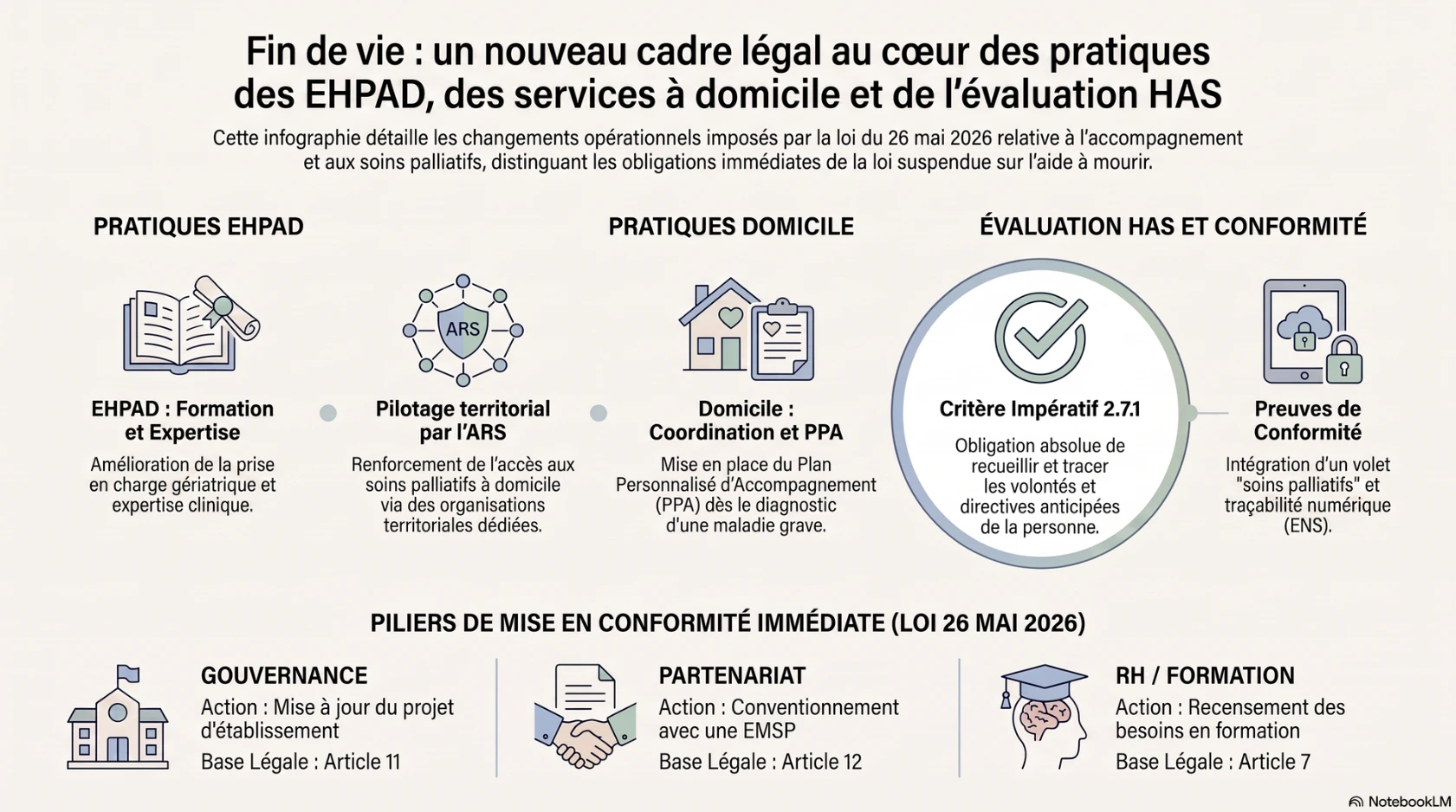
- A section on “support and palliative care” in the establishment project (article 11 of the law): the palliative approach must be formalised — principles of the approach, internal organisation, respective roles (nurse, coordinating doctor, psychologist), coordination with mobile teams [4].
- An agreement with a mobile palliative care team — EMSP (article 12): the support of external expertise becomes a structural expectation, with formalised referral procedures and deadlines [4].
- Initial and ongoing training in palliative care (article 7), which concerns all professionals already in post, and not just new graduates — a decree will specify the modalities [4].
- A reference person responsible for coordinating access to support and palliative care, a role that may fall to the coordinating nurse or the health manager in EHPAD, in connection with the coordinating doctor [4].
- The implementation of the personalised support plan (PPA) (article 17), proposed after the announcement of a serious diagnosis, in the event of the worsening of a chronic condition or the onset of loss of autonomy, and kept in the digital health space [4].
Beyond these obligations, two posture requirements remain: a proactive role in identification — it is no longer just a matter of recording a directive at admission, but of regularly reassessing the resident's wishes as their condition evolves — and the collegiality of decisions, by strengthening ethical reflection spaces to avoid the isolation of caregivers as well as educational or activity teams.
The challenge of change management is real: the law transforms recommended good practices into expected compliance evidence, which evaluation will objectify (see § 4).
2. Disability and ESSMS: addressing the complexity of verbalisation
For establishments and services welcoming people with disabilities (MAS, FAM, life homes, SAMSAH…), the issues of end of life require sensitivity and adapted methodologies. The scope is broad: the law aims to all professionals in the medico-social and mental health sector, particularly regarding the training requirement [4].
Situations are often more complex to anticipate and share:
- Appropriate communication. The expression of wishes or suffering may be altered by cognitive, psychological, or speech disorders. The use of alternative and augmentative communication (AAC) becomes essential to ensure the true expression of autonomy and the gathering of wishes in conditions that make sense for the person.
- Peer and family support. The end of life of a resident in a care home affects the entire community of life. The personalised support plan — which explicitly covers the entourage, including after death [4] — offers a lever to mobilise, provided that its implementation is properly equipped.
3. Home autonomy services (SAD): meeting the challenge of breaking down silos
At home, end-of-life support faces specific organisational constraints: dispersion of caregivers (home helpers, freelance nurses, general practitioners), vulnerability of informal caregivers, and risk of isolation. Home autonomy services — stemming from the reform of home services outlined in articles D. 312-1 to D. 312-5 of the CASF [13] — are at the forefront of building a solid territorial network. The law supports them on several fronts:
- Enhanced coordination. The law entrusts the ARS with the coordination of territorial organisations responsible for strengthening effective access to palliative care at home [2][4], and the PPA, coordinated by a designated professional, is specifically intended to relieve the caregiver who, today, coordinates alone the general practitioner, IDEL and mobile teams.
- The continuity of information. Ensuring that the wishes expressed at home are recorded and accessible to all stakeholders — via the registration of the PPA and advance directives in the digital health space [4] — remains the key to avoiding unwanted emergency hospitalisations.
- A relay when the home is no longer tenable. The houses of support and palliative care are designed as a relay from home and a place of respite for relatives [2][6]; the SADs have an interest in registering from the prefiguration phase in these territorial cooperations.
- The support of volunteers. The Senate has expanded the possibilities of contracting HAD establishments with volunteer associations for home interventions [2]; a decree will specify the modalities of intervention for accompanying volunteers, a useful dimension for unblocking the most isolated situations [5].
The scientific literature supports this direction: evidence reviews show that strengthening palliative care at home increases the likelihood of dying at home and can improve the experience of patients and relatives, without demonstrated additional cost [14].
4. The direct impact on HAS evaluation of ESSMS
End-of-life support is already taken into account by HAS in the national reference framework for evaluating the quality of ESSMS (reference of 8 March 2022, updated evaluation manual in 2025). This reference, common to all ESSMS and deployed via the platform Synaé during an evaluation carried out every five years [10], is structured into 3 chapters (the supported person, the professionals, the ESSMS and its governance), 9 themes, 42 objectives and 157 criteria, including 18 mandatory criteria [9].
End of life is not a secondary subject. It falls under the objective 2.7 — “Professionals adapt the end-of-life and bereavement support project for the person”, particularly detailed by the criterion 2.7.1, which requires professionals to gather and document the person's wishes regarding their end-of-life support and advance directives, according to adapted methods [11]. End of life is also among the mandatory criteria of the reference — those whose non-fulfilment weighs most heavily in the evaluation result [9].
With the entry into force of the law of 26 May 2026, establishments will need to strengthen and document their evidence of compliance : continuous gathering and updating of wishes; effective personalisation of projects (linking with the PPA); documented coordination with palliative teams (EMSP agreement); support for relatives and caregivers, up to bereavement; rigorous traceability of decisions in the person's file.
| HAS evaluation axis | Operational expectations reinforced by the law of 26 May 2026 |
|---|---|
| Rights of the beneficiary (mandatory criterion 2.7.1) [11] | Accessible information and traceability of the collection of wishes, consent and advance directives, according to methods adapted to the person. |
| Support project | Integration of an anticipated end-of-life and bereavement support component, in line with the personalised support plan (article 17) [4]. |
| Governance & HR | ‘Support and palliative care’ component in the establishment project (article 11), training plan (article 7) and psychological support for teams [4]. |
| Partnerships & network | Formal agreement with an EMSP (article 12), coordination with HAD and territorial organisations led by the ARS [2][4]. |
5. Point of vigilance: anticipate without pre-empting the law on assisted dying
As long as the Constitutional Council has not ruled and the law has not been promulgated, no obligation regarding assisted dying weighs on the structures. It would be premature — and legally unfounded — to build internal procedures on this basis.
However, the leaders of ESSMS can usefully follow the points which, if the text is promulgated, will have direct organisational implications: the conscience clause — individual for professionals, and its possible application at the level of establishments, one of the grievances raised before the Council [3]; the coordination with the legal protection of adults (guardianship, curatorship); the offence of obstruction, whose contours directly interest the teams; and the coordination with the palliative care teams, of which the HAS reminds that they remain the reference response to suffering at the end of life. A regulatory watch is here more relevant than procedural anticipation.
What the establishment can engage in right now
Without waiting for the decrees, four projects are opened by the current law [4]:
- Identify the reference EMSP in its territory and initiate the convention process (article 12).
- Plan the update of the establishment project to integrate the support and palliative care component (article 11).
- Assess the training needs of the team and include them in the training plan (article 7).
- Raise awareness among the teams about the PPA and advance directives, by preparing their integration into the digital care file (article 17) — which directly overlaps with the imperative criterion 2.7.1 of the HAS evaluation [11].
Conclusion: translating the law into a culture of care and support
The evolution of the regulatory framework should not be perceived as a mere administrative or legal constraint. For medico-social structures and home services, the law of 26 May 2026 is an opportunity to consolidate the professional culture around ethics, respect for the person, and dignity until the end of life. The success of this transition will rely on three pillars: the continuing education of the teams, of the efficient traceability tools and a seamless territorial cooperation. As for assisted dying, it currently calls for a watchful oversight, not an implementation.
Sources
- LAW No. 2026-404 of 26 May 2026 aimed at guaranteeing equal access for all to support and palliative care — full text, Légifrance : https://www.legifrance.gouv.fr/jorf/id/JORFTEXT000054131776
- Proposed law aimed at guaranteeing equal access for all to support and palliative care — “The law in plain language” (content of the text, contributions from the Senate, removal of the opposable right, promulgation on 26 May 2026), Senate : https://www.senat.fr/travaux-parlementaires/textes-legislatifs/la-loi-en-clair/proposition-de-loi-visant-a-garantir-legal-acces-de-tous-a-laccompagnement-et-aux-soins-palliatifs.html
- Proposed law relating to the right to assisted dying — “The law in plain language” (cumulative conditions, conscience clause, obstruction offence, control commission, referrals to the Constitutional Council), Senate : https://www.senat.fr/travaux-parlementaires/textes-legislatifs/la-loi-en-clair/proposition-de-loi-relative-au-droit-a-laide-a-mourir.html
- “What the law of 26 May 2026 imposes on care homes” (operational reading of articles 7, 11, 12 and 17; PPA, EMSP, coordination referent), SOS IDEC : https://sosidec.com/actualites/maisons-accompagnement-palliatif-loi-2026-idec-ehpad
- “Publication of the support and palliative care law” (summary and expected decrees), Corpalif : https://www.corpalif.org/actualites/2026-05-28/publication-de-la-loi-accompagnement-et-soins-palliatifs-.html
- “Palliative care: the law definitively adopted by Parliament” (support houses, prefiguration 2026-2028), Weka : https://www.weka.fr/actualite/sante/article/soins-palliatifs-la-loi-definitivement-adoptee-par-le-parlement-214620/
- “The law relating to the right to assisted dying definitively adopted” (vote of 15 July 2026, law not immediately effective), Let’s Talk End of Life : https://www.parlons-fin-de-vie.fr/la-loi-relative-au-droit-a-laide-a-mourir-definitivement-adoptee/
- « Assisted dying: the issues surrounding the referral to the Constitutional Council » (suspension of the promulgation, one-month deadline), Aleteia : https://fr.aleteia.org/2026/07/16/aide-a-mourir-comment-les-sages-vont-ils-juger-la-loi/
- Implementing the evaluation of ESSMS (framework: 3 chapters, 9 themes, 42 objectives, 157 criteria including 18 imperatives), HAS : https://www.has-sante.fr/jcms/p_3323069/fr/mettre-en-oeuvre-l-evaluation-des-essms
- « HAS publishes the first national framework to evaluate quality in social and medico-social sectors » (five-year evaluation, Synaé platform), HAS : https://www.has-sante.fr/jcms/p_3323113/fr/la-has-publie-le-premier-referentiel-national-pour-evaluer-la-qualite-dans-le-social-et-le-medico-social
- Objective 2.7 and imperative criterion 2.7.1 (end of life, mourning and advance directives in the HAS framework), operational reference Qualineo : https://www.qualineo.io/post/evaluation-essms-kits-ressources-referentiel-has
- Supporting the end of life for elderly people in EHPAD (recommendations for good professional practices), HAS : https://www.has-sante.fr/jcms/c_2833689/fr/accompagner-la-fin-de-vie-des-personnes-agees-en-ehpad
- Home autonomy services — articles D. 312-1 to D. 312-5 of the CASF, Légifrance : https://www.legifrance.gouv.fr/codes/section_lc/LEGITEXT000006074069/LEGISCTA000006198642/
- End of life care at home (systematic review of evidence), Cochrane : https://www.cochrane.org/fr/evidence/CD009231_home-based-end-life-care
Method note: references to the article numbers of law no. 2026-404 (art. 7, 11, 12, 17) come from operational readings of the text [4]; for any application, it is recommended to refer to the authentic text published in Official Journal [1]. The status of the law on assisted dying is likely to evolve with the decision of the Constitutional Council: an update will be necessary after its publication.