
🚨 Residents no, caregivers yes: the HAS rules on the vaccination obligation 🩺💉 Vaccination obligation for flu: the HAS says yes for professionals, no for elderly residents. A coverage gap of 20% vs 83% at the heart of the decision — and a priority deployment in care homes and long-term care facilities. #Vaccination #PublicHealth
📌 This document marks a turning point: for the first time, the HAS recommends an annual flu vaccination obligation for healthcare and social care professionals in contact with vulnerable individuals — but refuses this obligation for elderly residents in communal settings. Understanding this asymmetry (and its ethical and epidemiological justifications) is essential for anyone preparing a campaign, leading a team, or conveying a prevention message in an establishment. It also provides quantifiable arguments that can be directly mobilised to persuade.
📜🔗LINK to the source
1. ANALYTICAL SUMMARY
A real burden, professional coverage in decline.
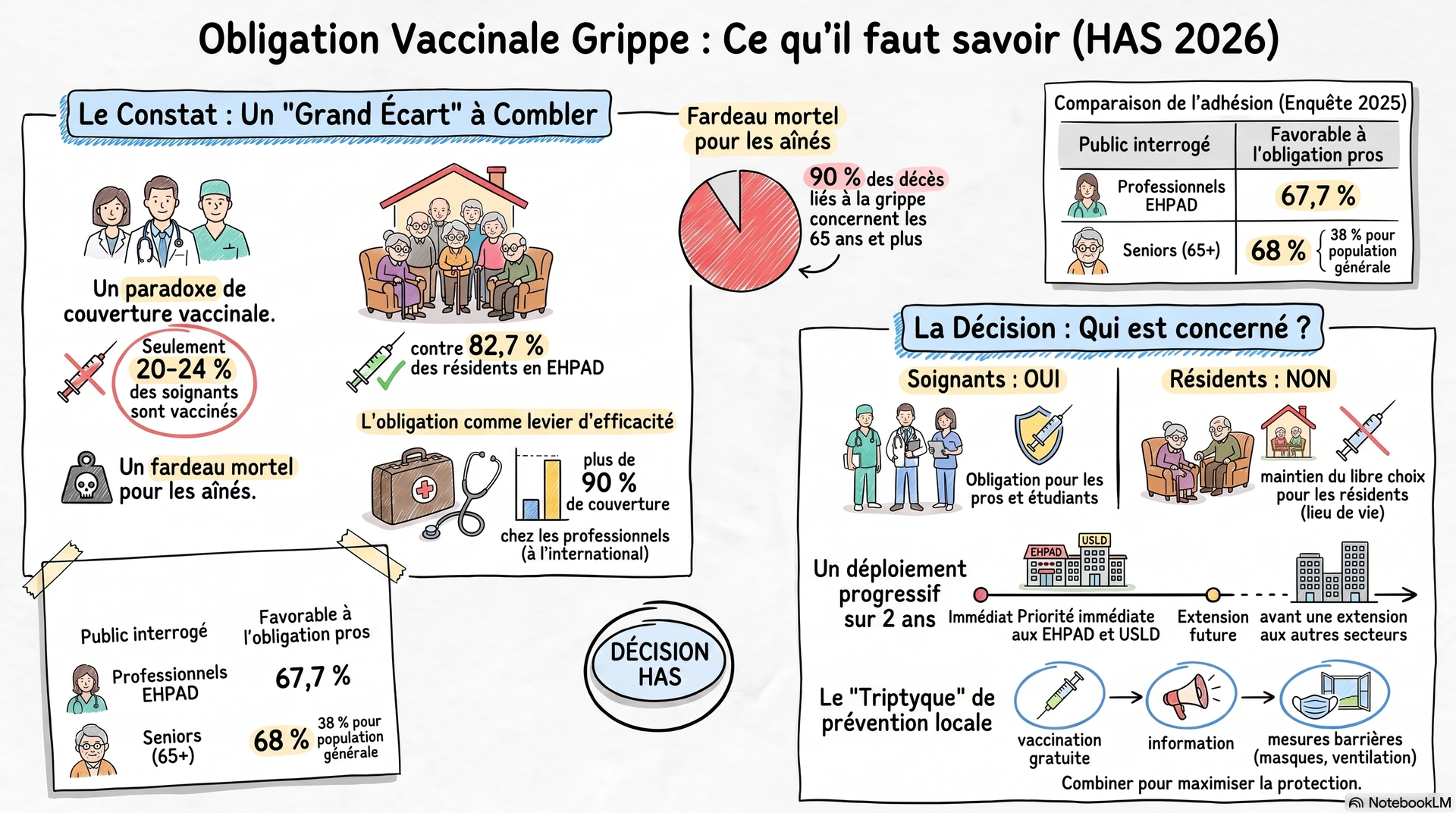
Commissioned by the Ministry of Health, the HAS assesses the opportunity for a flu vaccination mandate for two groups: professionals in contact with vulnerable individuals, and people aged 65 and over living in communal settings (p. 9). The flu remains a heavy burden: over 17,600 excess mortality deaths in 2024-2025, of which 90% are among those aged 65 and over (p. 9-10). However, professional coverage is very low — 20% in healthcare facilities, 24.2% in nursing homes — while that of residents reaches 82.7% (p. 11). This credibility gap is the common thread of the evaluation.
An asymmetrical decision, based on ethics and data.
The HAS concludes to a mandate targeted at professionals (and students from medical and paramedical fields), excluded for residents due to already high coverage and strengthened ethical requirements in a living environment (p. 15-17). It relies on vaccine efficacy (moderate but real), a favourable safety profile, the impact of existing obligations in France and abroad, and a majority adherence from the population. The deployment is prioritised in EHPAD and USLD, then gradually elsewhere over two years renewable for one year (p. 18-19), in line with Article 55 of the LFSS 2026.
2. KEY POINTS OF THE DOCUMENT
- The coverage gap is the core of the reasoning. The coverage of professionals is capped at 20% in healthcare facilities and 24.2% in EHPAD (it was 37.2% in 2007-2008), compared to 82.7% among residents. This gap "raises an issue of coherence and credibility of prevention messages" (p. 11 and p. 16-17).
- Moderate and variable vaccine efficacy — but not negligible. In real life, the efficacy against confirmed influenza is 41% to 76% in those aged 18-64 and 25.1% to 42% in those aged 65 and over (immunosenescence), hence the 2025 recommendation for high-dose and adjuvanted vaccines for this age group (p. 10). The repeated nature of vaccination only modestly affects efficacy (p. 10).
- The indirect protection of residents through the vaccination of caregivers is poorly established. A Cochrane meta-analysis (cluster randomised trials) shows little or no effect on laboratory-confirmed influenza in residents, but a reduction in all-cause mortality (RR 0.69; CI 0.60-0.80, moderate level) — a non-specific criterion to be interpreted with caution, as it is not explained by effects on strictly influenza-related criteria (p. 10-11).
- The obligation is the most effective lever to increase coverage. Internationally, it produces rates > 90 %: Finland (from ~41 % in 2014 to 83.7 % then 90.8 %), United States (97.3 % if mandatory vs 73.9 % if recommended) (p. 13). In France, the extension of the obligation in paediatrics has boosted meningococcal C coverage from 35.5 % to 75.8 % (p. 13).
- Adherence is majority — including among the affected populations. EHPAD survey 2024: 67.7 % of professionals in favour of an obligation concerning them, 60.9 % for residents. General population survey September 2025 (n = 4,000): among those aged 65 and over, 68 % in favour of the obligation for health professionals, only 38 % for the general population (p. 12-14).
3. ACTION PATHS FOR LOCAL ACTORS
- Take ownership of the asymmetry of the decision to communicate accurately : the obligation targets professionals, not residents. Use the considerations from recommendations 1 and 3 (p. 15-17) to avoid any misunderstanding among teams and families.
- Bridge the coverage gap with combined incentive measures, without waiting for the decree. The cited study shows that the combination of "free on-site vaccination + collective/individual information sessions + dissemination of information" adds nearly 10 percentage points of coverage (26.1 % vs 17.2 % in 2024-2025) (p. 13, section 3.5.3 p. 106). This triptych is actionable immediately.
- Strengthen complementary prevention measures, presented as non-substitutable but essential: ventilation of premises, hand hygiene, wearing masks by symptomatic and asymptomatic individuals entering the establishment, respiratory hygiene (recommendation 2, p. 16). Rely on the ministerial instruction of 12 November 2025 regarding masks during epidemic periods (p. 11).
- Anticipate the logistical feasibility of an annual campaign : early orders, storage, on-site vaccination or mobile teams, traceability of vaccination statuses — points of vigilance identified as critical, especially in the context of HR tensions and temporary staff (section 3.6, p. 123-129).
- Prepare the management of refusals within a proportionate framework, drawing inspiration from documented foreign models: reassignment away from contact with vulnerable populations (Finland), or vaccination/mask-wearing alternatives (United States, exemptions < 0.7%) (p. 13-14).
- Prioritise targeting EHPADs and USLDs in any strengthening action, in accordance with the prioritisation of recommendation 4 (p. 18): close and prolonged contacts, inability for the resident to avoid risk, difficulty of wearing masks during meals.
Identified unmet need: the document does not provide an operational implementation tool (control procedures, traceability models) — these remain to be constructed locally or will await regulatory texts.
4. ADDITIONAL REFERENCES
🔍➕ For more information, see the articles referenced by "Health Practices" on the topic of vaccinations ➡️🔗 https://www.pratiquesensante.com/vaccinations
- Public Health France — Vaccination coverage for flu/Covid-19 of residents and professionals in ESMS (points 2024 and 2025). Essential tracking data to objectify the coverage gap locally. → https://www.santepubliquefrance.fr/vaccination/donnees
- Public Health France — Study of flu and Covid-19 vaccination coverage among residents and professionals of ESMS, season 2025-2026. Survey methodology and the most recent data, complementary to the argument. → https://www.santepubliquefrance.fr/etudes-et-enquetes/etudes-de-couverture-vaccinale-contre-la-grippe-et-la-covid-19-des-residents-et-des-professionnels-salaries-des-etablissements-sociaux-et-medico-so
- CPIAS Île-de-France — Flu: prevention tools (resources 2025). Operational toolkit on barrier measures and prevention in establishments, directly supporting recommendations 2 and 4. → https://www.cpias-ile-de-france.fr/docprocom/grippe.php
5. FREQUENTLY ASKED QUESTIONS (FAQ)
- Is the flu vaccination becoming mandatory for everyone?
No. The recommended obligation targets healthcare and medico-social professionals in contact with at-risk individuals, as well as students in medical and paramedical fields. It does not concern not residents or the general population (p. 17). - Why are elderly residents exempt from the obligation?
Because their coverage is already high (82.7%, above the WHO threshold of 75%) and that the nursing home is a place of life, which reinforces the ethical requirements of consent and autonomy (p. 15). - What is the actual effectiveness of the vaccine?
Moderate and variable depending on the seasons: 41-76% among 18-64 year olds, 25.1-42% among those aged 65 and over. High-dose and adjuvanted vaccines are preferred for the elderly (p. 10). - Does vaccinating caregivers really protect residents?
The direct effect on confirmed flu cases among residents is weak and uncertain; a reduction in all-cause mortality is observed but remains subject to cautious interpretation (p. 10-11). - On what legal basis does this obligation rest?
On Article 55 of the LFSS 2026 (Law No. 2025-1403 of 30 December 2025), amending Article L. 3111-4 of the Public Health Code, which makes the obligation conditional on a prior recommendation from the HAS and a decree in the Council of State (p. 19). - When and how will the obligation be implemented?
As a priority in EHPADs and USLDs, then gradually elsewhere (healthcare facilities, other ESMS, private practice) over two years, renewable for one year, within a concerted framework (p. 18-19). - What should be done about a professional who refuses vaccination?
The document does not yet establish a French procedure but documents foreign models: reassignment away from contact with vulnerable populations (Finland) or a seasonal mask-wearing obligation in case of exemption (United States) (p. 13-14).
6. REWRITING IN EASY TO READ LANGUAGE
Flu is dangerous for older people.
Every winter, many people catch the flu.
Flu can be very serious.
In 2024-2025, more than 17,600 people died from it.
9 out of 10 people who died were 65 years old or older.
Few caregivers get vaccinated.
In hospitals, only 2 out of 10 caregivers are vaccinated.
In nursing homes (EHPADs), it's a bit more: about 2 out of 10 as well.
But in EHPADs, more than 8 out of 10 residents are vaccinated.
There is therefore a large gap between caregivers and residents.
The HAS has made a decision.
The HAS is an agency that provides health advice.
The HAS says: caregivers will have to be vaccinated every year.
This is called an obligation.
This rule also applies to students learning care professions.
Residents are not obliged.
The HAS does not make vaccination mandatory for elderly people.
These people live in care homes as if in their own home.
We must respect their choice.
Many are already vaccinated.
We start with care homes.
The rule will first apply in care homes.
Then it will apply in other care settings.
This will be done gradually, over two years.
Other measures also provide protection.
It is also important to ventilate the rooms well.
It is necessary to wash hands.
It is necessary to wear a mask when unwell.
The vaccine and these measures go hand in hand.
7. CROSS-ANALYSIS — VALUES OF HEALTH PRACTICES
- Literacy: partial — the document is technical, but its clear summary and explicit considerations facilitate understanding; no easy-to-read tools are proposed for the public.
- Empowerment: limited for residents, whose autonomy and consent are instead invoked to dismiss the obligation (p. 15); professionals are not involved in the design but consulted through hearings.
- Participation: real on the procedural level — multidisciplinary working group, hearings (CCNE, federations, expert), public consultation (section 5, p. 137-149).
- Community health : the collective dimension is central (protection of vulnerable individuals, herd immunity, coherence of messages), without a community approach in the participatory sense.
- Ethics : addressed in depth — principles of necessity, proportionality, equity, last resort, distinction between living place / care place (p. 12, ethics section supported by WHO and CCNE).
- Human rights : respect for autonomy, consent and freedoms explicitly weighed against the protection of the vulnerable; equity of access to the vaccine is posed as a condition (p. 12).
- Intersectorality : partnerships recommended between establishments, occupational health services, ARS and national level; articulation ministry / HAS / local actors (p. 18-19).
- Partnership : formalised in the ‘concerted’ deployment over two years with scientific support from HAS and national indicators (recommendation 5, p. 18-19).
- Fight against discrimination : the document warns of the risk of an obligation perceived as stigmatising (Covid-19 lessons, p. 13) and insists on non-judgment; medical exemptions are provided.
8. EVALUATION OF THE RELIABILITY OF THE RESOURCE
Scientific relevance : high. Structured HAS recommendation methodology (systematic review with meta-analyses 2023-2025, AMSTAR II and GRADE grids, study selection diagram), recent national surveillance data (Public Health France, until July 2026), international sources (WHO, Cochrane). The limitations are explicitly acknowledged by HAS itself: limited and heterogeneous French data on nosocomial transmission, non-specific all-cause mortality criterion, observational studies exposed to biases.
Operational relevance: average. The document provides a clear doctrine and directly mobilisable numerical arguments, but remains a normative opinion: the concrete implementation (control procedures, management of refusals, implementing texts) is not provided and will depend on the forthcoming decree in the Council of State.
Internal inconsistency noted (to be reported, not corrected): the vaccination coverage of professionals in nursing homes is indicated as 24.2 % in the Summary (p. 11) and as 21 % in the considerations of the recommendation (p. 17 and p. 18). This discrepancy is not explained in the text.
9. STRATEGIC HASHTAGS
#healthcarepractices #Vaccination #SeasonalFlu #PublicHealth #NursingHomes #VaccinationObligation #InfectiousPrevention #VaccinationCoverage