
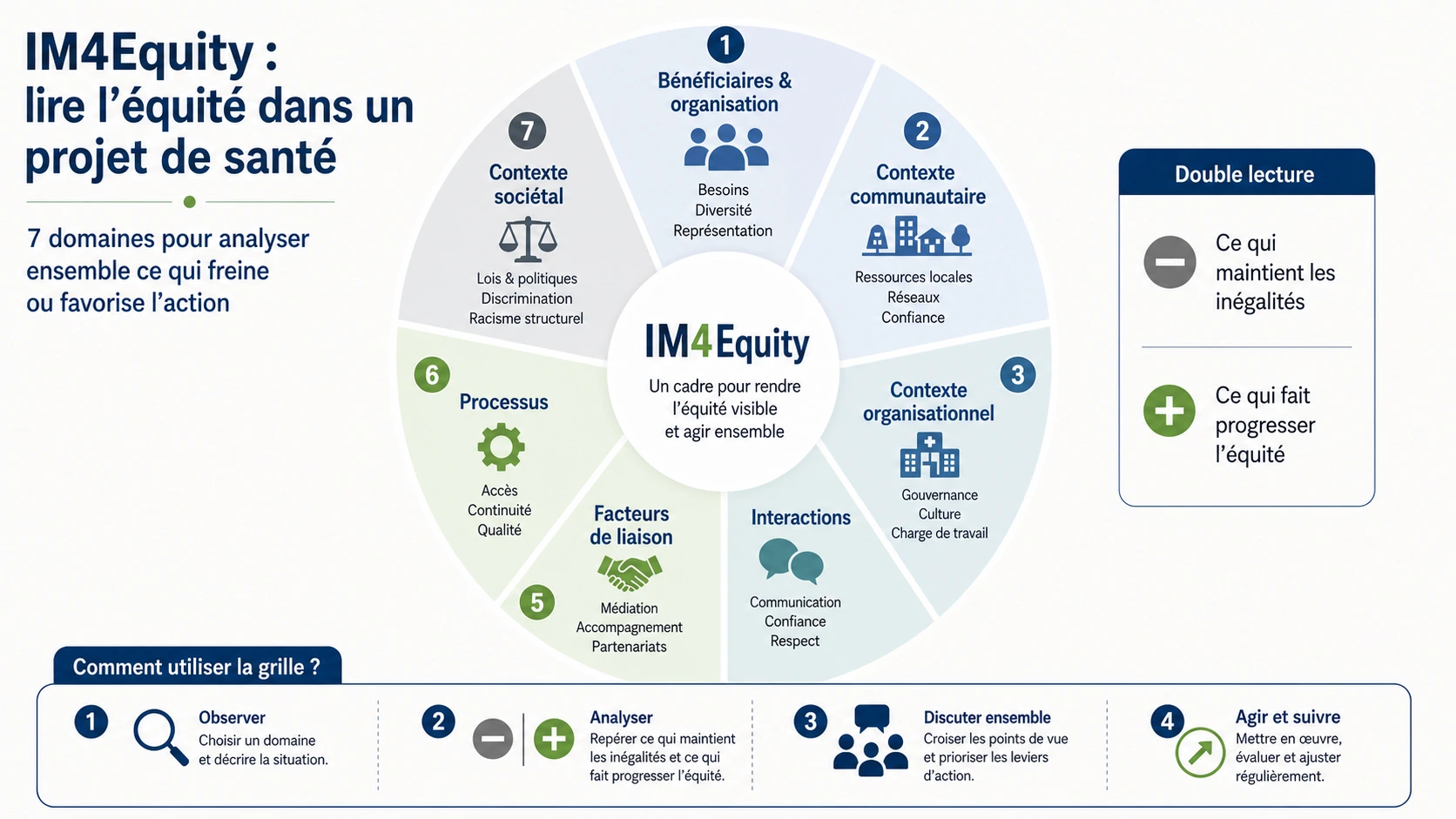
🔍💡 IM4Equity: finally a concrete framework for discussing health equity with residents, caregivers, and associations, on a shared visual support. #HealthEquity #Implementation🛠️🤝 IM4Equity helps local teams identify, with communities, what hinders or facilitates the implementation of actions in neighbourhoods, schools, or places of worship. #CommunityHealth #HealthLiteracy
📌 📌 This document is particularly useful for coordinators of prevention/community health programmes who need to adapt 'evidence-based' interventions to popular neighbourhoods, schools, community health centres, or places of worship.
It provides a structured framework to identify, with local stakeholders, the implementation and equity determinants to consider, from the societal context to beneficiary-intervenor interactions. CLS managers, health city workshops, associations, or CCAS can use it to prepare, facilitate, and document co-analysis sessions with residents and partners.
Source: ✍️ IM4Equity: an implementation science meta-framework for community-engaged partnerships to advance health equity -
Lilian G. Perez, Jessica L. Merle, John D. Smith, Ashley G. Huebschmann et al., for the DECIPHeR Alliance, published in BMC Health Services Research (Springer Nature). March 2025
📜🔗LINK to the source
Number of pages: 13
1. ANALYTICAL SUMMARY
Context, inequalities and the need for a meta-framework
The article starts from the observation that "effective" interventions are often developed and tested in privileged contexts, and then late or insufficiently transposed to the communities most affected by inequalities (tobacco, uncontrolled hypertension, paediatric asthma, etc.). Implementation science has developed multiple frameworks (CFIR, EPIS, PRISM, HEIF…) to analyse contextual determinants, but very few explicitly integrate dimensions of equity, structural racism, or lived experiences of marginalised populations. The existence of more than 140 frameworks, of which only 12 focus on "equity", complicates comparisons between projects and collective capitalisation. Within the framework of the DECIPHeR Alliance (7 US academic centres in partnership with communities), the authors therefore sought to produce a readable meta-framework, integrating and harmonising four reference frameworks around a shared vision of health equity.
Operational contributions for action and co-construction
IM4Equity proposes seven main areas of determinants (perspectives of beneficiaries and organisations, community context, organisational context, beneficiary-intervenor interactions, ‘linking’ factors, implementation processes, societal context) and explicitly provides examples of factors that perpetuate oppression or, conversely, social justice for each. The article describes a user-centred design approach (focus groups, template testing, language adjustments) involving researchers and community partners to make this meta-framework truly usable in collective discussion. It provides concrete resources: main figures, simplified versions for three types of settings (healthcare, school, religious environment), a blank model to fill in, a flowchart of the process, and a facilitation guide. The overall aim is to enable local teams to co-construct their own ‘map’ of the determinants of implementation and equity, prioritise what matters, and choose indicators and strategies accordingly.
2. KEY POINTS OF THE DOCUMENT
A meta-framework integrating four implementation models.
IM4Equity results from the structured intersection of CFIR, EPIS, PRISM/RE-AIM, and HEIF, identifying overlapping areas and concepts as well as those that are specific (notably the ‘Recipient-Deliverer Interactions’ area from HEIF). This work leads to seven areas of determinants that synthesise the literature while remaining manageable for field use (p. 4, 6–7, 8–9).
An explicit focus on equity determinants.
The meta-framework provides, in each domain, examples of factors that can maintain systems of oppression (structural racism, implicit biases, language barriers, etc.) or conversely promote justice and equity (inclusive policies, community capacity building, etc.). These examples are designed to be illustrative and adaptable to local populations and contexts (p. 4, 6–8).
A user-centred design approach with focus groups.
Seven focus groups (43 participants: 38 researchers, 3 community partners, 2 with a 'dual role') were conducted to test the readability, relevance, and usability of the framework and figures, with critical feedback on jargon, visual density, and support needs. Based on this, the authors simplified the language, reorganised the figure, added a blank template and a step-by-step guide, and then tested these materials during an in-person workshop (p. 5–7).
Materials adapted to different settings (healthcare, school, faith).
Simplified versions of IM4Equity are offered for three types of settings: health structures, educational institutions, and religious organisations, allowing teams to better envision and illustrate the relevant equity factors in each context (e.g. trust/mistrust towards the institution, community norms, support resources). These figures serve as a basis for co-construction during workshops with partners and residents (p. 5, 8–11).
A clear analysis of limitations and future needs.
The authors acknowledge several limitations: a relatively low number of community partners in the tests, a restriction to four frameworks, the need to further adapt the language for certain audiences, and the absence of a direct link to outcome evaluation frameworks (RE-AIM for outcomes, for example). They call for tests in other consortia, the production of complementary tools by other teams, and an increase in evaluations conducted or co-conducted by the communities themselves (p. 9–11).
3. ACTION PATHWAYS FOR LOCAL ACTORS
To adopt IM4Equity as a collective reading framework for contexts.
To use the main figure (p. 8–9) as a working tool in a steering committee or partner group: to display the seven areas, inviting each actor (professional, volunteer, resident) to identify, using post-its or cards, the equity factors that weigh on the action (e.g. transport, trust, administrative barriers). This approach allows for a detailed documentation of structural and relational obstacles prior to a new programme or the adaptation of an existing action.
To co-construct a 'local' IM4Equity from the blank model.
By relying on the empty template and the facilitation guide (p. 5–7, supplements), to organise a 2–3 hour workshop where a facilitator supports the group in filling in, domain by domain, the determinants deemed priority, distinguishing between oppression factors and equity levers. This tool then becomes the 'context map' of the structure or territory, reusable for prioritising actions and tracking developments.
To integrate equity into all phases of the EPIS cycle.
Drawing inspiration from the articulation with EPIS (Exploration, Preparation, Implementation, Sustainment) to ensure that, at each phase, the determinants of equity have been identified, discussed, and addressed: choice of target groups, recruitment methods, cultural/linguistic adaptation, sustainability conditions. The proposed flowchart helps position the project and clarify which areas of IM4Equity to prioritise (p. 4–7).
Train teams and partners in a common non-jargon vocabulary.
By incorporating feedback from focus groups on jargon, locally adapt the titles of the domains and examples so that they resonate with teams who are not specialists in 'implementation science' (e.g. replace 'bridging factors' with 'links between institutions and residents'). This linguistic adaptation can be the subject of a specific working session with volunteers, mediators, translators, and users (p. 5–7, 9).
Articulate IM4Equity with a RE-AIM type evaluation framework.
Even though IM4Equity does not focus on outcomes, stakeholders can relate it to the RE-AIM framework (reach, effectiveness, adoption, implementation, maintenance) to define equity indicators: who are we reaching (or not)? who adopts the intervention? what discriminatory practices are decreasing? The authors explicitly invite this articulation to better connect determinants and outcomes in terms of equity (p. 8–11).
4. ADDITIONAL REFERENCES
Baumann AA, Shelton RC, Kumanyika S, Haire-Joshu D. (2023).
"Advancing healthcare equity through dissemination and implementation science." Health Services Research, 58(Suppl 3):327-344.
This article discusses how implementation science can be mobilised to reduce health inequalities and offers methodological recommendations complementary to IM4Equity.https://ouci.dntb.gov.ua/en/works/4b13REL7/
Fort MP, Manson SM, Glasgow RE. (2023).
"Applying an equity lens to assess context and implementation in public health and health services research and practice using the PRISM framework." Frontiers in Health Services, 3:1139788.
Proposes a concrete application of a framework (PRISM) with a strong focus on equity, useful for integrating with IM4Equity in concrete projects.https://www.frontiersin.org/journals/health-services/articles/10.3389/frhs.2024.1455365/full
Frontiers in Health Services (2024).
"Applying health equity implementation science frameworks to guide equitable implementation of population genetic screening programs." 10.3389/frhs.2024.1455365.
Review of several equity-focused frameworks, showing their use in a specific area (genetic screening), illustrating how to operationalise IM4Equity in other fields. https://www.frontiersin.org/journals/health-services/articles/10.3389/frhs.2024.1455365/full
5. FREQUENTLY ASKED QUESTIONS (FAQ)
What is the practical use of IM4Equity for a local prevention project?
IM4Equity is used to map, with partners and residents, what facilitates or hinders the implementation of an action, explicitly integrating equity issues (structural racism, access, trust, social norms, etc.). It helps to avoid a purely "top-down" approach and ensures that priorities are defined by the communities involved (pp. 2–3, 6–8).
What audiences and contexts were considered during its development?
The framework was developed within the DECIPHeR Alliance, which works with communities heavily affected by cardiopulmonary inequalities, in various contexts: healthcare systems, community health centres, schools, religious organisations. Participants in the focus groups came from several US states and diverse disciplines (research, community engagement, public health) (p. 3–5).
How to involve community partners in the use of IM4Equity?
The authors propose a multi-step process: define the intervention and the targeted health outcome, present IM4Equity in accessible language, use the blank template as a discussion aid, co-prioritise the determinants, and then define actions and indicators accordingly. Specific facilitation materials have been designed and tested for this purpose (p. 5–7, supplements).
Is the framework limited to cardiovascular and respiratory areas?
No, although it was developed in a programme focused on cardiopulmonary risks, IM4Equity is designed as a meta-framework adaptable to any implementation project with an equity objective (e.g. mental health, HIV, environmental health). The areas and examples of oppression/justice can be recontextualised according to the theme (p. 4, 8–11).
How to manage the level of complexity of the framework for non-expert teams?
Feedback from the focus groups shows that the framework can initially seem "overloaded" and jargon-heavy; hence the creation of simplified versions, guides, and recommendations to adapt the vocabulary. The authors suggest a gradual approach: start by working with a few priority areas, then expand to the whole as the team becomes familiar with the tool (p. 5–7, 9).
Does IM4Equity include a grid of indicators or a turnkey evaluation protocol?
No, IM4Equity is limited to contextual and equity determinants; it does not prescribe indicators or evaluation design. The authors recommend linking it with existing evaluation frameworks (RE-AIM, for example) and involving communities in the selection of relevant indicators (p. 8–11).
What are the main limitations to keep in mind before using it?
The framework reflects the experience of a consortium and four implementation frameworks; other contexts or theories may require adaptations. The relatively low involvement of community partners in the testing and the persistence of certain technical terms mean that adjustments are still necessary for fully autonomous use by non-academic collectives (p. 9–11).
6. REWRITING IN EASY TO READ LANGUAGE
Easy to Read Title
IM4Equity: a tool to better carry out health actions with local residents.
Easy to Read Summary – Context and Issues
In many countries, some people are less healthy than others.
Health actions are often planned in wealthy, well-organised places.
Then, we want to use them in poorer or more remote neighbourhoods.
But these actions do not work the same everywhere.
Often, we forget about racism, poverty, language, and trust.
IM4Equity helps to discuss these topics with residents and professionals.
Easy to Read Summary – Contributions and Use
IM4Equity provides a big picture with several parts.
Each section discusses a topic: people, places, laws, relationships.
You can write in each section what helps or what hinders.
Residents and professionals can fill in the tool together.
This allows for deciding what to act on first.
This helps make actions fairer for everyone.
Key points FALC
IM4Equity combines several researchers' tools into one.
It clearly addresses equity, racism, injustice.
It provides examples to understand each section.
Meetings have tested the tool with researchers and residents.
Simple versions exist for hospitals, schools, places of worship.
The tool still needs to be adapted in other countries and situations.
7. CROSS-ANALYSIS — VALUES OF HEALTH PRACTICES
Literacy:The system provides simplified figures, reworked language, and a facilitation guide to make implementation concepts accessible to non-specialist partners.
Empowerment:Beneficiaries are invited to co-identify, prioritise, and define the determinants of equity, giving them direct power over what matters to them.
Participation:The process relies on focus groups, workshops, and a shared filling of the IM4Equity template, encouraging co-construction rather than mere consultation.
Community health:IM4Equity explicitly targets local contexts (schools, places of worship, community health centres) and the involvement of structures rooted in the communities.
Ethics:The framework addresses systems of oppression (racism, bias, structural inequalities) as central determinants, which helps to highlight and discuss institutional biases.
Human rights:The approach emphasises equity, inclusion, and consideration of the experiences of marginalised groups as conditions for judging a 'successful' implementation.
Intersectorality:The document illustrates possible uses in health, education, and religion, and recommends multi-stakeholder partnerships within the DECIPHeR Alliance.
Partnership:Formalised collaboration models (research centres–communities, engagement committees) structure the governance and production of the framework.
Combating discrimination:The text explicitly mentions structural racism, biases against marginalised groups, and the need for anti-racist, non-judgemental, and culturally appropriate practices.
8. EVALUATION OF THE RELIABILITY OF THE RESOURCE
Scientific relevance.
The article is published in an international peer-reviewed journal (BMC Health Services Research), with a standard editorial process (submission, review, acceptance). It relies on widely referenced frameworks (CFIR, EPIS, PRISM/RE-AIM, HEIF) and on a recent review of equity-oriented frameworks; the qualitative methodology (focus groups, rapid analysis) is consistent with the tool design objective. The reference dates (up to 2024) and integration into an NIH programme (DECIPHeR) enhance credibility.
Operational relevance.
IM4Equity is very practice-oriented: it provides a synthetic diagram, examples, three versions per type of field, a blank template, and a facilitation guide. It does not provide a universal "recipe", but an adaptable framework, which is consistent with the realities on the ground where each territory must contextualise the determinants and solutions. For French professionals, an adaptation of vocabulary and regulatory references would be necessary, but the overall structure and logic are directly transposable.
#️⃣ #healthpractices #HealthEquity #Implementation #CommunityHealth #CitizenParticipation #HealthLiteracy #HealthResearch #Prevention @HealthPractices