
🚨 153 trends, one message: health is now played out in the community
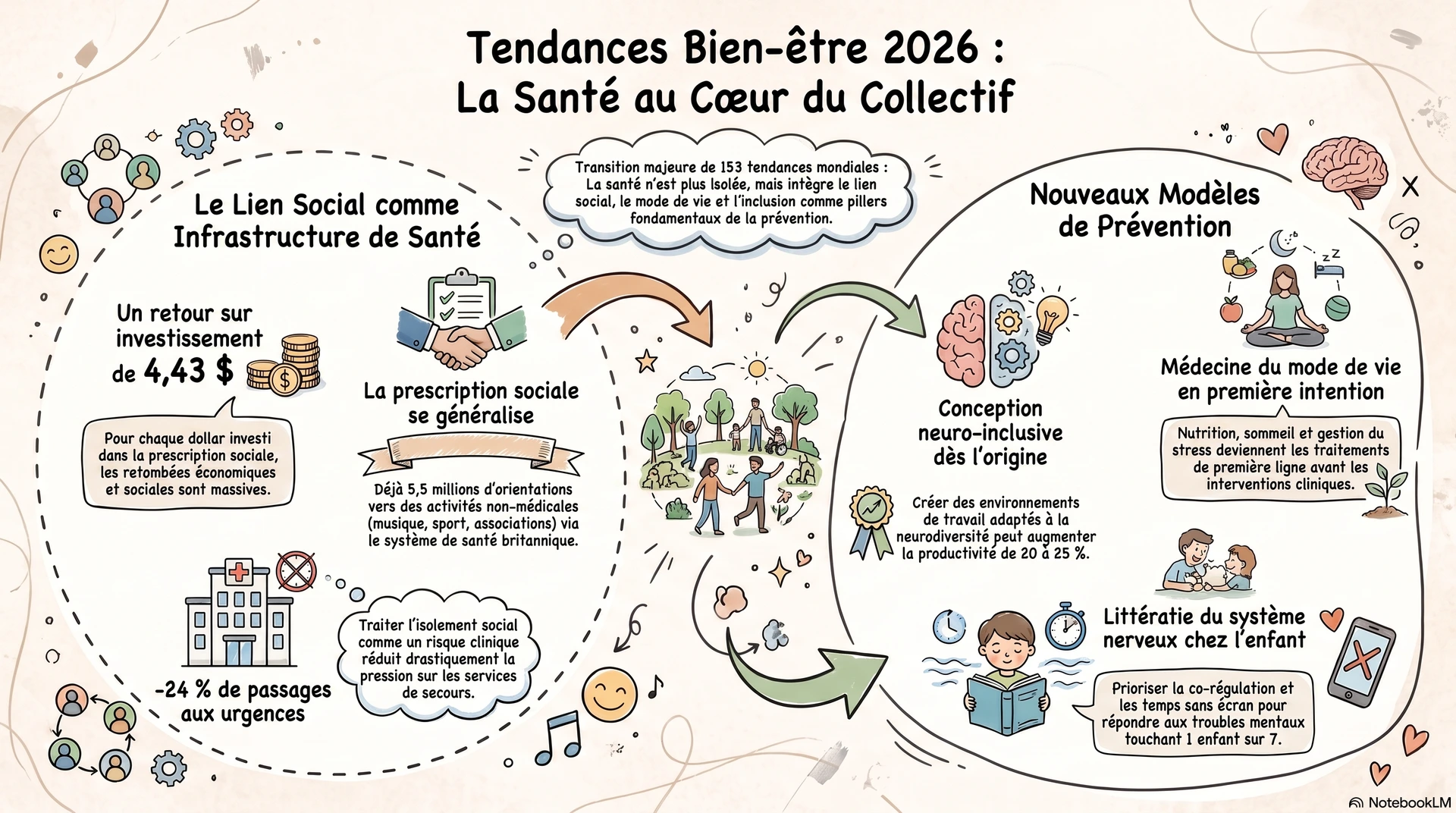
🔍💡 Social prescription & isolation: this international overview shows how social connection is becoming a measured, prescribed, and funded health intervention — 5.5 million referrals in the NHS, a return of $4.43 for every dollar invested in Canada. Enough to equip your advocacy. 🎶
📌This report provides an overview, in a single read, of the major shifts currently affecting health prevention and promotion: social prescription entering care systems, isolation treated as a modifiable risk factor, lifestyle medicine as a first-line approach, the design of environments as a health determinant. It provides benchmarks, models of reproducible programmes, and impact figures that can be directly mobilised to argue for a project or funding request. Vigilance remains essential: it is necessary to distinguish what is evidence-based from what is industry rhetoric.
Source :📒 Initiative Trends 2026 — Collective Intelligence and Foresight from Global Wellness Leaders✍️ Initiative Trends 2026 — Collective Intelligence and Foresight from Global Wellness Leaders - Global Wellness Institute (GWI), a non-profit organisation based in the USA (501(c)(3)). Executive summary signed by Vishal Patel, MD, PhD. Foreword by Susie Ellis, President-CEO.
📜🔗LINK to the source
1️⃣ ANALYTICAL SUMMARY
A systemic shift: from individual optimisation to collective infrastructure.
The report synthesises 153 trends reported by 27 initiatives across four continents. The executive summary (p. ii) identifies four converging currents: the regulation of the nervous system as an organising principle (“neurowellness”, identified by 14 initiatives); the redefinition of longevity, from aesthetic anti-ageing to experienced functional capacity (strength, balance, autonomy, VO₂ max); the built environment conceived as health infrastructure (circadian light, walkability, housing); and social connection requalified as a clinical variable. The target audiences are broad: health professionals, social workers, medico-social workers, employers, communities, private operators. The underlying issue is the shift from a reactive care model to a preventive, community-based model focused on determinants.
Concrete operational models, to sort from the marketing signal.
For field actors, the most solid contribution lies in the already evaluated devices: social prescription and musical prescription (p. 63-67), group medical visits and “Community as Medicine” (p. 109), lifestyle medicine programmes in post-cancer survival (PAVING, HEAL, p. 107-108), design of neuro-inclusive work environments (p. 34-35). The document provides mobilisable impact figures (reduction in consultations, return on investment) and useful epidemiological data (children's mental health, nervous system literacy). In contrast, a significant part of the content relates to consumption trends (hospitality, spas, luxury real estate, products) without probative value for public action.
2️⃣ KEY POINTS OF THE DOCUMENT
1️⃣ Social prescription becomes a public health infrastructure. Practiced in over 30 countries, it is integrated into the English NHS with ≈ 5.5 million referrals recorded through primary care in 2023 and more than 3,600 ‘link workers’, a study from Lancet Public Health (2025) confirming its establishment as a fundamental service (p. 63-64). Music prescription is developing there (choirs, concerts on prescription in Montreal) (p. 64).
2️⃣ Social isolation is treated as a modifiable risk factor, with impact figures. The data from the Canadian Institute of Social Prescription cited in the report announce a reduction of up to 42% in primary care consultations, 24% in emergency visits, and a return of $4.43 for every dollar invested (p. 64). This is a useful ‘cost avoided’ argument — to be handled with the methodological caution described below.
3️⃣ Lifestyle medicine is becoming the first line. The report describes its integration into care pathways for cardiometabolic diseases, mental health, and post-cancer, with an increase in shared medical visits, activity cohorts, and community prescriptions (p. 39, 41). Reproducible models are named: PAVING the Path to Wellness, HEAL, Community as Medicine (p. 107-109).
4️⃣ Child mental health is prioritised for early prevention. The report reminds us that 1 in 7 children in the WHO European Region lives with a mental health disorder, and cites the WHO-UNICEF strategy 2026-2030 ‘A Healthy Start for a Healthy Life’ (p. 113). It proposes simple family levers: sleep rituals, nervous system literacy, co-regulation, screen-free time (p. 114).
5️⃣ Work environments are designed for neurodiversity and structural well-being. The report documents the shift from "individual accommodation" to "inclusive design from the outset", the embedding of well-being in corporate governance via ISO 45003 and the European CSRD directive, and cites up to 20-25% additional productivity (McKinsey Health Institute) (p. 34-35, 122).
3️⃣ ACTION TRACKS FOR LOCAL STAKEHOLDERS
1️⃣ Map and formalise a local social prescription offer. Draw inspiration from the described models (link workers, referral to cultural, sports, and community activities) to structure a pathway between primary care and non-medical resources in the area (p. 63-64). Document the impacts to justify sustainable funding.
2️⃣ Use the "avoided cost" argument rigorously. Mobilise impact ratios (reduction in consultations, ROI of $4.43) for advocacy, citing the source methodology (KPMG analysis for the Canadian Institute of Social Prescription) and specifying that this is a prospective modelling, not a directly transferable proof to the French context (p. 64).
3️⃣ Deploy group visits / "community-health" workshops. Reapply the logic of shared medical visits and the Community as Medicine model: movement, nutrition, stress management, and peer support, relying on already frequented places (community organisations, social centres) to remove access barriers (p. 109).
4️⃣ Integrate a literacy of the nervous system into actions with families and children. Revisit the proposed concrete levers: breathing as a "reset", sensory integration, putting emotions into words, modelling co-regulation, micro-moments of mindfulness and exposure to nature (p. 114).
5️⃣ Rethink environments (welcome, work, collective spaces) for neurodiversity. Move from demand-driven arrangements to inclusive design by default: clear communication, predictable flows, training teams in neurodiversity (10 to 20% of the population according to the cited data) (p. 34-35, 115).
6️⃣ Take into account exposure to microplastics as an emerging determinant. Translate scientific monitoring into simple prevention actions (reducing single-use plastic in reception areas, informing the public), while being cautious about causal links still being established (p. 55, 57-58). Unmet need: the report does not provide a validated operational action protocol — to be constructed locally.
4️⃣ ADDITIONAL REFERENCES
🔍➕ For more information, see the articles referenced by "Health Practices" on the topic ➡️🔗 https://www.pratiquesensante.com/blog/pratiques-15/tag/bien-etre-444 and https://pratiquesensante.odoo.com/en/1-8-determinants
- Canadian Institute for Social Prescription / Canadian Red Cross — "A Healthier Canada: Analysis of the Economic and Social Impacts of Social Prescription" (KPMG report). Direct source of the $4.43 ratio cited by the GWI: allows tracing the methodology behind the figure. 👉 https://www.socialprescribing.ca/fr-ca/modeling-the-results-of-social-prescribing-in-canada
- Association for Public Health of Quebec (ASPQ) — Practical guide "Towards Participatory Public Health" (March 2026). Completes the participation / co-construction aspect, which is underdeveloped in a document focused on "market trends". 👉 https://www.fabrique-territoires-sante.org/ressource-guide-pratique-vers-une-sante-publique-participative-aspq/
- Public Health France — Weekly epidemiological bulletin no. 12/2025, "Acting in favour of health literacy in perinatality in Île-de-France". Anchors the document in social health inequalities and literacy (44% of French adults in difficulty). 👉 https://beh.santepubliquefrance.fr/beh/2025/12/2025_12_2.html
5️⃣ FREQUENTLY ASKED QUESTIONS (FAQ)
1️⃣ What is social prescribing?
The practice by which a health professional directs a person towards non-clinical and community activities to meet their well-being needs (isolation, chronic pain, malaise). Originating in the United Kingdom in the 1990s, it is now practiced in over 30 countries (p. 63).
2️⃣ What are the reported numerical impacts?
Up to −42% of primary care consultations, −24% of emergency visits, and $4.43 generated per dollar invested (cited Canadian data). These figures are modelled estimates, to be contextualised (p. 64).
3️⃣ How is children's mental health addressed?
Through alert data (1 in 7 children in Europe affected; 17.5% in China among 6-16 year olds) and the WHO-UNICEF strategy 2026-2030, with concrete preventive family levers (p. 113-114).
4️⃣ What does "lifestyle medicine as a first intention" mean?
The use of lifestyle interventions (physical activity, nutrition, sleep, stress regulation, social connection) as a first-line treatment, integrated into pathways and quality indicators, and not merely as a supplement (p. 39).
5️⃣ What does the report on neurodiversity at work bring?
The shift from individual accommodation to inclusive design by default, the rise of executive function coaching, and regulatory anchoring (ISO 45003, CSRD). A cited survey indicates that 82% of neurodivergent adults feel pressure to mask their condition (p. 34-35).
6️⃣ Does the document address microplastics?
Yes: ingestion, inhalation, skin contact; links explored with inflammation, endocrine disruption, and neurological risk. Causality is still being established; some units of measurement in the report contain errors (see reliability) (p. 55, 57).
7️⃣ Can this report be cited as scientific evidence?
Not as it stands. It is a sectoral foresight document: it aggregates evidence sources AND commercial signals. Claims must be re-verified at the source before any argumentative use (p. ii and passim).
6️⃣ REWRITING IN EASY LANGUAGE
What is this document about?
- It is a report on the major trends in well-being in 2026.
- It comes from a private American organisation, the Global Wellness Institute.
- It is not a scientific study. Information needs to be verified.
The most important ideas:
- Social connections are good for health. One can "prescribe" activities. For example: going to a choir or a concert.
- This practice is called social prescribing. It exists in more than 30 countries.
- It can reduce visits to the doctor. It can save money.
- Eating well, moving, sleeping well, and seeing people help to stay healthy. It can be advised as a real care.
- Many children have mental health difficulties. Simple actions help: an evening ritual, breathing to calm down, talking about emotions, time without screens.
- Workplaces can better accommodate different people. For example: people with ADHD.
- Very fine plastic (microplastics) enters our bodies. This can be bad for health. Scientists are still studying this topic.
7️⃣ CROSS-SECTIONAL ANALYSIS — VALUES OF HEALTH PRACTICES
- Literacy: partially — the report proposes levers of "nervous system literacy" for children, but remains written in a technical/English register that is not very accessible.
- Empowerment: low to medium — functional autonomy and self-regulation are valued, but the dominant logic remains top-down and service-oriented.
- Participation: underdeveloped — "community-informed design" and participatory planning tools (e.g. Maptionnaire) are mentioned, without formalized co-construction mechanisms (pp. 37-38).
- Community health: well-present dimension — social prescription, group visits, Community as Medicine and combating isolation place the collective at the centre (p. 63, 109).
- Ethics : partially addressed — the risk of cultural appropriation of traditional medicines is identified and calls for cultural humility (p. 38).
- Human rights : indirectly addressed — equity of access, historically disadvantaged groups and social determinants are cited, without an explicit rights framework (p. 34).
- Intersectorality : strong — housing, transport, food, culture and work are integrated into the health ecosystem (p. 37, 122).
- Partnership : present models — partnerships between health systems / cultural institutions / insurers / associations, particularly around social prescription (p. 66).
- Combating discrimination : treated ambivalently — the report analyses the rebranding of “DEI” and warns of the risk of diluting equity in “belonging”, while remaining descriptive (p. 35-36).
8️⃣ EVALUATION OF RESOURCE RELIABILITY
Scientific relevance — variable across sections. The document is heterogeneous : some initiatives rely on robust and recent sources (studies from the Lancet Public Health 2025, WHO/UNICEF data, meta-analyses on isolation). Others rely on surveys from private actors (Eventbrite, Ditto Music) or market observations without cited methodology. The framing of “avoided cost” (ROI of $4.43, announced savings) is useful in advocacy but does not have the value of enforceable proof as long as the methodology is not explained in context.
Internal inconsistencies noted (reported, not corrected):
- Unit errors (p. 57): microplastics defined as " < 5 mm (5000 m) " and nanoplastics " 1 to 1000 mm (0.001 to 1 m) " — the correct units are micrometres (µm), not metres. Obvious typos.
- Inconsistencies in dating references (lifestyle medicine, p. 39-42): several GWI posts are labelled " January 2026 " while their URLs carry the date " 2025/01/… "; the same article (" Impact of a Semi-Virtual Lifestyle Medicine Program ") is dated 2025 p. 39 then 2024 p. 42.
- References dated 2026 (including an article from Scientific Reports with an unusual DOI format " s41598-026-… "): difficult to verify at the date of publication of the report; to be traced back before citation.
- Adolescent physical activity data (" 80% insufficiently active ", p. 113) : based on a 2019 WHO study — solid but not the most recent.
- Occasional typos (" purpse " p. 41, etc.).
Operational relevance — good for perspective, average for direct action. The report provides excellent strategic benchmarks and named, reproducible programme models, but few protocols, check-lists or ready-to-use tools. It functions as a trend radar to be cross-referenced with operational French-speaking resources (see §4).
9️⃣ STRATEGIC HASHTAGS
#SocialPrescription #CommunityHealth #HealthLiteracy #SocialIsolation #LifestyleMedicine #HealthPrevention #SocialDeterminants #healthpractices