
🚨 Blood pressure, schools, businesses: the law that makes cardiac prevention everyone's business »
🔍💡 Cardio-neuro-vascular prevention: a law that unlocks the action of physiotherapists, pharmacists, schools and employers — and targets social and territorial inequalities. ❤️ A new framework to act before the first stroke. #CardioNeuroPrevention #healthpractices
📌 This law concretely opens the field of cardio-neuro-vascular prevention to non-medical actors: it legally secures the measurement of blood pressure by physiotherapists, pharmacists and nurses, and legitimises the partnership between employers, schools and approved associations. For a field worker, it is a direct lever to set up awareness-raising actions in businesses or in schools, now backed by a legal text. It also creates a screening appointment that must be offered to children around the age of 6 and establishes the reduction of social and territorial inequalities as an enforceable objective.
📜🔗LINK to the source
1️⃣ ANALYTICAL SUMMARY
A national framework for the 2nd leading cause of mortality
Cardio-neuro-vascular diseases account for nearly 140,000 deaths per year in France, or one death in five, and are responsible for nearly one million hospitalisations each year. The law establishes a multi-year national strategy for combating these diseases, set by the State in collaboration with research organisations, professionals, users, and other stakeholders (Art. 1, new art. L. 1411-6-6, p.1). It explicitly sets an objective to reduce inequalities in prevention, diagnosis, care, and research, particularly social and territorial inequalities — a useful anchor for those working with vulnerable populations. The target audiences are broad: the general population through prevention appointments, children around 6 years old, workers, and students from primary school onwards.Public Health France
Operational authorisations rather than a funded plan
The text mainly acts by removing legal barriers and opening partnerships. It allows physiotherapists, pharmacists, and nurses to measure blood pressure as part of a preventive approach, protected from the offence of illegal practice (Art. 2, p.1-2). It incorporates awareness-raising and screening into the labour code and the education code, relying on accredited prevention associations, CPTS, and local stakeholders (Art. 3 and 4, p.2-3). However, it does not include dedicated funding or a specified timeline: the concrete implementation will depend on the national strategy and implementing decrees, and a medico-economic evaluation is deferred to a report in three years (Art. 5, p.3).
2️⃣ KEY POINTS OF THE DOCUMENT
1️⃣ A multi-year national strategy is created and entrusted to the State in coordination with research, professionals and users; it defines the priority guidelines for prevention, screening and organisation of pathways, targeting the reduction of social and territorial inequalities (new art. L. 1411-6-6, Art. 1, p.1).
2️⃣ An early screening for children is established : a screening appointment for cardio-neuro-vascular diseases, particularly familial hypercholesterolemia, must be offered in the year following the 6th birthday, by a specially trained doctor; the obligation is deemed fulfilled by a certificate in the health record, including in cases of parental refusal (new art. L. 2132-2-3, Art. 1, p.1).
3️⃣ Blood pressure measurement is open to new professionals : physiotherapists (L. 4321-1), pharmacists (L. 5125-1-1 A) and nurses have legally secured the measurement of blood pressure in a preventive approach, through a long list of exceptions to the illegal practice of medicine (Art. 2, a to l, p.1-2).
4️⃣ Prevention enters the workplace : the labour code incorporates screening campaigns and annual awareness of risk factors, achievable in partnership with approved associations, CPTS, mutuals, provident institutions, insurers or any health promotion organisation; early screening is offered during the occupational health examination (Art. 3, p.2).
5️⃣ The school becomes a relay from primary school : health promotion actions can involve accredited associations, CPTS and local non-health professional actors, and information on cardio-neuro-vascular risk factors is provided once a year from primary school, under conditions set by decree (Art. 4, p.2-3).
3️⃣ ACTION TRACKS FOR LOCAL ACTORS
1️⃣ Positioning as an accredited partner with occupational health services and employers to co-construct the annual awareness campaigns now required by law (Art. 3, list a to g, p.2). Check your accreditation status under art. L. 1114-1.
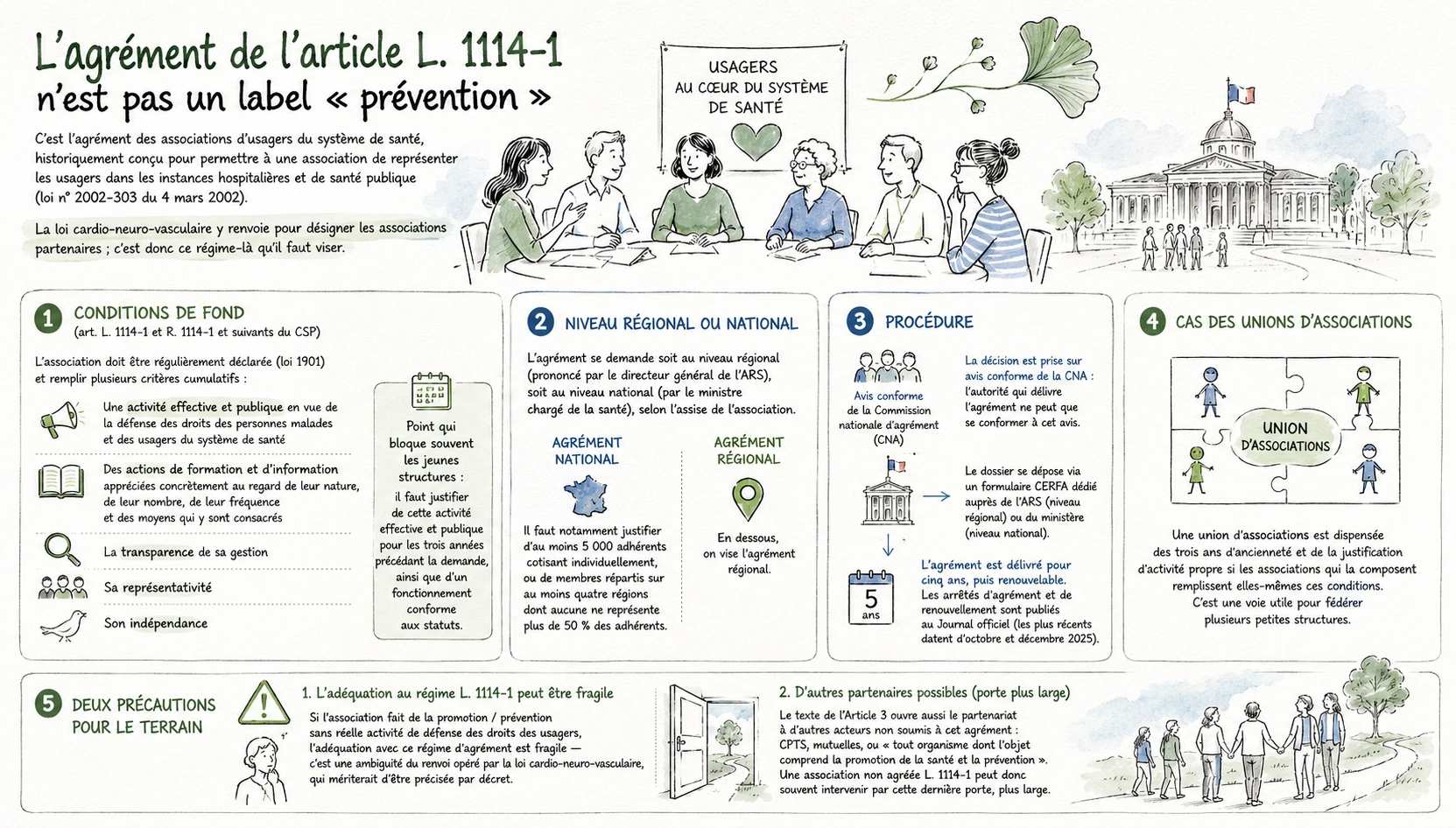
2️⃣ Establishing a partnership with the school to deliver annual information on risk factors from primary school, fitting into the renewed framework of art. L. 121-4-1 and L. 541-1 (Art. 4, p.2-3); anticipate the publication of the implementing decree.
3️⃣ Equipping non-medical professionals (physiotherapists, pharmacists, nurses) on secure blood pressure monitoring, clarifying the scope of the “prevention approach” to avoid any slippage towards diagnosis (Art. 2, p.1-2).
4️⃣ Preparing support for screening at 6 years old : creating information materials for families on familial hypercholesterolemia and the right to refuse, ensuring a non-anxiety-inducing message (new art. L. 2132-2-3, p.1).
5️⃣ Mobilising existing prevention appointments ("My Prevention Assessment") as an entry point: the law adds awareness of risk factors and takes into account the determinants specific to women, and allows for the provision of validated screening tools via the digital health space (Art. 1, amending L. 1411-6-2, p.1).
6️⃣ Documenting local inequalities to inform the future national strategy: the reduction of social and territorial disparities being a legal objective, a quantified territorial diagnosis strengthens advocacy and access to services (new art. L. 1411-6-6, p.1). Unmet need: the text provides neither earmarked funding nor indicators — to be developed locally while awaiting the decrees.
Actions to be taken
In the workplace and at work (Art. 3, labour code, p.2)
This is the area most directly opened up. The law provides for screening campaigns for cardio-neuro-vascular diseases and annual awareness of risk factors, achievable in partnership. Specifically: on-site blood pressure detection workshops, awareness stands during the QVCT week, information sessions on the eight risk factors targeted by the law (smoking, alcohol, sedentary lifestyle, obesity, cholesterol, diabetes, chronic kidney disease, hypertension), collective “physical activity” challenges, or referral to “My Prevention Assessment”. Early screening is also offered during the occupational health examination — a support point to articulate your action with the occupational health and prevention service.
At school, from primary level (Art. 4, education code, p.2-3)
The text allows for health promotion actions in partnership and establishes annual information on cardio-neuro-vascular risk factors from primary school. Possible actions: age-appropriate classroom interventions (heart rate, movement, nutrition), fun workshops on sedentary behaviour and “moving more”, family awareness through the school. Important caveat: the precise modalities are referred to a decree — to be monitored before contracting.
In prevention appointments and local links (Art. 1, p.1)
The law strengthens awareness of risk factors during prevention appointments and allows for the provision of validated screening tools via the digital health space. For a community actor: to support the public towards these appointments, produce materials in adapted literacy, or pay specific attention to the determinants specific to women's risk, which the text explicitly requests to be taken into account.
Around tension screening (Art. 2, p.1-2)
The legal securing of blood pressure measurement by physiotherapists, pharmacists, and nurses opens up screening actions "beyond the walls": blood pressure clinics in pharmacies, in social centres or during community events, carried out by these professionals in a preventive approach — never a diagnosis, the boundary must be maintained.
Support for child screening (Art. 1, L. 2132-2-3, p.1)
The appointment proposed around the age of 6, particularly for familial hypercholesterolemia, calls for mediation work: to inform families in a non-anxious manner, explain the proposed nature and the right to refuse, equip PMI and school professionals.
4️⃣ ADDITIONAL REFERENCES
- Public Health France — BEH Special Issue "Epidemiology of Cardiovascular Diseases in France" (March 2025). A base of quantified data and disparities that justifies the strategy. → https://beh.santepubliquefrance.fr/beh/2025/HS/2025_HS_0.html
- Public Health France — "Cardio-neuro-vascular Diseases: Significant Regional Disparities Persist" (30 June 2025). Directly useful for the territorial equity objective of the law. → https://www.santepubliquefrance.fr/presse/2025/maladies-cardio-neuro-vasculaires-de-fortes-disparites-regionales-qui-persistent
- Ministry of Health — "My Prevention Assessment: Health Appointments at Key Ages of Life". Support system on which the law is based (generalised since 2024). → https://sante.gouv.fr/prevention-en-sante/preserver-sa-sante/mon-bilan-prevention-les-rendez-vous-sante-aux-ages-cles-de-la-vie/article/mon-bilan-prevention-en-quoi-ca-consiste
5️⃣ FREQUENTLY ASKED QUESTIONS (FAQ)
1️⃣ Can a physiotherapist or pharmacist now measure a patient's blood pressure? Yes, the law legally secures this in a preventive approach to cardio-neuro-vascular risks (Art. 2, 2° and 5°, p.1-2). This is not a diagnostic act.
2️⃣ Is screening for children at 6 years old mandatory? It must be offered in the year following the 6th birthday. The obligation is deemed fulfilled even if the parents refuse, provided that the doctor certifies it in the health record (new art. L. 2132-2-3, p.1).
3️⃣ Who leads the national strategy? The State, in coordination with research, professionals, users, and all relevant stakeholders; it is multiannual and sets the priorities for prevention, screening, and pathways (new art. L. 1411-6-6, p.1).
4️⃣ Can our association intervene in companies? Yes, if it is accredited under art. L. 1114-1; the labour code explicitly provides for partnership for information and awareness (Art. 3, c-a, p.2).
5️⃣ What changes at school? Information on risk factors, provided once a year from primary school, and the possibility of involving local non-health professional stakeholders (Art. 4, p.2-3), with the modalities set by decree.
6️⃣ Does the law provide for a budget? No. It creates a framework and authorisations; the evaluation of costs and savings is deferred to a report to Parliament within three years (Art. 5, p.3).
7️⃣ What do we mean by "determinants specific to women's risk"? The text requires taking this into account during the screening proposed at prevention appointments, without detailing them; their operational definition will fall under recommendations and strategy (Art. 1, amending L. 1411-6-2, p.1).
6️⃣ REWRITING IN EASY TO READ LANGUAGE
The law, in simple summary
Heart and brain diseases kill many people in France.
Every year, about 140,000 people die from them.
France is creating a large strategy to better prevent them.
The aim is also to help all areas, not just the wealthiest.
What the law changes
- Pharmacists, physiotherapists, and nurses can measure blood pressure. This is allowed by law.
- Children of about 6 years old are offered a heart examination. Parents can refuse.
- Companies carry out an information action every year on these risks.
- Schools inform children once a year, starting from primary school.
- Associations can help schools and companies.
Important points
- The law provides a framework. It does not provide money immediately.
- Decrees will come later to say how to do it.
- A report will be written in 3 years to see if it works.
7️⃣ CROSS-ANALYSIS — VALUES OF HEALTH PRACTICES
- Literacy: the text allows for the provision of validated screening tools via the digital health space, but does not define any standards for accessibility or adaptation to levels of understanding.
- Empowerment: the stated objective of "becoming an actor in one's health" is evident through preventive appointments, but the law itself does not involve beneficiaries in its design.
- Participation : the national strategy is established "in coordination with users of the health system", which opens a space for non-detailed co-construction (L. 1411-6-6).
- Community health : the collective dimension is present through CPTS, schools, and businesses as intervention environments, without a formalised community approach.
- Ethics : the right of parental refusal for screening at 6 years is protected; no cultural or social bias is explicitly addressed.
- Human rights : the reduction of social and territorial inequalities is an enforceable legal objective, which places equity at the heart of the system.
- Intersectorality : strong — health, work, and education are mobilised simultaneously, with openness to mutuals, provident and insurance.
- Partnership : frameworks for collaboration are formalised (approved associations, CPTS, local actors) in the labour and education codes.
- Fight against discrimination : not addressed as such; the consideration of determinants specific to women constitutes the only marker of gender equity.
8️⃣ EVALUATION OF THE RELIABILITY OF THE RESOURCE
Scientific relevance : maximum from a legal standpoint — this is the authentic text promulgated, published in the JORF. However, the text does not cite any epidemiological data or methodology: it is a normative text, not a state of knowledge. The figures in the field (≈140,000 deaths/year, ≈1 million hospitalisations) are confirmed by the BEH Hors-Série 2025 from Santé publique France, consistent and current.
Operational relevance : high in the short term to frame partnerships and secure preventive actions, but conditional : several measures refer to decrees and the future national strategy. The text opens up possibilities more than it prescribes a manual.
⚠️ Inconsistencies / points to report (not corrected) :
- Missing law number in the body of the text : in 3° and 4° of Article 2, the codified references replace old references with « law n° aiming to equip France… » — the number and date are not provided in the text supplied, where it should state « n° 2026-668 of 27 July 2026 ». Editorial artifact to be verified against the authenticated version of the JORF.
- Dates of preparatory work : the section « Preparatory work » of the text provided indicates « 9 June 2026 » for the senatorial discussion of the conclusions of the CMP (TA n° 159), whereas the actual timeline places the agreement in CMP on 1 July 2026 and the final adoption in Parliament on 20 July 2026. Discrepancy likely due to the transcription/OCR of the document — to be cross-checked with the official JORF.
- Framing « avoided cost » (Art. 5) : the law announces an evaluation of the savings generated and even a "rise in GDP attributable to the improvement in productivity." This reasoning of avoided cost is a future evaluation objective, not a quantifiable opposing proof at this stage; the GDP-productivity projection is methodologically fragile.
9️⃣ STRATEGIC HASHTAGS
#CardioNeuroPrevention #HealthAtWork #HealthPromotion #HealthInequalities #EarlyScreening #SchoolHealth #HealthLiteracy #healthpractices