
🔦 🚨 Local deficit down: the trap that threatens social aid funding🔍💡 Finances of local authorities: behind the budgetary improvement of 2025, a structural fragility of departments that directly threatens the funding of ASE, APA and PCH. ⚖️ Inequalities between territories are not decreasing.
📌 Departments fund the majority of social aid (ASE, APA, PCH, RSA, social housing aid). This document shows why their balance remains fragile despite the improvement in 2025: dynamic social spending and "rigid downwards" in the face of volatile revenues and without fiscal levers. Understanding this mechanism is to anticipate the budgetary tensions that will weigh on the resources of field systems tomorrow. It is also to have a sourced and indisputable argument when it comes to defending a budget, a convention or a position against a funder who invokes constraints. Finally, the map of fragilities it draws helps to situate one's own territory and measure whether one is working in an area already under tension or still preserved.
📜🔗LINK to the source
1. ANALYTICAL SUMMARY
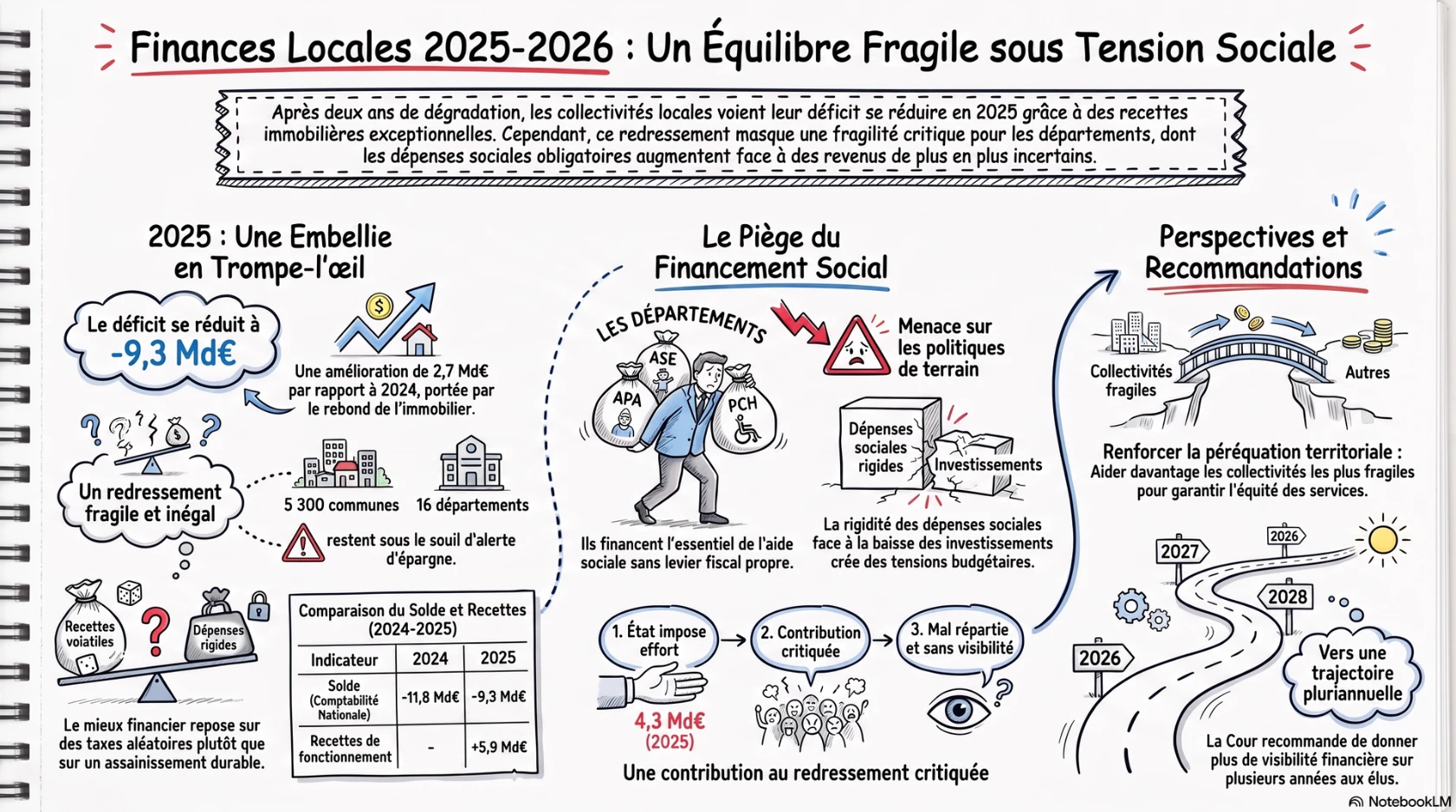
🔹 A real but fragile and unequal financial recovery
After two years of deterioration, the deficit of local authorities is reducing in 2025: -€9.3 billion in national accounting, representing an improvement of €2.7 billion (p. 2). This recovery is due to the rebound in property transfer taxes (DMTO, +€2.6 billion), the increase in departmental rates, and the slowing of operating expenses (return of energy prices, absence of indexation measures) (p. 3-4). But the Court insists: this improvement masks a strong heterogeneity. Departments and regions remain more fragile than the municipal bloc, and several thousand municipalities, around a hundred intercommunalities, and sixteen departments remain below the savings alert threshold (p. 5-7). The situation of the departments is deemed structurally vulnerable: dynamic social spending, volatile revenues, absence of fiscal power once the DMTO rate is raised (p. 7).
🔹 A contribution to the recovery deemed necessary but poorly designed
For the first time since 2020, financial laws impose a contribution from local authorities to the recovery of public finances: €4.3 billion in commitments in 2025, continued at €3.5 billion in 2026 (p. 8-9). The Court considers it legitimate (local authorities account for approximately 18% of public spending) but criticises its design: fragmentation into eight measures, incoherent smoothing mechanism (DILICO), unfair distribution, absence of a multi-year trajectory and visibility (p. 9-11). It recommends a programmed, transparent, and differentiated contribution by level, the phasing out of DILICO, the creation of reserve funds by level, and above all a strengthening of equalisation to prevent the most fragile local authorities from abandoning essential policies (p. 10-11 and 13).
2. KEY POINTS OF THE DOCUMENT
- A deficit that is reducing without disappearing. The balance for 2025 is set at -€9.3 billion (national accounting) or -€11.3 billion (budgetary accounting), compared to -€11.8 billion in 2024; the degradation trend that began in 2023 has halted, but the deficit remains high in relation to the surplus achieved during the 2014-2020 term (p. 2-4).
- A recovery driven by exceptional revenues, not by structural adjustment. The recovery of DMTO alone accounts for nearly half of the increase in operating revenues (+€5.9 billion excluding unions). These revenues are inherently volatile: the best of 2025 partially relies on a favourable contingency (p. 3).
- Solid fundamentals on average, but massive heterogeneity. The savings of municipalities exceed twice the alert threshold of 7%, while those of departments rise to 9.5%. However, approximately 5,300 municipalities (15%), 100 intercommunalities, and 16 departments remain below this threshold; more than 4,400 municipalities, 9 departments, and 2 regions exceed the debt alert threshold (p. 5-7).
- The specific vulnerability of departments, funders of social services. Their finances are exposed by the conjunction of dynamic social spending and rigid downward adjustments, volatile revenues (DMTO), and the absence of fiscal powers — a central point for any actor dependent on departmental credits (p. 7).
- A contribution to the recovery criticised in its design. Split into eight measures in 2026 (compared to six in 2025), not multiannual, inequitably distributed, with a DILICO deemed incoherent. Equalisation is not progressing, while the Court deems it essential to protect the most vulnerable communities (p. 8-11).
3. ACTION PATHS FOR LOCAL ACTORS
- Anticipate departmental arbitrations. The report indicates that departments and regions have "deferred" certain expenditures and reduced investment (roads, built heritage) to recover (p. 3-4, 6). Integrate this risk of deferral/freeze into the planning of partnerships and agreements.
- Situate your territory on the map of vulnerabilities. Identify if your associated community is among the levels below the alert threshold (savings < 7 %, debt > threshold) described p. 5-7, to objectify the upcoming tensions in the management dialogue.
- Mobilise the argument of equalisation. The Court establishes that inequalities in resources between communities are not decreasing and penalise disadvantaged territories (p. 7, 10-11). A sourced advocacy lever to defend the means of the systems in fragile territories.
- Follow the DILICO 2027-2029 schedule. The amounts collected must be returned to the communities between 2027 and 2029 (p. 10-11). A point of budgetary vigilance to be integrated into the multiannual forecasts of the structures funded by the communities.
- Document the on-the-ground impact of volatility. The report highlights the lack of multiannual visibility (p. 9). Establishing, on the ground, impact data (active files, delays, breaks in pathways) allows for feeding the advocacy on the concrete consequences of financial instability.
- Cross-reference with social expenditure data. The document does not quantify social expenditures by service; it needs to be supplemented by DREES sources (see §4) to objectify the invoked "downward rigidity" and relate it to real public needs.
Identified unmet needs: the document provides no data by public policy (ASE, autonomy, disability), no field evaluation tool, no infra-departmental breakdown. These blind spots must be filled by sectoral sources.
4. ADDITIONAL REFERENCES
- DREES — Child social assistance. Beneficiaries, measures and associated departmental expenditures — Edition 2025 (The Drees Files No. 131, June 2025). Figures and mapping of ASE expenditures borne by the departments (€11 billion in 2023): the essential sectoral complement to the 'rigidity' of social expenditures mentioned by the Court.
🔗 https://drees.solidarites-sante.gouv.fr/publications-communique-de-presse/les-dossiers-de-la-drees/250626_DD_aide-sociale-enfance-edition-2025 - DREES — Social assistance for the elderly or disabled — Edition 2025 (Drees Panoramas, October 2025). Documents APA, PCH and housing assistance (€19.1 billion of gross departmental expenditures in 2023) and their territorial disparities: sheds light on the other major social item of the departments.
🔗 https://drees.solidarites-sante.gouv.fr/publications-communique-de-presse-documents-de-reference/panoramas-de-la-drees/251001-Panoramas-aide-sociale-personnes-âgées-ou-handicapées - OFGL — 2025 Report on local authority finances, with a file 'Equalisation in the finances of the communal block' (July 2025). Delves into and provides data on the central equalisation issue in the Court's recommendations, with territorial exploration via data.ofgl.fr.
🔗 https://www.collectivites-locales.gouv.fr/etudes-et-statistiques/rapports-de-lobservatoire-des-finances-et-de-la-gestion-publique-locales-ofgl
5. FREQUENTLY ASKED QUESTIONS (FAQ)
- Has the deficit of local authorities really decreased in 2025? Yes: -€9.3 billion in national accounting, which is €2.7 billion better than in 2024. But it remains high and above the nearly balanced situation of the 2014-2020 term (p. 2-4).
- Is this improvement sustainable? Not guaranteed. It partly relies on the rebound of DMTO, a volatile revenue, and on deferred expenditures. For 2026, the Court mentions uncertainties (economic conditions, inflation related to the war in the Middle East) that could negate the expected improvement (p. 3-4).
- Why are the departments the most exposed? Because they combine dynamic and rigidly declining social expenditures, volatile revenues (DMTO), and lack of fiscal leverage once the rate is raised (p. 7). This is the point most directly related to social/medico-social funding.
- What is the DILICO? The cyclical smoothing mechanism for tax revenues: a reserve of revenues from local authorities (€1 billion in 2025, €740 million in 2026), returned in thirds over three years. The Court deems it inconsistent and recommends its abolition (p. 2, 9-11).
- How much does the contribution to recovery cost local authorities? €4.3 billion in commitments (€1.7 billion in cash) in 2025; €3.5 billion in commitments (€2.4 billion in cash) in 2026 after favourable measures, including a departmental safeguard fund raised to €600 million (p. 8-9).
- Is the contribution equitably distributed? No, according to the Court: under-utilised municipalities in relation to their capacities, overexposed intercommunalities in 2026, departments no longer contributing after deductions. The redistributive aspect remains marginal (p. 9-11).
- What does the Court concretely recommend? Five recommendations: multi-year financial trajectory specific to local authorities, standard for the evolution of state transfers by level, phasing out of DILICO in favour of smoothing funds by level, and redeployment by 2032 of VAT and DGF towards equalising criteria (p. 13).
6. REWRITING IN PLAIN LANGUAGE
What this report says
This report talks about the money of local authorities.
Local authorities are the municipalities, departments, and regions.
The Court of Auditors wrote this report.
The Court of Auditors checks public money.
The situation of money in 2025
In 2025, local authorities will be doing a bit better.
They are spending less money than before.
They are also earning more money.
But they are still spending more than they earn.
This is called a deficit.
Why it is getting a bit better
Many people have bought houses.
When you buy a house, you pay a tax.
This tax gives money to the departments.
Local authorities have also paid less for energy.
The problem of the departments
Departments pay for assistance to individuals.
For example: protected children, elderly people, disabled people.
These expenses increase every year.
We cannot easily reduce these expenses.
But the money of the departments is not secure.
So the departments are fragile.
The effort requested by the state
The state is asking for money from local authorities.
It is to help the whole country.
The Court of Auditors says: it is normal to ask for this money.
But the Court also says: it is poorly organised.
There are too many different rules.
Local authorities do not know what will happen later.
What should be done
The Court proposes ideas.
We need to plan things over several years.
We need to help poorer local authorities more.
This is called equalisation.
Equalisation gives more money to territories that need it.
7. CROSS-ANALYSIS — VALUES OF HEALTH PRACTICES
- Literacy: low. The report is technical and very jargon-heavy; only the summary offers a more accessible entry point, without a version truly adapted to the public.
- Empowerment: absent. The final beneficiaries of the policies (users of social services, medico-social services) are neither consulted nor mentioned; the logic remains institutional and budgetary.
- Participation: limited. The Court recommends consultation, but only between the state and local authorities, without citizen co-construction.
- Community health: not directly addressed; the collective dimension only appears through financial solidarity between territories (equalisation).
- Ethics: partial. The Court highlights the inequity of the distribution of contributions and its "brutal" effects on disadvantaged territories, which raises a concern for equity.
- Human rights: implicit. Territorial equity and the protection of "essential policies" are invoked, but without explicit reference to social rights.
- Intersectorality : partnerships limited to the State / territorial levels; no opening to health, social or associative actors.
- Partnership : a model of collaboration is proposed (concerted standard, shared trajectory State-communities), but strictly institutional.
- Combating discrimination : not addressed as such; only the issue of resource inequalities between communities is dealt with, without a dimension of non-discrimination of the public.
8. EVALUATION OF THE RELIABILITY OF THE RESOURCE
Scientific relevance : very high. Institutional reference source (Court of Auditors), data from the DGFiP and INSEE, explicit methodology (distinction between national / budgetary accounting), strong current relevance (2025 results, 2026 prospects). The recommendations are argued and traced. Caveat : the 2026 forecasts are explicitly surrounded by cyclical uncertainties recognised by the Court itself; some projections (DMTO, property taxes) are deemed "less well corroborated" than those of the finance law.
Operational relevance : indirect. This is not a field tool: no mobilisable methodology, no action indicators, no data by social policy. Its value for the actors is contextual (understanding the financial environment) and argumentative (feeding a sourced advocacy on resources and territorial inequalities). It must be cross-referenced with sectoral sources (DREES, CNSA) to shed light on health and social issues.
10. STRATEGIC HASHTAGS
#LocalFinances #Departments #SocialProtection #TerritorialInequalities #Equalisation #SocialDeterminants #HealthAndSocialCare #healthpractices