
🚨 Universal Health Coverage: The 3 Levers Every Field Actor Should Know
🔍💡 Health Financing: Co-payments and out-of-pocket expenses do not reduce waste; they exclude the most vulnerable from care. 50 global experts document this. 🌍 An open-access publication to empower your local advocacy. #FinancialProtection #AccessToCare
📌 This volume provides the keys to understanding why financial barriers to accessing care exist — out-of-pocket expenses, co-payments, informal payments, coverage gaps — and what reduces them according to international data. A field actor finds a solid foundation of arguments to advocate for financial protection for vulnerable populations, situate the French system within a global landscape, and objectify local advocacy. Useful when needing to convince a funder, an elected official, or a partner that funding solidarity is not an opinion but a documented lever.
📜🔗LINK to the source
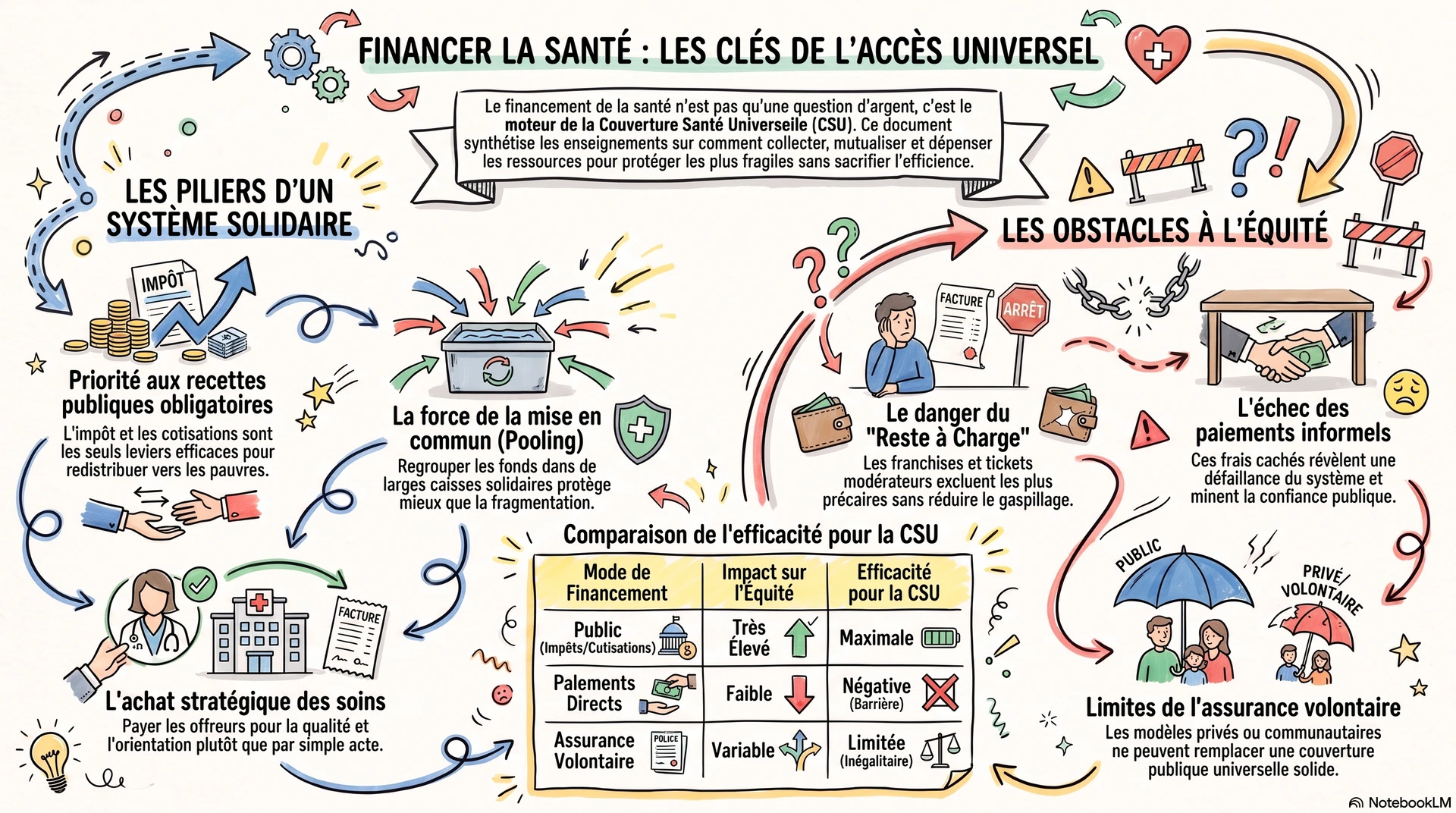
1. ANALYTICAL SUMMARY
Context and issues — Financing, the backbone of universal coverage.
Health financing is not just about raising and spending money: it determines who pays, how much, who benefits from resources, and what services are accessible. The work is organised around three fundamental functions — revenue collection, risk (pooling) and purchasing services. It addresses systems at all income levels and draws on global case studies. The central issue is the progression towards universal health coverage (UHC): protecting populations from financial difficulties related to care, while ensuring efficiency, equity, and quality. The most exposed groups — low-income, elderly, chronically ill, informal economy — are at the heart of the analysis.
Operational contributions — A decision tree for financing policies.
The volume updates the foundational work from 2002 (Funding health care: options for Europe) and expands its scope. For each function, it delivers validated key messages: the preeminence of mandatory public revenues (taxes, contributions) for UHC; the limits of voluntary and community insurance; the perverse effects of direct and informal payments; the payment mechanisms for providers (capitation, activity-based pricing, performance-based payment, bundled payments) and their incentives. It also addresses blind spots: long-term care, pandemic preparedness, antibiotics as a global public good, neglected diseases. For the French actor, it provides a comparative framework to read the national debates on out-of-pocket expenses, the articulation of the NHS / complementary insurance and sustainability.
2. KEY POINTS OF THE DOCUMENT
- Financial protection relies on mandatory public revenues. Taxes and social contributions are the most effective instruments for redistributing from the healthy to the sick and from the wealthy to the poor; a strong reliance on these sources is deemed essential for progress towards Universal Health Coverage. The historical distinction between Beveridgean (NHS) and Bismarckian (social insurance) models has blurred (chap. 1.1, p. 29).
- Direct payments (out-of-pocket expenses) are a suboptimal policy. Deductibles and co-payments generate revenue but create access barriers, exacerbate inequalities, and expose households to financial difficulties, particularly those with chronic or severe illnesses and the most disadvantaged. Supply-side mechanisms (prescription, referral) are fairer than those targeting demand (chap. 2.4, p. 224).
- Informal payments reveal a failure of the formal system. These undeclared payments to caregivers reduce access and financial protection and undermine trust; they are more frequent where medical density is low and where formal out-of-pocket expenses are high. Correcting this requires structural reforms, not just sanctions (chap. 3.3, p. 360).
- Risk pooling (pooling) is the most underestimated lever. Fragmenting the funds into small groups with homogeneous risks, without redistribution between them, degrades equity and efficiency. Consolidating, coordinating, equalising by risk adjustment and making membership mandatory are the documented strategies (chap. 2.1, p. 137).
- The funding of long-term care is an urgent and inequitable issue. Ageing increases demand while women, low-income individuals, and those with lower qualifications accumulate greater need and lesser access. The use of means testing acts as a regressive tax on wealth; the work advocates for expanded public funding, independent of wage contributions (chap. 2.5, p. 245).
3. ACTION PATHWAYS FOR LOCAL ACTORS
- Objectify your advocacy on access to care by relying on the key messages from the chapter on out-of-pocket expenses (chap. 2.4, p. 224): having data-driven arguments to advocate for exemptions, caps, and protection for chronic populations with funders and local elected officials.
- Identify non-tariff levers for controlling unnecessary care described in chap. 2.4 (strengthening prescription and referral, patient information): mobilise them rather than financial barriers in your prevention and health education actions.
- Document and report situations of forgoing care by cross-referencing your field observations with the framework of chapter 3.3 on informal payments and coverage inadequacy (p. 360), to inform territorial health diagnostics.
- Anticipate the needs for long-term care on your territory from chapter 2.5 (p. 245): mapping access inequalities (women, low income, informal caregivers) to target support and the opening of rights.
- Integrate the logic of pooling / solidarity (chap. 2.1, p. 137) into your health literacy actions: explain to the public why collective coverage protects better than individual and voluntary schemes (chap. 1.3, p. 91).
- Situate French debates in the international landscape through the introduction and executive summary (p. 1 and p. xxxiii): use the future challenges box (Box 0.1.1) as a reading grid for national reforms to train your teams and volunteers.
Unmet needs / necessary adaptations: the work is macro and international; it does not provide ready-to-use field tools (checklists, welcome protocols). Adaptation to the French context (Sécu, C2S, AME, complementary) must be done through the national references below.
4. ADDITIONAL REFERENCES
- DREES — Health expenditure in 2024. Results of health accounts, Edition 2025 (September 2025, corrections December 2025). Anchors the international question of out-of-pocket expenses in the French figures (€292 per inhabitant in 2024, France among the lowest out-of-pocket expenses in the EU).
🔗 https://drees.solidarites-sante.gouv.fr/publications-communique-de-presse-infographie-documents-de-reference/250930-Panorama-d%C3%A9penses-de-sant%C3%A9 - HCAAM / HCFEA / HCFiPS — For a sustainable recovery of social security (2025). Transposes to the French case the trade-offs on revenues, pooling and coverage of the most vulnerable addressed in sections 1 and 2 of the work.
🔗 https://www.securite-sociale.fr/home/hcaam/zone-main-content/rapports-et-avis-1/pour-un-redressement-durable-de-la-securite-sociale.html - Doctors of the World — 2025 Report of the Observatory on Access to Rights and Care (September 2025). Ground counterpoint on access inequalities and the erosion of financial protection, echoing chapters 2.4 and 3.3.
🔗 https://www.medecinsdumonde.org/actualite/rapport-2025-de-lobservatoire/
5. FREQUENTLY ASKED QUESTIONS (FAQ)
- Does charging users a part of the care really reduce abuse?
No. Direct payments generate revenue but mainly create access barriers and primarily affect the most vulnerable; acting on supply (prescription, referral) is more effective and fairer (chap. 2.4, p. 224). - Can voluntary or community health insurance replace public coverage?
No. Community-based health insurance (CBHI) is not a miracle solution — the very poor rarely insure themselves — and voluntary health insurance (VHI) creates inequalities due to premium costs. Improving access to publicly funded care remains more effective (chap. 1.2 p. 63; chap. 1.3 p. 91). - What is "risk pooling" and why is it central?
It is the way in which prepaid funds are pooled to cover a population. Too small funds, with homogeneous risks and without redistribution, degrade equity. Consolidation and equalisation strengthen UHC (chap. 2.1, p. 137). - What are informal payments and how to combat them?
These are undeclared payments made directly to the caregiver for already covered care. They reflect a mismatch between supply/demand/pricing. Reducing them requires formalising payments (with exemptions), clarifying the benefits package, and strengthening public coverage (chap. 3.3, p. 360). - How to pay professionals to improve quality without perverse effects?
No payment method (fee-for-service, capitation, performance-based payment) is neutral. Performance-based payment yields mixed results and can create inequalities if poorly adjusted to risk; a ‘holistic’ design aligned with system objectives is recommended (chap. 3.1, p. 285; chap. 3.2, p. 320). - Does the document say anything about long-term care and caregivers?
Yes. Ageing increases demand, access is inequitable, and informal caregivers (often women, unpaid) bear a major burden. The work advocates for expanded public funding and recognition of caregivers (chap. 2.5 p. 245; chap. 3.6). - Why do some diseases remain untreated and how to fund useful innovation?
Neglected diseases account for about one-fifth of the global burden of morbidity but are not considered profitable. ‘Push’ incentives (research grants) and ‘pull’ incentives (rewards after discovery) aim to decouple research costs from market profitability (chap. 3.10, p. 611; antibiotics chap. 3.9, p. 572).
6. REWRITING IN PLAIN LANGUAGE
What is this book about?
This book is about health financing.
Financing is the money that pays for care.
The book explains who pays, how much, and for what care.
More than 50 experts from around the world have written this book.
There are 3 main ideas.
Idea 1: how to find the money.
The best way is public money.
Public money comes from taxes and contributions.
Thus, rich people help poor people.
And healthy people help sick people.
Idea 2: how to share money.
We pool the money in a large fund.
A large fund protects better than a small fund.
Everyone must be in the same fund.
Idea 3: how to pay caregivers.
We can pay caregivers in several ways.
Each way has advantages and disadvantages.
It is important to choose well to have quality care.
An important point about the money paid by the patient.
Sometimes, the patient pays part of the care.
This money is called the out-of-pocket expense.
The out-of-pocket expense is a problem.
It prevents poor people from getting treatment.
It is better to avoid out-of-pocket expenses.
Vulnerable people need help.
Elderly people need long-term care.
Poor people often have less access to care.
The book calls for better protection for these people.
7. CROSS-ANALYSIS — VALUES OF HEALTH PRACTICES
- Literacy: low on the direct level — it is a dense academic work, not designed for audiences with varied comprehension; however, it sheds light on issues to be translated into literacy.
- Empowerment: not central; the work deals with funding at the macro level, not the direct involvement of beneficiaries in design.
- Participation: mentions the importance of stakeholder engagement (basket of care, disinvestment) but without a detailed mechanism for citizen co-construction (chap. 2.2, chap. 2.3).
- Community health : strong collective dimension through risk pooling and financing solidarity (chap. 2.1).
- Ethics : the work explicitly identifies equity biases (risk selection, “cream-skimming”, regressive asset tests).
- Human rights : approach based on universal health coverage and protection against financial hardship, consistent with equity and inclusion.
- Intersectorality : present on global public goods (pandemics, antibiotics, neglected diseases) calling for international cooperation (chap. 3.8 to 3.10).
- Partnership : formalised collaboration models mainly between buyers and providers, and between states/donors (chap. 1.4, chap. 3.5).
- Combating discrimination : addresses socio-economic inequalities in access and the over-risk of vulnerable groups (women, low income, elderly); individual non-judgment is not a theme, the angle being structural.
8. EVALUATION OF RESOURCE RELIABILITY
Scientific relevance : very high. Publication of the European Observatory / WHO via Cambridge University Press, freely accessible, bringing together more than 50 international experts, updating a reference work from 2002. Evidence-based approach, explicit conceptual frameworks, global case studies, recent data (VHI 2021, OECD LTC). No notable internal inconsistencies identified in the executive summary and introduction.
Operational relevance: indirect. Resource of skills development and argumentation, not for implementation. It does not provide check-lists or field protocols, and its international framework requires adaptation to the French context (Social Security, complementary, C2S, AME) — hence the importance of the above national complementary references. To be reserved for stakeholders wishing to base an advocacy or diagnosis on solid data.
10. STRATEGIC HASHTAGS
#healthpractices #UniversalHealthCoverage #HealthFinancing #FinancialProtection #AccessToCare #OutOfPocket #HealthPolicies #HealthLiteracy