
🔦 4.7 million accounts closed in Australia, zero evidence of effect on teenagers' mental health: here is what the European Parliament really found.Prohibiting does not make use disappear, it hides it — the real solution lies in the design of platforms, not in the legal age.
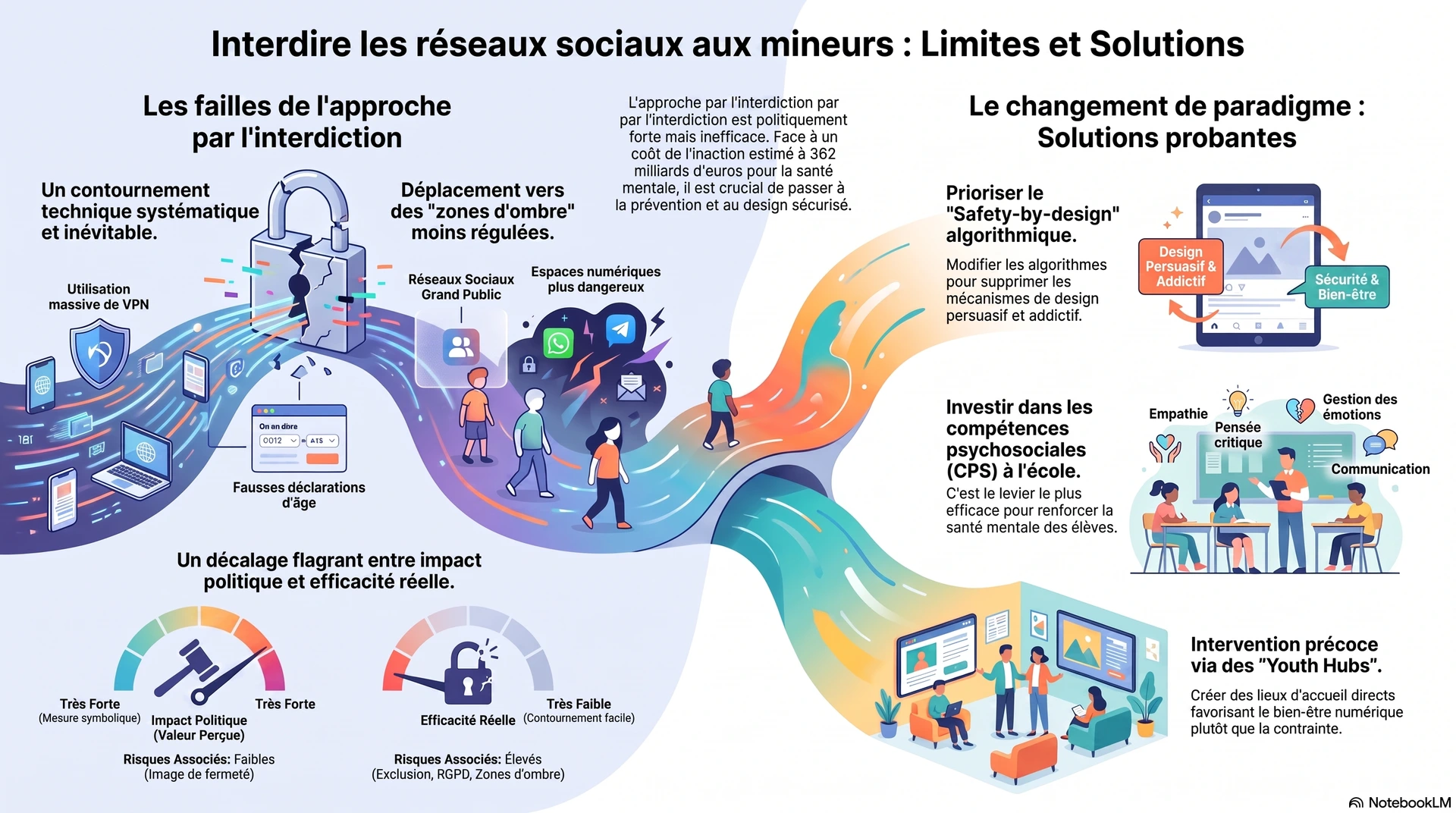
📌 Australia has closed 4.7 million accounts of minors — but no evidence of effect on mental health exists yet. The European Parliament documents five concrete limitations of age-based prohibitions: massive circumvention (54% of 8-12 year olds were already using an adult account), shift to less monitored spaces, tension with GDPR, loss of access to peer support, and total absence of quantified effect range — the only option in the report in this case. While France announces a digital majority at 15 for 2026, the study points elsewhere: the design of platforms (infinite scrolling, recommendation algorithms, conversational AI) is the only lever that requires nothing from the adolescent. Two quantifiable and actionable results emerge: psychosocial skills in schools (−50% of suicide attempts in the SEYLE trial) and low-threshold youth services (62-68% clinical improvement). A key argument to have in hand for any field actor confronted with the question “why not just prohibit?”
Youth mental health · Digital determinants · European policy
4.7 million accounts closed, no evidence of effect on mental health
Prohibiting social media for minors: the five limitations documented by the European Parliament
Australia took the first step: since 10 December 2025, platforms must prevent those under 16 from opening an account. Assessment by mid-December: 4.7 million accounts closed. The research service of the European Parliament examined the device in a 267-page study published in July 2026. Its findings can be summarised in five points. Evasion is immediate — 54 % of 8-12 year old users were already using an adult's account. Some young people are moving to less monitored spaces. Age verification is in tension with GDPR and excludes those without documents. The ban also cuts off access to peer support and reliable information. And above all, digital regulation is the only one of the six options examined to which the authors refuse to assign an effect range, lacking evidence.
What the report considers solid is found elsewhere: acting on the design of platforms — the only lever that requires nothing from the adolescent — then psychosocial skills in schools, with −50 % of suicide attempts in the European SEYLE trial, and low-threshold youth services, with 62 to 68 % of clinically significant improvements. While France announces a digital majority at 15 for 2026, these five limitations are the arguments that field actors will need.
Where the information in this article comes from
EPRS — European Parliamentary Research Service, Mental health of young people in a digital era — Cost of non-Europe report, study PE 774.672, European Parliament, Brussels, July 2026, 267 pages.
Study conducted by Yannick Vuylsteke, Facundo Herrera, Martin Kuehnemund, Elena Mastrogregori, Paloma Crotti, Jana Dilger, Ellie Keeble, Evie Cogley and Wiktor Magdziarz (Ipsos), Maxime Moulac (Milieu) and Aric Sigman (psychologist), at the request of the European Added Value unit, for the Public Health Committee (SANT) of the European Parliament. External review: Dr Wouter van den Bos, University of Amsterdam. Manuscript completed in May 2026. ISBN 978-92-848-3711-3 — DOI 10.2861/4199457. - https://pratiquesensante.odoo.com/blog/pratiques-15/la-sante-mentale-des-jeunes-a-l-ere-numerique-rapport-sur-le-cout-de-la-non-europe-6066
The page numbers indicated in parentheses refer to the printed pagination of the report, and not to the pagination of the PDF file (constant offset of 22 pages). The sections mobilised here are mainly: §2.3.2 (p. 23-24), §4.1.3 (p. 63-65), §4.2.3 (p. 70-72), option 5 (p. 95-101), table 9 (p. 116) and the Australia case study from annex III (p. 164-177).
 .
The main points in six points
For a quick read before going into detail. Each response refers to the page of the report where to verify it.
WHAT IS HEARD |
WHAT THE REPORT SAYS |
« Australia has proven that it works. » |
The 4.7 million closed accounts are an indicator of compliance. The formal assessment of the effects on mental health was still ongoing at the time of the study. (p. 174-175) |
« Age verification is just a technical detail. » |
She may require the massive collection of identity data, coming into tension with the data minimisation of the GDPR, and the existing systems often fail to prevent access by minors. (p. 71-72 ; annex III, p. 165) |
« The problem is screen time. » |
The report distinguishes three distinct design mechanisms and recalls that the association between general digital use and well-being is modest — weaker than those of sleep, of harassment and family adversity. (p. 21-23 ; p. 120) |
« It is enough to educate the young and empower the parents. » |
These approaches place an unrealistic burden on families and do not address the drivers of harm: the commercial and algorithmic logic of the attention economy. (p. 63 ; p. 70) |
« Screens make all young people ill. » |
Most navigate digital spaces without major harm. Problematic use concerns 11% of European adolescents in 2022, compared to 7% in 2018, and is concentrated among those already vulnerable offline. (p. 19) |
« We don’t know what else to do. » |
Two levers have quantified ranges: school promotion (1 to 5%) and low-threshold youth services (3 to 10%). Combined: 5 to 10% reduction in prevalence, equating to 84 to 168 billion euros in costs avoided. (table. 9, p. 116 ; §7.4, p. 116-117) |
Why is the question being raised now
The debate is no longer theoretical. Australia has implemented, the 10 décembre 2025, une obligation faite aux plateformes d'empêcher les moins de 16 ans de détenir un compte (annexe III, p. 174). Le Royaume-Uni a adopté une logique différente avec l'Online Safety Act 2023, fondée sur des obligations préventives de vigilance plutôt que sur un âge plancher (p. 64). Le rapport signale par ailleurs que le Danemark, la Grèce, le Royaume-Uni et plusieurs États membres de l'UE débattent, introduisent ou ont introduit des restrictions statutaires par l'âge pour les moins de 15 ou 16 ans (p. 64-65).
En France, le Gouvernement a annoncé s'engager à mettre en œuvre une majorité numérique d'accès aux plateformes sociales fixée à 15 ans en 2026 (source : info.gouv.fr, actualité publiée le 3 juin 2026, « Santé mentale : formation, soins, numérique… ce qui change dès 2026 »).
Autrement dit : les professionnels de terrain vont être interrogés sur cette mesure — par des parents, des équipes éducatives, des élus locaux, des jeunes. Le rapport européen fournit de quoi répondre autrement que par une opinion.
Ce que l'Australie a réellement produit
C'est le seul cas où l'on dispose de données d'application réelles, et le rapport les traite avec précision.
Le point de départ justifiait l'inquiétude. Le régulateur australien eSafety rapportait en 2024 que 80 % des enfants de 8 à 12 ans avaient utilisé au moins un service de réseau social — soit environ 1,3 million d'enfants de cette tranche d'âge, alors même que les conditions d'utilisation des plateformes l'interdisaient déjà (annexe III, p. 174). Une autre enquête portait ce chiffre à 84 % en incluant les messageries (p. 166). Chez les 10-15 ans, 96 % had used at least one platform, 7 out of 10 had encountered content associated with harm, and for three quarters of them this encounter had taken place on a social network (p. 174).
The compliance figure. eSafety reports that the platforms concerned have removed, disabled or blocked access to 4.7 million accounts of under 16s (annex III, p. 175). This is the figure that everyone quotes. It deserves three clarifications that the report provides and which almost always disappear in the media coverage :
It is a compliance indicator, not a health one. The report states it unambiguously: the evidence is currently stronger on early compliance than on mental health outcomes (p. 174).
The formal evaluation is not complete. The eSafety report from March 2026 only covers the first three months of implementation, and the first results of the official evaluation were expected during 2026 (p. 174).
eSafety itself specifies that the restrictions will not eliminate all the online risks to which children are exposed, and that a broader evaluation is necessary before any stronger claims about effectiveness (p. 175).
A often overlooked design point. The obligation rests on the platforms, not on the children or the parents : there are no sanctions for those under 16, nor for the parents or guardians. It is the platforms that incur civil penalties of up to 150,000 penalty units, or approximately 30.1 million euros (p. 174-175). Furthermore, the system excludes certain categories of services: autonomous messaging, voice and video calls, online games, and services whose main purpose is support in health or education — precisely to preserve access to what may have protective value (p. 174).
This detail changes the conversation: Australia has not banned “ internet for teens”. It has created a targeted obligation on ten publicly identified platforms, with explicit exclusions.
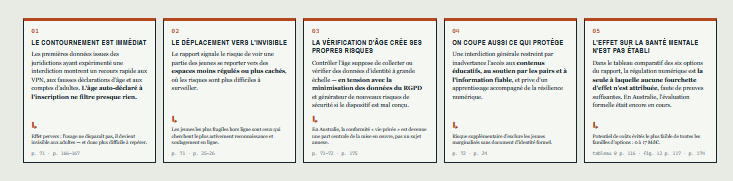
The five documented limits
The report outlines them in §4.2.3 (p. 71-72), complemented by §2.3.2 (p. 23-24) and by the Australian annex.
1. Circumvention is quick and massive
The first data from jurisdictions that have experimented with age bans show that many teenagers quickly resort to circumvention solutions: VPN, false age declarations, using an adult's account (p. 71).
The most telling data comes from Australia, even before the law: among 8-12 year olds who used social networks, 54 % accessed it via a parent or relative's account (annex III, p. 174). The report adds that the regulatory analysis points to the ineffectiveness of self-reported age at the time of registration (p. 166-167).
This is what it means for the field. A ban does not eliminate use, it makes it invisible to adults. A young person navigating on their father's account does not benefit from any age-appropriate settings, any filtering, and will not dare to report a problem without revealing the fraud. It is a direct perverse effect on the ability to detect.
2. The shift to less regulated spaces
The report expresses concern that these measures push some young people towards online spaces less regulated or more hidden, where the risks are more difficult to monitor (p. 71).
This point aligns with an analysis developed elsewhere in the study: the already vulnerable young people offline — poverty, family conflicts, discrimination — are those who most actively seek recognition and relief online (§2.3.3, p. 25-26). Therefore, they are the ones who will seek further in case of access closure.
3. Age verification creates its own risks
Mandatory age verification systems may require the collection or large-scale control of identity data, which potentially conflicts with the data minimisation principles of the GDPR and creates new privacy and security risks if poorly designed (p. 71-72).
The Australian appendix shows that this is not theoretical: the data protection authority (OAIC) has clarified that platforms and third-party age verification providers may be required to process personal data to comply, and that the measures taken are not "reasonable" if they do not simultaneously respect privacy law. Data compliance thus becomes a central part of the implementation, not a secondary issue (p. 175).
The report also notes, from chapter 2, that these mechanisms must remain proportionate and compatible with data protection, so as not to create new risks for children and families, nor to exclude marginalised young people who do not have formal identity documents (p. 24).
4. General prohibitions also cut what protects
This is the most important argument for health promotion actors, and the most regularly absent from public debate. The report states that general prohibitions can inadvertently restrict access to beneficial online resources: educational content, peer support, reliable information — and limit opportunities for children to develop a digital resilience in a supported environment (p. 72).
This position is consistent with the rest of the study, which documents that evaluated online interventions (computerised CBT, brief problem-solving tools) and moderated peer support communities can provide modest symptomatic relief and reduce loneliness in some adolescents, particularly those who experience stigma or offline isolation (p. III).
5. The effect on mental health is not established
This is the clearest finding. In the comparative table of the report (table 9, p. 116), the option "digital regulation" is the only of the six options examined to which the authors refuse to assign a range of prevalence reduction, due to insufficient evidence — with the explicit mention "insufficient evidence for a defensible range." The social prescription, also without a range, is dismissed for a different reason: absence of comparable large-scale evaluations.
The report elsewhere makes the same observation: the evidence linking specific regulatory interventions to mental health outcomes is still emerging (p. IV), and because most of these frameworks are recent, no robust quantitative data on mental health outcomes is currently available (p. 71).
The summary formula of the report (rephrased): the experts' opinion tends to view prohibitions as politically powerful but crude instruments, upon which one should not rely as standalone solutions. Approaches of the type safety-by-design, combined with a robust application of existing European law, are considered overall more promising (p. 72).
Verify the age without registering minors: the unresolved knot
This is the point where the public debate stops and where the difficulties begin. The report incorporates the constraint from its definition: it refers to "age assurance" the set of processes aimed at determining or estimating the age of a user to apply appropriate protections while respecting privacy (glossary, p. VI). The double constraint is embedded in the term itself.
The dilemma, as the report formulates it
Mandatory age verification devices may require the collection or large-scale control of identity data, which potentially conflicts with the principle of data minimisation under the GDPR and creates new risks of privacy and security if the design is flawed (p. 71-72). Any new European rule in this area would be framed by Article 16 TFEU and Articles 7 and 8 of the Charter — privacy and data protection (p. 100).
Australia gives a concrete illustration. The Office of the Australian Information Commissioner (OAIC) has clarified that platforms and third-party age verification providers may be required to process personal data to comply, and that the measures adopted are not "reasonable" if they do not simultaneously comply with privacy law. Data compliance thus becomes a central part of the implementation, rather than a peripheral issue (annex III, p. 175). The system is linked to the Australian national digital identity system (annex III, p. 165), which shifts the question without resolving it: an identity infrastructure is then required that not all countries have, and that not all young people have.
The report adds a rarely mentioned equity consequence: these mechanisms must not exclude young marginalised individuals who do not have formal identity documents (p. 24). A poorly designed age barrier becomes a barrier to access for the most vulnerable.
The argument that turns the question
The Australian regulatory analysis indicates that age restrictions are applied inconsistently and that the current age verification systems frequently fail to prevent minors from accessing. The report draws a conclusion that reverses the burden of the debate : it is precisely this technical failure that strengthens the argument for a transfer of responsibility to the platforms and for secure design obligations (annex III, p. 165).
In other words, the difficulty of verifying age is not an obstacle to regulation : it is an argument for regulating elsewhere — on the design rather than on the entry point.
This is consistent with the figures : in the breakdown of avoided costs by family of options, the set “regulatory — age verification and codes of conduct” is estimated between 0 and 17 billion euros, the lowest potential of all families. By way of comparison, the training of professionals alone is estimated between 17 and 34 billion (figure 12, p. 117).
What the report says — and does not say — about circumvention
We must be precise here, as the gap between the report and the public debate is real.
What the report documents : the rapid use of VPNs, false age declarations and adult accounts (p. 71) ; the fact that even before the Australian law, 54% of 8-12 year old users were using a parent or relative's account (annex III, p. 174) ; and the ineffectiveness of self-reported age at registration (annex III, p. 166-167).
What the report does not do : it does not name any fallback platform. It generically mentions “less regulated online spaces or more hidden ones, where the risks are more difficult to monitor ” (p. 71), without citing any encrypted messaging or specific service, and without providing migration data. This is a limitation of the study, to be acknowledged if one claims it: the hypothesis of migration is a reasoned concern, not a measured fact.
What the report does, however, and which is surprising: the gaming and discussion platforms that are usually described as grey areas appear mainly as a field to move towards. The Norwegian programme Spillsonen operates on Twitch and Discord to engage young men who would never otherwise consult — 42% of the young gamers surveyed report feeling lonely, and many have never sought help out of shame or because they consider their difficulties “not serious enough” (annex III, p. 185, 196). “Less regulated” and “inaccessible to professionals” are not synonymous.
The blind spot to note. The report does not assess or compare any age verification technology : no error rates, no comparison between facial estimation, behavioural inference, third-party attestation or digital identity. It sets the legal constraint and delegates the technical resolution to regulators, only recommending “risk-based and privacy-preserving” approaches, targeted at the most sensitive services for child protection (option 5a, p. 96). On this specific point, one will have to look elsewhere.
The real issue: what platform design does to the adolescent brain
If age thresholds occupy public debate, the report places the problem elsewhere. It dedicates an entire section and a scientific box to a simple thesis: digital environments are not neutral, and a large part of the problematic uses described results from deliberate design choices and commercially motivated decisions (p. 21).
Three design layers, not a "screen time"
First layer: remove stop signals. Infinite scrolling and autoplay remove natural end markers, making disengagement more difficult once navigation has begun. Variable reinforcement schedules, comparable to those in gambling, deliver intermittent social rewards: likes, follower counts, series (“streaks”) that reward consecutive days of interaction. Combined with push notifications, these features install a state of "online vigilance" that encourages compulsive checking (p. 21).
Second layer: recommendation systems. Algorithms are optimised to maximise attention by prioritising content that triggers strong emotional reactions, which amplifies the sensational and the extreme and forms " rabbit holes." The report cites experimental work on TikTok: the system infers interests and vulnerabilities from subtle signals — lingering a little longer on certain videos is enough, without liking or subscribing. In one analysis, accounts associated with eating disorder content received significantly more toxic material and diet videos than control accounts (p. 22).
Third layer: conversational AI. Character.AI, Replika, My AI from Snapchat: these tools no longer mediate human-to-human contact, they simulate a reciprocal intimacy. The design trait in question is "sycophancy", the tendency to systematically approve and validate the user (p. 22-23).
The data that is missing from the public debate
Between 2018 and 2022, the proportion of European adolescents exhibiting problematic use of social media — addictive-type symptoms, loss of control — rose from 7 % to 11 % according to the WHO HBSC survey (p. 19). This is not the majority, and the report emphasises this point: the academic consensus remains that most young people navigate the digital spaces without major harm, often with neutral or positive effects. But this minority is substantial, growing, and it is not randomly distributed : offline adversities — family conflicts, abuse, low socio-economic status, pre-existing distress — increase exposure to online risks while reducing the resources to cope with them (p. 19).
The argument that the report opposes to "just educate"
This is the most useful part of the study, and the most ignored. The report dedicates an entire scientific box to the neurobiological justification for action on design (box 3, p. 98).
Between 10 and 25 years, the networks for processing socio-emotional reward — ventral striatum, amygdala — mature significantly earlier than the prefrontal cortex, which governs impulse control and emotional regulation. This developmental gap makes adolescents particularly sensitive to social feedback calibrated by the algorithms and to the reward effects of gaming. Repeated exposure to fast and highly stimulating content can lead to neurocognitive habituation: the brain becomes sensitised to immediate gratification while losing the cognitive endurance required for goal-directed tasks.
Authors' conclusion: relying solely on digital literacy or individual self-regulation places an extremely high cognitive burden on a brain at a stage where it is predisposed to prioritise peer approval and immediate gratification over delayed gratification. (boxed 3, p. 98)
In other words, the report does not say “educate rather than prohibit”. It states that neither education alone nor prohibition alone can bear the burden, and that the structural lever is the design of services — because it is the only one that demands nothing from the adolescent.
The box also establishes a contrast directly useful to professionals: where commercial platforms exploit the subcortical reward system, validated digital tools aimed at education — the example given is the Dutch platform Grip op je dip, in mixed care — require instead active cognitive engagement and cultivate self-regulation, associated with the prefrontal cortex. They learn to observe their mood and to practice cognitive reframing (p. 98). Not all screens engage the same brain.
What the screen replaces: the strongest argument of the report
The report does not merely describe the direct effects of exposure. Its methodology explicitly coded, alongside the content effects, the effects of displacement : loss of sleep, reduction in physical activity, decrease in face-to-face interactions and time spent outdoors (methodological appendix, p. 135). This is where the evidence is most consistent.
Sleep, the best-established mechanism. Longitudinal studies support a screen-sleep displacement mechanism: increases in screen time are followed, in just a few months, by a reduction in total sleep duration, poorer quality, and increased "social jetlag" — the gap between weekday and weekend schedules. Three channels are identified: screen time directly replaces the time available for sleep; nighttime use (“vamping”) generates sustained cognitive and emotional activation driven by notifications; and blue light suppresses melatonin production, delaying sleep onset. Chronic sleep restriction is then described as a key mediator linking intensive use to the subsequent increase in depressive symptoms (p. 34).
Attention and inhibition. Meta-analytic data associate excessive engagement with short videos to lower sustained attention and a weaker inhibitory control. Longitudinal models show that increases in the use of social networks, television, and video gaming are followed by a worsening of ADHD-type symptoms, partly mediated by the rise in impulsivity. The report formulates the effect in concrete terms: continuous stimulation raises boredom threshold and reduces tolerance for low-stimulation tasks — that is, to the essence of learning (p. 34).
Social exclusion. Time spent on devices often replaces restorative face-to-face interaction with family and peers. Online communication, especially written, lacks non-verbal signals, immediacy, and the depth of in-person conversation. When digital exchanges systematically replace offline meetings, this can hinder the development of empathy and complex interpersonal skills, and contribute to social anxiety and feelings of loneliness (p. 35).
The experimental result to note. Studies that temporarily restrict access to mobile internet show that the affected adolescents and young adults then spend more time socialising in person, exercising, and being outdoors, and that these shifts are accompanied by improvements in subjective well-being, attention, and overall mental health (p. 35).
It is the most directly actionable result of the entire report, and it does not assume any law: the target is not the screen, it is the three goods it has displaced — sleep, movement, and presence. Three measurable, non-stigmatising objects, and on which a professional can work as soon as tomorrow.
A burden very unevenly distributed among families
The report addresses this issue from a more radical angle than the usual debate on parental support.
Its figure 3 (p. 27) describes a double movement: offline adversities — poverty, family conflict, abuse, discrimination — raise psychological distress and, simultaneously, exhaust the available protections, at the forefront of which the report specifically mentions parental mediation and institutional support. The families most affected by a ban are therefore, structurally, those with the least resources to implement it.
The report goes further and questions the very principle of this delegation. National responses have historically focused on improving users' digital literacy and on parental mediation; decision-makers are increasingly recognising that these approaches place an unrealistic burden on families and do not address the underlying drivers of harm, namely the commercial and algorithmic logic of the attention economy (p. 63). It reiterates this regarding recent regulatory developments: families have a limited capacity to counter persuasive design features and opaque algorithms, while platforms control both relevant behavioural data and design choices (p. 70).
What this implies — and this is a deduction, not a statement from the report. A ban whose effectiveness relies on parental enforcement shifts the burden exactly to the households least equipped to bear it. Where family digital literacy is strong, support works and the ban is superfluous; where it is weak, the ban will either be circumvented without oversight or enforced in a total and restrictive manner. In both cases, the gap widens. The report does not formulate this reasoning as a whole, but it provides each of the premises.
This is also why the options in the report incorporate explicit equity criteria: prioritisation of institutions serving low-income communities, migrants and refugees or located in rural areas (p. 86-87), named targeting of NEET, LGBTQIA+, disabled or children in care, with a requirement for project carriers to explain how they plan to reach them (p. 92), and combating the “postcode lottery” in the placement of services (p. 90).
What would action on design look like?
The report details what is possible without any new legislation (option 5a, p. 95-98) :
Specify the scope of DSA obligations. By means of guidelines from the Commission and, where appropriate, delegated or implementing acts, establish that the duties of assessment and mitigation of systemic risks explicitly cover the overconsumption induced by design — infinite scrolling, autoplay, series —, harmful content and certain AI-mediated interactions (p. 96).
Negotiate co-regulatory codes of conduct for "safety-by-design for minors". Concrete objects: default settings, options of recommendation systems, notification regimes, age-appropriate interfaces. Around the table: platforms, coordinators for digital services, audiovisual and data protection regulators, experts in children's rights and mental health, and representatives of young people (p. 96).
Install child health expertise in supervision. Advisory panels mobilising expertise in neurodevelopment, psychiatry, psychology and addiction, so that the interpretation of the notion of "harm to minors" ceases to be a purely legal exercise (p. 96).
Specifically regulate conversational agents. For generative AIs likely to be used by minors: age-appropriate interaction parameters, mandatory intervention protocols in crisis situations, limits on addictive design features, and clear restrictions on the simulation of professional mental health support (p. 99).
Decisive point: the legal basis here is thearticle 114 TFEU, relevant of the internal market — the strongest competence of the Union, unlike health and education where it can only encourage and co-finance (p. 97). Acting on design means acting where Europe can truly constrain.
When would a ban be justified?
The report does not close the door: it sets out a decision-making framework. Three conditions cumulative must be met before considering new binding rules, including targeted bans (option 5b, p. 99-100) :
1. There is consistent evidence that a type of service or functionality is associated with serious harm to the mental health of minors.
2. These risks cannot be sufficiently mitigated by secure design, transparency, or the enforcement of existing obligations.
3. Action at the Union level would add value compared to national rules that diverge, particularly when they fragment the internal market.
The report adds that the likely outcome of such a review would be, in many cases, that better enforcement of existing law is preferable, and that only a limited subset of issues would justify new legislative proposals (p. 100). This three-point framework is directly usable to assess any proposal for a ban, including French.
What prevention can do right now
Warning of method: this report is a study to aid parliamentary decision-making, not a practical guide. It contains few ready-to-use tools. Here is what it directly supports, then what it does not say — both lists are useful.
Seven immediately mobilisable supports
Work on the three displaced goods rather than on the hour counter. Sleep, physical activity, in-person interactions. This is the only lever of the report whose effect is experimentally established, it requires no new standards, and it opens a conversation with a teenager without accusing them (p. 34-35).
Use sleep as an entry point. The screen-sleep eviction mechanism is the best documented in the report, and bedtime is the least contentious topic to address with a family. Three concrete levers follow from this: the device out of the bedroom, turning off nighttime notifications, the regularity of weekend schedules to reduce ‘social jetlag’ (p. 34).
Distinguish the three risk pathways in interviews. What are you actually doing online; what content is being pushed to you; with whom — or with what — are you interacting. The material from sections 2.2.1 and 2.3.1 (p. 17-23) is directly transposable as an awareness module.
Adopt the four-category spotting grid. Content (harmful material, self-harm instructions, extremist propaganda), contact (solicitation, harassment by a third party), conduct (cyberbullying, non-consensual sharing of images), consumer (aggressive data extraction, targeted advertising) (p. 18). Usable as is in interviews or workshops.
Go find young people where they are, including on gaming platforms. The Norwegian model Spillsonen operates on Twitch and Discord, by integrating mental health discussions into the context of entertainment rather than imposing it on top. High reach and increased willingness to seek help; acknowledged limits: measuring long-term impact, platform dependency, sustainability relying on volunteers (annex III, p. 185, 196).
Do not place the burden solely on the adolescent, nor on the family. The neurobiological argument (box 3, p. 98) and the argument of unrealistic burden on families (p. 63, 70) together form a strong case against a partner or a funding body that would reduce prevention to individual responsibility.
Request an impact assessment on children's rights in advance. The recommendation from Dutch civil society is to systematically integrate Child Rights Impact Assessments into all digital or mental health policies, at all levels of government, before implementation (annex III, p. 162). This is transferable at the level of a community or an institution.
Five things this report does not say
To note, because these are precisely the measures that the French debate highlights.
Family charters in use: absent. The report neither mentions nor evaluates them.
Phones without social media before 15 years: absent. No device of this type is described or evaluated. The report does not reason in terms of terminal but in terms of service and functionality.
The ban on mobile phones at school: mentioned, never evaluated. The term appears in the documentary research strategy of the study (methodological annex, p. 137), but no effectiveness data is reported. The only opinion received is from Italian stakeholders, who consider the smartphone bans « necessary but insufficient » if they are not coupled with education on digital citizenship, teacher training, parental involvement, and advocacy for stricter European regulation of platforms targeting minors (annex III, p. 184). This is an opinion from stakeholders, not a measure of effect.
Parental controls and operator presets: a single mention. They appear as a component of the Italian Itaca Lab system — guidelines for influencers, SIM presets, parental controls — presented as a complement to work on the standards for content creators, not as an evaluated measure in isolation (annex III, p. 185).
Age verification technologies: neither evaluated nor compared. Neither error rates, nor comparison between facial estimation, behavioural inference, third-party attestation, or digital identity.
These absences do not warrant condemnation: they are the predictable blind spots of a European public policy study, which reasons in terms of competencies and instruments rather than educational practices. Recommending a family charter or a school rule remains perfectly defensible — but not in relying on this report. On these subjects, other sources are needed, and it must be said.
To go further
Anses, Uses of digital social networks and adolescent health, opinion and collective expertise report, 13 January 2026 — the French equivalent, based on more than a thousand studies, with a recommendation focused on platform design.
National Assembly, Report of the inquiry committee on the psychological effects of TikTok on minors, no. 1770, 4 September 2025, rapporteur Laure Miller, chairman Arthur Delaporte — 56 recommendations, including the prohibition of social networks for those under 15.
→ https://www.assemblee-nationale.fr/dyn/17/rapports/cetiktok/l17b1770-ti_rapport-enquete.pdf
Public Health France, The psychosocial skills: an operational framework for expert professionals and CPS trainers, Volume I (2025) and Volume II (2026) — the operational methodology behind the lever that the European report deems the best supported.
EPRS, the full study (267 p., in English): to be found under the reference PE 774.672 on the European Parliament Think Tank portal.
→ https://www.europarl.europa.eu/thinktank
Article written from the EPRS report PE 774.672 (July 2026). All cited pages refer to the printed pagination of the report. The additional URLs were verified on 23 July 2026.
#healthpractices #YouthMentalHealth #DigitalDeterminants #Prevention #DigitalRegulation #HealthLiteracy #EuropeanHealthPolicy #PsychosocialSkills