
Source: 📒 The French digital society: professionals in digital mediation facing the challenge of digital exclusion
📜🔗LINK
Number of pages:

📚📚 This report provides solid benchmarks to understand who digital mediators are, where they operate, and with which audiences, supported by data (digital barometer, ANCT mapping). A coordinator of a social or medico-social structure can use it to articulate digital mediation, social work, and administrative reception in their territory. An elected official or person in charge of digital inclusion will find objective arguments to target under-served areas and structure local partnerships with existing mediation schemes.
1. Analytical summary
Context and issues: a digital exclusion that is primarily social
The report is part of the second edition of the series "The French Digital Society" and extends the 2023 study on the definition and measurement of digital exclusion. It reminds us that more than 3 out of 10 French people aged 18 and over remain digitally excluded in 2023 (31%, including 9% non-internet users and 22% internet users who consider themselves to be poorly skilled), in a context marked by the stagnation of the number of internet users since 2020. Exclusion is no longer seen as a simple access gap, but as a socio-digital phenomenon, linked to social, economic, and cultural capital, and to individuals' "capabilities" (referring to Sen, Bourdieu, international studies). The digitisation of administrative procedures (Public Action Plan 2022) creates a connectivity obligation that increases the risks of non-use for already vulnerable groups, and shifts the pressure onto frontline "mediators". In this context, digital mediation professionals find themselves at the intersection of issues of inclusion, access to rights, social cohesion, and the reconfiguration of professions (digital mediation, social work, administrative mediation).
Operational contributions: mapping, professions, and enabling environments
The document proposes a precise and contextual definition of digital mediation, linked to popular education, digital culture, and the pathways of public appropriation towards empowerment. It provides an unprecedented national mapping of 13,203 digital mediation locations as of November 2024, detailing regional distribution, geographical proximity (threshold of 7 minutes of travel), and the gaps between non-internet users and struggling internet users. It analyses the 'professionalism challenges' experienced by three groups: digital mediators, social workers, and administrative mediation agents (notably France Services), showing how dematerialisation blurs professional boundaries and mandates. Finally, it highlights the notion of 'enabling environments' to think about the training and professional development of mediators (work content, organisation, and training resources) and calls for a structuring of the sector within the framework of France Numérique Ensemble 2023-2027.
2. Key points of the document
Digital exclusion: a multidimensional social phenomenon (p.11-21)
The prologue shows that exclusion is not limited to lack of equipment, but articulates inequalities of capital (economic, cultural, social, 'digital capital'), life contexts, conversion factors, and capabilities, with a halo of exclusion affecting 31% of adults in 2023.
Stabilisation of the number of excluded individuals despite the spread of equipment (p.13-18)
The authors describe the stagnation of the internet user rate since 2020, the persistence of 9% of non-internet users, and marked disparities according to education, income, and territory, despite a partial catch-up among seniors (70% of internet users among those aged 70+ in 2023).
Structured definition of digital mediation and its professional boundaries (p.22‑27)
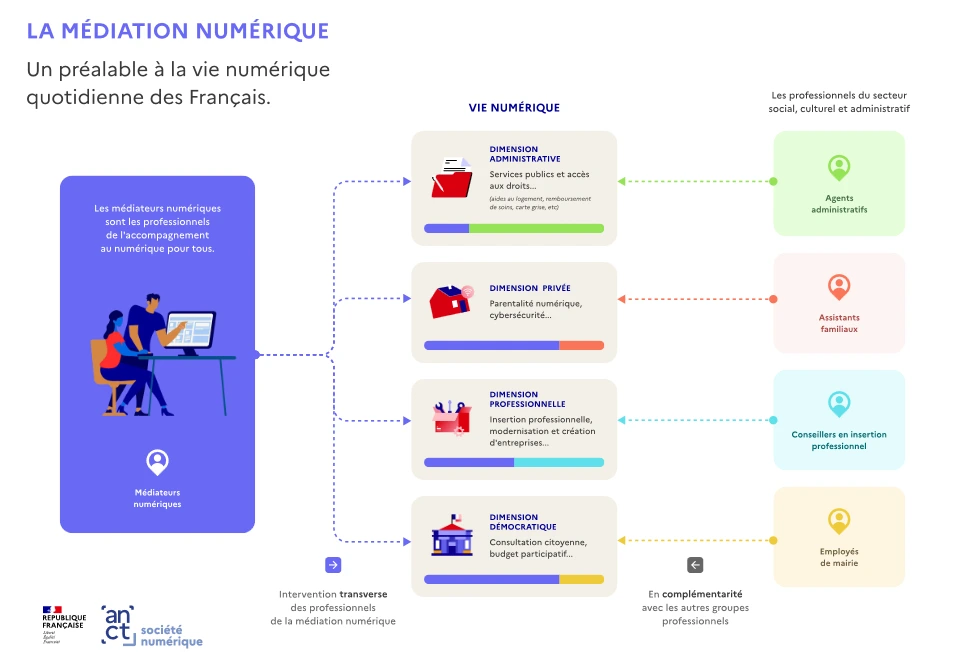
Chapter 1 clarifies the roots in popular education, distinguishes mediation as an activity and as a profession, typology of actors (core professionals, other professionals, volunteers) and clarifies the core mission: support, digital culture, empowerment.
National mapping of digital mediation locations and analysis of proximity (p.28‑35)
Based on the ANCT mapping and the digital barometer, the report lists 13,203 digital mediation locations in 2024, shows that 80% of the metropolitan population has a location in their municipality or within 7 minutes, but only 51% of non-internet users have local access, with under-resourced regions like Brittany.
Professionalism challenges and the articulation of digital/social/administrative mediation (p.36‑53)
Chapter 2 details how the dematerialisation of processes redistributes roles: digital mediators pushed to 'do it for' in administrative tasks, social workers caught between social and digital mediation, France Services agents seeing their counter work revalued, raising the question of clarifying mandates and organised complementarity.
3. Action points for local actors
Map and analyse digital mediation locations at the local level (p.28‑35)
Rely on the national ANCT mapping and access time data (7-minute threshold) to identify municipalities without mediation locations, under-resourced rural areas, and build a shared diagnosis with local authorities, CCAS, associations, and medico-social structures.
Clarify the roles between digital mediators, social workers, and reception agents (p.36‑53)
Organise, at the territorial level, inter-professional working times to define who does what in online administrative support, establish shared rules on 'doing with' versus 'doing for', and build explicit referral pathways between mediation locations, social services, and France Services.
Develop empowering environments for digital mediators (p.54‑59)
Use the identified levers (work content, organisation, training resources, communities of practice) to design multidisciplinary training plans, reflective times on practices, and cooperative spaces (peer reviews, professional groups, territorial networks).
Integrate digital mediation into local inclusion and access to rights strategies (p.5‑9, 36‑53)
Incorporate digital mediation locations and actors into territorial roadmaps for digital and social inclusion (CNR, France Numérique Ensemble), connecting them to issues of non-use, prevention of disengagement, and health, social, and medico-social services.
Adapt services to the most distant audiences (non-internet users, unemployed, low-educated groups) (p.17‑21, 48‑51)
Design mediation formats that do not rely solely on individuals' initiative (outreach, mobile mediation, partnerships with local structures), taking into account the real strategies in case of difficulty (relying on family, abandonment, non-use) described in the surveys.
4. Additional references
🔍➕ For more information, see the articles referenced by "Pratiques en Santé" on digital technology and AI ➡️🔗https://pratiquesensante.odoo.com/2-6-intelligence-artificielle-numerique
5. Cross-sectional analysis — values of Pratiques en Santé
Literacy: the report does not propose tools directly for the general public, but provides frameworks for thinking about mediation devices adapted to various levels of understanding, particularly through the notion of appropriation and usage trajectories (p.26‑27, 48‑51).
Empowerment: the focus is clearly on the empowerment of audiences, with an emphasis on "doing with" and the emancipatory digital culture inherited from popular education, even if social urgency sometimes leads to "doing for" (p.23‑27, 36‑39, 53).
Participation: the document mainly discusses the participation of professionals (communities of practice, enabling environments) rather than that of the public, but stresses the co-construction of territorial strategies with digital mediators (p.54‑59, 61).
Community health: the collective dimension is present through references to territories, networks of actors, and spaces of popular education, but the angle is more digital and social than strictly health-related (p.22‑25, 28‑35).
Ethics: the authors highlight the ethical issues related to online administrative support (privacy, consent, responsibilities) and the tensions when mediators step outside their explicit mandate (p.36‑39, 47‑53).
Human rights: the report addresses digital inclusion as a condition for access to social rights, emphasises the discriminatory effects of dematerialisation, and the necessity to limit non-recourse, without explicitly referring to human rights vocabulary (p.9‑10, 36‑39).
Intersectorality: the study documents the necessity of cooperation between digital mediation, social work, administrative mediation, public service operators, and local authorities, and refers to the France Numérique Ensemble roadmap (p.36‑53, 61‑62).
Partnership: implicit models of collaboration are described around mediation sites, France Services, and networks of mediators, with the idea of territorial networking as a condition for 'enabling environments' (p.54‑61).
Combating discrimination: the text draws attention to socio-digital inequalities (age, education, territory, unemployment) and the risks of non-recourse, but does not specifically address discrimination related to gender, origin, sexual orientation, or disability (p.11‑18, 36‑39).
6. Evaluation of the reliability of the resource
Scientific relevance
The report is based on a review of international and French literature (Bourdieu, Sen, Van Dijk, Ragnedda, works on digital capital and capabilities) and on robust quantitative data (Digital Barometer 2022‑2023, ANCT mapping of mediation sites). The methodology is explicit: exploitation of representative surveys, cross-referencing with geographical data (METRIC‑OSRM distance calculator), statistical analyses (logistic regressions mentioned) and detailed bibliography (p.63‑…). The data is recent (up to the end of 2023 for the barometer and November 2024 for the mapping), making the analysis current for 2025‑2026.
Operational relevance
Even though this is a research report, the results are strongly action-oriented: typology of actors, detailed description of "professionalism trials", data on territorial coverage, analyses of the actual strategies of disadvantaged audiences (relying on family and friends, dropping out, etc.). The proposals on enabling environments, the structuring of the sector, and the complementarity between digital, social, and administrative mediation are directly applicable for the programming of local initiatives, internal training, and the negotiation of partnerships with local authorities and the State within the framework of France Numérique Ensemble 2023-2027.
7. MCQ — 5 questions
Part 1 — MCQ without answers
Question 1 (p.13-18)
In 2023, what percentage of the population aged 18 and over in mainland France is considered to be digitally excluded according to the halo defined in the digital barometer?
a) 18%
b) 24%
c) 31%
d) 45%
Question 2 (p.22-27)
Digital mediation, as defined in the report, is primarily characterised by:
a) The provision of low-cost computer equipment
b) Support towards autonomy and the dissemination of a digital culture
c) The technical management of network infrastructures
d) The creation of mobile applications for public services
Question 3 (p.28-35)
According to the ANCT mapping cited in the report, how many digital mediation locations were recorded in November 2024?
a) 4,000 locations
b) 9,500 locations
c) 13,203 locations
d) 20,000 places
Question 4 (p.36‑53)
What is the main consequence of the dematerialisation of administrative procedures on digital mediators that is highlighted?
a) A significant decrease in the demand for support
b) A strict specialisation in leisure uses of the Internet
c) A "professionalism test" related to requests for online administrative assistance
d) A complete transfer of their missions to France Services agents
Question 5 (p.54‑61)
In the chapter on enabling environments, which lever is not mentioned as promoting the professional development of digital mediators?
a) The content of work (variety of activities, time for reflection)
b) The mode of work organisation (cooperation, room for manoeuvre)
c) Human resources management and training
d) The obligation to carry out all administrative procedures on behalf of users
Part 2 — Commented correction
Question 1 (p.13-18)
✅ Correct answer: c) 31%
📝 Explanation: The report updates the "halo" of digital exclusion and indicates that in 2023, 31% of people aged 18 and over are digitally excluded, including 9% non-internet users and 22% internet users feeling poorly skilled. Source: p.13‑14.
Question 2 (p.22-27)
✅ Correct answer: b) Support towards autonomy and the dissemination of a digital culture
📝 Explanation: The definition of digital mediation emphasises the support of diverse audiences towards autonomy in their usage, the dissemination of a digital culture, and an emancipatory aim stemming from popular education, well beyond mere technical assistance. Source: p.22‑24.
Question 3 (p.28-35)
✅ Correct answer: c) 13,203 locations
📝 Explanation: The Digital Society Programme, based on its collaborative mapping, identifies 13,203 locations of professional digital mediation as of November 2024, with a regional analysis and geographical proximity (7-minute threshold). Source: p.28‑33.
Question 4 (p.36‑53)
✅ Correct answer: c) A "professionalism test" related to requests for online administrative assistance
📝 Explanation: Chapter 2 shows that dematerialisation leads to urgent requests for administrative support for digital mediators, for which they are not always trained or mandated, creating a tension between their mission of digital emancipation and the "doing for" users. Source: p.36‑39, 47‑53.
Question 5 (p.54‑61)
✅ Correct answer: d) The obligation to carry out all administrative procedures on behalf of users
📝 Explanation: Enabling environments are described as combining work content, organisation, and training policies to support the development of professionals' skills; the obligation to "do for" users is instead identified as a problematic drift, contrary to the aim of empowerment. Source: p.54‑59, 61.
8. Frequently Asked Questions (FAQ)
Who is this report on digital mediation aimed at?
It is primarily aimed at public decision-makers, those responsible for digital mediation structures, social workers, researchers in the humanities and social sciences, as well as stakeholders involved in digital inclusion policies and access to rights. References: p.3‑5, 9‑10.
How does the report define digital exclusion today?
Exclusion is defined as a multidimensional social phenomenon that combines non-access, low feelings of competence, limited usage, and difficulties in converting digital opportunities into concrete benefits, linked to socio-digital inequalities and capabilities. References: p.11‑18.
What are the main profiles of professionals involved in digital mediation?
The report distinguishes three profiles: digital mediators for whom mediation is the core business, professionals from other sectors (libraries, animation, education, social work) who occasionally carry out digital mediation, and volunteers from associations or computer clubs. References: p.22‑27.
What is the state of territorial coverage in digital mediation venues?
As of November 2024, 13,203 digital mediation venues are recorded, mostly in mainland France, with 80% of the population having a venue in their municipality or within 7 minutes, but significant disparities exist according to regions and the profile of residents (notably non-internet users). References: p.28‑35.
How does the dematerialisation of administrative procedures impact professionals?
It strengthens requests for online administrative assistance, blurs the boundaries between digital mediation, social work, and administrative mediation, and generates professional tensions related to the absence of a clear mandate, specific training, and appropriate resources among some actors. References: p.36-53.
What does the concept of a "enabling environment" mean for digital mediators?
It is a framework that describes how the organisation of work, the content of activities, and training provisions can promote or hinder professional development, agency, and the autonomy of digital mediators in their missions. References: p.54-59.
What recommendations are proposed in conclusion to strengthen digital mediation?
The report recommends identifying the specific needs of mediators in each area, enhancing their initial and ongoing multidisciplinary training, clarifying the roles between digital, social, and administrative mediation, and networking local actors within the framework of France Numérique Ensemble. References: p.61-63.
9. Rewriting in Easy-to-Read Language
Easy-to-Read Title
The French digital society: digital mediators and people far from digital technology
Easy-to-Read Summary
Digital technology is present everywhere in daily life in France.
Many people still struggle with the internet and digital tools.
The report states that 3 out of 10 people are still far from digital technology.
It is not just a problem of equipment or connection.
It is related to age, education level, money, and place of residence.
The dematerialisation of procedures makes public services more difficult for some.
Some people sometimes give up their rights because everything is done online.
Digital mediators help people use digital tools.
They often work with social workers and reception staff.
The report explains how to better organise and train these mediators.
Key points FALC
Being far from digital technology
Many people never connect or feel they lack skills.
They may be afraid of the internet or not see its benefits.
They are more likely to not complete their procedures online.
What is digital mediation?
Digital mediation helps people use digital tools.
The aim is for the person to become more autonomous with their tools.
The digital mediator explains, shows, and does with the person.
Where are the mediation locations?
There are more than 13,000 digital mediation locations in France.
Most residents have a location close to their home.
But the most disadvantaged people are not always well covered.
Changing professions
Digital mediators often need to help with online procedures.
Social workers and reception staff are also involved.
The roles of each are not always clear to professionals.
Better training and organising of digital mediators
Mediators need training throughout their professional lives.
They need time to reflect on their practices with colleagues.
Structures must support them in developing their skills.