
🔦 🔍💡 Evaluation of establishments: the well-being of students (psychological, relational, physical), the school climate, and territorial equity finally enter the heart of management. 🏫 A logic of collective self-evaluation from which social and prevention can draw inspiration.
📌📍 This report provides an understanding, from the inside, of how a public policy of systemic evaluation is established over five years and shifts from a control logic to a participatory approach based on data. For a prevention or social actor, the interest is twofold: a transferable model of collective self-evaluation (12 entry points, 360° questionnaires, feedback loop) and a direct reading of the health determinants addressed at school — well-being, school climate, bullying, social and territorial equity.
📜🔗LINK to the source
1. ANALYTICAL SUMMARY
An evaluation policy that moves from experimentation to cruising mode.
Six years after its creation, the CEE assesses the results of a first five-year cycle (2020-2025) at the end of which almost all secondary schools and more than 70% of primary schools have been evaluated. France, long one of the last OECD countries without a systemic evaluation of its schools, has chosen to evaluate institutions — and not to control individuals. The report documents the entry into a second wave (2025-2030), focused on the "post-evaluation": transformation, training in leadership for local managers, and restructuring of school projects into "collective success plans". The target audiences are all educational stakeholders (headteachers, school directors, teachers, academic referents, families, students).
A now structured methodological toolkit
The document presents the instrumental innovations of simplification: a framework of 12 entry points linked to the four areas of evaluation, a national EOS platform for submitting and utilising reports (with an AI module by the start of the 2026 school year), four 360° evaluation questionnaires (students, parents, teachers, non-teaching staff) and an updated regulatory framework. It also reports on the work of two technical committees — teacher training and educational equity — which produce directly usable resources: fifteen self-assessment technical sheets, literature reviews, field surveys on social diversity.
2. KEY POINTS OF THE DOCUMENT
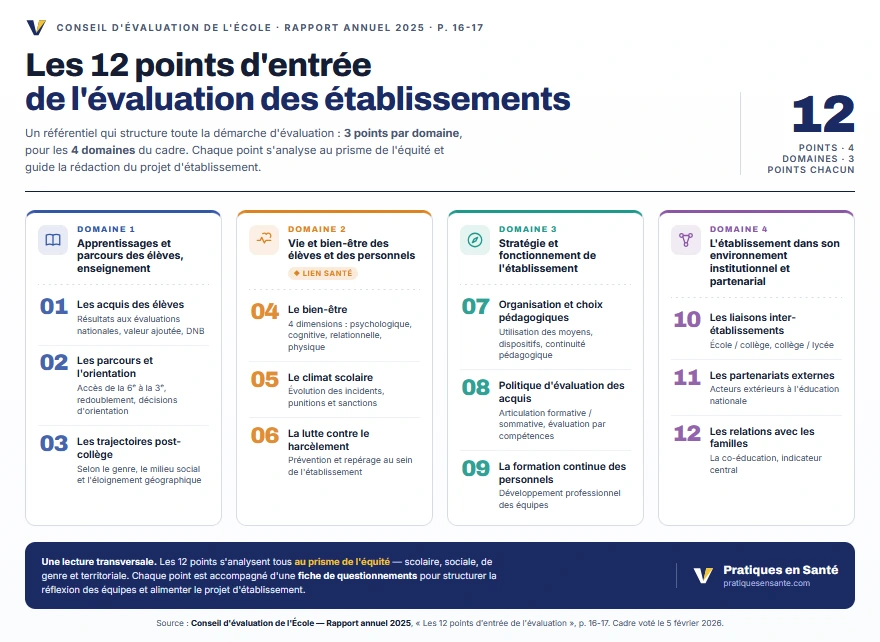
- The 12 entry points of the evaluation (p. 16-17) now structure the entire approach: 3 points for each of the 4 areas. The second area explicitly integrates the well-being according to four dimensions — psychological, cognitive, relational and physical —, the school climate and the fight against bullying, recognised as “major determinants of educational success”. It is the most direct point of contact with health.
- The EOS platform (p. 17-18) centralises the submission, tracking and exploitation of reports over a history of three cycles (15 years), with an artificial intelligence module planned for the start of the 2026 school year. Dematerialisation aims to preserve institutional memory beyond team changes — a challenge transferable to any longitudinal tracking system.
- The self-assessment toolkit for constellations (p. 9-10): fifteen technical sheets (June 2024) organised into three sections — Action, Examples, Deepening — tested in six districts in the North (2024-2025). The founding principle: evaluation as a training object in its own right, not as an external judgement.
- The observation on social segregation (p. 10-12): literature reviews and hearings show beneficial effects of diversity on the school climate and cohesion, but a widening gap between public and private colleges (20 points difference for very advantaged families at the start of the 2022 school year compared to 11 points in 1989). The field survey notes a “de facto diversity” rarely accompanied by an explicit pedagogical strategy.
- Key figures 2025 (p. 50-51): 10,000 schools and 2,200 institutions evaluated, 8,000 evaluators in primary education and 6,000 in secondary education, more than 900,000 students surveyed during the evaluation of their institution, 70 academic referents, 7 international cooperations.
3. ACTION PATHS FOR LOCAL ACTORS
- Transposing the logic of the 12 entry points (p. 16-17) to a shared diagnosis in social or medico-social structure: avoid dispersion by choosing a main entry point per domain, rather than a "catalogue of actions" (identified pitfall p. 37).
- Draw inspiration from the architecture of 360° questionnaires (p. 18) to objectify dimensions that are difficult to measure — sense of belonging, quality of relationships, perception of the environment — beyond the only immediately available administrative data (see the interview p. 20).
- Mobilise the triptych well-being / climate / harassment (p. 16) as an entry grid for any prevention action in the school environment: the institutional recognition of the four dimensions of well-being offers a common language with the National Education.
- Use the three components of the toolbox (Action sheets, Examples, Deepening — p. 10) as a resource design model: couple the operational, the illustration by transfer from other contexts, and the theoretical/ethical anchoring.
- Leverage the expanded accessibility of reports (p. 19): the footnote specifies that accessibility includes understanding — summary, synthesis, or even translation by sovereign AI tools from September 2026. A concrete lever for literacy and the inclusion of non-native families.
- Anticipate the indicators "physical health and sport" (p. 49) and the "Alumni" project for tracking former students: this 2026 work opens points of articulation between tracking school cohorts and long-term health determinants (to be monitored for potential intersectoral partnerships).
Identified unmet need : the report itself acknowledges (editorial, p. 2; interview Auverlot p. 25) that the measurement of real effects on student outcomes and achievements remains underdeveloped — "what happens after the report is submitted?" The connection between health/social/educational remains entirely to be built on the ground.
4. ADDITIONAL REFERENCES
- Public Health France — Psychosocial skills: an operational framework for expert professionals and CPS trainers. Volume 1 (March 2025, 231 p.). Direct methodological complement: the CPS are included in the 2028 CEE programme ("skills of the 21st century") and underpin a protective school climate. 👉 https://www.santepubliquefrance.fr/competences-psychosociales/le-programme-daction-de-sante-publique-france-sur-les-competences-psychosociales
- Public Health France — Mental health and well-being of middle and high school students in France (results of the EnCLASS 2024 survey, published on 2 June 2026). Provides the epidemiological data that the CEE report does not supply on student well-being. 👉 https://www.santepubliquefrance.fr/presse/sante-mentale-des-enfants-et-des-adolescents-sante-publique-france-publie-de-nouveaux
- CESE — Mental health and well-being of children and young people: a societal issue (opinion, October 2025, NOR: CESL1100018X). Frames school well-being in an intersectoral and advocacy perspective, a political complement to the technical view of the CEE. 👉 https://www.lecese.fr/sites/default/files/pdf/Avis/2025/2025_18_sante_mentale.pdf
5. FREQUENTLY ASKED QUESTIONS (FAQ)
- Does the CEE evaluate teachers individually?
No. The approach evaluates the institution as a whole, not individuals. This is a foundational distinction that alleviated union concerns at the launch (interview Gille, p. 23). - What are the "12 entry points"?
A framework of 3 points per domain (4 domains), covering students' achievements and pathways, well-being and climate, the institution's strategy, and partnership environment (p. 16-17). - Is the EOS platform operational?
Not fully yet. Its finalisation is scheduled for 2025, but complete operationality is expected for the start of 2026, with a few months of assumed delay (p. 2-3, p. 17-18). - How are well-being and bullying addressed in the evaluation?
Well-being is broken down into four dimensions (psychological, cognitive, relational, physical); the school climate is measured via incidents/punishments/sanctions; the fight against bullying constitutes a dedicated entry point (p. 16). - Who has access to the evaluation reports?
Rectors, local authorities of attachment, IEN and town hall for primary education, and the entire educational community of the institution (with a reminder of confidentiality), p. 19. - What tool is used for the self-evaluation of teacher training?
The self-evaluation toolkit for constellations: fifteen sheets in three sections (Action, Examples, Deepening), tested in the North (p. 9-10). - What changes in the second wave (2025-2030)?
The focus shifts from the evaluation itself to the 'after': collective success plans, leadership training, learning institution, and generalisation of 'nuggets' of post-evaluation transformation (p. 28-30).
6. REWRITING IN EASY TO READ LANGUAGE
What the School Evaluation Council does
The School Evaluation Council is called the CEE.
The CEE looks at how schools and colleges work.
He does not judge teachers one by one.
He looks at the whole establishment together.
Five years of work
The CEE started its work in 2020.
In five years, almost all colleges and high schools have been evaluated.
Many schools have been evaluated as well.
Now, a second period begins.
The important points
The CEE uses 12 points to evaluate.
These points talk about students' results.
They also talk about students' well-being.
Well-being is feeling good in your body and mind.
The CEE also looks at bullying in schools.
A computer tool
The CEE has created a platform on the computer.
It is called EOS.
EOS keeps all reports in one place.
That way, we do not lose the memory of the work done.
Asking questions to everyone
The CEE asks questions to students.
It also asks questions to parents and teachers.
These questions help to better understand life at school.
7. CROSS-ANALYSIS — VALUES OF HEALTH PRACTICES
- Literacy : the report provides that the accessibility of reports includes summaries, syntheses and AI translations (p. 19), and a FALC version is not provided but the spirit of accessibility is present.
- Empowerment : students and parents are solicited via 360° questionnaires (p. 18), but mainly as data sources, little as co-designers of the system.
- Participation : co-construction is affirmed (collective self-assessment, availability of reports to the educational community, p. 19), but local elected officials demand more space in self-assessment (interview Auverlot, p. 25).
- Community health : the collective dimension is central — evaluation is conceived as a unifying moment of the "educational community" (p. 30).
- Ethics : a deontological framework for the use of EOS and a charter are announced (p. 3, p. 46); cultural/social biases are not explicitly problematised.
- Human rights : equity (educational, social, gender, territorial) is a transversal prism of the 12 entry points (p. 16), linked to article L. 111-1 of the Education Code.
- Intersectorality : partnerships with health (HAS cited as a model, p. 30), higher education (HCERES), international (Portugal, Wallonia-Brussels, Morocco) are documented (p. 40-41).
- Partnership : formalised models exist — cooperation agreement signed in Rabat (Oct. 2024), EUNEC network, advisory and territorial committees (p. 35, 40-41).
- Fight against discrimination : social segregation between institutions is addressed head-on (p. 10-12); non-judgment is mentioned as a condition for sincere self-assessment (interview Charbonnier, p. 32).
8. EVALUATION OF THE RELIABILITY OF THE RESOURCE
Scientific relevance : solid. The technical committees are chaired and composed of recognised academics (Ria, Mathiot, Ben Ayed, Monso, Van Zanten, Demeuse). The instruments are anchored in an international reference corpus (PISA, TALIS, TIMSS, PIRLS) and in dated literature reviews (Nov. 2023). The honesty is real on a sensitive point: the report itself acknowledges that it does not measure the effects on student outcomes.
Operational relevance for the health/social field : indirect. It is a governance document for the educational sector; the tools directly mobilisable by a prevention or social actor are limited. The value lies in the transferable evaluation logic and in the entry points of "well-being" and "equity".
⚠️ Caveats and internal inconsistencies to report :
- Divergent evaluator figures : the editorial mentions "more than 13,000 external evaluators" (p. 2), the key figures total 8,000 + 6,000 = 14,000 (p. 50), and the 2026 programme refers to "more than 10,000 staff" who have conducted at least one evaluation (p. 49). Three different orders of magnitude — imprecision to be relativised.
- Footnote error : some annex pages display "ANNUAL REPORT 2024" (p. 44-45) instead of 2025.
- Temporal discrepancy : titled "2025" but informed by 2026 events (appointments, plenary sessions of May 2026). Consistent for a report written in 2026, but to keep in mind.
- Pro domo posture : somewhat self-evaluative, generally positive tone; few critical or dissenting voices (unions, dissenting researchers). The indicator "75,000 LinkedIn impressions" (p. 51) pertains to communication, not evaluation.
9. STRATEGIC HASHTAGS
#healthpractices #SchoolAssessment #WellBeingAtSchool #SchoolClimate #TerritorialEquity #PsychosocialSkills #HealthPromotion #DeterminantsOfHealth