🚨 Integration evenings: more than 1 in 3 students witness violence — the tools to act
🔍💡 Hazing & Sexual and Gender-Based Violence at the start of term: ready-to-use animation ideas to share before the integration evenings. 🎯 A clear legal framework and a language that speaks to students, to prevent without moralising.
📌 This booklet provides, ready to use, two short videos, customisable posters, and animation ideas to open the discussion on hazing and Sexual and Gender-Based Violence at the most at-risk time: the start of term and integration evenings. It legally frames hazing — an offence — and documents its reality through a recent national survey. The approach is non-moralising, with a touch of humour, to speak to students without making them feel guilty. Specifically, it can be used as is to facilitate a prevention session, equip a student association, or display a referral to support services.
Source :📒 Accompanying booklet — Awareness resources: Hazing and Sexual and Gender-Based Violence
✍️ CPED (Permanent Conference of Equality-Diversity Mission Officers), with MAKE CHANGE PRODUCTION and FAGE; partial funding MESRE.📜🔗LIEN vers la source
1️⃣ Analytical summary
A blind spot in prevention at the start of term
The booklet starts from an observation of the field: the lack of resources on hazing and the persistence of cases, related or not to sexual and gender-based violence (SGBV), in establishments (p. 1-2). Under the guise of "tradition", the integration rites rely on group pressure and the will to be integrated; they expose newcomers to humiliating, degrading acts or excessive alcohol consumption — legally a crime (art. 225-16-1 to 225-16-3 of the Penal Code, p. 2). Target audiences: students (especially first-year), student associations and higher education institutions. Identified issues: trivialisation, low reporting and lack of knowledge of support systems (p. 3).
A ready-to-use kit for facilitating and disseminating
The document provides directly usable materials: two awareness-raising videos (one on hazing, the other on SGBV at parties), their short 9/16 versions for social media, two posters with customisable QR codes, Instagram variations and discussion prompts post-viewing (p. 4-8). It directs towards reporting systems and offers a documented bibliography (documentaries, videos, podcasts, scientific articles 1992-2026) (p. 9-10). The approach is clear: non-moralising, to question practices rather than to blame (p. 4).
2️⃣ Key points of the document
1️⃣ Explicit legal framework. Hazing is a crime (art. 225-16-1 to 225-16-3 of the Penal Code) engaging the criminal and disciplinary responsibility of both individuals and legal entities (p. 2).
2️⃣ A recent documentary base. The booklet is based on the survey "Behind Student Rites " (Observatory of VSS in Higher Education, 2024, 131 p.), presented as the first national quantification of hazing practices and their effects (p. 2, p. 9). — Self-reported survey, to be treated as such.
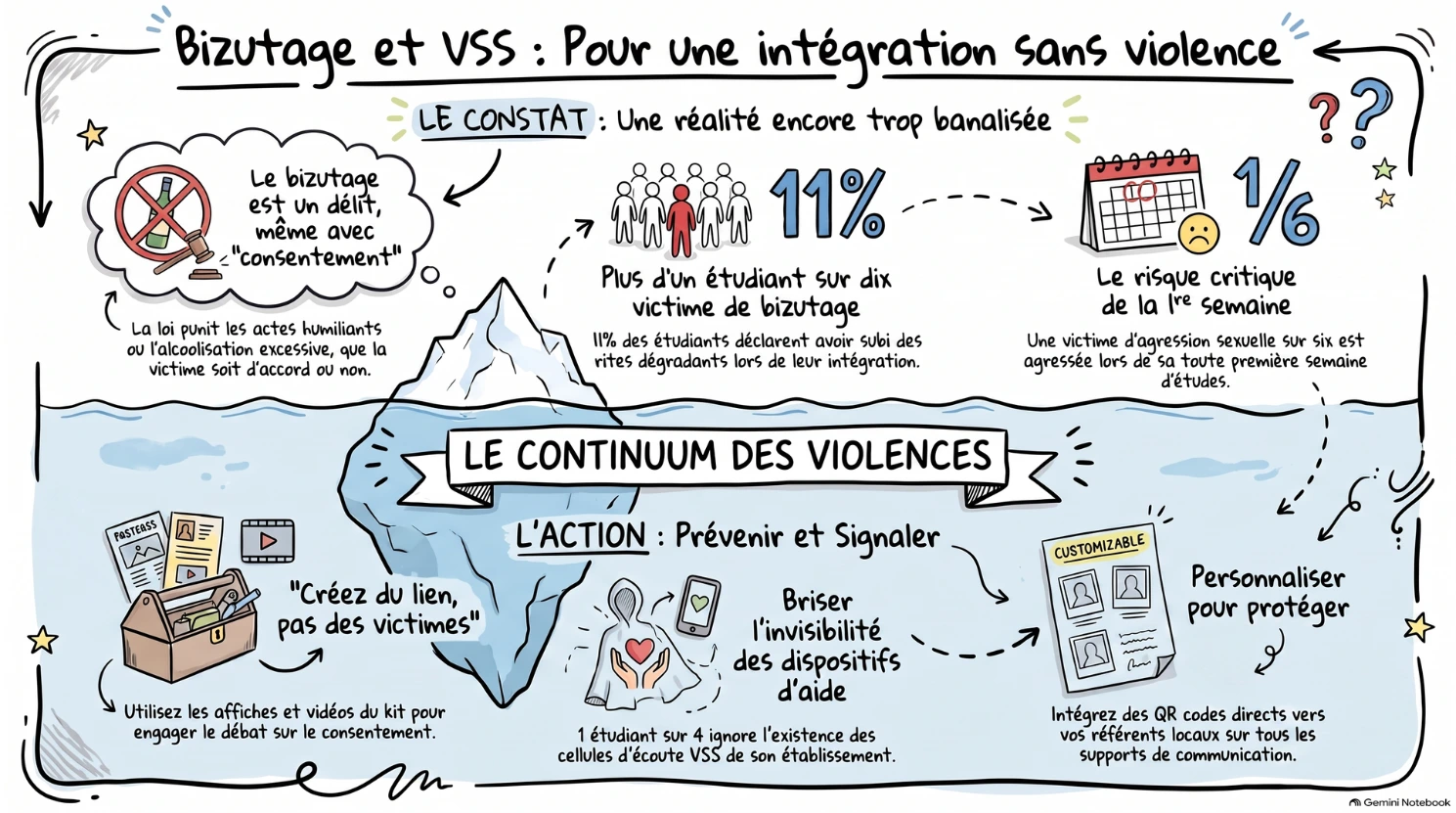
3️⃣ Key figures (from this survey). More than 1 student out of 10 (11 %) reports having experienced hazing (13.8 % in schools and institutes); more than 1 respondent out of 3 has been a victim or witness of at least one VSS during integrations (> 60 % among women and non-binary individuals); 1 victim of sexual assault out of 6 was assaulted in the first week of their first year (p. 3).
4️⃣ Two complementary videos ready to be distributed. One, socio-historical, on hazing (3 min 08); the other on VSS at parties and the culture of consent (3 min 42) — each accompanied by discussion points (p. 4-6).
5️⃣ A complete communication kit. Short excerpts 9/16 (1 min 09; 1 min 51), PDF/PSD posters with customizable QR codes linking to the national mapping of VSS cells (MESRE site) or the internal system, and Instagram feed/story variations (p. 7-8).
3️⃣ Action points for local stakeholders
1️⃣ Distribute the video "hazing" (3 min 08) in the pre-term amphitheatre or before an integration weekend, then facilitate a debate with the six proposed questions (p. 5).
2️⃣ Use the 2nd video (VSS, 3 min 42) to introduce the culture of consent and the continuum of violence (iceberg image), referring to the MESRE guide for festive events (p. 6).
3️⃣ Display the two versions of the poster "Create connections, not victims" on the campuses, in libraries and cafeterias, by customising the QR code to your reporting device (p. 7-8).
4️⃣ Schedule the 9/16 clips on your networks separately, a few days apart, for better impact (p. 7).
5️⃣ Make your VSS referents and your listening unit visible, in response to the finding that nearly 1 in 4 students are unaware of their existence (p. 3, p. 6).
6️⃣ Equip the student associations (supportive events, risk reduction, alcohol as an aggravating factor) using the bibliography and referenced practical sheets (p. 4, p. 9).
Unmet needs / adaptations: the booklet is a sensitisation tool, not a report handling protocol. It must be linked to an establishment procedure (welcoming speech, orientation, sanction) and to a framework of emotional safety in facilitation (see section H). It does not provide an impact assessment tool for the actions taken.
4️⃣ Additional references
Three additional references,
MESR — Guide to festive and student integration events (2024 edition). Tools, legal framework and advice for organising safe events (alcohol, hazing, VSS, discrimination). Directly referenced by the booklet. enseignementsup-recherche.gouv.fr — 2024 edition
Observatory of VSS in higher education — White paper for the start of the academic year (2025). Management of VSS cases, discrimination and hazing in associations and external resources. observatoire-vss.com (PDF)
Practices on Health (internal) —The health of students - https://www.pratiquesensante.com/blog/tag/etudiants-60
5️⃣ Frequently Asked Questions (FAQ)
1️⃣ What is hazing in the sense of the law?
An offence (art. 225-16-1 to 225-16-3 of the Penal Code): to lead others, against their will or not, to undergo/commit humiliating or d degrading acts, or to consume alcohol excessively, during events related to school, sports and socio-educational environments. Criminal and disciplinary responsibility, individuals and legal entities (p. 2).
2️⃣ Does the consent of the student make hazing legal?
No : the law targets acts "against their will or not". Group pressure and the desire for integration weigh on this "consent" — a central question for discussion points (p. 2, p. 5).
3️⃣ What is the link between hazing and sexual violence?
Sexual violence is common during integrations and is an integral part of certain practices (forced kisses, exhibition…). According to the 2024 survey, more than 1 in 3 respondents has been a victim or witness of at least one instance of sexual violence (p. 3). — Self-reported data.
4️⃣ What are the consequences for victims?
Social (rejection from the group, withdrawal, decline in results), physical and sexual (injuries, assault, rape) and psychological (depression, eating disorders, suicidal thoughts) (p. 3).
5️⃣ How to use the videos?
In the pre-term lecture, before integration weekends, on the screens of the establishment, in training or during themed weeks. They are complementary but can be viewed separately, and followed by discussion points (p. 4-6).
6️⃣ Where to direct a student who is a victim or witness?
Towards the reporting system and the VSS referents of the institution, as well as the national mapping of VSS cells (QR code of the posters, MESRE site). Reminder: nearly 1 student out of 4 is unaware of the existence of these systems (p. 3, p. 6-8).
7️⃣ What is the role of alcohol?
Without being the cause of VSS, it is an aggravating factor: decreased vigilance, complicated collection of free and informed consent, increase in acts (p. 4).
6️⃣ Rewriting in Easy to Read and Understand (FALC)
What is this booklet?
The CPED created this booklet in August 2026.
It helps to talk about hazing and sexual violence.
It provides videos, posters, and questions to discuss.
What is hazing?
Hazing is forcing a person to do humiliating things.
This often happens during integration parties.
Hazing is prohibited by law. It is a crime.
The law can punish individuals and groups.
“ VSS” means sexist and sexual violence.
What the survey says (2024)
About 1 student out of 10 reports having experienced hazing.
Many students see or experience violence at parties.
Many do not know the support available at their school.
Note: these figures come from a survey. People responded freely.
What the booklet provides
Two short videos to show.
Posters to put on the walls.
A QR code to find help.
Questions to discuss after the videos.
How o help?
Show the videos before the integration parties.
Say where to find help in your school.
Remind that alcohol makes situations more dangerous.
7️⃣ Cross-sectional analysis — values of Health Practices
Literacy : Yes — short videos, non-moralising language, posters and QR codes for a young audience (p. 4, p. 7).
Empowerment : Partial — the videos invite students to design caring integrations; the final audiences are not described as co-evaluators of the materials (p. 4-6).
Participation : Field actors (associations, federations) were consulted (Feb.-Jul. 2026) and FAGE contributed to the videos; co-construction upstream, not formalised with the final audiences (p. 1).
Community health: Yes — collective logic (shared responsibility, culture of consent, safer events) rather than individual (p. 4, p. 6).
Ethics : Partial — the non-moralising language and the focus on consent address biases; cultural/social biases are not analysed as such (p. 4).
Human rights: Yes — inclusive approach (inclusive writing, mention of non-binary people, dignity of victims) (p. 3, p. 5).
Intersectorality : Yes — higher education institutions, associations, ministry (MESRE), audiovisual producer, observatory (p. 1).
Partnership : Formalised — CPED + MAKE CHANGE + FAGE + MESRE funding; contributions listed on the technical sheets (p. 1, p. 5-6).
Fight against discrimination: Yes — VSS and LGBTQIA+phobias mentioned, displayed non-judgment, aimed at “inclusive” integrations (p. 3, p. 5).
8️⃣ Evaluation of the reliability of the resource
Scientific relevance — average to good (for a awareness-raising support)
The legal framework is accurate (art. 225-16-1 to 225-16-3 of the Penal Code). The data comes from a single and recent source (Observatory, 2024, 131 p.), but it is a declarative survey on a self-selected sample (~4000 testimonies): the percentages describe the respondents, not the student population. The bibliography is rich and multidisciplinary (theses, articles 1992-2026). It is neither a primary research document nor an impact assessment.
Operational relevance — high
Ready-to-use supports, formats adapted to contexts (amphitheatre, networks, affiches), provided animation tracks and guidance towards the systems. Limitations: absence of a reporting treatment protocol and evaluation tool; requires a framework of emotional safety in animation.
9️⃣ Strategic hashtags
#Hazing #VSSPrevention #InformedConsent #StudentLife #StudentHealth #RiskReduction #EqualityDiversity #healthpractices
H. Points of vigilance in animation
Applicable — the booklet addresses sensitive themes (hazing, sexual violence, LGBTQIA+phobias).
Risks of emotional triggering
Among participants (students, volunteers, professionals), some may have experienced or witnessed hazing or sexual violence. Potentially triggering content present in the document : forced kisses, exhibitionism (“Limousin dance”), assault, rape, as well as mentions of eating disorders and suicidal thoughts (p. 3). The source report (Observatory, 2024) itself contains a warning (trigger warning).
Recommended precautions
Announce the topic and a warning at the beginning of the session; remind the possibility to leave or not participate in a session.
Work on mechanisms, not on experiences: do not solicit personal testimonies.
Prepare and display, before the session, up-to-date support resources: listening cell and sexual violence contacts at the institution, national mapping of sexual violence cells (QR code), and national hotlines (e.g. 3114, suicide prevention) — contact details to be verified and adapted locally.
Plan a time for decompression and a available interlocutor after the session.
Remain in a non-moralising register (consistent with the stance of the videos), without trivialising or dramatising.
This article was developed in accordance with the Charter
of the use of artificial intelligence of Health Practices.
Click on the image