
🔦 🔍💡 AI and social support: 3 "Small Companions" to reduce non-access, lighten the burden on teams and strengthen the agency of vulnerable individuals. #EthicalAI #HealthPractices🤝🧩 HR tension, complexity of rights, isolation: this note shows how to co-construct concrete, acceptable and secure AI uses with professionals and the individuals supported. #DigitalInclusion #SocialHealthcareAI
📌 📌 The note concretely clarifies how to use AI to relieve the burden on professionals while preserving the helping relationship, in a context of strong tension between growing needs and limited resources.
It is directly mobilisable by ESSMS management, health executives, programme coordinators, social workers and community mission officers to think about realistic and ethical AI pilots.It provides operational use cases (Lucie, Étienne, Hector) and a roadmap in 4 phases, usable as a basis for specifications and dialogue with technology partners.
📜🔗LINK to the source
1. Analytical summary
Context and issues: AI, vulnerabilities and structural tension
The note starts from the observation of a lasting tension between the rising social and medico-social needs and the scarcity of human and financial resources, generating cognitive overload, disruptions in pathways, and non-access to rights. AI is often mentioned as a solution, but remains a "blind spot": few publications concern social vulnerabilities, the majority of work focusing on risks (bias, surveillance, dehumanisation) rather than on positive experiments. Between May and December 2025, the Vulnerabilities and Society Circle conducted a three-phase approach: mapping 150 international use cases, 8 expert interviews, and then a collaborative workshop with 25 field actors (professionals, supported individuals, caregivers, decision-makers). This approach highlights a central paradox: the utility and technical feasibility of the solutions are high, but acceptability remains fragile, with trust becoming the main limiting factor. It leads to three major scenarios for AI in the sector (augmented profession, augmented autonomy, augmented inclusion) and to the hypothesis of targeted "Small Companions" AI rather than a generalist mega-platform.
Operational contributions: scenarios, "Small Companions" and roadmap
The document proposes three structuring scenarios, each detailed in problems, priority uses, expected functions, benefits, risks and safeguards: augmented profession (lightening the load and securing continuity), augmented autonomy (supporting expression and the power to act) and augmented inclusion (fighting against non-recourse and the complexity of rights). These scenarios are realised in three Small Companions: Lucie (relational memory for replacements), Étienne (situational assistant 24/7 to clarify needs), and Hector (territorial inclusive agent guiding processes and orientation). For each, the note specifies the targeted audiences, modes of operation, success indicators and main challenges (interoperability, accessibility, ethical governance, updating territorial databases). A roadmap in four phases (design, development of MVPs, field experimentation, deployment/industrialisation) translates these use cases into a trajectory of 12 to 24 months, with deliverables, points of attention and conditions for success. The text thus provides both principles of acceptability (trust, consent, right of refusal, systematic human validation) and very concrete benchmarks for launching AI pilots in the medico-social sector.
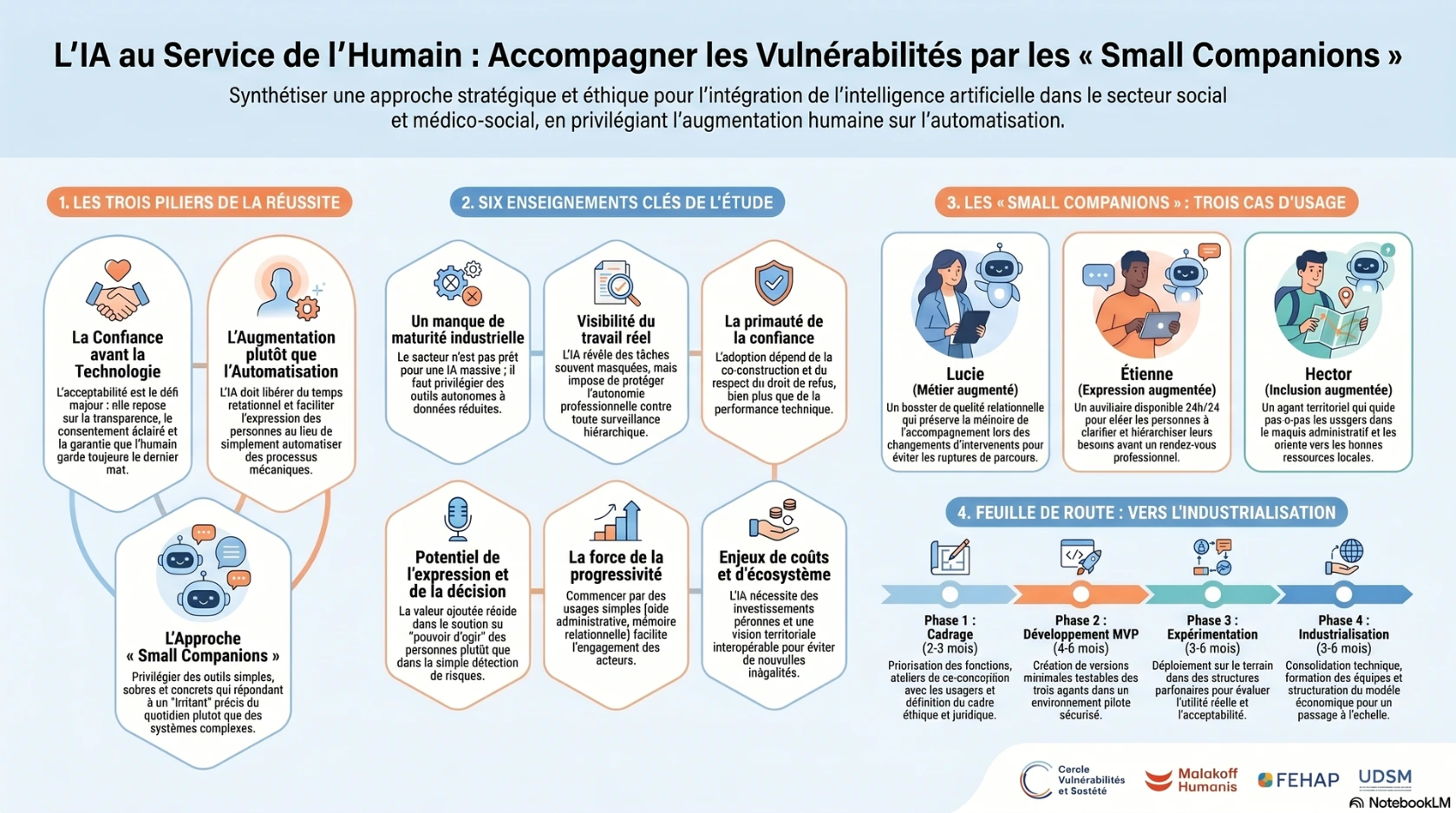
2. Key points of the document
An objective international assessment (p. 7–8)
The mapping of 150 AI use cases in 31 countries shows a strong concentration in North America and the United Kingdom, a predominance of organisational uses (recommendation, detection, coordination) and under-investment in vulnerable populations, mental health and rural areas. The analysis of scores highlights a marked gap between perceived utility (93% rated 4–5), technical feasibility (71%) and acceptability (60%), which justifies focusing the approach on trust and participation.
Six key lessons from the analysis and experts (p. 7–9)
Experts emphasise that the sector is not ready for large-scale industrial AI (low-quality data, low interoperability, limited data culture), that AI highlights 'real work' rather than replacing jobs, and that adoption primarily depends on trust. They also stress the potential of AI to support expression and decision-making rather than just detection, the need to start with simple uses that address immediate irritants, and the importance of cost and ecosystem logic.
Three usage scenarios: enhanced profession, autonomy, inclusion (p. 10–14)
The December 2025 workshop validates three scenarios: enhanced profession (preserving relational time and continuity despite turnover), enhanced autonomy (facilitating the expression of needs, understanding processes) and enhanced inclusion (making rights readable and accessible). For each scenario, the note details the issues, vision, priority uses, expected functions, anticipated benefits for individuals, professionals and institutions, as well as risks and safeguards.
The Small Companions: Lucie, Étienne, Hector (p. 15–20)
Faced with the limits of a mega-platform, the chosen option is to develop functionally restricted AI assistants, technically autonomous, ethically by design (mandatory human validation, no scoring, minimal data, sober use). Lucie secures relational memory for substitutes, Étienne structures the speech of individuals before an appointment in easy-to-read language, Hector translates procedures into guided pathways with a switch to local resources in case of blockage.
A realistic roadmap in four phases (p. 21–22)
The document proposes a schedule of 12 to 24 months with four phases: framing/design (2–3 months), MVP development (4–6 months), field experimentation (3–6 months), then industrialisation and deployment (3–6 months). The conditions for success emphasise co-construction with users and professionals, ethical requirements from the outset, gradual usage, ecosystem thinking (IT systems, professions, partners) and anticipation of operating costs.
3. Action points for local actors
Equipping replacements and the continuity of pathways (p. 12, 16–17)
An establishment or service can use Lucie as a model to design a synthetic "care map", updated by voice dictation or restructured notes, so that any substitute has essential information (objectives, points of vigilance, ways to establish contact) in less than two minutes. On a territorial scale, this type of tool can first be tested on a priority audience (psychic or mental disability) before an extension, with simple success indicators (continuity incidents, satisfaction of users and substitutes).
Strengthening the expression of needs before appointments (p. 13, 17–18)
Social structures (CCAS, social centres, food aid associations, social services) can draw inspiration from Étienne to propose an appointment preparation tool, accessible online or on a kiosk/tablet, allowing individuals to formulate their needs, priorities, and limits in just a few minutes. The tool should produce a short validated "waiting card" by the individual, usable as a support for the interview, which can first be tested in a MDS or a reception structure for people in precarious situations.
Combatting non‑access through a territorial orientation agent (p. 14, 19–20)
A community or a group of stakeholders can lead a project like Hector to transform the main "tricky" pathways (RSA, APA, MDPH, housing assistance, mobility assistance, etc.) into step-by-step guides with actionable outputs (pre-filled emails, checklists, call scripts). The challenge is to couple the conversational agent with a shared territorial reference framework, updated by a multi-stakeholder committee, and to systematically plan for a switch to human mediators in case of blockage or fragility.
Strongly anchor ethics and governance in each project (p. 10–11, 15, 21–22)
Every local AI project should integrate explicit rules from the outset: informed consent, transparency on operations, right to refuse without consequence, human validation of important decisions, and prohibition of managerial use of the tool to control professionals. A usage charter co-constructed with teams and representatives of the supported individuals, aligned with the GDPR and the future European AI Regulation, is a key deliverable of the framing phase.
Organise a progressive experimentation with simple indicators (p. 6, 18, 20–21)
Local actors can structure their pilots by following the proposed sequence: participatory framing, development of a frugal MVP, experimentation on a limited number of willing sites, and then gradual extension. Indicators such as appointment time, sense of agency, correct referral rate or non-use, and professional satisfaction should be defined from the outset to adjust the tools and objectify the effects.
4. Additional references
🔍➕ For more information, see the articles referenced by "Health Practices" on the theme of AI and digital ➡️🔗 https://pratiquesensante.odoo.com/2-6-intelligence-artificielle-numerique
European regulation on AI ("AI Act") – consolidated text and practical guide
Essential tool for legally framing AI projects in social and medico-social contexts (obligations for high-risk systems, transparency, data management).
URL : https://eur-lex.europa.eu/legal-content/FR/TXT/?uri=OJ:L_202401689
OECD – "Governing with Artificial Intelligence: The state of play and way forward in core government functions" (webinar and report, 2025)
Proposes operational principles for ethical, participatory, and public service-centred AI deployment, transposable to social and medico-social policies. https://oecd.ai/en/ai-publications/governing-with-ai
Institut Montaigne – "Investing in safe and trustworthy AI" (action note, 2024)
Provides concrete recommendations on the robustness, explainability, transparency, and ethical alignment of AI systems, useful for equipping the framing and governance phases.
All these resources are available online, dated after 2023, and their URLs are active to this day.
5. Frequently Asked Questions (FAQ)
What types of structures and professionals does the document address? (p. 2, 4–6, 10)
The note primarily targets actors in the social and medico-social sector: ESSMS, associations, federations, funds, local authorities, and institutional partners, as well as field professionals (educators, social workers, psychologists, managers) and decision-makers. The individuals supported and caregivers are also considered stakeholders in the co-construction of AI uses.
What are the main risks identified around AI for vulnerable populations? (p. 5, 7–9, 11, 14–15)
The cited risks include algorithmic biases, unequal access, loss of autonomy, dehumanisation, perceived surveillance, extensive data capture, opacity of algorithms, and managerial control uses. To address this, the document emphasises the right to refuse, human validation, transparency, and the absence of scoring or automated decisions.
How was the approach concretely carried out? (p. 4–6, 21, 23)
Between May and December 2025, a mapping of 150 use cases in 31 countries was carried out, complemented by 8 expert interviews and a collaborative workshop bringing together 25 participants (professionals, concerned individuals, caregivers, AI experts, decision-makers). The approach combines document analysis, sector expertise, and field co-construction, with generative AI used as a facilitation tool during the workshop.
What are the three non-negotiable conditions for acceptable AI projects? (p. 4, 8–11)
Firstly, place trust before technology: transparency, informed consent, right to refuse, human validation, clear governance. Secondly, aim for the enhancement of human capabilities (freeing up time for relationships, facilitating expression, making processes understandable) rather than pure automation. Thirdly, start with simple, targeted, co-constructed uses, in the form of Small Companions.
What exactly does the Small Companion "Lucie" consist of? (p. 15–17)
Lucie is an assistant for professionals who need to replace a colleague at short notice, providing them with a synthetic "care map" containing the situation, priorities, relational modalities, and sensitive points. It relies on lightweight NLP/LLM to restructure notes or voice dictations, imposes human validation, and aims to reduce breaks in continuity and fatigue for the individuals being supported.
How are individuals involved in scenarios of enhanced autonomy and inclusion? (p. 10–14, 17–20)
In the enhanced autonomy scenario, the person pilots the tool Étienne, validates the expectations map, chooses what to share, and retains the option to revert to a classic expression. In the enhanced inclusion scenario, Hector offers guided pathways and a switch to local actors, without ever substituting for human decision-making, respecting the individual's choice regarding the desired level of support.
What are the prerequisites for moving from a pilot to a larger-scale rollout? (p. 6, 20–22)
Scaling up assumes that the real utility in situation, the acceptability of the public, and the technical robustness have been validated, while working on interoperability with existing information systems, team training, and the economic model (licenses, hosting, maintenance). It also requires a stabilised multi-stakeholder governance around data management, updating of reference frameworks, and monitoring of effects.
6. Rewriting in Easy-to-Read Language (summary + key points)
Title of the document
Title: "AI and Support for Vulnerabilities".
The document talks about artificial intelligence.
It talks about people in situations of vulnerability.
Easy-to-Read Summary – Context
Today, many people need social and medico-social assistance.
There are not enough professionals and the processes are complicated.
Artificial intelligence can help, but it is also frightening.
The authors studied 150 AI projects around the world.
They spoke with experts and with affected individuals.
Their question is: how to use AI without damaging the human relationship.
Easy-to-Read Summary – Contributions
The document proposes three main ways to use AI.
First way: to help professionals better follow individuals.
Second way: to help individuals better express their needs.
Third way: to help understand rights and processes.
AI remains a tool, the decision must remain human.
It should always be possible to refuse AI without consequence.
Key points in Easy-to-Read Language
Point 1 – Trust is essential
People are afraid for their personal data.
They are afraid of being monitored and judged.
AI is only possible if everything is clear and explained.
Point 2 – AI must assist, not replace
AI must save time for professionals.
It must help to better understand situations.
It must not make decisions on behalf of humans.
Point 3 – Start with small tools
The authors propose "Small Companions".
These are small AI tools for a specific problem.
They are simple to use and controlled by humans.
Point 4 – Example: Lucie
Lucie helps a new professional who is replacing a colleague.
She summarises a person's situation on one page.
The professional can act quickly without making a mistake.
Point 5 – Example: Étienne
Étienne helps the person prepare for an appointment.
The person answers simple questions.
Étienne writes a clear sheet with their needs.
Point 6 – Example: Hector
Hector helps to take steps for rights.
He explains the steps one by one.
He also suggests help locations near you.
7. Cross-analysis – Values of Health Practices
Literacy : The document promotes simplification tools (FALC, translation, reformulation) and explicitly targets linguistic and cognitive barriers, which addresses varying levels of understanding.
Empowerment : Scenarios of enhanced autonomy and tools like Étienne aim to strengthen individuals' agency by helping them articulate their needs and make informed decisions.
Participation : The approach is based on a co-construction workshop with supported individuals, caregivers, and professionals, and recommends co-design for each use case.
Community health : Hector operates within a territorial logic, valuing local resources and aiming to reduce non-utilisation at the territorial level.
Ethics : The note explicitly states non-negotiable ethical principles (no scoring, human validation, minimal data, secure hosting) and discusses biases and risks of dehumanisation.
Human rights : The emphasis on access to rights, combating non-utilisation, respect for consent and the right to refuse reflects an approach aligned with equity and inclusion.
Intersectorality : The text stresses the need to work in an ecosystem (structures, professions, information systems, partners, public policies) for the implementation of AI.
Partnership : It describes a multi-actor governance involving think tanks, federations, mutuals, associations, institutions, and recommends local committees to oversee the frameworks and ethics.
Combating discrimination : The document mentions the risks of bias and the reproduction of inequalities, advocates for uses that reduce non‑take-up and improve the perceived legitimacy of rights.
8. Assessment of the reliability of the resource
Scientific relevance : The report is based on a foundation of 150 documented AI use cases according to a standardized framework, on aggregated figures (utility scores, feasibility, acceptability) and on international references (OECD, European Commission) consistent with the state of knowledge. It does not present a strictly experimental study, but a methodical and triangulated synthesis (mapping, interviews, workshop), clearly positioned as such.
Operational relevance : The document is very action-oriented: detailed scenarios, problem/vision/use/function/benefit/risk matrices, use cases described from the user's perspective, success indicators, a timeline roadmap with deliverables. For field actors or local decision-makers, it offers a solid foundation for building a specification and organising ethical and progressive AI experiments.
#healthpractices #ethicalAI #Prevention #DigitalInclusion #MedicoSocial #HealthLiteracy #NonTakeUp #Empowerment #essms