
🔦🔍💡 Governance of AI in public health: WHO sets a clear framework to distinguish the tool that enhances decision-making from the one that strips it of its humanity. ⚖️🩺 Useful for any organisation that must decide on the adoption of an AI tool in its evaluation or management practices. #ArtificialIntelligence #HealthPolicies
📌 This document sheds light on a blind spot: the way AI infiltrates the very fabric of public health decision-making, long before it reaches a medical office or care facility. It provides keys to understand why certain territorial diagnostics, funding priorities, or choices of prevention programmes may tomorrow rely on AI tools — and to demand transparency on these choices. The concrete use: having a vigilance framework (data bias, opacity, exclusion of local knowledge) to mobilise whenever an institutional partner mentions an AI tool in a local diagnosis, a call for projects, or an evaluation of a system. A solid starting point to question, in steering meetings, how the data concerning you is mobilised beyond direct care.
📜🔗LINK to the source
1. ANALYTICAL SUMMARY
Context and issues — an increasingly AI-assisted public decision-making The document starts from an observation: public health decision-making (evidence-informed policy-making, EIP) has historically relied on the synthesis of clinical trials, systematic reviews, and field knowledge, but this process remains slow and resource-intensive (p. 1-2). AI — machine learning, generative AI, large language models — promises to accelerate every step of this cycle: detection of epidemiological signals, scenario modelling, prioritisation of issues (p. 4-5). The target audiences are public decision-makers, regulators, health system leaders, and AI developers (p. 1), not directly field professionals — a point to keep in mind for content adaptation. The central issue: these speed gains come with structural risks — opacity of algorithms, concentration of power among a few commercial actors, impoverishment of human judgement, algorithmic discrimination (p. 6-7).
Operational contributions — a transferable governance framework The document mainly proposes a method: not to reinvent AI governance frameworks from scratch, but to articulate existing evidence-based decision-making tools (transparency, stakeholder consultation, standards of evidence) with AI governance frameworks (impact analysis, human oversight, risk regulation) (p. 10-11). It details actionable principles: prioritising augmentation over automation of decisions, maintaining multidisciplinary review committees, systematically documenting the biases of the data used (p. 12-13). For actors already dealing with literacy, ethics, and participation, this framework offers a common vocabulary to engage institutional partners who are deploying or considering AI tools in the management of public health systems.
2. KEY POINTS OF THE DOCUMENT
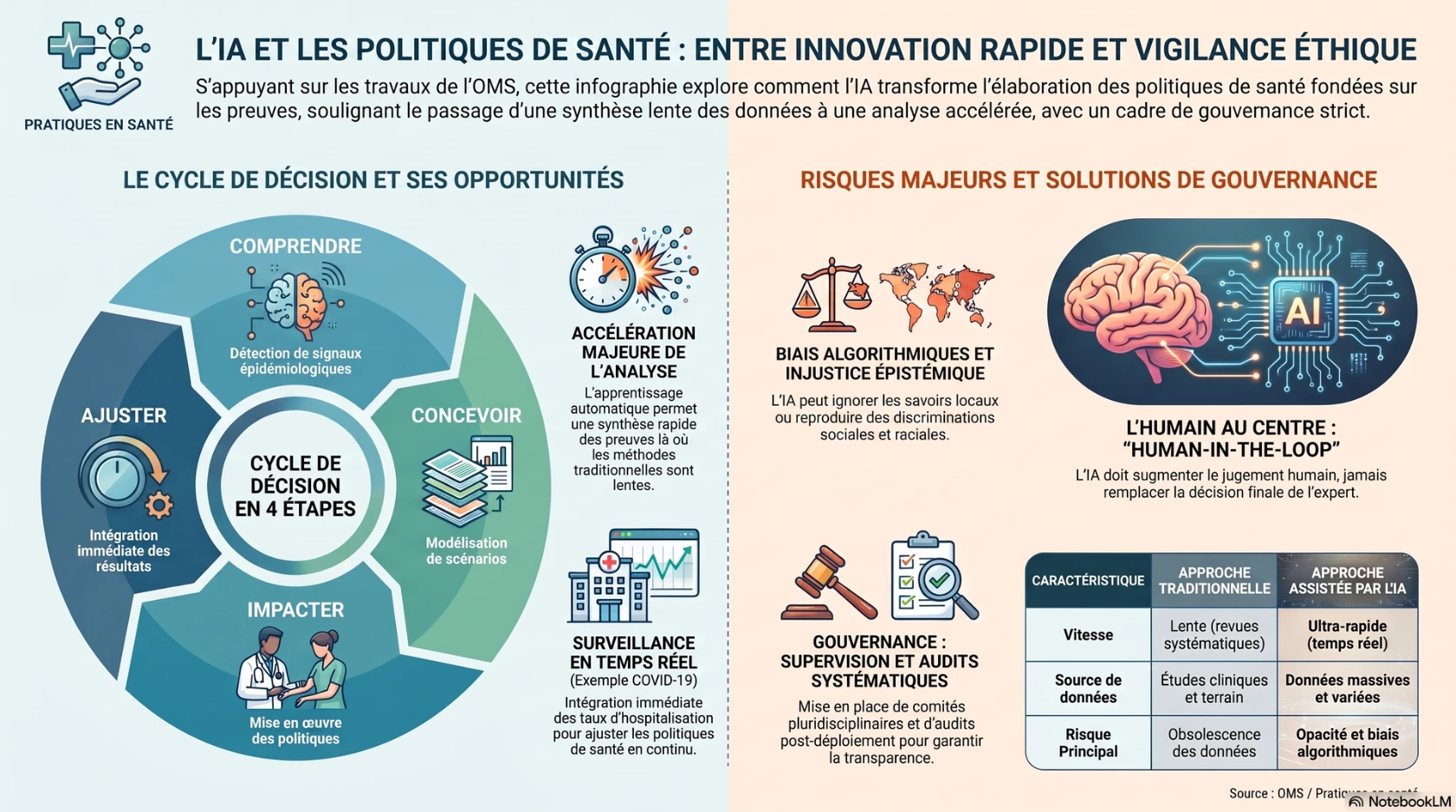
- Evidence-based public decision-making (EIP) follows a four-stage cycle — understanding the problem, designing the solution, achieving impact, adjusting — and AI can intervene at each of these stages, with already documented uses such as AI surveillance systems during the COVID-19 pandemic that allowed for real-time integration of testing and hospitalisation rates (p. 4).
- A summary table (Table 1, p. ix) maps, phase by phase, the opportunities, risks, governance benchmarks, and practical responses — a quick reference tool to be familiarised with before diving into the main text.
- The document names a risk that is still little formalised elsewhere: "epistemic injustice", that is, the risk that AI systematically favours quantifiable data from dominant institutions to the detriment of experiential knowledge, local knowledge, and indigenous knowledge (p. 7) — a point directly transposable to the debates on the place of experiential knowledge of supported individuals.
- A concrete and documented example of algorithmic discrimination is cited: the Dutch algorithm for assessing childcare benefits, which has led to racial profiling and unjustified accusations against thousands of families (p. 7) — a case that can be used in training to concretely illustrate the risk of bias.
- The document proposes an operational checklist of "human-in-the-loop" before any deployment of an AI tool: review of data provenance, bias testing, algorithmic impact analyses, human decision gates, post-deployment audits, regulatory sandboxes (p. 14) — directly transposable to the evaluation of any digital tool proposed by an institutional partner.
3. ACTION POINTS FOR LOCAL ACTORS
- Use the summary table (Table 1, p. ix) as a quick reading grid in team meetings before addressing a project involving AI in a territorial diagnosis or an evaluation of a system.
- Rely on the "human-in-the-loop" governance checklist (p. 14) to question any institutional partner deploying an AI tool: who supervises, with what training, and how often are audits conducted?
- Mobilise the concept of "epistemic injustice" (p. 7) to argue, in a steering or co-construction instance, the necessity of integrating qualitative data and experiential knowledge alongside quantitative data from AI tools.
- Use the Dutch case of family allowances (p. 7) as a concrete teaching aid in training or awareness-raising, to make tangible the risk of algorithmic discrimination among non-tech-savvy audiences.
- Systematically pose, in relation to an AI tool presented as a "decision support tool", the four framing questions proposed p. 12: is the question posed to the AI formulated in a sufficiently precise and contextualised manner? Does a multidisciplinary committee validate the results? Do tasks requiring normative judgement remain human? Are bias audits planned?
- Necessary adaptation: the document is primarily aimed at decision-makers and regulators (p. 1), not field professionals; the above suggestions therefore assume a work of translation and contextualisation for use in mediation or social support, which the document does not provide itself.
4. ADDITIONAL REFERENCES
🔍➕ For more information, see the articles referenced by "Health Practices" on the digital and AI theme ➡️🔗 https://pratiquesensante.odoo.com/2-6-intelligence-artificielle-numerique
- HAS (High Authority of Health), First keys to the use of generative AI in health, October 2025 — educational guide intended for professionals in the health, social and medico-social sectors, structured around the A.V.E.C. method (Learn, Verify, Estimate, Communicate). Complementary to the WHO document as it translates governance principles into practical benchmarks directly usable by a field professional, which the WHO document does not do. https://www.has-sante.fr/jcms/p_3703115/fr/premieres-clefs-d-usage-de-l-ia-generative-en-sante
- Digital Health Agency (ANS) / Delegation for Digital Health, Guide to implementing ethical AI in health, public consultation May-June 2025 — operational framework of ethical criteria associated with the phases of developing an AI system (design, learning, validation, commissioning, monitoring). Complementary to the governance framework presented in section 6 of the WHO document, anchoring it in the French and European regulatory context (GDPR, European regulation on AI). https://esante.gouv.fr/actualites/intelligence-artificielle-en-sante-une-concertation-publique-pour-un-deploiement-ethique
- HAS / CNIL, Supporting the proper use of artificial intelligence systems in care contexts, working document, February 2026 — guide of graduated recommendations (legal obligations, standard and advanced recommendations) on internal governance, training of professionals, human oversight and patient information. Provides a very concrete and sector-specific breakdown of the principles of human oversight and audit mentioned on p. 14 of the WHO document. https://www.cnil.fr/sites/default/files/2026-03/guide_has_cnil_recommandations_ia.pdf
5. FREQUENTLY ASKED QUESTIONS (FAQ)
- Can AI replace human expertise in public health decision-making? No. The document emphasises the principle of augmentation rather than automation: AI remains a provisional input, humans retain responsibility for framing questions, judging the quality of evidence, and contextual interpretation (p. 12).
- What is the "epistemic injustice" mentioned in the document? It is the risk that AI systems systematically favour quantifiable data from dominant institutions, to the detriment of experiential knowledge, local knowledge, and indigenous knowledge, which devalues the legitimacy of certain forms of knowledge in public decision-making (p. 7).
- What are the concrete risks of algorithmic bias in health/social already documented? The document cites the Dutch case: an algorithm used for assessing childcare allowances led to racial profiling and unjustified accusations against thousands of families (p. 7).
- How was AI concretely used during the COVID-19 pandemic? AI-based surveillance systems enabled real-time integration of data streams such as testing and hospitalisation rates, enhancing real-time monitoring and the capacity for rapid synthesis of evidence (p. 4).
- What guarantees does the document recommend before deploying an AI tool in a public policy cycle? A structured pre-assessment: rating the level of technological maturity, algorithmic impact analyses, pilot projects before generalisation, and then a continuous supervision mechanism including post-deployment audits and regulatory sandboxes (p. 14).
- Is this document aimed at field professionals? Not directly. The explicitly targeted audiences are public decision-makers, regulators, health system leaders, and AI developers (p. 1). Field professionals will need to adapt the proposed principles to their practice context.
- Does the document provide a quick synthesis tool to navigate its content? Yes, Table 1 (p. ix) succinctly maps the opportunities, risks, governance benchmarks, and practical responses for each phase of the public policy cycle — a useful entry point before the full reading.
6. REWRITING IN PLAIN LANGUAGE
Artificial intelligence and public health decisions
What does this document say?
This document comes from the World Health Organization. It is called WHO.
WHO explains how artificial intelligence is changing public health decisions. Artificial intelligence is a computer that can analyse a lot of data very quickly.
Why is this important?
Previously, to decide on a health policy, it took a lot of time. It required reading many scientific studies.
Now, artificial intelligence can help speed things up. But this assistance also has risks.
What are the risks?
- Artificial intelligence can make mistakes without us easily noticing. This is called a lack of transparency.
- Artificial intelligence can treat some people unfairly. This is called bias. For example: in the Netherlands, a computer wrongly accused families. These families had done nothing wrong.
- Artificial intelligence can ignore the knowledge of field workers. It sometimes prefers numbers to testimonies.
What the WHO proposes
The WHO says that artificial intelligence must help humans. It must never replace humans.
A human must always verify the results of artificial intelligence. A human must always make the final decision.
What to remember
- Artificial intelligence can help to decide faster.
- Artificial intelligence can also be wrong or unfair.
- A human must always verify and decide.
- This document is mainly aimed at decision-makers, not directly at field professionals.
7. CROSS-ANALYSIS — VALUES OF HEALTH PRACTICES
- Literacy : The document does not provide any outreach tools suitable for non-expert audiences; its technical glossary (p. vii) remains aimed at readers already familiar with the field of AI and public policies.
- Empowerment : The end beneficiaries (patients, users) are not mentioned as stakeholders in the design or evaluation of AI tools; only decision-makers, regulators, and developers are identified as target audiences (p. 1).
- Participation : The document recommends "inclusive participatory forums" and the maintenance of multidisciplinary committees (p. 12-13), but without detailing a concrete mechanism for co-construction with the audiences affected by the analysed policies.
- Community health : The collective dimension appears through the call for "collective intelligence" and shared deliberation processes among institutional actors (p. 14), but remains conceived at the level of health systems rather than that of local communities.
- Ethics : Cultural and social biases are explicitly identified (data bias, epistemic injustice, discrimination) and an entire section is dedicated to them (p. 6-9).
- Human rights : The document anchors its reflection in the principles of human autonomy, equity, and public interest upheld by the WHO doctrine on the ethics of AI in health (p. viii, ix).
- Intersectorality : The document calls for strengthened interdisciplinary collaboration between researchers, decision-makers, civil society, and multilateral institutions (p. 15), without detailing a concrete model of territorial partnership.
- Partnership : Existing collaboration frameworks are cited as references (EVIPNet network, OECD standards, European regulation on AI) but no model of local or field partnership is formalised (p. 10-11).
- Combating discrimination : The document directly addresses algorithmic discrimination, with a documented and already occurred example (Dutch family benefits algorithm, p. 7), and calls for regular bias audits as a safeguard (p. 13).
8. EVALUATION OF THE RELIABILITY OF THE RESOURCE
Scientific relevance : The document relies on 81 recent bibliographic references (up to 2025), including peer-reviewed publications (Nature, BMC Health Services Research, PLOS Computational Biology) and key regulatory texts (European regulation on AI from 2024, GDPR, NIST risk management framework). The development process involved an international editorial committee and a multi-regional peer review (p. vi), which enhances its methodological robustness. A limitation to note: the document remains a "discussion paper", that is to say a reflective document not validated as an official WHO guideline — a status that the authors themselves explicitly remind in the conclusion (p. 15), and which must be indicated to any training audience.
Operational relevance : The document is directly usable by public decision-makers or regulators, but requires significant translation and contextualisation work for field professionals, due to the lack of immediately transposable practical tools (grids, protocols, reflex sheets). The proposed action pathways in section 3 of this brief partially bridge this gap, but remain an adaptation and not content directly derived from the document.