🚨 From nursery to adult life: the autism pathway restructured by the HAS
🔍💡 Autism, children & adolescents: the HAS updates 14 years of practices and rules on non-recommended methods.
🧭 Early intervention, AAC without prerequisites, decision trees for sleep and behaviours: concrete guidelines for the field.
📌 Binding reference document that redefines, over nearly fifteen years, what is recommended, what is not, and why. It provides directly usable guidelines: early interventions at ≥ 10 hours/week, explicit list of non-recommended methods, three decision trees (sleep, behavioural symptoms, psychotropics), pain scales for non-communicative individuals. It covers the entire real pathway — from early childhood to the adult transition — including schooling, emotional and sexual life, child protection and intensive needs. Useful for aligning team practice, preparing training or securing a referral.
Source :
📒 Autism spectrum disorder: interventions and life pathways for infants, children and adolescents
✍️ High Authority of Health (HAS) - adopted on 8 January 2026📜🔗LINK to the source
1️⃣ Analytical summary
A updated national framework for a coherent pathway. The HAS updates its 2012 recommendation for all children and adolescents with autism up to 20 years old, from the moment a diagnosis is made or the suspicion is confirmed in primary care. The text acknowledges the transition to DSM-5, an estimated prevalence of 1-2%, and the importance of identifying associated disorders (other neurodevelopmental disorders, psychiatric and somatic disorders). It aims to harmonise practices, to intervene early, to involve families, and to prevent disruptions in care pathways, particularly during adolescence. The vast majority of recommendations are based on expert consensus, unless a grade is mentioned — an important point for calibrating their scope (preamble, pp. 12-14).
Operational guidelines by domain. The document outlines the assessment of functioning, support for families, global and domain-specific interventions (autonomy, communication, social skills, sensory-motor skills), adaptation and technical aids, schooling, somatic and psychiatric follow-up, the transition to adulthood, profound autism, affective and sexual life, child protection, problem behaviours, and the training of professionals. It provides directly usable tools: a list of non-recommended methods, adapted pain scales, and three decision-making figures (sleep, behavioural symptoms, psychotropics).
2️⃣ Key points of the document
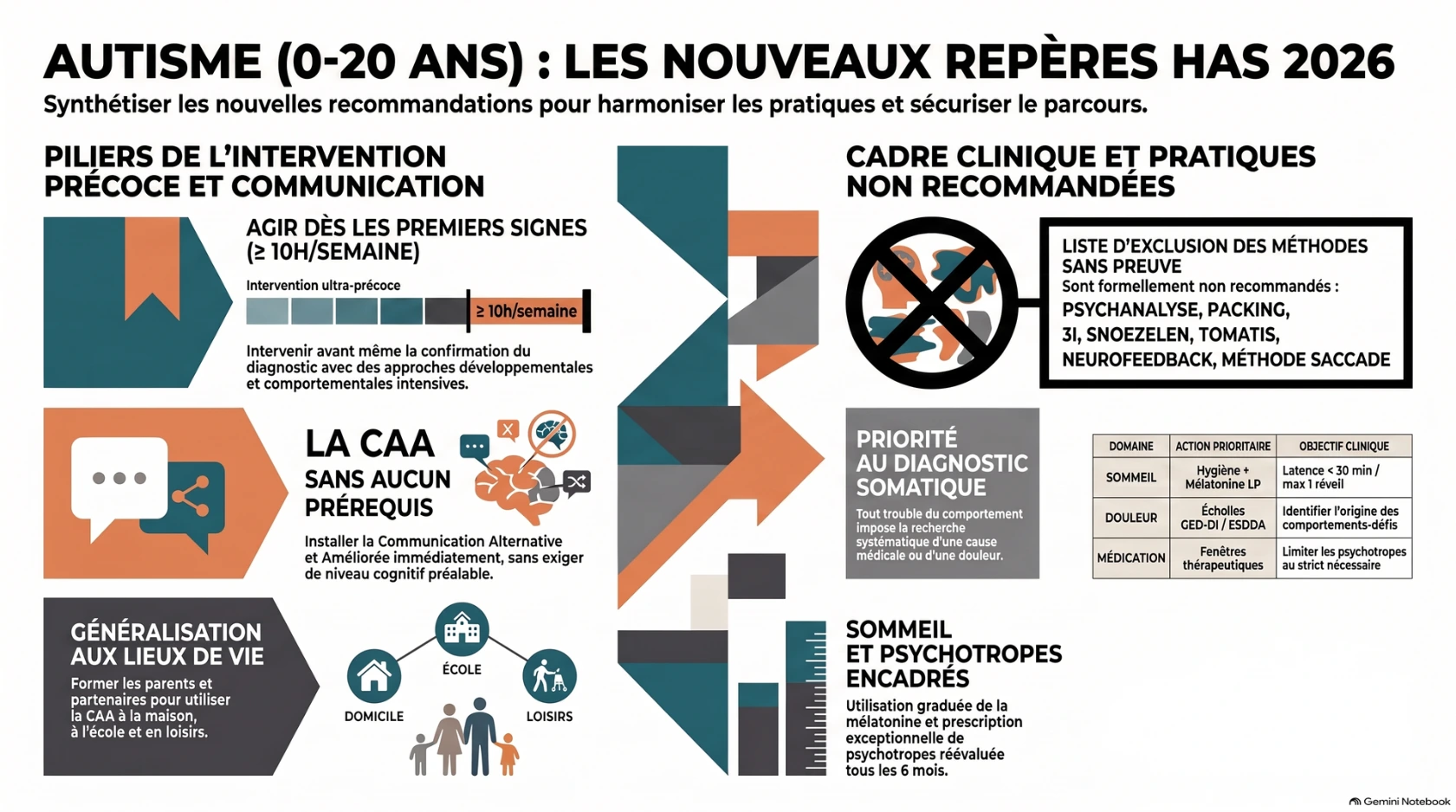
1️⃣ Intervene early, without waiting for the diagnosis. Early intervention starts as soon as the first warning signs appear, before confirmation, with at least 10 hours per week by professionals trained in developmental and behavioural approaches, supplemented by parent-mediated activities (p. 24). Table 2 rates the effectiveness by domain (grades B and C as applicable, p. 26).
2️⃣ A clear list of non-recommended methods. The text names approaches with no evidence or insufficient evidence: Doman-Delacato, Feuerstein, Padovan, facilitated communication and Rapid Prompting, Saccade®, integration of primitive reflexes, Son-Rise®, 3i, neurofeedback, psychoanalysis, Snoezelen; and two for which the lack of effect is demonstrated: auditory integration/Tomatis (grade B) and packing (p. 28).
3️⃣ Alternative and augmentative communication (AAC) without prerequisites. Every project includes a personalised communication component; AAC is a foundation of the overall project, to be implemented from the very first stages, without prerequisites, and to be generalised to all living environments (p. 23, 30).
4️⃣ Three decision trees for health monitoring. Sleep disorders and regulated prescription of LP melatonin (2 → 5 → 10 mg, target latency < 30 min and ≤ 1 awakening, figure 2, p. 44-48, 82); behavioural symptoms with systematic search for a somatic or painful cause (figure 3); prescription of psychotropics (exceptional, re-evaluated every 6 months, therapeutic windows, p. 47).
5️⃣ Populations and subjects long underrepresented. Chapters dedicated to profound autism / intensive needs (24/7 support, p. 51-52), relational, emotional and sexual life (adapted EVRAS, consent, victims of sexual violence, p. 53-54), child protection (distinguishing autism and abuse to avoid unjustified reports, p. 55) and the transition to adulthood (anticipation from 14-15 years, vigilance for depression/anxiety/suicide, p. 49-50).
3️⃣ Action tracks for local stakeholders
1️⃣ Audit the methods proposed in your area in regard to the list of non-recommended interventions (p. 28) and redirect towards developmental and behavioural approaches based on evidence.
2️⃣ Implement the AAC from the start of support, without requiring prerequisites, with training for parents and communication partners to ensure generalisation to different living environments (p. 30).
3️⃣ Integrate the appropriate pain scales (GED-DI, ESDDA) into the follow-up and preparation protocols for consultations, as pain can be expressed through changes in behaviour (p. 43-44).
4️⃣ Formalise a reference/coordinator for the pathway and secure transitions (school-college-high school, change of AESH, transition to adulthood 16-18 years) through prior visits and written transmissions (p. 60-63).
5️⃣ Systematise the support for caregivers and the identification of burnout (parental guidance, psychoeducation, respite arrangements, attention to the sibling) as a component of the child's pathway (p. 20-22).
6️⃣ Anticipate the EVRAS before puberty with appropriate materials (social scenarios, visual aids), by training teams to identify signs of vulnerability and abuse, and by preparing support for victims of sexual violence (p. 53-54).
Unmet need reported by the text itself: no robust data on the autism/gender incongruence association — caution recommended (p. 53).
4️⃣ Additional references
1️⃣ HAS — Neurodevelopmental disorder/ADHD: diagnosis and therapeutic interventions for children and adolescents (published on 23 September 2024). ADHD is one of the most frequently associated disorders with ASD, with therapeutic decision trees. Verified URL: has-sante.fr/jcms/p_3302482
2️⃣ HAS — Support for the development of self-determination and the ability to act of individuals in ESSMS — Framing note (March 2025). Methodological supplement on a central value of the ASD text. Status: framing note, recommendation in progress. Verified URL: has-sante.fr/jcms/p_3598052
3️⃣ House of autism — Practical sheets and autism/TND resources official live platform (accessed in September 2026). Operational and accessible resource for professionals, caregivers, and families. Verified URL: maisondelautisme.gouv.fr/fiches-pratiques-autisme
Epistemic reserve: the 3 URLs have been opened and verified; titles and dates are those displayed at the time of writing. The Health Practices blog has been explored: the “autism” fund is predominantly prior to 2024, not retained under the post-2024 criterion.
5️⃣ Frequently asked questions (FAQ)
1️⃣ Should we wait for a confirmed diagnosis to intervene?
No. Early intervention begins as soon as the first warning signs appear and continues after confirmation (p. 24). Access to rights and rehabilitation can also precede confirmation (p. 64).
2️⃣ What is the hourly volume for early intervention?
At least 10 hours per week by trained professionals, complemented by activities mediated by parents and care settings (p. 24).
3️⃣ What methods should not be proposed?
Those without evidence (e.g. facilitated communication, Padovan, Feuerstein), with insufficient evidence (e.g. Son-Rise®, neurofeedback, psychoanalysis, Snoezelen) or whose ineffectiveness is demonstrated (auditory integration/Tomatis, packing) (p. 28).
4️⃣ Does the CAA require prerequisites?
No. No prerequisites are necessary; the CAA is a foundation of the overall project, to be implemented early and generalised (p. 30).
5️⃣ How to address sleep disorders?
First, sleep hygiene and behavioural approaches; melatonin (LP or LI) is used as a supplement in cases of partial effectiveness and significant impact, according to the algorithm in figure 2 (p. 44-48, 82).
6️⃣ Are gluten/casein-free diets recommended?
No, unless prescribed by a doctor after a confirmed diagnosis of intolerance or digestive pathology (e.g. coeliac disease). They then require monitoring (p. 48).
7️⃣ What to do when faced with an autistic child under child protection?
Distinguish signs of autism and abuse to avoid unjustified reports, train foster families, and make adherence to RBP a prerequisite for placement (p. 55).
6️⃣ Rewriting in FALC (Easy To Read and Understand)
What does this document talk about?
The HAS has written advice to help autistic children.
This advice is for professionals and families.
It concerns children aged 0 to 20 years.
The document replaces older advice from 2012.
What the document says (main ideas)
Autism is a developmental disorder of the brain.
Every autistic child is different.
One must help the child very early.
One can help the child even before being sure of the diagnosis.
One must help the child at least 10 hours a week.
Parents are part of the team. We listen to them and train them.
How o help the child
We help the child to communicate. We can use pictures, gestures, or a tablet. This is AAC.
We don't need conditions to start AAC.
We help the child to be independent: eating, dressing, washing.
We adapt the environments: less noise, less bright light, quiet spaces.
We help the child at school. School must remain possible for everyone.
The child's health
We monitor the health of the body and sleep.
Pain can be difficult to see. We use special tools to measure it.
Behavioural medications should remain rare. A specialist doctor decides them. We often check if they are still useful.
What not to do
Some methods do not work. The document provides the list.
One must not promise to "cure" autism.
One must not force a child to take medication to welcome them.
7️⃣ Cross-sectional analysis — Values of Health Practices
Literacy : yes — visual supports, pictograms, concrete and unambiguous language, accessible written and oral information (p. 34, 45).
Empowerment : central — self-determination, seeking the child's consent, involvement in choices and the timetable (p. 34, 37, 49).
Participation : co-development of the personalised project between parents, child and professionals ; peer support (p. 20, 27).
Community health : collective dimension through territorial partnerships, inclusive activities (leisure, sport, culture) and public health actions for the profound autism (p. 41, 52).
Ethics : consideration of family diversity (cultural, social, economic) ; strict regulation of maintenance devices and psychotropics (p. 20, 45-47).
Human rights : explicit support for the 2005 law, consent and the right to education for all ; emotional and sexual life established as a fundamental freedom (p. 37, 53).
Intersectorality : yes — health, medico-social, National Education, child protection, justice, sport/culture (p. 39, 55-56, 61).
Partnership : formalised models (pathway coordinator, ESS, transdisciplinarity, territorial agreements) (p. 60-62).
Fight against discrimination : prevention of school bullying, vigilance on stigmatisation, sexual violence and vulnerabilities ; non-judgement and diversity taken into account (p. 38, 50, 54).
8️⃣ Evaluation of the reliability of the resource
Relevance scientific: high on an institutional level (HAS, formalised consensus, working groups, scoring and reading, management of conflicts of interest). Important reservation to convey to the field: the vast majority of recommendations stem from expert agreement, not a strong level of evidence — only certain points are graded (A/B/C). The text states this explicitly and invites further research (p. 14). The documentary research stops in 11/2024.
Relevance operational: very strong. Key messages by chapter, actionable lists, named scales, three decision-making figures and schooling diagrams make it a tool that can be directly mobilised in teams and training.
9️⃣ Strategic Hashtags
#healthpractices #TSA #TND #EarlyIntervention #CAA #Autism #CarePathways #EvidenceBasedPractices
You can support Health Practices: https://www.pratiquesensante.com/blog/annonces-28/pour-soutenir-pratiques-en-sante-3253
This article has been developed in accordance with the Charter
for the use of artificial intelligence of Health Practices.
Click on the image