🚨 105 studies, one verdict: we cooperate a lot, we almost never evaluate
🔍💡 Health–community partnerships: 105 studies scrutinised identify 4 major barriers (money, data, culture, governance) and 3 concrete levers for the field. 🧭 Unambiguous finding: only 9 out of 105 studies measure a real effect on health.
📌 This document offers a structured map of what makes partnerships between communities and public health succeed — or fail — based on 105 studies. It precisely names the recurring barriers (inadequate funding, cultural gaps, data silos) and the levers (community participation, skills development, presence of ‘champions’). Useful for arguing a project to elected officials, anticipating the breaking points of intersectoral cooperation, and objectifying the fact that the overwhelming majority of initiatives remain unevaluated on their real health effects. To be read as a shared diagnosis, not as a recipe.
Source:📒 Transition systems for health equity: a scoping review of municipal-public health partnerships
✍️ Bridging systems for health equity: a scoping review of municipal–public health partnerships - BMC Public Health — Received on 6 November 2025, accepted on 12 June 2026, published online on 3 July 2026
Authors: Akram Mahani, Marina Revelli (corresponding author), Sara Zahid, Shanzey Ali, Aleksandra Tymczak, Razieh Safaripour, Cara Bradley, Nazeem Muhajarine, Patrick Fafard, Saqib Shahab, Tania Diener, Tom McIntosh, Adèle Cassola, Kelly Husack, Camilla Martha Ihlebæk, Cordell Neudorf (team predominantly affiliated with Canadian universities — Regina, Saskatchewan, Ottawa, York — with a Norwegian contribution, NMBU).📜🔗LINK to the source
Capsules Audio de Pratiques en Santé 🎙️🎥 https://www.youtube.com/watch?v=1cQ0Zk84vbk
1️⃣ ANALYTICAL SUMMARY
Decisive but poorly equipped communities
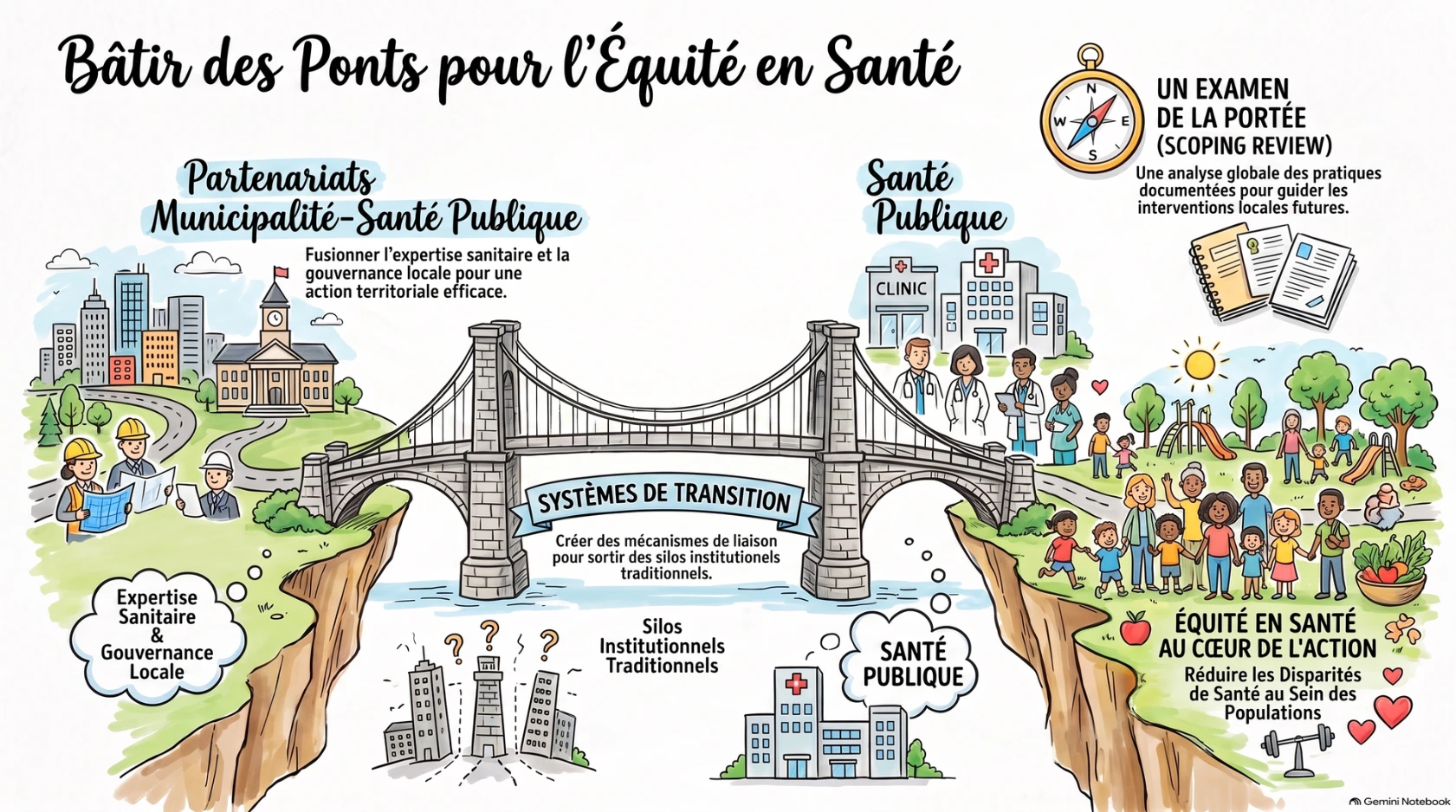
Municipalities act on health directly (fluoridation, road safety, anti-tobacco efforts) and indirectly through housing, transport, income, social services (p. 2-3). Promoted as "ideally placed" actors to address inequalities due to their proximity, they remain constrained by limited fiscal autonomy, restrictive provincial or national legislation, a deficit of public health expertise, and frequent confusion between public health and the healthcare system (p. 3-4). The review aims to fill a blind spot: governance, relational dynamics, and contextual factors of partnerships between communities and local public health (p. 4-5).
A mapped landscape, a failing evaluation
Of 1,392 references, 105 studies are retained (p. 2, 10). Two models emerge: ad hoc project collaborations, and institutionalised collaborations (intergovernmental relations, Health in All Policies, strategic planning — 58% of the sample, p. 32). The document provides stakeholders with a framework of prioritised barriers and facilitators, backed by occurrence frequencies (Table 2, p. 35). Its major contribution is also a warning: 65% of studies only document the implementation process, 37 studies evaluate nothing, and only 9 studies (8%) examine health effects (p. 2, 33). Evidence of effectiveness is lacking.
2️⃣ KEY POINTS OF THE DOCUMENT
1️⃣ Two partnership models, one of which is dominant. The analysis distinguishes between ad hoc project collaborations and institutionalised collaborations; the latter represent 58% of the sample (61 studies out of 105) and are divided into three sub-forms: intergovernmental relations, Health in All Policies (HiAP) and strategic planning (p. 31-33).
2️⃣ Funding, the primary barrier. Inadequate or misaligned funding is the most cited barrier — 48 studies (45%): insufficient resources, incompatible budget cycles, inequitable allocation, disparities between partners. Without sustainable and equitably distributed funding, partnerships remain at the 'project' stage rather than systemic (p. 35-36).
3️⃣ Cultural gaps, fragmentation and data. Second barrier: the gaps in expertise, values, and organisational culture (33 studies), with divergent definitions of what "counts" as a health issue (p. 36). Then comes systemic fragmentation (32 studies) and, within it, data sharing (20 studies) — limited electronic communication, unequal access to health data, quality asymmetries (p. 37).
4️⃣ Three families of levers. The facilitators are grouped into community participation (34 studies), skills development/training (33 studies), and leadership-advocacy, where the presence of a motivated "champion" (22 studies) is identified as critical for connecting actors and maintaining momentum (p. 38-39, Table 2 p. 35).
5️⃣ The evaluation gap. Of 105 studies, 37 provide no evaluation and 40 are limited to the implementation process; only 9 discuss a potential link to health effects (e.g. smoking in Scotland, cancer screening in Japan, transport provision in Granville). The absence of comparable effect measures, counterfactuals, and reliance on self-reported data limit any causal inference (p. 33-34, 40-42).
3️⃣ ACTION PATHWAYS FOR LOCAL ACTORS
1️⃣ Secure funding before launching. Address the question of compatible budget cycles and the fair allocation of human resources between partners from the outset, identified as a primary determinant of success (p. 35-36). In France, anticipate the articulation of cross-funding (ARS, local authorities, project calls).
2️⃣ Identify and mandate a "champion". Appoint an institutional referent (elected official, manager, coordinator) responsible for linking services and maintaining momentum over time — a documented key factor (p. 38-39). Natural French transposition: the coordinator of the Local Health Contract (CLS).
3️⃣ Address data sharing upstream. Map from the outset the asymmetries of access and data quality between partners, a recurring obstacle to joint planning and evaluation (p. 37). Provide a sharing framework compatible with GDPR.
4️⃣ Invest in cross-skilling. Jointly train community partners and public agents using technical tools (checklists, structured frameworks) to internalise health promotion logics, particularly where the role of local authorities in health is poorly understood (p. 39).
5️⃣ Integrate community participation early. Mobilise existing community networks and the detailed knowledge of residents regarding local priorities from the design stage (p. 38) — consistent with French community health approaches and CLSM.
6️⃣ Fill the unmet need: effect evaluation. The document explicitly identifies the absence of standardised effect measures as the central gap. Plan, from the design of a partnership, comparable effect indicators and an evaluation plan (beyond mere process monitoring), in line with the cited evaluation recommendations (mixed methods, quasi-experimental, longitudinal — p. 41-42).
4️⃣ ADDITIONAL REFERENCES
- French Network Cities-Health (RfVS), Health and well-being. The role of cities and intercommunalities (November 2025, 108 p.) — direct French equivalent of the statement: structured municipal action levers in four areas (living environment, lifestyle habits, support for populations, access to care). Transposes the debate to the context of French local authorities.
🔗 https://www.pratiquesensante.com/blog/politiques-10/sante-et-bien-etre-le-role-des-villes-et-intercommunalites-5429 - High Council for Public Health (HCSP), Implementing integrated public policies favourable to quality of life in the French context (28 August 2025) — national framework on intersectorality, co-benefits, and Health in all policies at national and local levels (tools: EIS, CLIAPQV, cross-funding). Precisely fills the lack of French context in the analysed document.
🔗 https://www.hcsp.fr/explore.cgi/avisrapportsdomaine?clefr=1454 - Public Health France, Strategy 2025-2030 to address major public health challenges (10 December 2025) — national strategic anchoring of territorialised action and prevention, useful for situating local partnerships in French governance.
🔗 https://www.santepubliquefrance.fr/docs/rapportsynthese/strategie-2025-2030-pour-repondre-aux-grands-enjeux-de-sante-publique
5️⃣ FREQUENTLY ASKED QUESTIONS (FAQ)
1️⃣ How many studies, and using what method?
105 studies selected from 1,392 references, using the Arksey & O'Malley framework refined by Levac et al., with guidance from the Joanna Briggs Institute and the PIO (Population-Intervention-Outcome) framework, in six steps (p. 6, 10).
2️⃣ Which countries are covered? France?
78 studies (74%) come from the United Kingdom, Canada, Norway, and the United States; corpus limited to OECD countries and English. No French studies (p. 8-9, 31, 43).
3️⃣ What are the identified partnership models?
Two: project-based ad hoc, and institutionalised (intergovernmental relations, Health in all policies, strategic planning — 58% of the sample) (p. 31-33).
4️⃣ What is the main obstacle?
Inadequate or misaligned funding, in 48 studies (45%), ahead of cultural and relational gaps (33) and systemic fragmentation (32) (p. 35-37).
5️⃣ What makes a partnership successful?
Community participation (34 studies), capacity building (33), and leadership-advocacy, notably the presence of a 'champion' (22 studies) (p. 38-39).
6️⃣ Do these partnerships really improve health?
We do not know reliably: only 9 studies (8%) discuss a health effect, 37 evaluate nothing, and 40 are limited to the process. The authors conclude a lack of evidence of effectiveness (p. 2, 33-34, 40-42).
7️⃣ What is needed to make progress, according to the authors?
More robust evaluation methods (mixed approaches, quasi-experimental, longitudinal) and standardised frameworks capable of capturing health and equity effects; theorisation depends on a stronger empirical evaluation base (p. 41-44).
6️⃣ REWRITING IN EASY LANGUAGE
What is this document about?
This text talks about local councils and public health.
Local councils act on the health of residents.
They act on housing, transport, water.
They can work with health services.
This collaborative work is called a partnership.
What the researchers did
The researchers read 105 studies.
These studies mainly come from Canada, the United Kingdom, Norway, and the United States.
There is no French study.
What prevents partnerships from working
- There is often a lack of money.
- Partners do not always understand each other.
- They do not share their data (their information) well.
What helps partnerships to work
- Residents participate early in decisions.
- Partners receive training.
- A motivated person guides the group. They are called a "champion."
The important point
It is not well known whether these partnerships improve health.
Out of 105 studies, only 9 measure a real effect on health.
Results need to be measured better in the future.
7️⃣ CROSS-SECTIONAL ANALYSIS — VALUES OF HEALTH PRACTICES
- Literacy : poorly developed; the document mentions technical tools (checklists, frameworks) for partners, but no tools suitable for varying levels of public understanding (p. 39).
- Empowerment : present through early community participation, but described from the perspective of institutional partners more than the beneficiaries themselves (p. 38).
- Participation : community participation is the most cited facilitator (34 studies); co-construction mechanisms mentioned but not well formalised (p. 38).
- Community health : central collective dimension — mobilization of community networks and local actors (p. 38).
- Ethics : not addressed head-on; the authors honestly point out the biases of the corpus (overrepresentation of the West) rather than the cultural biases of the interventions (p. 43).
- Human rights : health equity is the guiding thread (defined p. 3 as the absence of unjust and avoidable differences), but the inclusion of vulnerable populations remains poorly operationalized.
- Intersectorality : heart of the document — cooperation between health, urban planning, housing, transport, social (p. 3, 7).
- Partnership : the very subject of the review; two formalized models (ad hoc / institutionalized) and their determinants (p. 31-33).
- Fight against discrimination : not explicitly addressed; equity is aimed for but specific discriminations are not named.
8️⃣ EVALUATION OF THE RELIABILITY OF THE RESOURCE
Scientific relevance : high in form. Peer-reviewed scope review, explicit and recognized methodology (Arksey & O'Malley/Levac/JBI), broad documentary research, team selection, 87 updated references (including sources 2024-2025). Reservations: (a) unedited version “Article in Press” — the publisher indicates the possibility of errors (p. 1); (b) corpus English-speaking and OECD only, geographical bias of 78% acknowledged by the authors; (c) a scope review does not rank the quality of evidence — the frequencies of occurrence do not measure importance, as the authors specify (p. 42).
Identified internal inconsistencies (noted, not corrected):
- Number of full-text exclusions: 172 (p. 10) vs 173 in the PRISMA diagram (Figure 1, p. 11).
- PRISMA arithmetic: 914 screened − 635 excluded = 279, whereas 278 are « sought for retrieval » (discrepancy of one unit, p. 10-11).
- Terminology: the sub-theme is « Intergovernmental relations (federalism) » but the text refers to « International relations accounted for the largest share (46 studies) » (p. 32) — inconsistent term.
- Table 1 (p. 21-26): several publication years appear reversed or incorrect — Glasby, Dickinson & Smith (2010) listed as « 2013 »; the two entries Plochg (2006 / 2013) seem swapped; Reynolds (2004) listed as « 2019 »; Diallo (2020) listed as « 2022 ».
- Typos: « Wimbush and Robertson » (p. 33, for Robertson); « Health in Policies » (p. 32, for Health in All Policies).
- Frequencies of sub-themes in Table 2 are not additive (the sub-themes exceed the total of their category): coding structure to be read as multiple codings, not as a sum.
Operational relevance: good as a framework for diagnosis and argumentation, weak as a turnkey action guide — the document describes the conditions for success/failure but provides neither protocol nor proof of effectiveness, and requires adaptation to the French context (skills of local authorities, CLS/CLSM, ARS, law 3DS).
9️⃣ STRATEGIC HASHTAGS
#healthpractices #CommunityHealth #Intersectorality #HealthPromotion #HealthInequalities #LocalAuthorities #HealthInAllPolicies #HealthEvaluation
This article was developed in accordance with the Charter
of the use of artificial intelligence of Health Practices.
Click on the image