🚨 Prevention: is France pretending? 48 proposals to stop
🔍💡 Primary prevention: act on living environments, not just on individuals.
48 proposals to make the local health contract the operational arm on the ground, recognise invisible functions (mediation, outreach, literacy) and drive by data.
📌 This 131-page report; 48 proposals, provides a common language and an argumentative framework for any actor who acts on living conditions rather than just individual behaviour. It names and values often invisible functions — mediation, outreach, identification, territorial animation, literacy — and includes them in the local health contract, presented as the pivot of action. It provides material to support a project, convince an elected official or a funder, and move away from the logic of permanent experimentation. Useful for situating one's action within a national strategy currently under construction, and for anticipating developments (literacy, mental health, strengthened CLS).
Source:
📒 Building a national system of primary prevention
✍️ Cyrille Isaac-Sibille, MP (The Democrats / MoDem, 12th constituency of Rhône), ENT doctor, member of the Social Affairs Committee
Two general inspectors and a group of experts led by Professor Franck Chauvin; 327 hearings, 15 trips, 147 written contributions
The report was submitted to the Prime Minister on 13 July 2026. It was then presented publicly on Wednesday 16 September 2026 during a press conference at the National Assembly.📜🔗LINK to the source
1️⃣ Analytical summary
A French paradox: treating a lot, preventing little
The report starts from an observation: France knows how to treat but struggles to collectively organise the conditions for staying healthy. The life expectancy without disability remains nearly twenty years lower than the total life expectancy (p. 7), social and territorial inequalities widen from childhood, and the deficit in the health branch could reach 41 billion euros by 2030 according to Health Insurance (p. 58). The author posits as a guiding principle that 80% of health status is related to environments and behaviours, 20% to care (p. 47-48). He proposes to speak of “primary” prevention: preventing the very emergence of risk factors by transforming living environments (urban planning, housing, school, work, diet), rather than sending everyone back to their individual responsibility (p. 9-10).
An architecture of action: living spaces, priorities, governance, financing
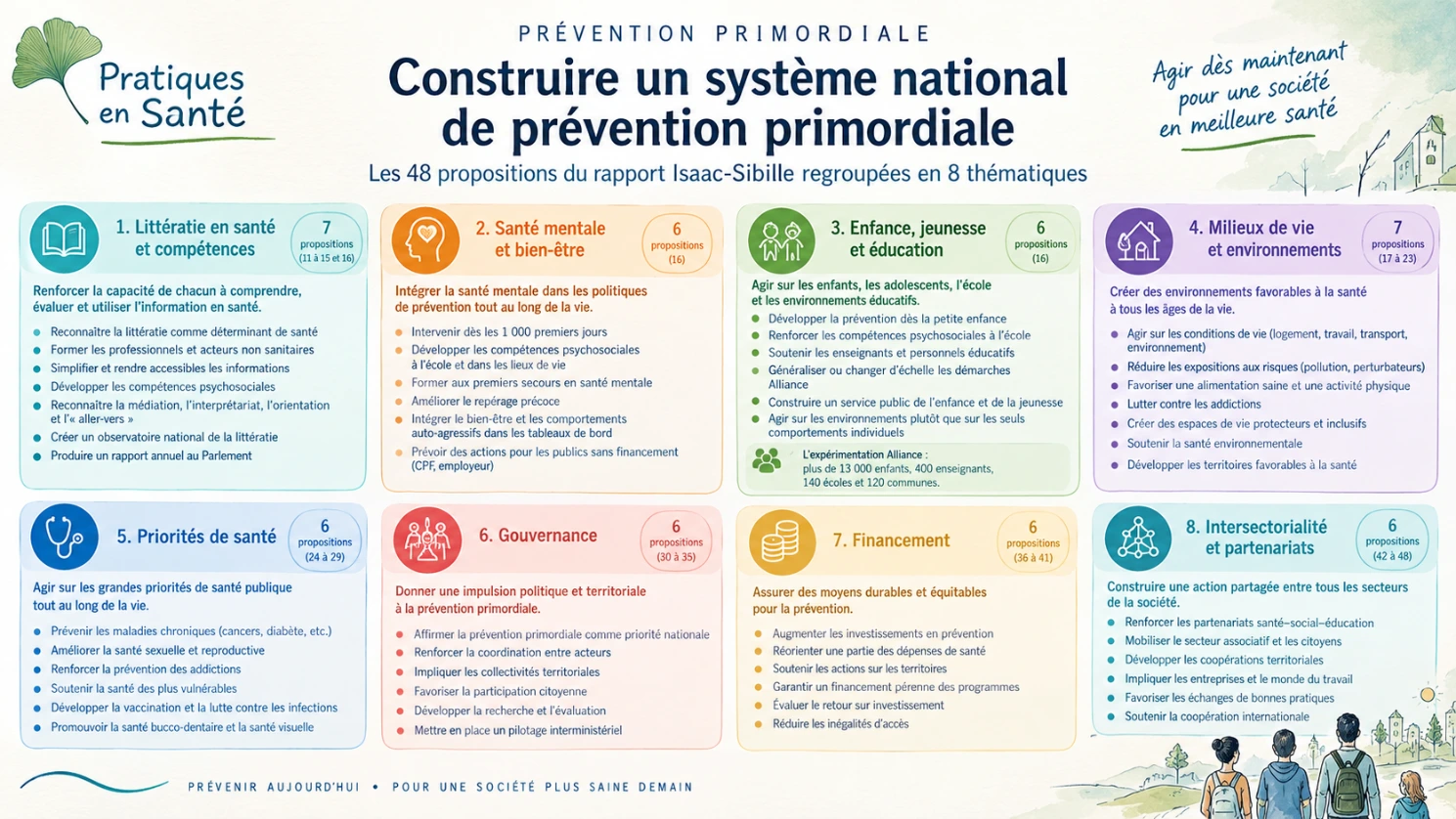
The report structures 48 proposals around four levers. Make living spaces environments conducive to health, relying on the local health contract (CLS) as the pivot document of the territory (p. 119). Act on six priorities outlined in the National Health Strategy: literacy, mental health, vaccination, healthy ageing, environmental health, favourable behaviours (p. 75). Change governance, with a national health conference, an annual interministerial committee, and a "One Health" ministry backed by a rearmed DGS (p. 118). Sustainably finance, by making prevention clear in the budget and directing revenues towards primary prevention (p. 120). All guided by data and evaluated through health impact studies.
2️⃣ Key points of the document
1️⃣ A clear and enforceable conceptual framework
The report clearly distinguishes between primordial, primary, secondary, and tertiary prevention, making primordial — acting on the physical, social, economic, and institutional environments — the keystone (p. 9-10). Useful for framing a discourse and moving beyond individual injunction.
2️⃣ The cost of inaction, quantified and sourced
A table summarises the orders of magnitude: approximately 68,000 smoking-related deaths in 2023 (Public Health France), 41,000 from alcohol, a socio-economic cost of obesity estimated at 12.7 billion euros (Asterès, 2024), ~140 billion euros/year for physical inactivity and sedentariness (p. 56-58). These figures are cited by the report, not produced by it.
3️⃣ The CLS established as a territorial pivot
The local health contract (created in 2009) becomes the "armed wing" and the reference document to which other territorial schemes should be articulated, concluded at the level of the EPCI or the living area (p. 34, p. 119). Direct recognition of the work of field coordination.
4️⃣ Health literacy recognised as a determinant
The report proposes to recognise literacy as a health determinant, to train non-health actors (elected officials, urban planners, social workers…) and to create a National Observatory of literacy with an annual report to Parliament (proposals 11 to 15, p. 76-82). The box on p. 78 lists what "every health professional should know how to do".
5️⃣ A proof of feasibility: the Alliance experiment
Conducted between 2019 and 2025 in Auvergne-Rhône-Alpes, Alliance reached more than 13,000 children, 400 teachers, 140 schools and 120 municipalities, with 17 scientific publications (p. 82). It shows that literacy and psychosocial skills can be built from primary school, through teachers and environments, rather than through one-off actions. Results presented as "first": to be interpreted with caution.
3️⃣ Action tracks for local actors
1️⃣ Rely on the CLS as a project framework
Position its actions within the local health contract of the territory and require articulation with other schemes (urban planning, mobility, early childhood). The CLS is presented as public, based on a territorial diagnosis and dashboards (p. 34, p. 119).
2️⃣ Mobilise the argument of "cost of inaction"
Refer to the table on p. 56-58 to objectify, with an elected official or a funding body, the interest in investing upstream — citing the sources of origin (Court of Auditors, SpF, Asterès, OFDT) rather than the report alone.
3️⃣ Make your organisation "favourable to literacy"
Draw inspiration from the box on p. 78 and from proposal 13 to simplify information, identify non-use, and adapt messages to levels of understanding, without turning prevention into an injunction.
4️⃣ Have "invisible" functions recognised
Document and name the functions of mediation, outreach, interpretation, navigation, territorial animation (proposals 13-14, p. 81). The report advocates for their recognition and funding: a lever to secure field positions.
5️⃣ Apply "Every contact counts" (MECC)
Seize every user contact as an opportunity for brief prevention or orientation, without experiencing it as an injunction (proposal 8, p. 72). Adaptable to reception, mediation, and local care.
6️⃣ Integrate mental well-being and CPS throughout life
Rely on proposal 16 (p. 84): psychosocial skills and mental health first aid (PSSM) in living spaces, with attention to groups who cannot have them funded by the employer or the CPF. Unmet need: the funding modalities for these groups remain to be specified.
4️⃣ Additional references
On the platform Practices in Health
- Health literacy: from individual competence to the responsibility of organisations
Strengthening health prevention and promotion in law (Geneva)
External references
Public health France (Dec. 2025) — Health inequalities: the weight of social determinants. National overview based on the 2024 Barometer; sheds light on the chapters "determinants" and "STIs".
HCSP (28 August 2025) — Implementing integrated public policies favourable to quality of life — pathways for primordial prevention. Conceptual framework "Health in all policies" and primordial prevention, directly convergent.
HCSP (20 March 2026) — Integrated local policies for quality of life: local authorities, major actors in prevention. Completes the territorial axis / CLS of the report.
5️⃣ Frequently asked questions
1️⃣ What does "primordial prevention" mean and how does it differ from primary prevention?
Primordial prevention acts upstream of risk factors, transforming the environments (urban planning, housing, school, work). Primary prevention acts on the risk factors themselves before illness. Secondary prevention screens, tertiary limits complications (p. 9-10).
2️⃣ Where does the figure "80% / 20%" come from?
The report presents it as a guiding principle: about 80% of health status would relate to environments and behaviours, 20% to the healthcare system (p. 47-48). It is a mobilising order of magnitude, not a precise measurement.
3️⃣ What is the territorial tool highlighted?
The local health contract (CLS), created in 2009, presented as a pivotal document and framework for implementing the national strategy at the territorial level (p. 34, p. 119).
4️⃣ What does the report on mental health propose?
To build a lifelong prevention pathway: early interventions (1000 first days), CPS and first aid in mental health, dashboards including well-being and self-harming behaviours (proposal 16, p. 83-84).
5️⃣ And what about tobacco and alcohol?
A "tobacco-free generation" for people born after 2009 combining prevention, risk reduction, pricing and an unfavourable environment (proposal 23, p. 103); regarding alcohol, a ban on advertising by influencers and minimum pricing per unit, based on the Scottish example (p. 103-104). These are proposals, not measures in force.
6️⃣ What national governance is proposed?
A national health conference every five years, an annual interministerial committee, a "One Health" ministry and a DGS redefined as responsible for global health and primary prevention (proposals 34 to 36, p. 117-118).
7️⃣ How to finance primary prevention?
To make prevention identifiable in the budget, allocate a share of revenues to primary prevention, create a national funding window for scaling up and experiment with innovative tools (proposals 39 to 47, p. 120-125).
6️⃣ Rewriting in Easy-to-Read Language
Easy To Read and Understand. This text reiterates the meaning of the report with simple words.
What is this report about?
France takes good care of sick people.
But it poorly prepares for the good health of everyone.
Many illnesses could be avoided.
Our health mainly depends on our everyday life.
It depends on housing, school, work, food.
The report calls this "primary prevention."
This means: changing our living environments to stay healthy.
What does the report propose?
Act near people, in every city and village.
Help people understand health information. This is called health literacy.
Take care of mental health from a young age.
Help people to smoke less and drink less alcohol.
Better organise the state to act together.
Put more money into prevention.
Why is it important?
If nothing is done, more people will be ill.
And it will cost France a lot.
Acting early protects health and protects public money.
7️⃣ Cross-sectional analysis — values of Health Practices
Literacy : central theme; dedicated proposals and framework of basic competencies (p. 76-82).
Empowerment : the « power to act » is affirmed, backed by psychosocial competencies and scientific culture (p. 81) ; few concrete involvement mechanisms described.
Participation : citizen consultation (27 April 2026) cited ; CLS presented as a document of health democracy (p. 74, p. 119).
Community health : population approach (Population Health) and action on environments claimed ; the collective dimension structures the report (p. 50).
Ethics : repeated warning against reducing prevention to an individual injunction ; vigilance on an unregulated market of prevention by AI (p. 59).
Human rights / equity : proportional universalism posed as a principle of action (p. 54) ; non-recourse and “forgotten” publics (prisoners, disabled) taken into account.
Intersectorality : « Health in All Policies » claimed ; seven ministries involved.
Partnership : formalised models proposed (GIP for a public service for children and youth, contractualisation State / departments / universities, p. 68).
Fight against discrimination : angle addressed mainly through social and territorial inequalities and the non-recourse ; non-judgment is implicit (warning against the injunction), not explicitly stated as such.
8️⃣ Evaluation of the reliability of the resource
Scientific relevance : high. Official mission report, supported by a group of experts (Pr Chauvin), 327 hearings, cited and dated institutional sources. Caveat: figures taken from third parties, to be cross-checked at the source; some results (Alliance) presented as “ firsts.”
Operational relevance: indirect. This is a political document of proposals, not a guide for intervention. It provides a framework, a vocabulary, and a solid argument; it does not provide ready-made tools. Assumed misalignment of template.
9️⃣ Strategic hashtags
#PrimordialPrevention #HealthPromotion #HealthDeterminants #HealthLiteracy #HealthInAllPolicies #HealthInequalities #LocalHealthContract #healthpractices
You can support Health Practices: https://www.pratiquesensante.com/blog/annonces-28/pour-soutenir-pratiques-en-sante-3253
This article was developed in accordance with the Charter
for the use of artificial intelligence of Health Practices.
Click on the image