🚨 🏃♀️🧠 What if moving became a lever for mental health? Benefits, limits, barriers and action paths: this report helps health, medico-social and sports actors to better support individuals and to build accessible and inclusive practices. 11 recommendations.

Source :
🎙️🎥
1️⃣ SUMMARY
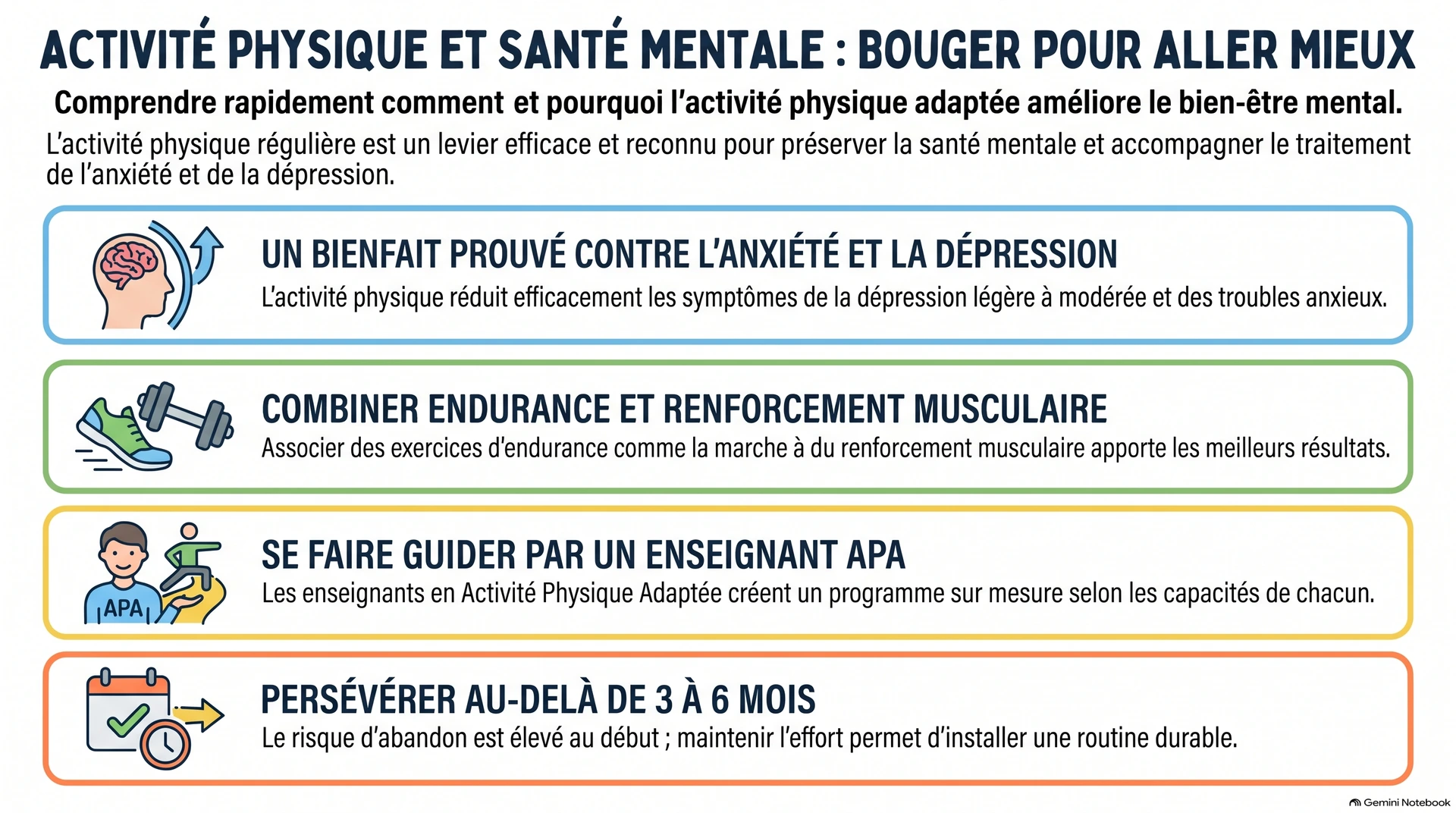
Commissioned by the Ministry of Sports to the collective "For a Fit France ", this report examines the links between physical activity and mental health. It explores its effects on well-being, the prevention and support of mental disorders. The benefits appear particularly supported for mild to moderate depression and anxiety disorders. For other disorders, the results remain more uncertain and require further research. The observed effects vary according to age, the characteristics of individuals and the modalities of practice. The report also analyses the neurobiological, cognitive and psychosocial mechanisms that may explain them. It reminds that excessive or inappropriate practice can have negative consequences on mental health. It thus encourages prioritising a regular, accessible activity tailored to everyone's needs.
The report also examines the conditions for integrating physical activity into care and support pathways. It presents the role of sport-health houses and professionals in adapted physical activity. It highlights the obstacles related to motivation, cost, access to facilities, and training of interveners. Individualised support and coordination between actors are essential to sustain a lasting practice. Particular attention is given to stigma and discrimination in the sporting world. The authors recommend involving the people concerned in the design and evaluation of programmes. Eleven recommendations propose guidelines for research, care, prevention, training, and inclusion. They call for a coordinated inter-ministerial policy and regular evaluation of actions undertaken.
2️⃣ WHAT TO REMEMBER
1️⃣ Unequal levels of evidence (finding). The report highlights that the strength of evidence varies according to conditions. Its methodological analysis mentions meta-analyses of randomised controlled trials for mild to moderate depression and anxiety disorders. Table 3, however, presents anxiety disorders based on randomised trials and before/after studies. For schizophrenia and bipolar disorders, the authors indicate that conclusions often rely on observational studies: these may suggest benefits, but do not allow for establishing a direct causality between physical activity and the observed effects (p. 87-88).
2️⃣ A preventive scope to be nuanced (finding). The synthesis indicates that the APS prevents depressive and anxiety disorders, but does not seem to prevent bipolar disorders, schizophrenia, ADHD or ASD (p. 5). The conclusions specify that the benefits in primary prevention mainly concern children and adolescents; for the entire population, the APS would act more in secondary prevention (p. 89).
3️⃣ Sport-health houses facing mental disorders (finding, data IGAS 2025 cited). For 2024, the report estimates between 10 and 20% the proportion of people presenting with mental disorders among the audiences welcomed in sport-health houses; nearly a third of these individuals would have presented themselves spontaneously (p. 10 and 80-81). Across all pathologies, 30 to 40% of patients would continue physical activity independently after the end of their care (p. 81). The report also indicates that less than 10% of MSS are directly integrated into public health establishments (p. 82). These figures are reported here as they appear in the document, without independent verification of the IGAS source.
3️⃣ TO ACT
1️⃣ Existing tool explicitly cited. The report notes that three guides from the HAS (2022b, 2022c, 2025) and references on depression (2019a) and schizophrenia (2022a) are "available to health professionals" (p. 77). It also presents the four levels of intervention in APA defined by the HAS (p. 75).
2️⃣ Existing devices explicitly cited. The report states that 581 sport-health houses have been deployed across the territory, without specifying the exact date of this count in this passage (p. 78). It describes an initial assessment of the person, followed by a personalised APA programme, discussed and validated with them (p. 79). The Médicosport-Santé of the CNOSF lists federal protocols adapted to different pathologies; according to the report, 33 federations offered them for depression in 2020 (p. 83). Health Practices Suggestion: identify the sport-health house in your territory and check its reception and support methods for individuals with mental disorders.
3️⃣ Action requested by the document (recommendation 9). The report recommends appointing ‘mental health’ referents in federations and sports structures, training educators, coaches, leaders and volunteers, and integrating testimonials from affected individuals into awareness-raising actions (p. 114). The sports movement and its structures are explicitly targeted, but this recommendation does not designate an operational manager for each measure and does not set a implementation timeline.
4️⃣ 3 PRACTICAL QUESTIONS
1️⃣ What type of activity should be prioritised? For depression, the combination of aerobic activities and muscle strengthening seems to be the most effective; team sports for adolescents; walking, tai chi or aquatic exercises for the elderly (p. 32). The effect relies “always on the regularity and accessibility” of the practices (p. 7).
2️⃣ Who can supervise the APA of a person with a mental disorder? The report presents teachers in APA-S as the referents of APA for therapeutic purposes (p. 74). Other professionals — physiotherapists, ergotherapists, psychomotor therapists and sports educators trained in health-sport — can intervene within their field of expertise and in accordance with their regulatory prerogatives (p. 75). The choice of the supervisor must take into account the abilities, limitations, objectives and complexity of the person's situation; these professionals are therefore not interchangeable. A specific training on mental health issues is deemed fundamental (p. 10-11).
3️⃣ What risks of dropout are reported and how can they be limited? Based on exchanges with coordinators of health-sport houses, the report indicates a high risk of dropout from practice in the first three to six months among individuals with mental disorders. The mentioned difficulties include anxiety limiting social interactions, cognitive disorders, repeated hospitalisations, demotivation, difficulties in establishing a routine and financial barriers. It describes the importance of enhanced support, particularly through more frequent calls and support at the practice locations (p. 79). It also highlights the role of the motivational approach in the prescription consultation (p. 78). This field feedback does not constitute a national dropout rate.
5️⃣ TO GO FURTHER
Blog Health Practices: on mental health https://pratiquesensante.odoo.com/blog/tag/sante-mentale-35 - on physical activity - https://pratiquesensante.odoo.com/blog/tag/activites-physiques-24
External resource : Guide " Mental health and physical activity ", Ministry of Sports and Ministry of Health, with the Maison Sport-Santé PEPS of Clamart, published on 8 September 2025 on Santé.fr (external source, consulted on 9 November 2026). It presents the disorders, the benefits of activity and practical advice. sante.fr/node/18268219
Page source of the report: sports.gouv.fr, page dated 6 October 2026 (consulted on 9 November 2026): " Sport and mental health: a winning duo for well-being "
6️⃣ #️⃣ HASHTAGS
#healthpractices #MentalHealth #AdaptedPhysicalActivity #SportHealth #SportHealthHouses #Sedentariness #Stigmatisation #HealthPromotion
🔎 Need to delve deeper into a topic?
The articles from Pratiques en Santé provide an initial insight into publications and resources useful for professionals and field actors.
To go further, answer a specific question or explore a topic in depth, I also offer documentary research and personalised monitoring, tailored to your needs and projects. Do not hesitate to contact me: pratiquesensante@pm.me - To learn more
To go further, order a research or documentary monitoring
This article: An editorial production based on
experience enhanced by artificial intelligence - The English version of the site is an automatic translation: the French version prevails - Click on the image