
🔍💡 Hyperconnected children and teens: how to protect their mental health without excluding them from the digital world? This UNESCO report outlines ethical red lines and provides very concrete levers for parents, schools, and decision-makers. #YouthMentalHealth #healthpractices📱⚖️ Between educational opportunities and risks of cyber violence, the digital environment of young people is neither "all good" nor "all bad": UNESCO proposes a framework of rights, protection, and co-construction with the young people themselves. #DigitalEthics #ChildhoodAndRights
📌 This report provides an ethical and human rights framework for managing the digital use of children/adolescents, directly linking these uses to their mental health. It is particularly useful for teachers, specialised educators, mental health professionals, social workers, and local policy makers who must arbitrate between protection, autonomy, and digital inclusion. It allows for the transformation of diffuse concerns ("screens are harmful") into concrete guidelines: regulation, educational practices, parental support, requirements for platforms.
Source : ✍️ Ethical considerations for youth mental health in the digital environment - International Bioethics Committee (IBC) of UNESCO, Social and Human Sciences sector of UNESCO
📜🔗LINK to the source
Number of pages: 73
1. Analytical summary
Context and issues: a childhood lived online and offline
The report starts from the observation that almost all children and adolescents now live in a digital environment, where the Internet, social networks, video games, and AI shape learning, social interactions, and leisure activities. It highlights that these uses offer opportunities (access to information, health resources, social support, civic participation) but also expose them to risks: inappropriate content, cyberviolence, privacy violations, behavioural addictions, exacerbation of pre-existing disorders. The IBC adopts an approach based on ethics and children's rights (Convention on the Rights of the Child) to analyse how the digital world influences the "intrinsic goods" of childhood and adolescence (trust, play, identity experimentation, carefreeness) and their mental health. The stakes are heightened by social and gender inequalities (digital divide, online gender-based violence, disparities in access to care), and by polarised debates between alarmism ("moral panic") and minimisation of risks.
Operational contributions: a framework of shared responsibilities
The report proposes a normative framework articulated around the right to mental health, the principle of the best interests of the child, and the co‑responsibility of all actors (parents, schools, health services, public authorities, civil society, digital companies). It details the benefits and risks of platforms (mental health, social networks, gaming, generative AI), the social determinants (poverty, gender, environment, discrimination), and the forms of “safety by design” and “children’s rights by design” expected from companies. Part VII brings together recommendations structured by audience: parental support, teacher training, integration of digital technology into mental health services, policies to reduce the digital divide, obligations of companies (transparency, moderation, secure architecture), and participation of young people in the design of policies and tools. The whole provides a basis for local action plans articulating digital literacy, risk prevention, and the maintenance of the rights and freedoms of young people.
2. Key points of the document
The digital usage of young people is ubiquitous and ambivalent (p. 10–24, 27–33)
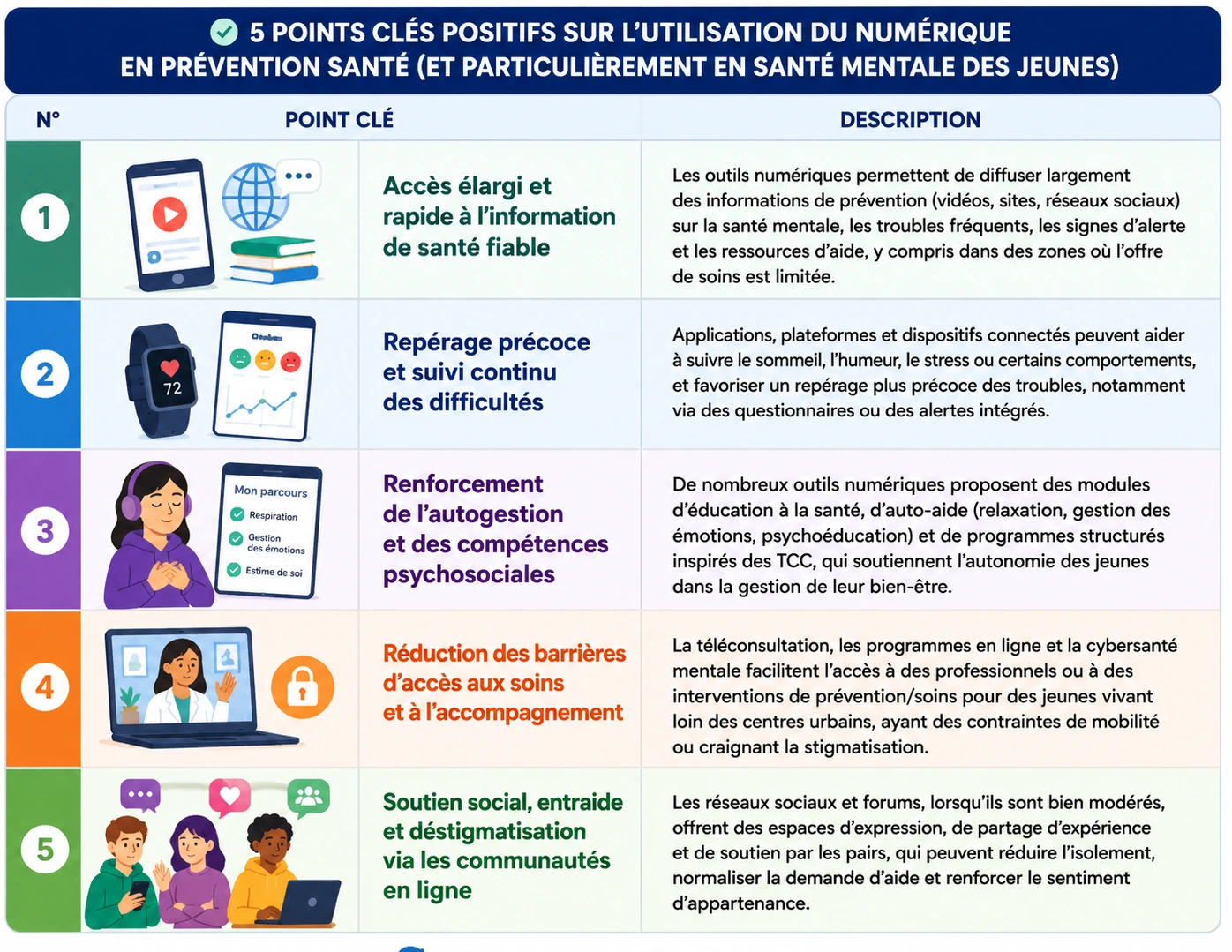
The report describes a digital environment that supports access to education, health information, sociability, and mental health services, while potentially undermining attention, sleep, socio-emotional development, and mental health (anxiety, depression, digital addictions, eating disorders). It warns against simplistic approaches, emphasising the decisive role of content, context of use, and individual vulnerabilities.
The digital divide exacerbates social and health inequalities (p. 24–27)
Chapter IV shows that two thirds of school-aged children do not have internet access at home, especially in low or middle-income countries, which limits access to learning, social participation, and mental health resources. It highlights the double risk: digital exclusion for the poorest and unprotected exposure for those who access poorly regulated digital content, particularly in contexts of poverty, rurality, and local violence.
Digital risks to mental health are multiple and interconnected (p. 27–33)
The report distinguishes between intensive use and problematic use (close to addiction), and describes their effects on attention, memory, sleep, stress, body image, eating behaviours, self-harm, substance use, depression, anxiety, and cyber violence. It documents the particular vulnerability of certain groups (girls, minorities, young people with mental disorders or disabilities) and the emergence of new diagnoses (Gaming Disorder, Screen Dependency Disorder) related to digital technology.
An ethical framework centred on the well-being of children, children's rights, and the best interests (p. 34–48)
Section VI offers a normative reading of the "well-being of childhood and adolescence" (trust, love, carefreeness, play, identity exploration, gradual autonomy) and their intrinsic link to mental health. It articulates these well-being aspects with children's rights (health, education, participation, non-discrimination, protection from violence, privacy) in the digital environment, and clarifies the principle of best interests as a right, interpretative principle, and procedural rule.
Detailed and multi-stakeholder recommendations for a child-centred "safety by design" (p. 53–59)
The report concludes with a set of recommendations aimed at parents, schools, health services, policymakers, civil society, and digital companies, emphasising collaboration, training, reducing inequalities, and youth participation. It introduces the standard "Children’s Rights by Design" (CRbD) and calls for the integration of mental health and the prevention of online violence in the design of services, with transparency, accountability, and access for researchers to data under confidentiality guarantees.
3. Action points for local stakeholders
Establish family–professional co‑digital rules (p. 54–56)
Health professionals, social workers, and educators can co‑construct with parents "digital usage contracts" including screen time, types of content, supervision methods, and off-screen time (sleep, physical activity, relationship time). The report stresses the need to equip parents (digital literacy and mental health), through meetings, simple audio/visual materials, and support from parent associations.
Institutionalise digital literacy and risk prevention in schools (p. 55–56)
Schools are encouraged to integrate modules on responsible digital use, critical thinking, emotional management, and risk identification (cyber violence, misinformation, self-harm content) into the curriculum, linked to existing psychosocial skills programmes. The report also recommends training teachers to identify early mental health issues related to digital use and to refer to support services.
Develop validated and accessible digital care and support offerings (p. 20–22, 56–57)
Mental health services (CMP, youth consultations, associations) can integrate validated digital tools (apps, teleconsultations, online programmes) as complements and not substitutes for care, particularly targeting young people in rural or disadvantaged areas. The report emphasises the need for scientific validation, professional oversight, and cultural/language adaptation to reduce access inequalities.
Reducing the digital divide as a mental health policy (p. 24–27, 56–58)
Local authorities are encouraged to consider affordable access to digital technology (connection, equipment, skills) as a health determinant; this involves equipping schools, libraries, and community spaces, supporting families, and implementing digital mediation schemes. These policies should be aligned with strategies to combat poverty and local violence, to prevent digital technology from exacerbating exclusions.
Require platforms to implement "safety by design" measures and accountability (p. 49–52, 57–59)
Public and associative actors must advocate for clear obligations: age authentication mechanisms, restrictions on adult/youth contacts, protective default settings (privacy, content recommendations), and simple reporting and appeal tools. The report recommends conditioning trust in companies on transparency procedures, independent audits, and access for researchers to anonymised usage data.
4. Additional references
🔍➕ For more information, see the articles referenced by "Health Practices" on the theme of AI and digital technology➡️🔗 https://pratiquesensante.odoo.com/2-6-intelligence-artificielle-numerique
5. Frequently asked questions (FAQ) for field actors
Le rapport considère‑t‑il le numérique comme « dangereux » pour tous les jeunes ? (p. 10–13, 19–23, 27–33)
Non. Le rapport insiste sur le caractère ambivalent de l’environnement numérique : il offre des opportunités majeures (apprentissage, soutien social, accès aux soins) mais, en cas d’usage excessif ou problématique, peut nuire au développement cognitif, émotionnel et social et aggraver des troubles mentaux. L’enjeu est de réduire les risques sans priver les enfants de ces opportunités, notamment pour les plus défavorisés.
Qu’est‑ce que l’« usage problématique » par rapport à un simple usage intensif ? (p. 28–30)
L’usage intensif renvoie au temps passé, tandis que l’usage problématique se rapproche d’un comportement addictif : tolérance, perte de contrôle, abandon d’autres activités, symptômes de sevrage, poursuite malgré les conséquences négatives, mensonge à l’entourage, utilisation pour fuir des émotions, peur de perdre des relations ou des opportunités. Cette distinction est importante pour éviter de pathologiser tout usage intensif et cibler les situations réellement à risque.
Quels jeunes sont les plus vulnérables dans l’environnement numérique ? (p. 17–18, 24–27, 32–34)
Le rapport identifie plusieurs groupes : filles exposées à la violence et aux normes de genre en ligne, jeunes vivant dans la pauvreté ou des quartiers violents, enfants appartenant à des minorités, adolescents avec troubles mentaux préexistants (TDAH, troubles alimentaires, anxiété, dépression) et enfants/adolescents en situation de handicap. Ces jeunes cumulent souvent risques hors‑ligne et en ligne, ce qui justifie des interventions ciblées.
Comment le rapport articule‑t‑il l’autonomie des adolescents et la protection ? (p. 34–40, 46–48)
The IBC insists that adolescents are developing moral agents, with a right to autonomy "in trust" (right-in-trust) that must be protected by responsible adults. This implies not imposing general prohibitions (for example, banning all access to digital) but combining support, proportionate limits, and the participation of adolescents in decisions that concern them, including in digital policies.
What concrete recommendations are there for parents and caregivers? (p. 54–56)
Parents and caregivers should: provide a secure emotional environment, regulate time and content, discuss online experiences, co-learn with young people, model reasonable usage, and support balance with sleep, physical activity, and offline relationships. The report recommends developing accessible digital literacy and mental health programmes (audio, visual, multilingual formats) for parents, including those with low literacy.
How can schools concretely act without exacerbating inequalities? (p. 24–27, 55–56)
Schools must integrate digital literacy, the prevention of cyber violence, and media education, while ensuring that students without equipment or home connectivity are not penalised. This involves organising access to digital tools during school time, offering non-digital alternatives when necessary, and working with families to avoid a "double penalty" (digital requirements without support).
What does the report ask of digital companies? (p. 49–52, 57–59)
The report asks companies to respect children's rights through business models and technical architectures that do not exploit the vulnerability or data of young people: privacy-by-design, safety-by-design, CRbD, limitation of certain features (unknown contacts, sensitive content), transparency of algorithms and conditional data sharing with independent researchers. It recommends public accountability mechanisms and independent audits to strengthen trust.
6. Rewriting in Easy-to-Read Language
Easy-to-Read Title
Young People, Screens and Mental Health: What UNESCO Says
Easy-to-Read Summary – Context and Issues
Children and teenagers use the Internet, social media, and video games a lot.
This can help them with school, leisure, and their friends.
But it can also create stress, sadness, or sleep problems.
Some young people see violent or mean images or messages.
Poor young people or those living far from cities often have less access to the Internet.
Girls and certain groups experience more online violence.
Easy-to-Read Summary – What the Report Proposes
The report states that young people's mental health is very important.
It reminds that young people have rights, including online.
It asks adults to protect young people without preventing them from learning.
It proposes rules for parents, schools, caregivers, and companies.
It wants young people to participate in decisions about digital matters.
Key Points in Easy-to-Read Language
1. Digital technology can help or harm
Screens can help to learn and to talk with friends.
Too many screens or bad content can make one sad or anxious.
2. Not all young people have the same opportunities
Many children do not have the Internet at home.
They may fall behind at school and feel excluded.
3. Some young people are more vulnerable
Young people who are already struggling mentally suffer more from screens.
Disabled young people and girls are often targeted more online.
4. Adults must support
Parents must talk about screens with their children.
Schools must teach students to use the Internet safely.
5. Companies must protect young people
Websites and apps must be designed to protect children.
It must be easy to report a problem or dangerous content.
7. Cross-cutting analysis – Values of Health Practices
Literacy : the report promotes digital literacy and mental health for children, parents, and professionals, emphasising accessible materials suited to low reading levels.
Empowerment : it stresses the participation of children and adolescents in the design of digital policies and tools, and their right to express their views and to be taken seriously.
Participation : participation is presented as a right (Article 12 CRC) and as a practical requirement to co-create safer and more meaningful digital environments.
Community health : the report links digital interventions and community determinants (neighbourhood violence, poverty, infrastructure), and calls for integrated community responses (schools, associations, services).
Ethics : it examines social, gender and economic biases in the digital realm, and calls for clear accountability frameworks for states and businesses, based on human rights and the best interests of the child.
Human rights : the analysis is explicitly based on the Convention on the Rights of the Child, the right to health, non-discrimination, privacy and protection from violence, including mental health as an integral part of these rights.
Intersectorality : the implementation of the recommendations requires cooperation between health, education, justice, child protection, digital regulators and the private sector.
Partnership : the report values co-construction models involving children, families, professionals, NGOs and businesses, through consultation, co-design and shared governance mechanisms.
Combating discrimination : it explicitly mentions discrimination based on gender, disability, origin and socio-economic status, and calls for proactive measures for non-discrimination and equitable access to digital resources and care.
8. Assessment of the reliability of the resource
Scientific relevance
The report relies on a very recent and diverse bibliography (articles up to 2025) (WHO, OECD, UNICEF, empirical research and systematic reviews), with an effort to distinguish between consensus and uncertainties (for example, on the causality between digital use and disorders).
It clarifies the limitations of the data (limited samples, needs for longitudinal studies, risks of diagnostic inflation) and integrates current scientific debates, which enhances its credibility.
Operational relevance
The recommendations are structured by type of actors (parents, schools, services, decision-makers, businesses, civil society), with a high level of precision regarding responsibilities, expected measures (safety by design, CRbD) and concrete levers (literacy, reduction of the digital divide, youth participation).
For local actors, the document remains quite macro (state and large business level) but provides a robust framework for adapting action plans, usage charters, training and territorial advocacy.