🚨 6 signals to spot a health fake news in seconds
🔍💡 Health misinformation and adolescents: a 1-hour or 2-hour Inserm workshop, with 4 verification reflexes, a radar with 6 alert signals and 12 real cases to analyse in teams.
📌 This ready-to-use workshop helps develop critical thinking in health with adolescents, without being moralistic. The guide provides a timed outline, animation phrases, answers and 12 cases drawn from social media (detox, peptides, pill, HPV, mental health on TikTok…). It can be used as is in class, or adapted for a health education session, youth welcome or team training. The grid of 6 alert signals “BAUMEC” can be easily reused in other prevention actions.
Source:
📒 Fake news in health: a workshop to learn how to recognise false information
✍️ Inserm (National Institute of Health and Medical Research) — July 2026.📜🔗LINK to the source
1️⃣ ANALYTICAL SUMMARY
Infodemic : adolescents exposed to health information from everywhere
The kit starts from an observation: young people receive health information through social media, artificial intelligence, their peers and professionals, with very variable reliability (p. 13-15). It distinguishes between disinformation (false information spread to mislead) and misinformation (false information shared in good faith) (p. 16-18). It describes the possible effects in real life : delayed care, dangerous practices, anxiety, unnecessary expenses, influence of sectarian drifts (p. 19-20). The workshop claims a non-moralising stance: learning to ask questions rather than telling what to think (slide 2).
A method in two stages: understand, then investigate
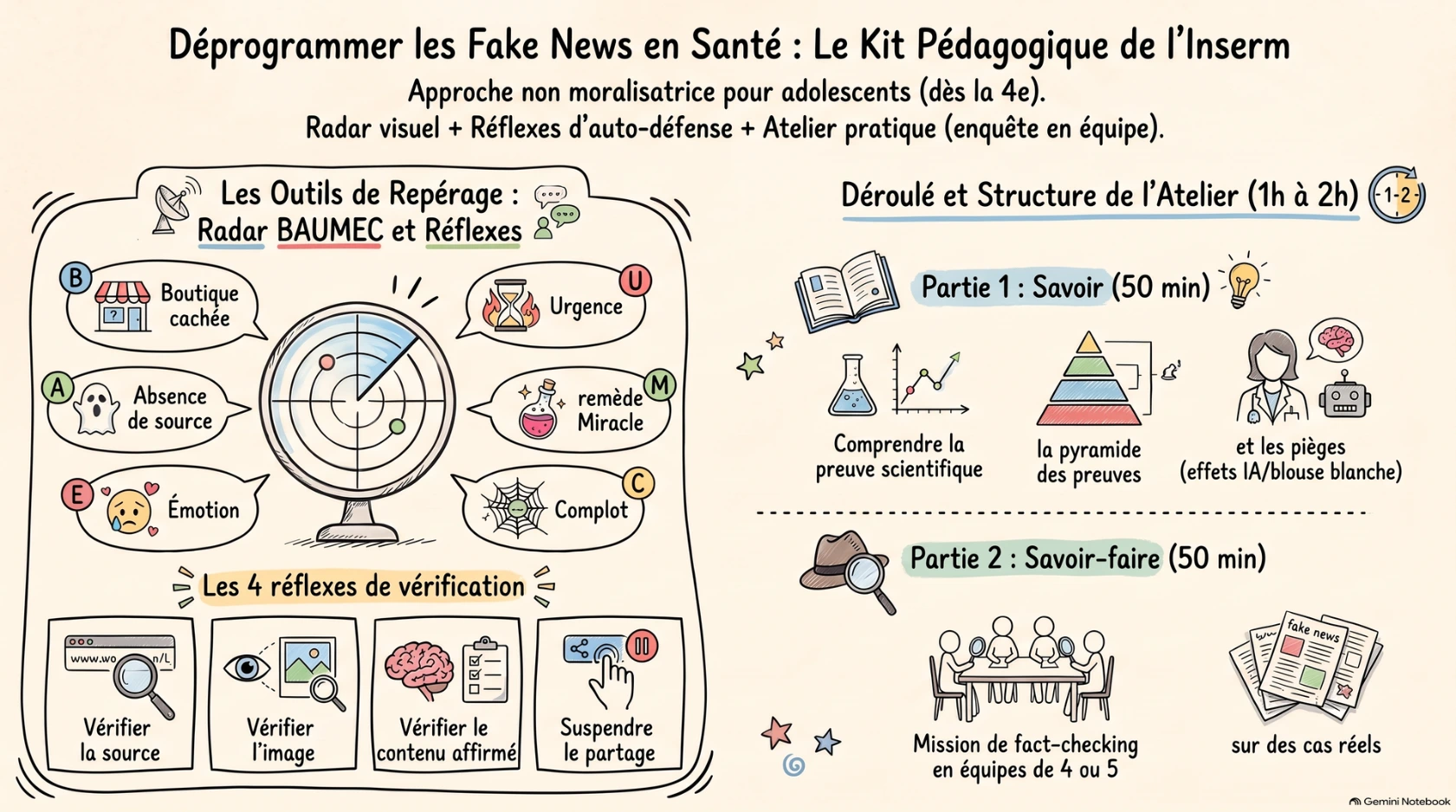
Part 1 (50 min, "knowledge") features a true/false game, the construction of scientific evidence, the pyramid of evidence, 4 verification reflexes and the alert signals radar (p. 7-39 ; slide 5). Part 2 (50 min, "skills") offers a quiz followed by a fact-checking mission in teams of 4 or 5, with roles and an investigation sheet, on 12 pieces of information (p. 40-57). Each slide is accompanied by notes: objective, duration, key messages, animation technique, example of speech, transition (slide 6). The conclusion recalls the basics of health and the weight of living conditions (p. 58-59).
2️⃣ KEY POINTS OF THE DOCUMENT
1️⃣ A radar with 6 easy-to-remember alert signals. "BAUMEC": Hidden shop, Absence of source, Urgency to share, Miracle remedy, appeal to Emotion, Conspiracy. The kit specifies that a single signal is not enough to conclude, but it invites verification (p. 36-37 ; support 05).
2️⃣ The scientific evidence explained simply. Hypothesis, protocol, results, then replication: "a study provides a piece to the puzzle." The pyramid of evidence contrasts "a study says that..." with "what emerges from all the studies" (p. 21-25).
3️⃣ Four verification reflexes. Inspired by Mike Caulfield's SIFT method: check who is speaking, check the image (reverse search with Google Lens or TinEye), check what is claimed, do not share before verification. The "white coat effect" and AI-generated faces are addressed (p. 29-35, 63).
4️⃣ A structured fact-checking mission. Groups of 4 or 5, defined roles (scientific lead, investigator, alert signal detector, image and AI expert, reporter), investigation sheet in 4 steps and detailed corrections (p. 45-46; supports 02 and 04).
5️⃣ Cases that are not all false. Mobile phone and brain cancer (rather solid information), pill ("not so simple"), depression more frequent in women (generally true, to be nuanced). The kit works on grey areas, not just true or false (p. 48, 50, 57).
3️⃣ ACTIONS FOR LOCAL ACTORS
1️⃣ Start with the 1-hour format. Hide the slides 57 to 70 and keep the "knowledge" part (slide 4). Allow for an hour of preparation, a projector and a test of the videos before the session (slide 7).
2️⃣ Choose the cases according to the group. Retain, among the 12 pieces of information (support 03), those that resonate with the group : nutrition, contraception, mental health, exams. Prepare with care, or set aside, sensitive topics (see section H).
3️⃣ Reuse BAUMEC outside of the workshop. Display the memo sheet (support 05) in the CDI, in the waiting room or in a youth welcome area. Use it as a quick grid in other actions : nutrition, emotional life, addictive behaviours.
4️⃣ Facilitate in pairs with a health professional. Inserm foresees a session led by the teacher alone or with a facilitator. A partnership with the school nurse, a sexual health centre or a youth consumer consultation helps to address issues regarding the pill, HPV, HIV or misused medications (p. 49-50, 53, 56).
5️⃣ Adapt for young people distanced from writing. Part 2 requires computers and internet (slides 3 and 7). Outside of school: use tablets, read the information aloud, work orally, reduce to 2 or 3 cases. The kit does not offer an adapted version : it is an unmet need.
6️⃣ Measure the effect of the session. Use the self-assessment from 1 to 5 (p. 61) and the student, teacher and facilitator questionnaires (p. 62). Check before the session that the links to the online questionnaires are still working.
4️⃣ ADDITIONAL REFERENCES
🔗 Internal resource Health Practices
Health Practices —
Health literacy: from individual competence to organisational responsibility - https://www.pratiquesensante.com/litteratie
🌐 External references (2025-2026)
1️⃣ Costagliola D., Maisonneuve H., Molimard M. — « Health information: assessment of strengths and weaknesses. Recommendations for a national information strategy and combating health misinformation », report submitted to the Government on 12 January 2026. Its first recommendation focuses on education for critical thinking from childhood. This report is already cited by the kit (p. 63): it provides the national framework.
Presentation — Sorbonne University
2️⃣ Government — « National strategy to combat health misinformation », presented on 12 January 2026. One of its four pillars aims at education for critical health literacy, prioritising young people and digital platforms.
3️⃣ Regional public health authority of Montreal — fact sheet « Digital habits: social networks and misinformation », 2025. It offers classroom activities and reminds us that correcting facts is not always enough to counter misinformation. Quebec context to transpose.
Fact sheet PDF — santepubliquemontreal.ca
Note : references 1 and 2 are public policy frameworks rather than methodological guides. They are included for their relevance and their direct link to educating young people about health information.
5️⃣ FREQUENTLY ASKED QUESTIONS (FAQ)
1️⃣ For which audience and for how long?
Students from Year 4 and high school students. The workshop lasts 1 hour (part « knowledge ») or 2 hours (with the fact-checking mission), in one or two sessions (slide 1 to 4).
2️⃣ Do you need to be a healthcare professional to facilitate?
No. The notes provide key messages and examples of speeches, to be adapted and not recited (slide 6). The kit advises going through the entire presentation and estimates about 1 hour of preparation (slide 7).
3️⃣ What materials should be prepared?
A projector for part 1. Computers or tablets with internet for part 2. Print the quiz and the survey sheets (slide 7; materials 01 and 02). The case videos are online (material 03).
4️⃣ What does BAUMEC mean?
Hidden shop, Absence of source, Urgency to share, Miracle remedy, call to Emotion, Conspiracy (p. 37; material 05). The kit presents it as a pedagogical tool for identification, not as an official scientific tool (p. 36).
5️⃣ What difference is there between disinformation and misinformation?
The intention. Disinformation is spread to deceive or harm. Misinformation is shared without the intention to deceive. The consequences can be the same (p. 18, 41).
6️⃣ How to avoid putting a student in difficulty?
Do not trap or single out those who are wrong (p. 7). Value the reasoning, even if incorrect (p. 40). Present self-assessment as a feeling, not a test (p. 61). Do not shame about health (p. 58-59).
7️⃣ Are all the mission's information false?
No. Some are accurate (mobile phone, p. 48), others nuanced (pill, p. 50; depression in women, p. 57). The verdict must be justified by evidence and sources (p. 45). Corrections: material 04.
6️⃣ REWRITING IN FALC
What is this kit about?
Inserm has created a workshop on false health information.
They are also called "infox" or "fake news".
The workshop is for students, starting from Year 9.
Young people see a lot of health information on social media.
Some information is true. Others are false.
A false piece of information can cause harm.
For example, a person may seek treatment too late.
How is the workshop conducted?
The workshop lasts 1 hour or 2 hours.
First, the students understand how science proves things.
One study is not enough. Multiple studies are needed.
Then, the students learn 4 steps to verify information.
Then they investigate in small groups about real information.
What is important to remember
The word BAUMEC helps to remember 6 warning signs.
B : someone wants to sell you a product.
A : the information does not say where it comes from.
U : you are urged to share quickly.
M : you are promised a magic remedy.
E : the information wants to scare you, or give you too much hope.
C : you are told that the truth is being hidden from you.
The 4 steps to verify
I look at who is speaking.
I check the image. It may be false or computer-generated.
I check what is being said.
I do not share before I have verified.
And also
A white coat proves nothing.
In teams, each student has a role.
Some information is true. One must think before judging.
7️⃣ CROSS-ANALYSIS — VALUES OF HEALTH PRACTICES
▸ Literacy : Memo sheet of 2 pages, acronym BAUMEC and explained vocabulary facilitate understanding; part 2 remains very written and no version for low readers is proposed (support 05; p. 16-18).
▸ Empowerment : Students become investigators, deliver a reasoned verdict and evaluate the workshop by questionnaire; their participation in the kit design is not mentioned (p. 45, 61-62).
▸ Participation : Votes, short debates and team roles structure the workshop; no co-construction mechanism for the content is described (p. 7, 46).
▸ Community health : The collective dimension is limited to the class group; the conclusion reminds that health also depends on the living environment, resources and access to care (p. 58-59).
▸ Ethics : The kit asks not to trap or blame and addresses the bias of naturalness and the white coat effect; cultural or social biases of the audiences are not addressed (p. 7, 12, 29, 58).
▸ Human rights : The kit is free and aims for everyone to have access to reliable information; the example on depression avoids the idea that women are “ weaker” (p. 57).
▸ Intersectorality : The workshop links school, public research, health institutions and verification media (AFP Factuel, Les Décodeurs…) (p. 30, 34).
▸ Partnership: A teacher and Inserm speaker duo is proposed, without a formal collaboration model (Inserm page).
▸ Fight against discrimination: The HIV case reminds us of the true modes of transmission and the mental health case evokes destigmatisation; discrimination is not named as such (p. 53, 55).
8️⃣ EVALUATION OF THE RELIABILITY OF THE RESOURCE
Scientific relevance
The kit is produced by a public research organisation. The sources are listed (p. 63-64): WHO, Council of Europe, National Academies (2025), national report of 2026, Cochrane (2025), Santé.fr. They are alongside press articles, some of which are older (Inserm 2018 on detox, Le Monde 2018). The BAUMEC radar is honestly presented as an educational tool, not as a validated tool (p. 36).
Points to review before use
• p. 49: the favourable effect of HPV vaccination on male fertility is stated affirmatively, without a precise source in the note.
• p. 50: the example of a risk that goes "from about 11% to 14%" does not specify either the population or the period; check the source before citing it.
• p. 64 / slide 79: title errors and typos in the list of sources.
• No published evaluation of the workshop's effectiveness to date; the feedback questionnaires are being collected (p. 62).
Operational relevance
It is high: timed outline, examples of speeches, corrections, printable materials and modular format. Limitations: strong dependence on digital (online videos, internet in part 2), number of slides exceeding the available time, which the kit itself recognises (slide 4), and preparation time of about 1 hour.
9️⃣ STRATEGIC HASHTAGS
#healthpractices #HealthFakeNews #CriticalThinking #HealthLiteracy #Infodemic #YouthPrevention #EMI #HealthEducation
You can support Health Practices: https://www.pratiquesensante.com/blog/annonces-28/pour-soutenir-pratiques-en-sante-3253
This article has been developed in accordance with the Charter
of the use of artificial intelligence of Health Practices.
Click on the image