🚨 Discriminations: 4 reproducible field devices that work in social centres in Seine-Saint-Denis🔍💡 Fighting against discrimination in popular neighbourhoods: four social centres in 93 detail their initiatives — inclusion of disabled children, anti-ageism carnival, common law workshops against non-recourse. With the obstacles named directly: budget instability, long timelines, team exhaustion. ⚡ Transferable, not theoretical. #FightingAgainstDiscrimination #CommunityHealth
📌This document shows what a local structure produces in practice that acts against discrimination — sometimes by naming them explicitly, often without designating them as such, through practices of welcome, access to rights, and co-construction rooted in daily life. It describes, step by step, four reproducible low-cost devices — inclusion of disabled children in leisure activities, a carnival against ageism co-constructed by retirees, role-playing workshops on common law, a mock trial written by young people. It also mentions what few publications write: the exhaustion of teams, funding that weakens from year to year, the feeling of doing the work that the institution no longer does. Usable from tomorrow to equip a team meeting, feed a shared diagnosis, or build an action with those most concerned.
Profession Suburb, the Federation of social centres of 93 and the students of the Mediterranean World master's at Paris 8
📜🔗LINK to the source
Audio Capsules of Health Practices 🎙️🎥 https://www.youtube.com/watch?v=CR2zjU9ETCg
1️⃣ ANALYTICAL SUMMARY
Paragraph 1 — A territory where discrimination is a measured fact, and structures in a pivotal position
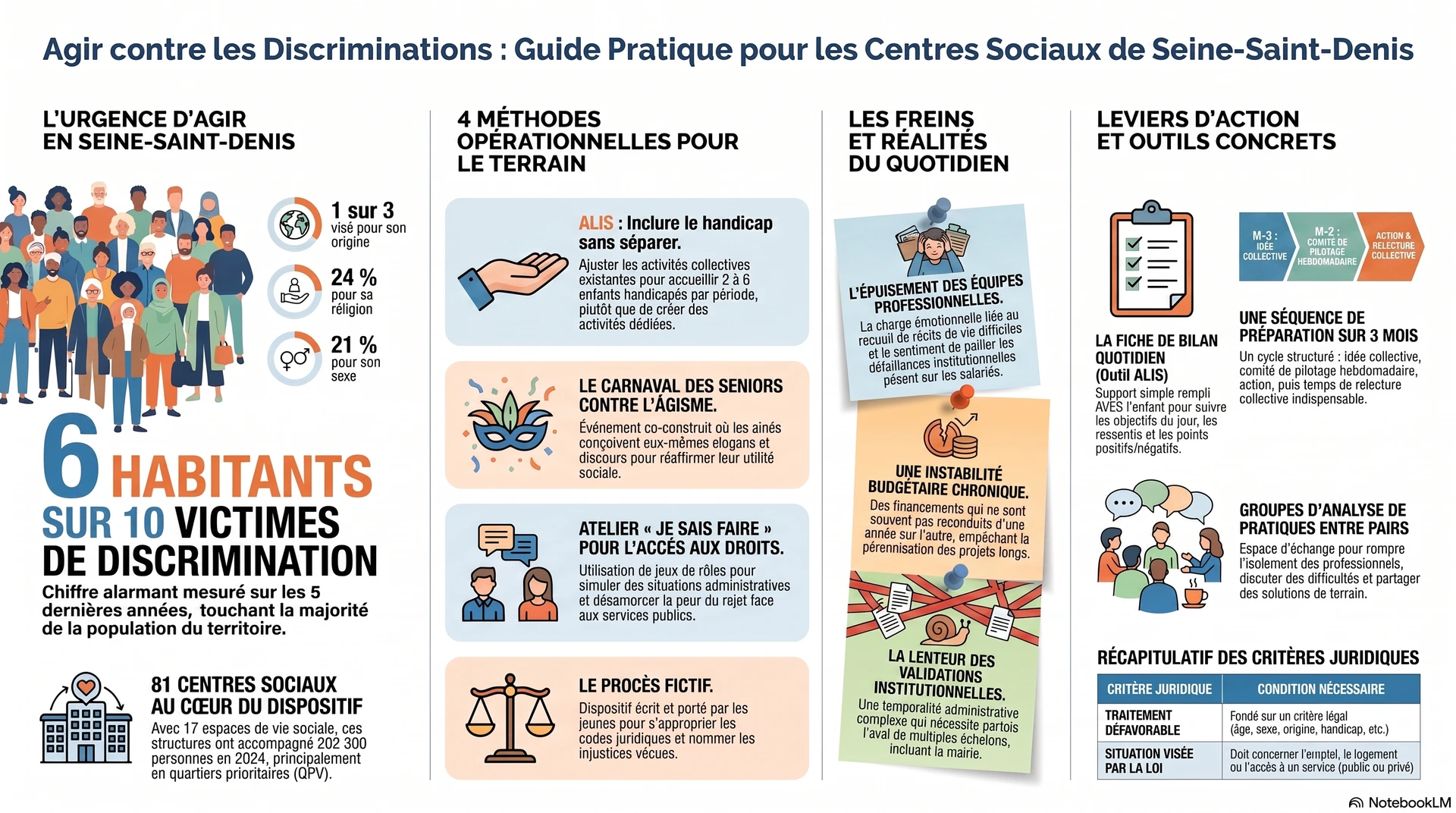
In Seine-Saint-Denis, more than 6 residents out of 10 report having been victims of discrimination in the last five years, more than 1 in 3 due to their origin, 24% due to their religion, 21% due to their gender (p. 8). The document reminds us that the fight against discrimination (LCD), very present in the early city contracts of the 2000s, has gradually faded from public action "in favour of" territorial inequalities, contributing to the invisibility of certain forms of discrimination (p. 5). In this context, the 81 social centres and 17 accredited social living spaces in the department — of which 89% are located in QPV, where 41.9% of the population resides (p. 8) — occupy a first reception position that places them on the front line to collect accounts of discrimination. The document highlights that this LCD is rarely named as such in the structures: it plays out in daily practices, unconditional welcome, and support for access to rights (p. 6).
Paragraph 2 — Three transferable methodologies and a candid diagnosis of the conditions of practice
The operational contribution consists of two blocks. First, project sheets detailed enough to be replicated : the ALIS system (p. 10) provides its protocol in three stages — preliminary meeting with the family, adjustment of the collective schedule rather than creating a separate activity, daily report sheet filled with the child; the engaged carnival of seniors (p. 11-12) documents a ramp-up over three months with a weekly committee; the workshop "I know how to do it" (p. 12-13) formalises role play as a tool for defusing the fear of common law. Then, a clear diagnosis of the barriers (p. 15-16): the accumulation of social emergencies that crush long-term projects, funding not renewed from one year to the next, a chain of institutional validation sometimes reaching the mayor, exhaustion and a feeling of devaluation among the teams. The document accompanies this observation with three tested levers: listening as a foundation, peer practice analysis, and federal training.
2️⃣ KEY POINTS OF THE DOCUMENT
1️⃣ The legal criterion of discrimination is clearly stated — and it is restrictive (p. 6-7)
The document recalls the definition retained by the Defender of Rights: discrimination requires two cumulative conditions — unfavourable treatment based on a criterion defined by law (sex, age, disability…) AND relating to a situation covered by the law (employment, service, housing…). Not every injustice is therefore legally a discrimination. The glossary (p. 7) also distinguishes between direct, indirect, and systemic, the latter being defined as embedded in the ordinary functioning of organisations and not addressable in a one-off manner. It is the most directly reusable conceptual tool in training.
2️⃣ The ALIS protocol: include without creating a separate system (p. 10)
Two to six places are open during each holiday period for children with disabilities at the Félix Merlin sociocultural centre (Épinay-sur-Seine), with priority given to children distanced from school culture or who are out of school. The central methodological principle is explicit: not to create a dedicated activity, but to adjust each collective activity — for example, by assigning a different role to the child in a sports activity. The follow-up is based on a form filled out daily with the child (objectives of the day, feelings, positive and negative points), which serves as a memory from one session to the next. The system is inspired by the Ulis of the National Education, but deliberately freed from the injunctions of the school curriculum.
3️⃣ The seniors' carnival: co-construction up to the design (p. 11-12 and 17)
The event on 4 October 2025 in Montreuil was born from an inter-centre stay in April 2025 bringing together ten social centres from six departments. The idea came from the seniors themselves (“we need to hold a demonstration… because people do not realise how useful we are”). The committee met once a week from August. Slogans, speeches, material collection, and flash-mob choreography were conceived and carried out by the seniors; the lead professional describes herself as a coordinator and not as a designer (p. 17). A simple participatory device deserves to be noted: a large blank sign “And for you, what is the purpose of seniors?” filled with post-its by passers-by, still displayed in the large hall of the centre at the time of the interviews (p. 12).
4️⃣ The workshop “I know how to do it”: naming the mechanism of self-exclusion (p. 12-13)
Carried by the Adept (Drancy), a social centre specialised in working with Travellers, this workshop uses role-playing games in a fictional common law situation — "how to ask for something without being rejected, pushed away." The accompanying analysis is the most nuanced in the document: marginalisation is not subjective, it stems from the systemic discrimination of public services; assigned to an otherness, individuals self-exclude from the administrative space by renouncing to assert their rights. The document supports this finding with the 2021 report from the Defender of Rights Travellers: removing barriers to rights and a study from the European Union Agency for Fundamental Rights (2020).
5️⃣ A diagnosis of the barriers that names exhaustion (p. 15-16)
Three barriers are documented: social urgency and the specificity of the public that compel prioritisation ("given the existing institutional failure, I find myself doing the work of a social worker"); budgetary instability and the timing of validations, implementation may depend on several public structures and sometimes on the mayor's approval; finally exhaustion and the feeling of being undervalued, the emotional burden of working with exposed populations is not compensated by institutional or political recognition. The conclusion (p. 18) acknowledges the limit: social centres cannot alone remedy systemic failures, and without commitment from public policies, field actions risk becoming exhausted, draining teams and the public.
3️⃣ ACTION PATHS FOR LOCAL ACTORS
1️⃣ Take up the daily report sheet from ALIS as a tool for individualised welcome (p. 10)
The three criteria — objectives of the day, feelings of the child, positive and negative points — constitute a light tracking support, transferable to any collective reception, including outside of disability. Point of caution: the document does not specify either the format, the future of these sheets, or the methods of preservation. Necessary adaptation: formalise a GDPR framework and a duration of preservation before deployment.
2️⃣ Replicate the carnival preparation sequence over three months (p. 11 and 17)
The calendar is reproducible: idea stemming from a collective inter-structure time → weekly committee starting from D-2 months → repetition of the public speaking just before the event → time for collective review after (p. 12). This last time is most often neglected and the document shows that it produces value: it allowed the organisers to reconstruct the chronology, to express divergent readings of the event (political significance for one, moment of solidarity for the other) and to formulate the wish for a new edition.
3️⃣ Set up a low-cost public speech collection device (p. 12)
The blank sign « And for you, what is the purpose of seniors? » filled with post-its is a mobilisation tool immediately transferable to any theme (ableism, origin, sexual orientation, precariousness). Almost no cost, visible restitution, and lasting effect since the board remains displayed in the structure.
4️⃣ Build a role-playing workshop on common law (p. 12-13)
The format « I know how to do it » aims to share practical keys (management of deadlines, forms) to demystify administrative codes. It can be adapted for any audience exposed to non-recourse. Identified unmet need: the document does not provide any standard scenarios, animation grids, or session duration — these elements need to be constructed locally.
5️⃣ Establish practice analysis groups among professionals (p. 16)
Explicitly recommended as a response to burnout: helping each other, discussing difficulties, feeling less alone, "sometimes making a call for help." To be articulated with the use of the local associative network for materials, the mobilization of residents, and logistics. This is the least costly and most immediately actionable avenue in the document.
6️⃣ Bring together the "discrimination" projects from the health and medico-social sector (p. 13 and 17)
Two examples invite this: the work of Adept with the EMPP (mobile psychiatric teams for precarious situations), who intervene anonymously during the sessions; and the parental respite stay of Félix Merlin, built with a specialized disability association, parents, health professionals, and the Child/Adolescent Medical-Social Centre. Necessary adaptation: these partnerships here rely on informal acquaintance; their reproduction assumes formalization (agreement, identified referent, timing).
4️⃣ ADDITIONAL REFERENCES
🔍➕ For more information, see the articles referenced by "Practices in Health" on the theme OF DISCRIMINATIONS ➡️🔗https://www.pratiquesensante.com/blog/tag/discriminations-217
1️⃣ Defender of Rights — Preventing discrimination in care pathways: an equality issue (6 May 2025) Report based on a call for testimonies conducted at the end of 2024 with patients and healthcare professionals. Documents the discrimination at the entry into the healthcare system and during care (precarity, AME/CSS, perceived origin, disability, transgender people), and emphasizes their structural nature and not just individual.Complementarity : extends the mechanism of self-exclusion analysed on p. 12-13 of the document to the health field. 🔗 https://www.defenseurdesdroits.fr/rapport-prevenir-les-discriminations-dans-les-parcours-de-soins-un-enjeu-degalite-853
2️⃣ CNCDH — Follow-up opinion on the effectiveness of the rights of older people (A-2025-4), adopted on 18 March 2025; Assessment over twelve years (2013-2025) of the fight against ageism in France. Formulates five recommendations, two of which are directly actionable in social centres: strengthen the fight against ageism through awareness and training, and improve the involvement of older people in the development of public policies that concern them. Complementarity : institutional reference framework for an engaged carnival-type project (p. 11). 🔗 https://www.cncdh.fr/publications/avis-sur-leffectivite-des-droits-des-personnes-agees-2025-4
3️⃣ CNSA (with ODAS) — Build a public policy to combat the isolation of older people. Thematic and methodological guide, September 2025; Methodological guide in two phases (build a shared territorial strategy / implement), with identification of partners, participatory diagnostic tools, outreach approaches and an overview of levers. The FCSF was consulted in its development and social centres are identified as essential actors in local social animation.Complementarity : provides the methodological tools that the analysed document, by its narrative nature, does not supply. 🔗 https://www.pratiquesensante.com/blog/pratiques-15/construire-une-politique-publique-de-lutte-contre-l-isolement-des-personnes-agees-5336
5️⃣ FAQ
1️⃣ Specifically, from when does a situation perceived as unfair legally become discrimination?
Two conditions must be met cumulatively : the unfavourable treatment must be based on a criterion defined by law (sex, age, disability, origin…) and fall under a situation covered by the law (access to a job, a service, housing…). An injustice or violence does not therefore automatically fall under discrimination in the legal sense. → p. 6 and p. 7 (glossary)
2️⃣ Our teams never speak of “fighting against discrimination”. Is this a problem?
The document answers that no, not necessarily: the LCD is not always explicitly named in social centres, but it is present in daily practices and is carried out through concrete actions. It does, however, highlight the importance of naming it, if only to make it visible to funders and institutions. → p. 6
3️⃣ How many places can reasonably be opened in an inclusion scheme for leisure activities?
The ALIS scheme opens two to six places per school holiday period, with dedicated inclusive facilitators. The document specifies that demand exceeds supply. → p. 10
4️⃣ Should specific activities be created for children with disabilities?
No — this is the explicit principle of ALIS. The aim is to include them in all moments with the other children and to adjust each activity, for example by assigning a different role in a sports activity. The burden of adaptation rests on the overall team, not on the child. → p. 10
5️⃣ How to prevent ‘co-construction’ from just being a word?
Three concrete indicators emerge from the described cases: the idea of the project comes from the people involved and not from the team (carnival, p. 17); the people involved manage structuring dimensions of the project (slogans, speeches, choreography, material collection); and the structure establishes modalities of power sharing, such as the complete self-management of a space — the sewing workshop of the Floréal community centre, where participants organise the activity themselves and train each other. → p. 17-18
6️⃣ Why do our projects take so long to start?
The document identifies temporality as a structural barrier: social centres depend on several public structures, several phases of validation precede implementation, and depending on the size of the project, the mayor's approval may be required. The implicit recommendation is to anticipate well in advance (“We work over a longer time frame, with a lot of anticipation”). → p. 15
7️⃣ Where to direct a person who thinks they have been discriminated against?
The 3928, free national number for victims and witnesses of discrimination, accessible by phone, online chat and via a platform dedicated to deaf or hard of hearing people. The document also refers to the Defender of Rights and the associative guide of the Seine-Saint-Denis departmental council. → p. 20
6️⃣ REWRITING IN EASY TO READ FRENCH
What this document says
This document talks about Seine-Saint-Denis.
It is a department near Paris.
Many people there are victims of discrimination.
Discrimination is when a person is treated badly.
They are treated badly because of their age.
Or because of their disability.
Or because of their religion.
Or because of their origin.
Or because of their sex.
The figures
More than 6 out of 10 people say they have been victims of discrimination.
1 in 3 people say it is because of their origin.
24 out of 100 people say it is because of their religion.
21 out of 100 people say it is because of their sex.
Who helps these people?
Social centres help these people.
A social centre is a place open to everyone.
Activities are held there.
People talk about their problems there.
Help is requested for paperwork there.
In the department, there are 81 social centres.
In 2024, these centres helped 292,300 people.
Three projects described in the document
Project 1: welcoming disabled children
A social centre in Épinay-sur-Seine welcomes disabled children.
It is during the school holidays.
There are 2 to 6 places available each holiday.
Beforehand, the team meets the child and their parents.
The team gets to know the child.
Then, the child plays with the other children.
No separate activities are done for them.
The activity is changed so that they can play too.
Every evening, an adult talks with the child.
They write together about how the day went.
Project 2: the seniors' carnival
In Montreuil, elderly people held a carnival.
It was on 4th October 2025.
They wanted to show that they are useful.
They were fed up with being forgotten.
They prepared everything themselves.
They wrote the slogans.
They wrote the speeches.
They prepared a dance.
They met once a week.
On the day of the carnival, they marched in the square.
They sang and danced.
Journalists came.
Project 3: learning to ask for one's rights
In Drancy, a social centre helps Travellers.
Many people do not dare to ask for their rights.
They are afraid of being rejected.
So the centre organises role-playing games.
People act out a scene.
For example: asking for a document at an office.
This way, they train without risk.
Afterwards, it's easier in real life.
What is difficult for the teams
The teams lack money.
Funding can stop from one year to the next.
Projects take a long time to start.
It requires a lot of permissions.
Sometimes, the mayor's approval is needed.
The teams are tired.
They hear hard stories every day.
Often, no one thanks them.
What helps the teams
The teams talk to each other.
They meet to discuss their difficulties.
It feels good.
The teams work with local associations.
They attend training.
The teams build the projects with the residents.
Not for the residents.
This is the most important rule of the document.
Need help?
Call 3928.
It's a free number.
It's for people who are victims of discrimination.
It's also for people who have witnessed discrimination.
There is also an online chat.
There is a service for deaf people.
7️⃣ CROSS-ANALYSIS — VALUES OF HEALTH PRACTICES
Literacy — Treated indirectly: the workshop "I know how to do it" explicitly aims at demystifying administrative codes and sharing practical keys (deadlines, forms) with people struggling with institutional writing (p. 12-13). However, the document itself does not offer any simplified version or tools adapted to varying levels of understanding.
Empowerment — This is the guiding thread of the document, formulated under the term "power to act": social centres are described as catalysts for the power to act of residents (p. 6), and the carnival is presented as having enabled seniors to develop their agency in a social context that devalues older people (p. 17).
Participation — Several concrete mechanisms are described: senior committees, residents' councils, collaborative workshops, and especially the self-management of spaces where participants manage the organisation of their activity themselves and train among peers (p. 17-18). The question of the risk of a top-down approach is explicitly raised (p. 18).
Community health — The collective dimension is structuring (unconditional welcome, speaking groups, collective action), but health is only intermittently addressed: EMPP, health prevention in the cycling project, access to care as a fundamental right. No project is built on an explicit health entry.
Ethics — Biases are identified on the side of institutions (systemic discrimination in public services, p. 13) and on the side of professionals ("questioning the framework", p. 21). However, the document does not lead to any formalised ethical reflection on its own production conditions or on the partial anonymisation of the cited individuals (first names only).
Human rights — Approach centred on effective access to rights and the fight against non-recourse, explicitly linked to Nancy Fraser's conception of social justice based on representativity and full public participation (p. 6).
Intersectorality — Documented partnerships with the medico-social sector (specialised disability association, CMS children/adolescents), mental health (EMPP), justice (legal professionals for the Trajectoires project), decentralised state (sub-prefecture, “Quartier d'Avenir” scheme) and national education (Ulis inspiration).
Partnership — The described collaborations are primarily based on mutual knowledge and individual commitment; no formalised model (standard agreement, charter, shared governance) is proposed. This is an implicitly recognised limitation when the document calls for “spaces for exchanging practices” and time (p. 18).
Fight against discrimination — The very subject of the document. Non-judgment is explicitly claimed as a component of professional DNA (p. 21), and the diversity of criteria is taken into account: disability/ableism, age/ageism, origin, belonging to the Travellers/anti-Roma sentiment, religion, sex, gender identity (via resources p. 20). Intersectionality, however, is never named as a concept, even though several described situations involve cumulative criteria.
8️⃣ EVALUATION OF THE RELIABILITY OF THE RESOURCE
Scientific relevance — moderate, and this is acknowledged
The document mobilises strong academic and institutional references: Milena Doytcheva (2010) on the invisibilisation of the LCD in urban policies, Fabrice Dhume (2016) on systemic discrimination, Nancy Fraser on social justice, the 2021 report from the Defender of Rights on Travellers, a study from the European Union Agency for Fundamental Rights (2020), the SIG City 2024 data and INSEE. The methodology, however, is that of a pedagogical commission: semi-directive interviews conducted in January 2026 with 7 professionals and 3 users, in 4 structures within the same department. Neither survey protocol, nor interview grid, nor analysis method are specified. No impact measures of the described projects are produced: success is established by the testimony of the project leaders (“demand exceeds supply”, “it has changed a lot of things”). The discrimination data on p. 8 are presented without year or source, whereas the reference departmental surveys date from 2019-2020.
9️⃣ STRATEGIC HASHTAGS
#healthpractices #FightAgainstDiscrimination #SocialCentres #PopularEducation #PowerToAct #AccessToRights #Ageism #NonUse