🧠💡 Creativity and critical thinking: two key skills for empowerment and health literacy. The OECD provides an operational framework tested in 11 countries, with 100 concrete lesson plans and directly applicable metacognitive tools. #HealthLiteracy #Empowerment #HealthPractices #PopularEducation #CriticalThinking #SocialInnovation #CitizenParticipation #CommunityHealth
📌 This document is essential for professionals in education, health prevention, and community development as it offers a concrete and internationally validated methodology for developing two fundamental transversal skills: creativity and critical thinking. Field actors in public health and prevention will find directly transferable metacognitive tools to enhance empowerment, health literacy, and citizen participation. The structured competency framework revolves around four actions — searching, imagining, doing, and reflecting — providing an operational framework for designing educational interventions that promote the autonomy of audiences and their ability to critically analyse health information. Particularly relevant for professionals and volunteers who lead health education, prevention, or socio-professional integration workshops for diverse audiences.
Source: 📒 Developing students' creativity and critical thinking: Concrete actions for schools
✍️ Stéphan Vincent-Lancrin, Carlos González-Sancho, Mathias Bouckaert, Federico de Luca, Meritxell Fernández-Barrerra, Gwénaël Jacotin, Joaquín Urgel and Quentin Vidal - OECD (Organisation for Economic Co-operation and Development) — Centre for Educational Research and Innovation (CERI) - 2020📜🔗LINK to the source - FR
Link to source - ENNumber of pages: 378
1. ANALYTICAL SUMMARY
Context and issues: an international project to transform educational practices
The OECD coordinated a five-year action-research project involving over 400 teachers, 17,000 students, and 13 teams from 11 countries (Brazil, Spain, United States, Russian Federation, France, Hungary, India, Netherlands, Slovakia, United Kingdom, and Thailand). The aim was to establish a common professional language on creativity and critical thinking in primary and secondary education, and to provide teachers with concrete tools to develop these skills in their students within existing curricula. The project is based on an economic and social observation: creativity and critical thinking are the most sought-after skills in the job market in the face of increasing automation, and are essential pillars for individual well-being and the democratic functioning of societies. Teachers, although aware of their importance, find it difficult to teach and assess them systematically.
Operational contributions: frameworks, lesson plans, and a validation protocol
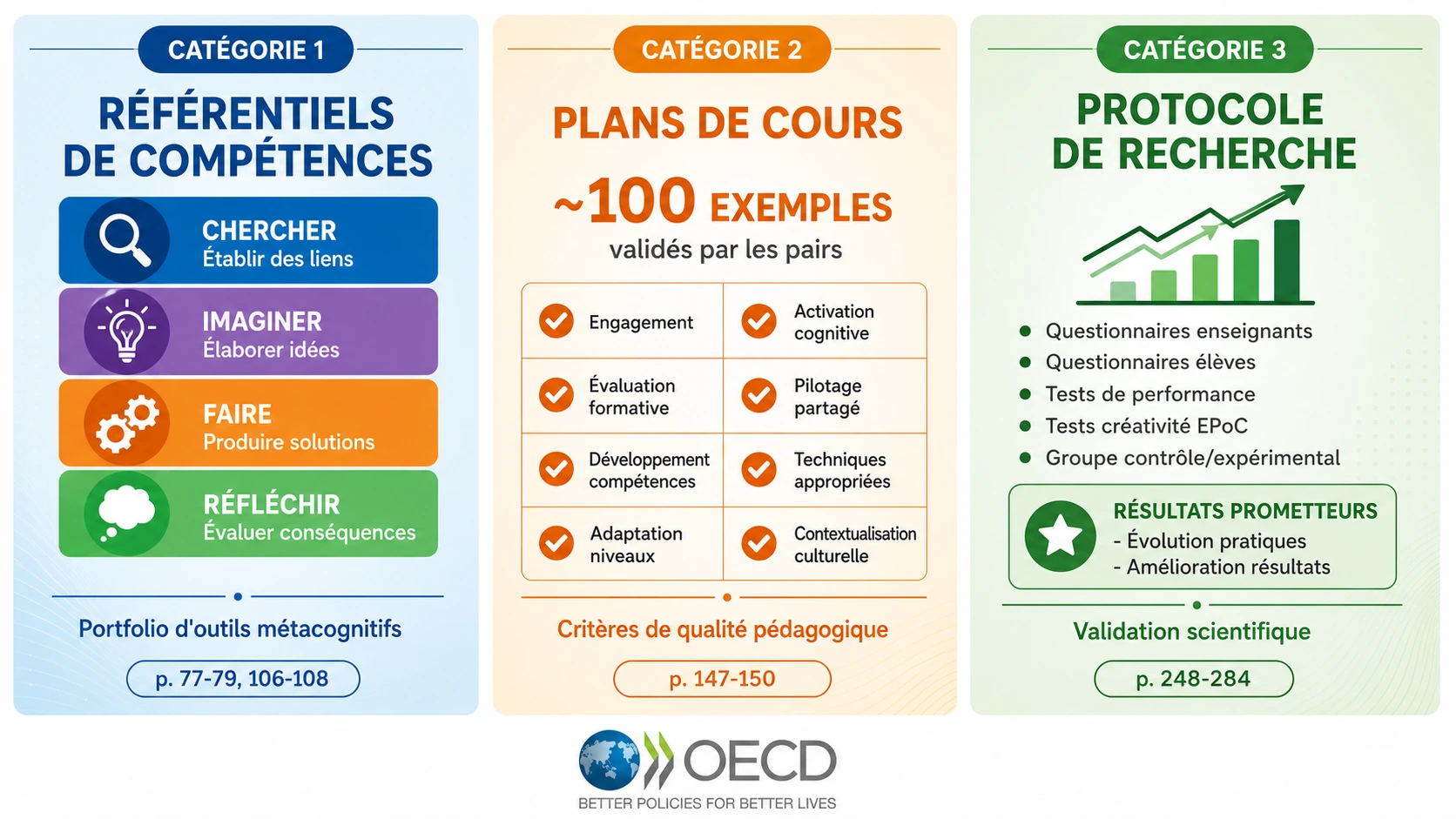
The document presents three categories of concrete deliverables tested in the field. Firstly, a portfolio of competency frameworks (generic global, generic adapted for classroom use, and five specific frameworks by discipline: mathematics, science, music, visual arts, languages) structured around four action verbs — search, imagine, do, and reflect — enabling teachers to explicitly and systematically identify and develop these skills in their students (p. 77-79). Secondly, about 100 examples of peer-reviewed lesson plans, illustrating how to transpose these concepts into different subjects and educational levels, accompanied by eight criteria for lesson development to ensure their pedagogical quality (p. 147-150). Thirdly, a quasi-experimental research protocol with survey instruments (teacher and student questionnaires, performance tests, EPoC creativity tests) allowing for the evaluation of the effectiveness of the implemented practices, with promising preliminary results on the evolution of teaching practices and student outcomes (p. 248-284).
2. KEY POINTS OF THE DOCUMENT
1. Operational definition of creativity and critical thinking for the educational context
Creativity is defined as the ability topropose new ideas and solutions, while critical thinking involvesquestioning and evaluating ideas and solutions(p. 78). These two skills are presented as distinct but complementary, specific to disciplinary areas (creativity in mathematics does not automatically guarantee creativity in visual arts), and each mobilises four main dimensions: searching (establishing links with other concepts), imagining (developing original ideas for creativity; examining multiple viewpoints for critical thinking), doing (producing a personal solution for creativity; explaining strengths and weaknesses using logical criteria for critical thinking), and reflecting (on novelty and its consequences for creativity; on possible alternatives for critical thinking) (p. 79).
2. Competency frameworks as metacognitive tools in the service of teaching
Competency frameworks are teaching and formative assessment tools that promote metacognitive learning — that is, the use of deliberate strategies that help students reflect on their learning and better self-regulate (p. 74-76). Research shows that metacognitive strategies significantly improve learning outcomes with an effect size of 0.7 in Hattie's meta-analyses (2009), equivalent to a 7-month advance in learning according to the Education Endowment Foundation (p. 76). In the context of the project, 75% of teachers in the experimental group adopted the competency frameworks, primarily to design new lesson plans (55%), improve existing courses (50%), and discuss with students the ins and outs of creativity and critical thinking (45%) (p. 90-91).
3. Eight criteria for course development to ensure the development of skills
Course plans that develop creativity and critical thinking must meet eight operational criteria: (1) student engagement and motivation; (2) cognitive activation linked to existing knowledge; (3) opportunities for formative assessment; (4) shared management of the learning process between teachers and students; (5) development of at least one dimension of creativity or critical thinking; (6) use of appropriate pedagogical techniques; (7) adaptation to different levels of competence; (8) cultural and disciplinary contextualisation (pp. 147-150). These criteria allow for the design of educational activities that mobilise skills while respecting existing curricula, without requiring major curricular reform.
4. The professional development of teachers as an essential lever for change
The success of the implementation relies on three pillars of professional development: training sessions (ideally 4 to 5 days), personalised support for teachers by tutors or mediators, and participation in a professional learning community that fosters dialogue among peers (pp. 184-202). The experience in Brazil shows that the active involvement of school leaders and education system officials (school visits, organisation of workshops, logistical support) is a determining factor for success (pp. 199-201). Teachers reported that the improvement of their professional skills was mainly due to "classroom practice" and the concrete observation of students' positive development, thereby reinforcing their intrinsic motivation (p. 202).
5. Promising preliminary effects on teaching practices and student outcomes
The quantitative analysis of the pilot phase reveals positive trends among students in the experimental group: improvement in creativity test scores (EPoC) for primary school students across several teams, positive development in learning dispositions, interest in STEM (science, technology, engineering, mathematics) and AVM (visual arts and music) subjects, and better understanding of creativity and critical thinking concepts (pp. 270-274). Teachers' pedagogical practices have significantly evolved: increased use of techniques that promote the exploration of alternative ideas, open questioning, self-assessment by students, and peer collaboration (pp. 224-228). Approximately 75% of school leaders in the experimental group felt that the project had fostered unusual and positive collaboration among teachers (p. 17).
3. ACTION POINTS FOR LOCAL STAKEHOLDERS
1. Adapt the competency frameworks to health education and prevention contexts
Public health professionals can transpose the adapted generic framework for classroom use (p. 79) to structure their educational interventions. For example, in a workshop on balanced nutrition, use the dimension 'search' to identify participants' assumptions about nutrition, 'imagine' to explore alternatives to current eating habits, 'do' to co-construct a menu that fits the budget and preferences, and 'reflect' to assess feasibility and potential barriers. The document provides examples of science lesson plans ('Evaporative Cooling', p. 164) and interdisciplinary plans ('My Region: What if...?', p. 172) that can be directly adapted to environmental health themes or social determinants of health.
2. Establish communities of practice among professionals to strengthen pedagogical skills
Draw inspiration from the Brazilian model (p. 195-196) by creating networks of 'educational mediators' tasked with observing practices, identifying best experiences, and facilitating exchanges between structures. Organise quarterly collaborative workshops where professionals collectively design health intervention plans that integrate creativity and critical thinking, then test these tools in real situations before sharing their feedback. Develop a collaborative digital platform (based on the Brazilian team's model) that allows for the publication of tools, posing questions, and providing constructive comments among peers (p. 196).
3. Use evaluation grids to measure the development of critical skills among audiences
The OECD assessment frameworks for creativity (p. 83) and critical thinking (p. 85) propose four levels of progression: underdeveloped skills, emerging, excellent, and exceptional. These frameworks can be adapted to formatively assess the progression of participants in therapeutic patient education (TPE), socio-professional integration, or literacy programmes. For example, in a health literacy workshop, observe whether participants move from the 'underdeveloped' level (repetition of information without analysis) to the 'emerging' level (questioning sources) and then to 'excellent' (critical comparison of multiple sources and identification of underlying assumptions).
4. Train facilitators and volunteers in pedagogical techniques that promote critical thinking
Table 4.2 (p. 157) lists concrete pedagogical techniques: Socratic questioning to develop critical thinking, mind maps to visualise connections between concepts, brainstorming to stimulate imagination, problem-based learning to encourage investigation, and peer assessment to enhance reflection. Organise two-day training sessions for health facilitators and social mediators, alternating theoretical input on competency frameworks and practical applications of these techniques in realistic scenarios (e.g., facilitating a workshop on vaccination, screens, or stress management).
5. Integrate the assessment of unmet needs and necessary adaptations into any intervention approach
The document highlights that creativity and critical thinking are specific to disciplinary fields and must be assessed in context (p. 73). Before deploying a health education programme, identify with target audiences the critical skills they deem necessary (e.g.: the ability to decode food advertisements, to assess the reliability of health information on the internet, to question social norms related to body image). Adapt the frameworks and intervention plans according to the levels of literacy, language barriers, and the socio-economic realities of the participants, in accordance with the cultural contextualisation approach promoted by the project (p. 150).
4. ADDITIONAL REFERENCES
1. Réseau Canopé (France) – Framework and grids for assessing critical thinking in the classroom (2024) -Practical guide from the National Education Scientific Council (CSEN) offering assessment grids and teaching strategies for critical thinking, complementary to OECD tools. Available online.https://www.reseau-canope.fr/fileadmin/user_upload/Projets/conseil_scientifique_education_nationale/groupes_de_travail/CSEN_Grille_evaluation_esprit_critique_web.pdf
2. Cnesco (France) – Summary report "Knowledge and Skills: Developing Critical Thinking" (March 2025) -Summary of recent research on teaching critical thinking in the digital age, with recommendations for training informed citizens in the face of misinformation. Integration of issues related to artificial intelligence and fact-checking.https://www.cnesco.fr/fr/ressources/dossier-de-synthese-nouveaux-savoirs-et-nouvelles-competences-des-jeunes/
3. IBO (International Baccalaureate) – The role of metacognition in teaching and learning (2024) -Research document on interventions aimed at improving students' metacognitive abilities, with concrete pedagogical practices: the art of asking metacognitive questions, reciprocal teaching, keeping a reflection journal.https://revues.acaref.net/wp-content/uploads/sites/3/2025/01/8-Mamadou-Diang-Diallo.pdf
5. FREQUENTLY ASKED QUESTIONS (FAQ)
1. What is a competency framework and how can it be concretely used in a health education intervention?
A competency framework is a one to two-page document describing the important criteria for a complex task and, ideally, the different levels of quality of execution (p. 74-75). In the OECD project, the generic framework adapted for classroom use (p. 79) structures creativity and critical thinking around four actions: searching, imagining, doing, and reflecting. To use it in a health education workshop, start by identifying which dimension(s) you wish to develop (e.g., "imagining" for creativity = generating original ideas; "searching" for critical thinking = identifying and questioning assumptions), then design a pedagogical activity that explicitly mobilises this dimension (e.g., asking participants to propose three alternatives to a problematic health habit, and then analysing the underlying assumptions of each alternative). The frameworks also serve as a dialogue tool with participants to make visible what is expected of them.
2. How long does it take to train facilitators or professionals to use these tools?
The project's experience shows that a single introductory training session is insufficient for sustainable ownership (p. 200-201). The teams that achieved the best results offered a series of 4 to 5 training days spread over several months, complemented by regular personalised follow-up (in-situ visits, individual feedback) and participation in a professional learning community (collaborative workshops, digital exchange platform) (p. 184-202). In the French context (CRI and Lamap teams), training concentrated over 2 to 3 days followed by periods of independent experimentation and then regroupings for practice analysis proved effective (p. 305-315). The key is to plan for long-term support (a minimum of 6 months) rather than a one-off training.
3. Can creativity and critical thinking be developed without profoundly modifying the content of existing intervention programmes?
Yes, this is precisely one of the major contributions of the project: the lesson plans show that it is possible to develop these skills within the framework of existing school programmes, without major curriculum reform (p. 17). Teachers have integrated the objectives of creativity and critical thinking by modifying their teaching techniques (open questioning, exploring alternatives, self-assessment) rather than changing the disciplinary content (p. 224-228). For example, the mathematics lesson plan "A World with Limited Resources" (p. 166) teaches the concepts of proportions and statistics while developing students' ability to imagine creative solutions to social problems. Similarly, in health education, a traditional workshop on oral hygiene can incorporate a critical thinking dimension (analysing toothpaste advertisements, identifying fallacious arguments) without altering the underlying message.
4. How can we formatively assess participants' creativity and critical thinking skills?
The document proposes two types of tools: the assessment grids for final productions (p. 83-85) and the observation of the learning process. The assessment grids include four levels of progression: at level 1 (unused skills), the participant demonstrates a good technical mastery of the subject but does not mobilise creativity or critical thinking; at level 2 (emerging skills), they show effort but with still partial technical mastery; at levels 3 and 4 (excellent and exceptional), they combine technical mastery and effective mobilisation of skills (p. 82-85). In practice, formative assessment also involves observing behaviours in workshops: does the participant ask open questions? Do they explore several alternatives before choosing? Do they compare different viewpoints? Do they self-assess reflectively? (p. 75-76). The “capsules” used in student questionnaires (p. 262-264) can be adapted to measure participants' understanding of concepts.
5. What are the main mistakes to avoid when implementing interventions aimed at developing critical thinking?
First mistake: considering creativity and critical thinking as generic skills that can be automatically transferred from one domain to another. The document emphasises their disciplinary specificity: being creative in visual arts does not guarantee being creative in solving public health problems (p. 73). Second mistake: limiting oneself to playful activities without real cognitive activation. The criteria for course development (p. 147-150) specify that engagement must be accompanied by demanding intellectual work linked to existing knowledge. Third mistake: neglecting formative assessment and providing regular feedback to participants on their progress (p. 75). Fourth mistake: offering a one-off training without follow-up over time or a learning community among professionals (p. 200-201). Fifth mistake: using competency frameworks solely for summative assessment, when they are primarily metacognitive tools intended to make thought processes visible and to promote self-regulation of learning (p. 74-76).
6. Are the proposed tools suitable for audiences in vulnerable situations or with comprehension difficulties?
The document addresses the issue of adaptation and pedagogical differentiation. Criterion 7 for course development (p. 150) states that activities must be adaptable to different levels of competence, allowing each participant to progress at their own pace. Several national teams have worked with disadvantaged groups: in Brazil, the team collaborated with institutions in the state of Santa Catarina that cater to students from socio-economically disadvantaged backgrounds (p. 289-295); in India, the interventions focused on rural and semi-urban areas with significant socio-economic disparities (p. 325-329). The results show that students from disadvantaged backgrounds particularly benefited from the experience on certain indicators (p. 273). However, the document does not provide an Easy to Read and Understand (FALC) version of the frameworks, which limits accessibility for audiences with low literacy levels. An adaptation in FALC of the key concepts would be necessary for optimal use in health prevention.
7. What concrete results have been observed in participants who benefited from these pedagogical approaches?
The quantitative analysis of the pilot phase reveals several statistically significant positive effects (pp. 270-274). Among the students in the experimental group: improvement in scores on the EPoC creativity test, particularly in divergent thinking (the ability to generate multiple original ideas) for primary school students; positive evolution of learning dispositions (curiosity, perseverance, openness); increased interest in STEM and AVM subjects; better understanding of the concepts of creativity and critical thinking measured by the "capsules"; improvement in self-assessment practices and peer collaboration. Teachers in the experimental group reported observing increased attention in class, greater engagement in activities, and a greater ability to question and propose alternatives among their students (p. 237). Approximately 75% of school leaders felt that the project had fostered unusual and positive collaboration among teachers, providing unprecedented professional development opportunities (p. 17).
6. REWRITING IN EASY TO READ AND UNDERSTAND (FALC)
What this document says
What is this document about?
This document talks about 2 important skills: creativity and critical thinking.
Creativity= finding new ideas.
Critical thinking= asking questions about ideas.
Why is it important?
These 2 skills help people to:
Better understand information.
Make good decisions for their health.
Find solutions to their problems.
Who did this work?
The OECD (an international organisation) worked with over 400 teachers in 11 countries for 5 years.
They created tools to help education and health professionals.
The 4 actions to develop these skills
The document explains 4 actions to take:
1. Search
= Look at what we already know.
= Make connections between the information.
Example in health:Before talking about nutrition, ask people what they know about vegetables.
2. Imagine
= Find several different ideas.
= Think of other possible solutions.
Example in health:Find 3 different ways to move more every day (walking, cycling, stairs).
3. Do
= Create something new.
= Explain why it is a good idea.
Example in health:Create a menu for the week with the foods we like and explain why it is good for health.
4. Reflect
= Look at what we have done.
= Ask ourselves if we can do better.
Example in health:After trying to eat more vegetables for 1 week, reflect on what worked and what was difficult.
Key points to remember
Point 1: Creativity and critical thinking can be learned
We can develop these skills through practice.
It's like learning to ride a bike: you have to practice.
Point 2: There are tools to help
The document provides tools called "frameworks".
These tools explain what to do to develop creativity and critical thinking.
Point 3: Facilitators need training
People who lead workshops need to learn how to use these tools.
The training lasts at least 4 days.
Support over time is also necessary.
Point 4: It really works
Tests show that participants:
Ask more questions.
Come up with more ideas.
Are more motivated.
Point 5: It can be used for health
These tools are useful for:
Health education workshops.
Prevention programmes.
Professional integration.
Concrete example: a workshop on nutrition
Without using these tools:
The facilitator explains that you should eat 5 fruits and vegetables a day.
People listen and leave.
With these tools:
1. Explore:What are your eating habits? What do you know about fruits and vegetables?
2. Imagine:Find 3 ways to add vegetables to your meals this week.
3. Do:Create a menu for tomorrow with at least 2 vegetables. Explain why you chose these vegetables.
4. Reflect:What will be easy? What will be difficult? How can you organise yourself?
To go further
If you want to use these tools, you can:
Read the full document (378 pages).
Look at the examples of lesson plans (about 100 examples).
Request training to learn how to use the frameworks.
Join a group of professionals who are already using these tools.
7. CROSS-ANALYSIS — VALUES OF HEALTH PRACTICES
Literacy
The document offers metacognitive tools (competency frameworks structured around "searching, imagining, doing, reflecting") that enhance individuals' ability to process information critically and independently (p. 74-79). The four-level assessment grids allow for the adaptation of interventions to different levels of understanding and to track participants' progress. However, the document does not provide a simplified or easy-to-read version of the frameworks, which limits their accessibility for audiences with low literacy levels.
Empowerment
The approach explicitly promotes empowerment through the "shared steering of the learning process between teachers and students" (criterion 4 for course development, p. 147-150). The frameworks make expectations and success criteria visible, allowing participants to better self-assess and self-regulate their learning (p. 74-76). The "reflecting" dimension encourages a reflective and critical stance towards one's own productions and thought processes.
Participation
Co-construction mechanisms are integrated into the methodology: teachers have adapted the frameworks to their local contexts in collaboration with their peers (p. 89-95), and several teams (Brazil, Netherlands, Thailand) have involved students in designing their own self-assessment frameworks (p. 111). The eight development criteria explicitly include "cultural contextualisation" (p. 150), recognising the need to adapt tools to local realities. However, the document does not describe mechanisms for the participation of end beneficiaries (students/citizens) in the initial design of international frameworks.
Community health
The collective dimension is partially integrated through the development of professional learning communities among teachers (p. 194-202) and the encouragement of collaborative learning among students (peer assessment, group work) (p. 157). The Hungarian example of a geometry activity incorporating an empathy dimension towards other students in the community (p. 81) illustrates how tools can serve social cohesion objectives. However, the document does not explicitly develop the links between critical thinking development and citizen participation in community health issues.
Ethics
Cultural biases are identified: the document acknowledges that creativity and critical thinking are "culturally situated" concepts requiring contextual adaptation (p. 150). National teams have worked to translate and contextualise the tools in their respective languages and cultures. The assessment grids incorporate "logical, ethical or aesthetic criteria" to justify a solution (p. 79, 85), opening the possibility for ethical reflection. However, the document does not explicitly address the risks of manipulation or instrumentalisation of critical thinking for ideological purposes.
Human rights
The approach respects the principles of equity by proposing activities that are adaptable to different levels of competence (criterion 7, p. 150) and by showing that students from socio-economically disadvantaged backgrounds can significantly benefit from these pedagogies (p. 273). The analysis of results according to migration status, gender, and socio-economic background demonstrates a concern for equity (p. 258-260). The principle of non-discrimination is implicit in the universality of the targeted skills, but the document does not explicitly address situations of disability or the necessary adaptations for students with special educational needs.
Intersectorality
Institutional partnerships are formalised: the project involved ministries of education, NGOs (Ayrton Senna Foundation in Brazil), universities, educational research institutes, and cultural organisations (Arts Council of Wales) (p. 5-7). The Welsh model explicitly integrates artists into classrooms to co-facilitate with teachers (p. 191-192). However, the document does not describe partnerships with the health or social sectors, limiting its intersectoral dimension to the educational and cultural fields.
Partnership
Collaboration models are formalised: the document details the roles of national coordinators, tutors/mediators, and disciplinary experts in supporting teachers (p. 184-202). The Brazilian example of "multipliers" (p. 195-196) and the Dutch model of researcher/pedagogical specialist pairs (p. 191) constitute reproducible frameworks for professional partnerships. The document emphasises the importance of institutional support (headteachers, educational authorities) as a success factor (p. 198-201).
Fight against discrimination
The document mentions the consideration of migration status, socio-economic background, and gender in the analysis of the effects of the intervention (pp. 258-260, 273). The results show that students from disadvantaged backgrounds and students from immigrant backgrounds particularly benefited from certain dimensions of the experience (p. 273). Criterion 8 for course development requires a "cultural contextualisation" (p. 150), implicitly aimed at respecting diversity. However, the document does not explicitly address discrimination related to disability, sexual orientation, or gender identity, and does not directly tackle issues of stereotypes or prejudices in the educational content.
8. EVALUATION OF THE RELIABILITY OF THE RESOURCE
Scientific relevance
The document is based on a rigorous methodology of collaborative action research involving 11 countries, over 400 teachers, and 17,000 students over a period of five years. The competency frameworks were developed iteratively in consultation with an international advisory scientific council composed of recognised experts (Paul Collard, Todd Lubart, Bill Lucas, Zemira Mevarech, Barbara Schneider, Ellen Winner) (p. 4). The conceptual framework articulates the scientific literature on creativity and critical thinking (notably the work of Csikszentmihalyi, Amabile, Sternberg, Facione, Ennis) with the operational needs of practitioners (p. 61-74). The quasi-experimental research protocol with a control group, pre/post-intervention measures, and propensity score matching to control for selection bias demonstrates methodological rigor in line with educational research standards (p. 266-268). The use of validated instruments (EPoC test by Lubart, Besançon, and Barbot 2011) enhances the credibility of the results (p. 251). The data was published in June 2020, which is more than 5 years ago as of May 2026, necessitating a perspective on recent developments (notably the rise of generative artificial intelligence and its impacts on the teaching of critical thinking).
Operational relevance
The direct usability in the field is very high: the document provides ready-to-use references (pp. 78-79, 106-108), about 100 detailed lesson plans accessible online, and eight concrete criteria for developing educational activities (pp. 147-150). The examples cover different disciplines (mathematics, sciences, music, visual arts, languages) and levels (primary/secondary), facilitating adaptation to various contexts. The qualitative feedback from participating teachers attests to the applicability of the tools: 75% have used the references to design or improve their lessons (pp. 90-91). The four-level assessment grids (pp. 83-85) are directly usable for formative assessment. However, the document remains bulky (378 pages), which may be a barrier for professionals pressed for time; a concise 'practical guide' version (20-30 pages) would be desirable to facilitate initial appropriation. Furthermore, the absence of an easy-to-read version of the references limits accessibility for audiences with low literacy levels.