
🚨Saving people from the river… or preventing them from falling in?
🔍💡 Determinants of health: a simple framework to identify whether your actions address the causes or only the effects of inequalities. 🌊 A tool for positioning, not a recipe.
📌 This document provides a common language and an immediately usable framework to situate each action — your own as well as that of your partners — on a downstream / intermediate / upstream continuum. It helps to articulate why well-intentioned initiatives (food banks, behaviour workshops) do not reduce inequalities if they do not address structural causes. It provides concrete markers to shift, even modestly, your work upstream from its current position, and ready-to-use questions to engage a team. Its major interest: it transforms an abstract concept into a shareable analytical reflex.
Source :📒 Moving upstream: Let's talk about it✍️ Dianne Oickle and Mandy Walker — National Collaborating Centre for Determinants of Health (NCCDH), St. Francis Xavier University, Antigonish (Nova Scotia, Canada), funded by the Public Health Agency of Canada
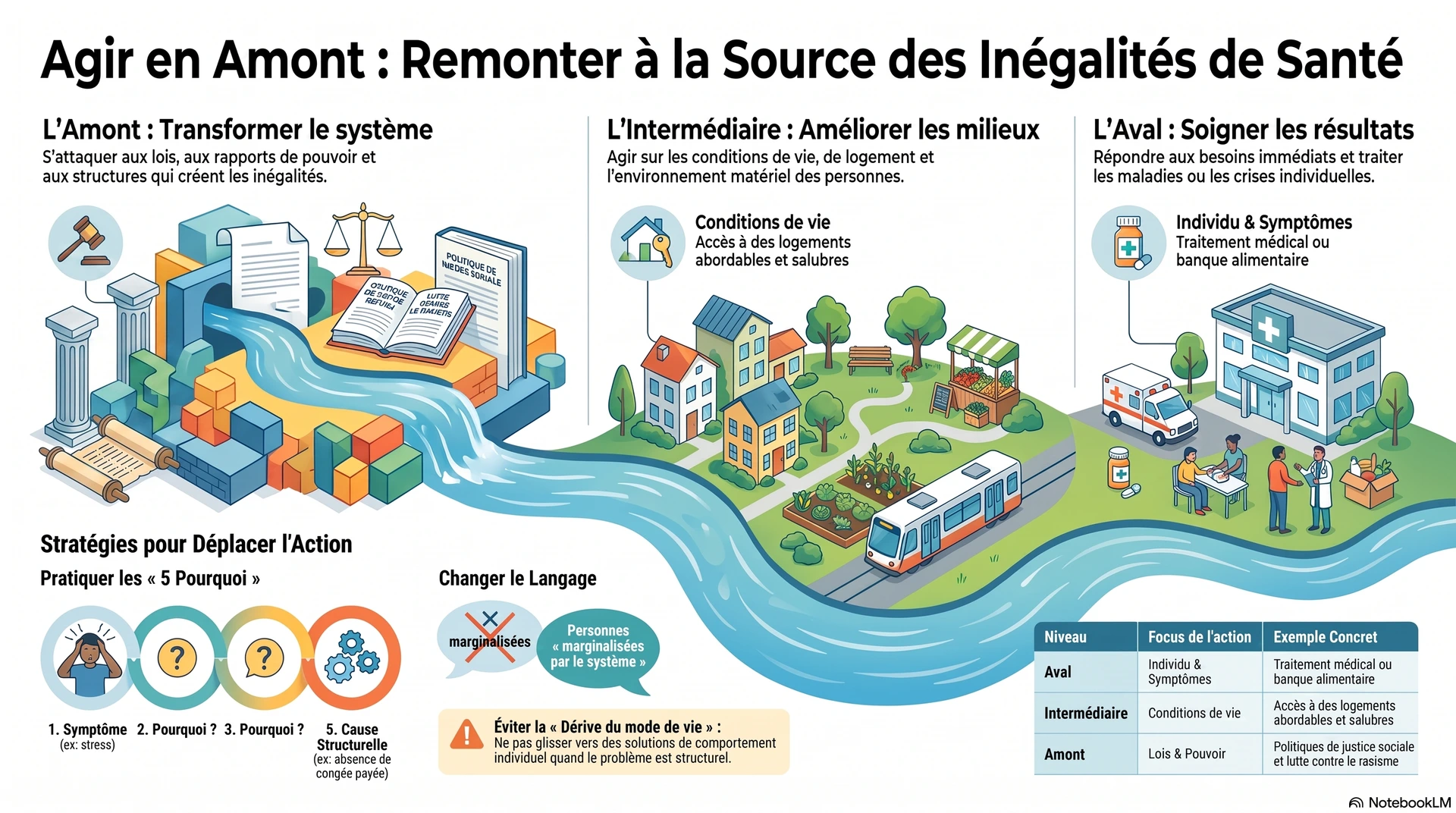
1️⃣ ANALYTICAL SUMMARY
From the bank to the source: rethinking where we act. The document takes up the metaphor of the river (attributed to Irving Zola and McKinlay): by repeatedly rescuing people swept away by the current, one eventually goes back to the source to understand why they fall in (p. 2). It reminds us that not everyone has an equal chance: stigma, discrimination, and oppression "push" certain people into the rapids, while unfavourable socio-economic conditions make the bank more slippery (p. 2-3). The target audience is broad — public health, community organisations, health professionals, intersectoral partners — and the issue at hand is structural: a system focused on individual responsibility and the biomedical model struggles to address the root causes (p. 9).
A framework to shift action upstream. The document distinguishes three levels of intervention — downstream (health outcomes), intermediate (living conditions), upstream (structural determinants: values, norms, laws, power) — and puts them into practice in tables of concrete examples (p. 5-8). Its operational contribution is a tool-equipped reflexive posture: questioning one's own assumptions, "talking about power", resisting the drift of lifestyle, mobilising community self-determination, measuring differently (qualitative indicators, relationships, experiences of discrimination) and adopting a language focused on systems rather than individual blame (p. 11-14). The key message: no action is intrinsically "upstream", but everyone can orient theirs more towards the source from their current position (p. 10).
2️⃣ KEY POINTS OF THE DOCUMENT
1️⃣ A continuum in three levels structures the entire analysis : downstream acts on health outcomes (physical and mental), the intermediary on social determinants (living and environmental conditions), upstream on structural determinants — written and unwritten rules, power, resources, systems of oppression (figure 1, p. 5; table 1, p. 6-7). This is the central mapping tool of the document.
2️⃣ “Upstream” encompasses three distinct realities : a concept (relative position of the intervention), an ethical justification (the why we work for equity) and a way of thinking and working (mindset, resource allocation, intersectoral mobilisation) — p. 3. This clarification avoids the vague use of the term.
3️⃣ Addressing an immediate need is not intervening upstream : shelters, food vouchers or free recreational programmes remain focused on individual circumstances; likewise, a “universal” intervention is not automatically upstream if it does not address structural determinants (p. 9). An essential distinction to avoid overestimating one’s own measures.
4️⃣ The “lifestyle drift” (lifestyle drift) is a named and documented trap : policies first recognise the need to act upstream, then slide towards individual lifestyle factors, which are easier to implement and measure — which can increase inequalities (p. 12). The document encourages actively monitoring this shift.
5️⃣ A concrete reflective toolkit : « talk about power » (visible, hidden, invisible sources), the exercise of the « 5 whys » applied to a situation (p. 12), the shift to a systems-centred language — « marginalised people by oppression » rather than « marginalised people » (p. 14) — and new indicators (quality of life, established relationships, experiences of discrimination) to assess upstream action (p. 13).
3️⃣ ACTION PATHWAYS FOR LOCAL ACTORS
1️⃣ Map your portfolio with the discussion questions (p. 15): where is the majority of my work on the river located? Use figure 1 and table 1 (p. 5-6) as a positioning grid in team meetings.
2️⃣ Test the depth of an existing device with the box « How to know if your actions are more upstream? » (p. 13): if the action does not change structural and social factors, it is downstream — acknowledge it and seek to connect it to a more upstream lever.
3️⃣ Adopt the « 5 whys » exercise at reception (p. 12) to trace symptoms back to causes (e.g. depression → stress → job loss → lack of paid sick leave) and redirect the focus towards resolving obstacles rather than changing behaviours (p. 11).
4️⃣ Link a downstream service to a more upstream lever : based on the model of integrating a tax declaration service in a community clinic (p. 4), couple an existing device with support on income, housing or employment (tables 2-3, p. 8).
5️⃣ Revise organisational language (p. 14) : identify in the internal documents the formulations that blame individuals and rephrase them to designate systemic causes — a low-cost project with a strong symbolic effect.
6️⃣ Share decision-making power with communities (p. 12) : support community organiser groups in defining priorities, rather than defining them for them. Necessary adaptation for the French context : several upstream examples are specific to Canada (indigenous land rights, coverage of undocumented migrants, decolonisation); they need to be transposed to French levers (access to rights, non-recourse, combating discrimination, urban policies).
4️⃣ ADDITIONAL REFERENCES
- Public Health France — Health inequalities: the weight of social determinants of health (data from the 2024 Barometer, updated on 16 December 2025). French numerical overview of the social gradient and discrimination: anchors the Canadian concept of 'upstream' in hexagonal field data.
👉 https://www.santepubliquefrance.fr/inegalites-sociales-et-territoriales-de-sante/les-inegalites-de-sante-le-poids-des-determinants-sociaux-de-sante - INSPQ — Determinants of health (model of the National Public Health Programme 2025-2035, updated on 18 February 2026). Recent Francophone framework classifying determinants into four sets (global context, public systems, living environments, individual characteristics): directly mobilisable conceptual complement.
👉 https://www.inspq.qc.ca/notions-sante-publique/determinants - INSPQ — Population responsibility (updated on 18 February 2026). Operationalises "acting upstream" at the scale of a territory (example of diabetes, intersectoral partnerships): translates the posture of the document into a concrete organisational approach.
👉 https://www.inspq.qc.ca/notions-sante-publique/responsabilite-populationnelle
5️⃣ FREQUENTLY ASKED QUESTIONS (FAQ)
1️⃣ In practical terms, what does "working upstream" mean?
Addressing the root causes, non-medical, of health outcomes — structural determinants such as laws, norms, values, and power relations — rather than just individual behaviours (p. 3-4).
2️⃣ What is the difference between the three levels of intervention?
Downstream = treating and responding to immediate needs; intermediate = improving living and environmental conditions; upstream = transforming the structural factors that shape these conditions (table 1, p. 6-7).
3️⃣ Is responding to a social emergency acting upstream?
No. Shelters, food vouchers, or one-off aid mitigate the impacts but remain downstream; it is necessary, but it is not the same as intervening on the causes (p. 9).
4️⃣ Should we abandon downstream actions?
No — they address real needs. The document encourages action at all positions, while directing attention towards the source to enhance the impact of actions (p. 11).
5️⃣ What is the "lifestyle drift" and how can it be identified?
It is the tendency of policies to first recognise the need to act upstream, then to slide towards individual lifestyle factors. We identify it when solutions focus on behaviour rather than structural conditions (p. 12).
6️⃣ How can I know if my action is really upstream?
Check that it addresses structural and social factors and measures changes in relationships, engaged sectors, quality of life, and experiences of discrimination (box, p. 13).
7️⃣ I do not do public policy: can I still act upstream?
Yes. One can change the policies, practices, norms, and values of their own organisation, use their voice to advocate, and ally with partners — "the system is us" (p. 10).
6️⃣ REWRITING IN EASY LANGUAGE
What the document says
The document talks about a river.
People fall into the water.
We save them one by one.
But it is tiring and endless.
So we go upstream.
We look for why they fall into the water.
Often, they fall because of their difficult lives.
For example: no money, no housing, racism.
These causes are stronger than individual choices.
The three ways to help
There are three ways to act:
- Downstream : we care for people. We respond to urgent needs.
- Intermediate : we improve living conditions.
- Upstream : we change the major rules of society.
Acting "upstream" means: changing the root causes.
What the document advises
- Look at where your work is located.
- Ask "why?" several times. It helps to find the true cause.
- Do not blame individuals.
- Change the words you use.
- Share decisions with the residents.
- You can act a little more upstream, every day.
Note: "upstream" = act on the causes. "downstream" = address the effects.
7️⃣ CROSS-ANALYSIS — VALUES OF HEALTH PRACTICES
- Literacy : the document promotes a systems-focused language and offers a simple educational version (series "Let's Talk About It"), but does not provide tools graded according to the levels of understanding of the target audiences (p. 14).
- Empowerment : central — community self-determination and shared decision-making power are presented as intrinsically "upstream" strategies (p. 12).
- Participation : co-construction involves mobilising community members in setting priorities and decision-making (p. 12).
- Community health : fully integrated collective dimension — the goal is the health of the community, the population, and society, not just the individual (p. 9).
- Ethics : biases and power relations (privilege, positionality, critical reflexivity) are explicitly named and invited to be questioned (p. 11).
- Human rights : equity and inclusion are the guiding thread; respect for human rights is among the upstream levers (p. 7).
- Intersectorality : recommended as an essential characteristic of the upstream approach — partners from all sectors and communities (p. 3-4).
- Partnership : formalised through collaboration with professional organisations, employers, and community organisers (p. 7, 10).
- Combating discrimination : very present — racism, colonialism, stigma, and exclusion are identified as levers of inequality; non-judgment and diversity (sexual, gender) are taken into account (tables 1 and 3, p. 6-8).
8️⃣ EVALUATION OF THE RELIABILITY OF THE RESOURCE
Scientific relevance : strong. 27 references, mostly peer-reviewed articles (2018-2023) and recognised institutional sources (WHO, PHAC, Solar & Irwin framework), supplemented by expert conversations (2024-2025). It is a knowledge transfer synthesis based on a metaphor, not original empirical research: the robustness lies in the literature mobilised, not in produced data. Notably: reference 17 (Stronger together, CCNDS) is announced as “coming in 2025” and therefore not verifiable at the time of publication — coherence to monitor.
Operational relevance : very high. Example tables at three levels, discussion questions ready to facilitate, concrete exercises (“5 whys”, test “am I upstream?”), indicator grid. Main reservation: strong Canadian anchoring (legislative context, indigenous examples, public health competencies of Canada) which requires transposition for French or European use.
9️⃣ STRATEGIC HASHTAGS
#healthpractices #HealthEquity #SocialDeterminants #HealthPromotion #CommunityHealth #HealthInequalities #Empowerment #Intersectorality