
🔦 55 measures against discrimination: what is (finally) changing on the ground
🔍💡 Discrimination related to origin: for the first time, a whole axis targets health, housing and employment — with testing, measurement of inequalities and information for patients about their rights. A framework 2026-2029 to know in order to act locally. 🛡️
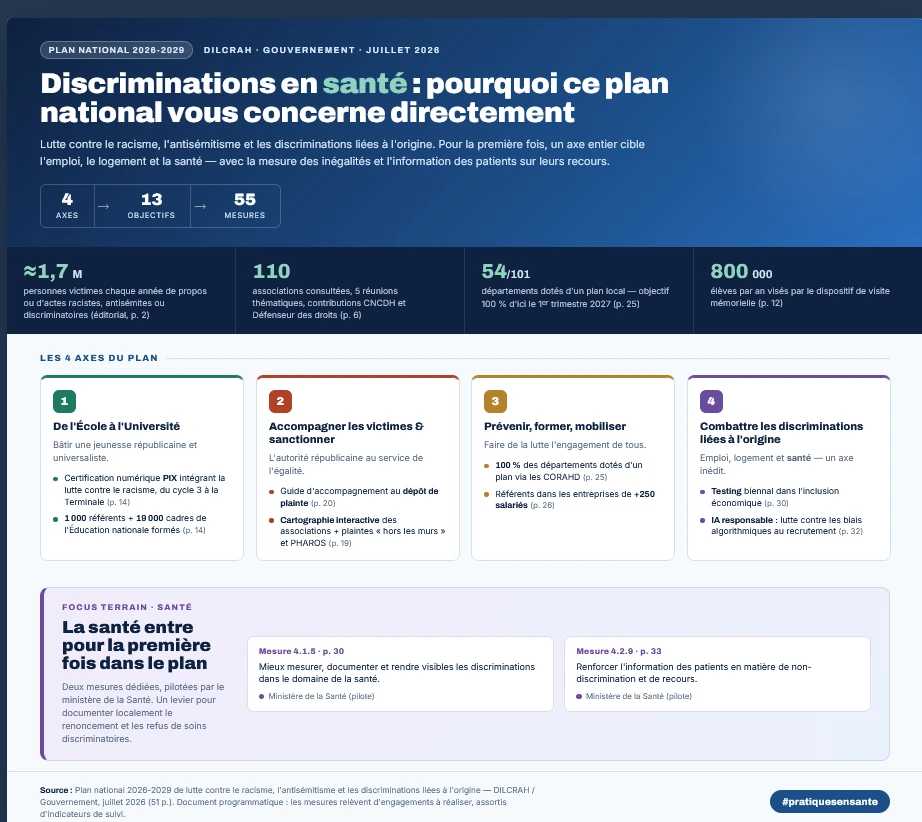
For the first time enters for the first time into the plan
- Measure 4.1.5 (p. 30): better measure, document and make visible discrimination in the field of health — Ministry of Health (pilot).
- Measure 4.2.9 (p. 33): strengthen patient information regarding non-discrimination and recourse — Ministry of Health (pilot).
📌 This plan is the national reference framework that will structure, until 2029, local public action against racism, antisemitism and discrimination related to origin — including, for the first time, in the fields of health, housing and employment. It provides directly mobilisable levers on the ground: mapping of associations, complaint filing guide, reporting mechanisms, departmental plans to be generalised. Its knowledge allows for anchoring local action in a roadmap equipped with indicators and funding, and articulating prevention, access to rights and the fight against social health inequalities.
Source: 📒 https://www.dilcrah.gouv.fr/priorites/plans-interministeriels
📜🔗LINK to the source
1. ANALYTICAL SUMMARY
A revamped inter-ministerial framework in response to the normalisation of hate.
Every year, nearly 1.7 million people report experiencing racist, anti-Semitic or discriminatory remarks or actions (editorial, p. 2). In response to this resurgence, the 2026-2029 plan mobilises the entire Government around four priorities: to instil republican values from a young age, to better protect victims and sanction perpetrators, to sustainably mobilise society, and — for the first time — to specifically combat discrimination related to origin (p. 3). It is the result of consultations involving 110 consulted associations, 5 major thematic meetings, parliamentarians, the CNCDH and the Defender of Rights (p. 6). The fight against online hate and the challenges of artificial intelligence are integrated transversally into the four axes (p. 4).
An operational architecture accompanied by indicators and strengthened governance.
The plan outlines 13 strategic objectives and 55 measures, each linked to monitoring indicators and one or more lead ministries (p. 7). Governance is based on two annual technical committees (March, October) and a ministerial committee (December), with the CNCDH evaluating progress each year (p. 7). For field actors, the most direct contributions relate to access to rights (complaint filing guide, interactive mapping of associations, 'out-of-the-walls' complaint mechanisms), the objective measurement of discrimination (biennial testing campaigns) and the explicit opening of a 'health' project, led by the Ministry of Health.
2. KEY POINTS OF THE DOCUMENT
1. An axis entirely dedicated to discrimination related to origin, including health (Axis 4, pp. 28-33). For the first time, a complete axis targets employment, housing and health. Two measures fall directly within the health sector, under the leadership of the Ministry of Health: "Better measure, document and make visible the discrimination in the field of health" (measure 4.1.5, p. 30) and "Strengthen patient information regarding non-discrimination and recourse" (measure 4.2.9, p. 33).
2. The objectification of discrimination through testing and measurement (Axis 4, p. 30). The plan provides for a large-scale testing campaign in economic inclusion every two years (measure 4.1.1), the integration of non-discrimination indicators in companies' impact measures (4.1.3) and a DILCRAH guide reminding of the legal framework CNIL/Constitutional Council for measuring diversity (4.1.2).
3. Operational tools for access to rights for victims (Axis 2, pp. 19-20). Are scheduled: a guide to assist in filing complaints (measure 2.3.10, p. 20), an interactive map of specialised associations accessible to the general public on the DILCRAH website (2.2.8, p. 19), and an annual communication on the "out-of-the-walls" devices (Visioplainte, Maisons France Service) and the PHAROS platform (2.2.9, p. 19).
4. A generalised territorial implementation (Axis 3, p. 25). To date, 54 departments out of 101 have a local plan to combat racism, anti-Semitism and discrimination. The plan sets the objective of 100% of departments having a plan by the first quarter of 2027 (measure 3.2.10, p. 25), supported by the semi-annual meeting of the CORAHD.
5. A massive deployment of training and digital prevention (Axis 1, pp. 13-15). Objective of 800,000 students per year benefiting from a memorial visit (measure 1.1.2, p. 12), training of 1,000 "Values of the Republic" referents and 19,000 national education executives (1.2.12, p. 14), integration of the fight against racism and anti-Semitism into the PIX certification from cycle 3 to the final year (1.3.14, p. 14). Training in the fight against anti-Semitism in higher education is made mandatory by the law of 31 July 2025 (box p. 15).
3. ACTION TRACKS FOR LOCAL ACTORS
1. Identify and disseminate, as soon as it is published, the interactive map of specialised associations announced on the DILCRAH website (measure 2.2.8, p. 19) to guide victims of discrimination towards local support.
2. Integrate into its welcome and information materials the future guide for filing complaints (measure 2.3.10, p. 20) and the reporting channels "outside the walls" — Visioplainte, Maisons France Service, PHAROS (measure 2.2.9, p. 19).
3. Get closer to the departmental CORAHD (operational committee chaired by the prefect, meeting twice a year, p. 25) to include its local action in the territorial plan and, where it does not yet exist, support its creation before the first quarter of 2027 (measure 3.2.10, p. 25).
4. Mobilise the "health" entry of the plan to locally document the renunciation and refusals of discriminatory care: support the data collection planned by measure 4.1.5 (p. 30) and enhance patient information on their recourse (measure 4.2.9, p. 33). Unmet need: the plan remains at the stage of measurement and documentation, without a detailed operational health mediation system — a blind spot to be filled by field actors.
5. Rely on the network of engaged museums (60 structures, boxed p. 27) and memorial sites to build moments of transmission and dialogue, particularly through the Culture Pass and its dedicated ambassadors.
6. For employers with more than 250 employees, anticipate the designation of a referent for "combating racism and antisemitism", following the model of sexual harassment referents (measure 3.2.12, p. 26), and utilise the DILCRAH guide on measuring diversity within the legal framework of CNIL (measure 4.1.2, p. 30).
4. ADDITIONAL REFERENCES
🔍➕ For more information, see the articles referenced by "Health Practices" on the theme of inequalities https://pratiquesensante.odoo.com/2-1-inegalies-sociales-territoriales ➡️🔗 in the fight against violence ➡️🔗 https://pratiquesensante.odoo.com/2-2-lutte-contre-les-violences
1. Defender of Rights — Preventing discrimination in care pathways: an issue of equality (May 2025). Report based on over 1,500 testimonies, directly complementary to the "health" entry of the plan (measures 4.1.5 and 4.2.9). Recommends a national strategy, training for professionals, and the development of health mediation.
2. CNCDH — 36th annual report on combating racism, antisemitism, and xenophobia (June 2026). Independent evaluation report of public policy, with Racism Barometer and updated statistical data. Critically sheds light on the implementation of successive national plans.
3. DILCRAH / DGESCO — Vademecum Acting against racism, antisemitism and discrimination related to origin in schools (version February 2026). Operational tool of fact sheets (understand, analyse, respond, prevent), which the plan generalises the use of (measure 3.1.4). Directly transposable into animation and training.
5. FREQUENTLY ASKED QUESTIONS (FAQ)
1. What distinguishes this plan from the previous one (2023-2026)? The addition of a completely dedicated axis to combat discrimination related to origin in employment, housing and health — a first (p. 3, pp. 28-33) — and the transversal integration of online hate and AI into the four axes (p. 4).
2. How will the plan be monitored and evaluated? Two technical committees per year (March, October) and one ministerial committee (December), with an annual evaluation of progress by the CNCDH; each measure is linked to monitoring indicators (p. 7).
3. Does the plan include measures directly concerning health? Yes: measuring, documenting and making visible health discrimination (measure 4.1.5, p. 30) and strengthening patient information on non-discrimination and recourse (measure 4.2.9, p. 33), with the Ministry of Health being the lead.
4. What does the plan provide to concretely help victims to act? A complaint filing guide (2.3.10, p. 20), an interactive mapping of associations (2.2.8, p. 19), an annual communication on complaints "beyond the walls" and PHAROS (2.2.9, p. 19), and the clarification of online hate reporting pathways (2.4.14, p. 20).
5. How does the plan act at the territorial level? It aims for 100% of departments to have a local plan by the first quarter of 2027 (54/101 today), with the CORAHD as the semi-annual coordination body (measure 3.2.10 and box p. 25).
6. How does the plan intend to objectify discrimination? Through a biennial testing campaign in economic inclusion (4.1.1, p. 30), the integration of indicators in companies' impact measures (4.1.3) and a DILCRAH guide framed by the CNIL and the Constitutional Council (4.1.2, p. 30).
7. Are businesses and employers concerned? Yes: designation of referents in companies with more than 250 employees (3.2.12, p. 26), deployment of "Diversity" plans (4.2.8, p. 33), measurement of the effectiveness of the training obligation on non-discrimination (art. L. 1131-2 of the Labour Code, measure 4.2.6, p. 32).
6. REWRITING IN EASY TO READ LANGUAGE
What the document says
France has a new plan for 2026 to 2029.
This plan fights against racism and antisemitism.
It also fights against discrimination.
Discrimination means treating a person worse because of their origin.
Every year, many people are victims of racism.
Nearly 1.7 million people in France.
The plan wants to stop this.
The important points
The plan has 4 main parts.
It contains 55 actions to be taken.
Part 1: the school.
Students are taught to respect others.
Teachers are trained.
Part 2: helping victims.
We help victims to file a complaint.
We punish those who do harm.
Part 3: acting throughout France.
Each department must have a plan.
Associations and local councils work together.
Part 4: equality in work, housing and health.
This is a new development.
The plan measures discrimination in health.
It informs patients of their rights.
A patient can appeal if they are mistreated.
What you can do
You can inform people of their rights.
You can help them find an association.
You can help them to file a complaint.
7. CROSS-ANALYSIS — VALUES OF HEALTH PRACTICES
Literacy: partial — the plan provides for strengthening patient information (4.2.9) and media education, but does not detail tools suitable for low literacy levels.
Empowerment: the support of youth councils in their anti-discrimination competence (measure 3.2.7) and the strengthening of patient appeals reflect a logic of empowerment, while still being framed by the State.
Participation: strong at the stage of development (110 associations consulted, 5 thematic meetings, parliamentary contributions) ; co-construction continues through monitoring committees involving civil society (pp. 6-7).
Community health : not explicitly defined as such ; the collective dimension is evident in the mobilisation of territories and the associative network, without a formalised community approach.
Ethics : the plan identifies biases — particularly algorithmic in recruitment (measure 4.3.11) — and frames the measurement of diversity by CNIL and Constitutional Council benchmarks.
Human rights : the entire plan is based on the principles of equality and non-discrimination, with a strong republican universalist grounding.
Intersectorality : structurally strong — each measure involves several lead and contributing ministries (Education, Interior, Justice, Health, Labour, Housing, Culture, Sports).
Partnership : formalised through framework agreements (police/gendarmerie, ENM, places of memory), charters of commitment and the network of engaged museums.
Fight against discrimination : central object of the plan ; non-judgment and diversity are taken into account, particularly through testing, measurement and training in non-discrimination.
8. EVALUATION OF THE RELIABILITY OF THE RESOURCE
Scientific relevance : raised at the institutional level. Official government document, resulting from broad consultation and informed by independent authorities (CNCDH, Defender of Rights). The numerical data (1.7 million victims, 54/101 departments) is consistent with public sources. Gender reporting: this is a programmatic and political document, not a study or methodological guide — the measures pertain to the commitment to be made, not to already evaluated mechanisms. The CNCDH, in its evaluation of the previous plan (March 2026), pointed out a mixed record and a decline in political support: to be read as a framework of intention whose effectiveness will depend on implementation.
Operational relevance: good to average. The monitoring table (indicators + lead ministries) is directly usable to locate a local action. However, several “health” measures remain at the stage of measurement/documentation, without immediate operational tools — the field usability will need to be supplemented by third-party resources (cf. report Defender of Rights).