
🔦 🔍 Mental health in Schools and Universities: 28,450 requests in 2025 (+20%), and dozens of accounts where administrative burdens exacerbate already existing suffering. 💡 The report provides 15 concrete recommendations — from early detection to human support at critical moments (assignments, exams, results). ⚠️ A must-read to understand why the support available exists… but does not reach those who need it. #MentalHealth #HealthPromotion
📌This report documents, case by case, the precise moment when an administrative procedure becomes an aggravating factor of psychological suffering: a registration cancelled due to an email landing in spam, an misunderstood grade, an overpayment claimed during a sick leave. It is rare material: real situations, traced, with the outcome obtained after mediation.Concrete usefulness: it provides case studies directly applicable in practice analysis, a quantified overview of the distress of students, pupils, and staff, and 15 operational recommendations that clearly describe what is lacking in current systems.For those working on early detection, administrative literacy, or access to rights, it is a revealer of the invisible barrier between the existing offer and actual recourse.
📜🔗LINK to the source
1. ANALYTICAL SUMMARY
An institution that produces part of the distress it observes
In 2025, the mediation network (15 collaborators and nearly 100 academic mediators) handled 28,450 requests, an increase of +20% in one year and nearly +60% in five years (p. 8, p. 16). 76% come from users, 24% from staff. The report does not claim to provide an assessment of mental health: it documents the friction points of institutional functioning that cause or amplify pre-existing psychological suffering (p. 12, p. 47). Nearly 450 requests explicitly mention distress in a student — a figure recognised as underestimated, increasing by +66% in primary education and +48% in secondary education over four years (p. 48). Requests related to bullying and violence rose from 275 in 2020 to 970 in 2025 (p. 9); reports of mistreatment suffered by students reached 1,000 cases in December 2025, compared to 400 per year in 2023-2024 (p. 16).
Recommendations focused on human reception and the clarity of procedures
The document formulates 15 recommendations (ReMedia 2025-1 to 2025-15, p. 122-131), structured into three areas: students, learners, staff. The proposed levers are operational and inexpensive to describe: welcome units during critical periods (assignments, exam registrations, results), an online "parents' toolkit" integrating exam regulations simplified and understandable by all, generalisation of free mental health consultations at the onset of adolescence, doubling the number of school nurses, a support protocol for staff in distress with a dedicated institutional reference, systematic explanation of negative responses. The common thread: the quality of communication is a determinant of health, not an extra soul.
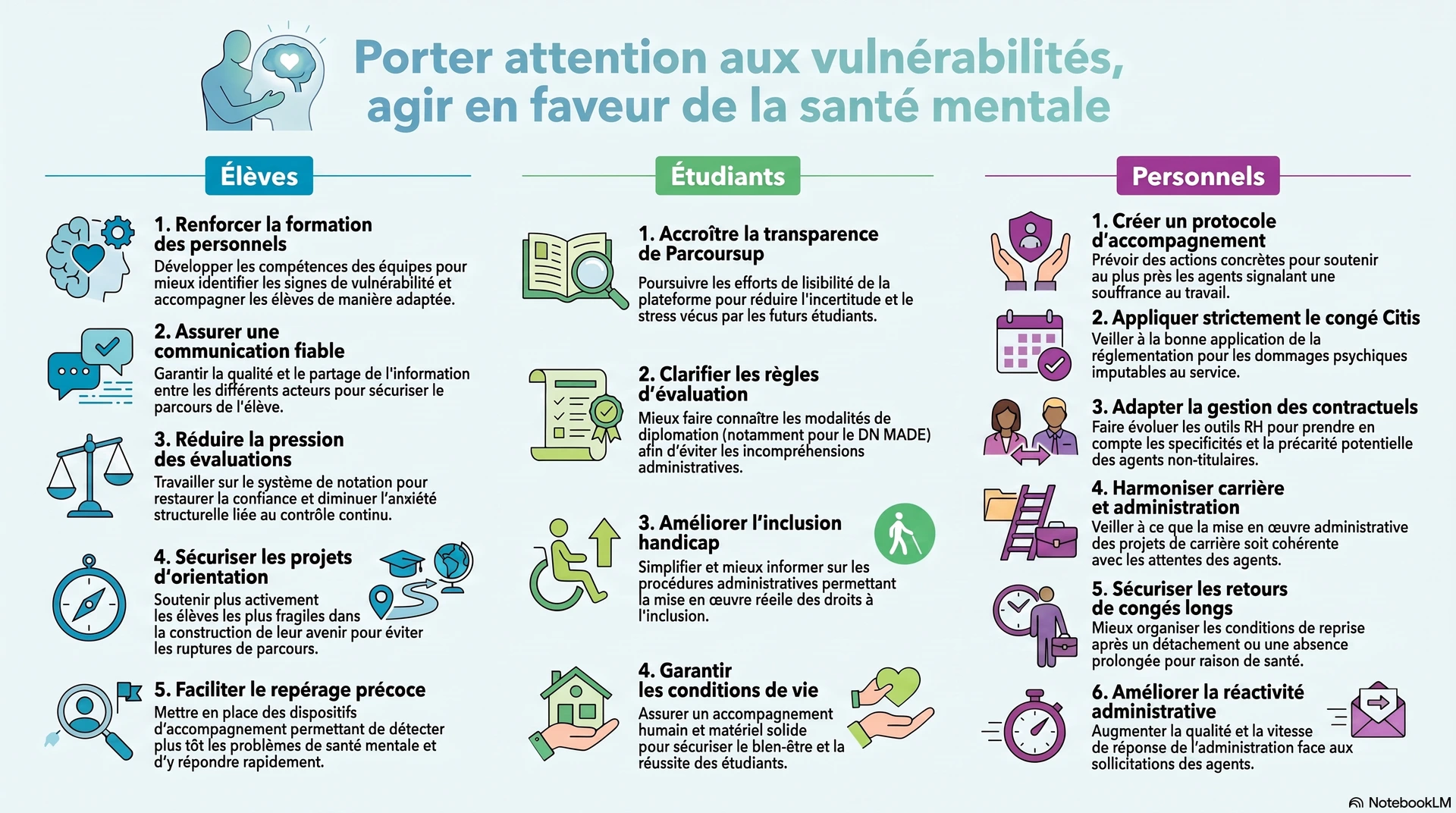
The 15 recommendations
Students
- 1. Strengthen staff training to better identify the needs of vulnerable students and support them
- 2. Ensure reliable communication and better share information
- 3. Reduce the pressure of assessments and restore confidence in grading
- 4. Support the calm construction of students' guidance projects, particularly for the most vulnerable
- 5. Better support students, facilitate early identification of mental health issues to respond more effectively
Learners
- 6. Continue efforts for transparency in Parcoursup to reduce the uncertainty experienced by future students
- 7. Better publicise the rules of assessment and graduation, particularly for the DN MADE
- 8. Twenty years after the disability law, clarify and better inform about the administrative procedures that enable the inclusion of students
- 9. Ensure human support and the material living conditions of students in order to secure their pathways and improve their well-being
Staff
- 10. Provide a protocol of actions to allow support as close as possible to staff suffering at work
- 11. Better apply the regulations on leave for temporary disability attributable to service (Citis) concerning psychological damage
- 12. Improve processes and management tools to adapt them to the specific situations of contractors
- 13. Ensure coherence between career projects and their administrative implementation
- 14. Better organise the conditions for returning from a secondment or long leave
- 15. Improve the quality and responsiveness of responses to staff
2. KEY POINTS OF THE DOCUMENT
1. The volume and nature of submissions are changing. 28,450 submissions processed, +20% in one year compared to +16% in 2024 and +12% in 2023: the acceleration is clear (p. 8). 93% were closed before 31 December, 92% in less than three months, 74% in less than one month; in 78% of cases where the mediator intervened, the situation or understanding of the complainant improved (p. 9). The area of “daily life and conflicts in institutions” is exploding: +136% over five years (p. 9).
2. Student data converge towards a heavy picture. The Ipsos-BVA barometer from September 2025, cited on p. 74, indicates that fewer than one in two students (45 %) consider themselves to be in good mental health, with 60 % showing signs of psychological distress (compared to 36 % in the general population), with 63 % linking their difficulties to their studies and that 38 % are considering interrupting their course for this reason. Female students are more affected: 37 % say they are in good mental health compared to 53 % of men, and 30 % report having experienced multiple forms of violence (p. 75).
3. The gap between the availability of support and actual use is quantified. 64 % of students know that their institution offers support services, but 54 % do not know who to turn to and 55 % would not seek help (p. 75). Only 51 cases in 2025 directly mention a mental health issue — compared to 3 in 2022 (p. 75). The taboo, isolation (57 % in the first year) and lack of knowledge about resources are identified as the main barriers.
4. Assessment and guidance are described as structural sources of anxiety. Continuous assessment, whose grades determine access to higher education, generates ongoing pressure from Year 9 to Year 13 (p. 56-58). The report also documents a blind spot: students who take exams on a computer as a compensation for a disability are subject to suspicions of cheating that further weaken them (p. 59-60). Approximately 15 % of students ‘disappear’ in Year 1 and 192,000 seek to change their course via Parcoursup in 2025 (p. 81).
5. Contract staff are the breaking point of the HR system. 6,228 cases from staff in 2025 (+23 % in one year, +78 % in ten years); those from non-permanent staff are increasing by +42 % in one year and +170 % in five years (p. 96-97). 43 % relate to financial issues (+200 % in five years). The mechanism is identified: in the absence of subrogation, contractors on sick leave receive daily allowances directly and are then asked to repay overpayments, with incomprehensible calculation methods (p. 113-118). Subrogation will only be generalised for 2027.
3. ACTION PATHS FOR LOCAL ACTORS
1. Reintroduce the mental health protocol as the basis for local coordination. The five-step protocol (identify, alert, assess, refer, follow-up) is described on p. 47 and is linked to the Health Promoting School approach and the Édusanté label. A point of caution to raise in partnership meetings: the report indicates that only 1.6 % of EPLE staff are trained in mental health (note p. 69). Training, not the document, is the bottleneck.
2. Draw inspiration from the return to school guide from the Tarn department (p. 52). This guide, co-signed by the student, the family, the head of the establishment, the medico-social service of national education and the care service, formalises the mode of schooling, the articulation of care/education, the referents on both sides, and the schedule for interim assessments. It is a transferable model of school-health contractualisation.
3. Establish a human welcome point during critical periods (p. 123, ReMedia 2025-2). Assignments, exam registration, publication of results: these are the moments when requests and decompensations concentrate. A physical presence, provided by trained volunteer staff, costs little and avoids disruptions in pathways.
4. Treat the readability of regulations as a health literacy issue (p. 123). The report explicitly recommends regulating exams "in a simplified and understandable form for all." The cases on pp. 51-54 show that a family with poor command of the language or digital skills may lose the benefit of replacement tests. A FALC reformulation of exam and registration procedures is a preventive action.
5. Map and make visible the existing resources available to students (p. 87). Cnaé (0 800 737 800, free and confidential), Student Mental Health (up to 12 free consultations, network of 1,900 psychologists, 62 student health services), Nightline, 24 BAPU. The issue is not to create, but to fill the documented access deficit (54% do not know who to turn to). Provide short, visual materials, disseminated by peers.
6. Open the subject of overpayments and subrogation in social dialogue bodies (pp. 113-118). For AESH and non-teaching contractual staff — a public often precarious and feminised — the report proposes, pending Gape and subrogation (2027), a dedicated academic return unit for employment return certificates and a detailed explanatory letter in case of recovery (amount, date, reason). Identified unmet need: no cash advance scheme is planned.
4. ADDITIONAL REFERENCES
🔍➕ For more information, see the articles referenced by "Health Practices" on the theme of health and work ➡️🔗
1. CESE — The mental health and well-being of children and young people: a societal issue (opinion adopted on 14 October 2025, rapporteur Helno Eyriey). Methodologically complementary: the opinion has been co-constructed with a panel of 20 young people aged 12 to 18 selected at random, whose report is attached. It brings the participatory dimension absent from the mediator's report. 🔗 https://www.lecese.fr/travaux-publies/la-sante-mentale-et-bien-etre-des-enfants-et-des-jeunes-un-enjeu-de-societe (URL verified)
2. Éduscol / DGESCO — Acting to promote the mental health and well-being of students (updated resource page; notice of the mental health protocol, June 2025). Contains the framework protocol in five steps, alert sheets, the framework for staff "mental health guidelines" and training materials. It is the operational tools of what the report recommends. 🔗 https://eduscol.education.gouv.fr/5958/agir-pour-favoriser-la-sante-mentale-et-le-bien-etre-des-eleves (URL verified)
3. Public Health France — Operational reference for psychosocial skills, volume 1 (2025), and CPS action programme (training kit, participant sheets, self-assessment grids for the quality of the intervention). Complementary on the health promotion side: where the mediator addresses the remedial, this reference provides tools for the preventive, within the framework of the inter-ministerial CPS strategy 2022-2037. 🔗 https://www.santepubliquefrance.fr/competences-psychosociales/le-programme-daction-de-sante-publique-france-sur-les-competences-psychosociales (URL verified)
5. FAQ
1. Can the mediator be contacted directly for a mental health issue?
No, this is not his front door. The report indicates that mediators are "very rarely called upon directly regarding mental health" (p. 46, p. 75): suffering appears incidentally, in the context of a dispute over a grade, an assignment, a scholarship, or a contract. This is precisely what gives the material its value: it reveals situations that would never have been reported as such.
2. Does harassment fall under mediation?
In principle, no (p. 9). Harassment falls under specific provisions of national education (pHARe, 3018) or criminal procedures, sometimes both. However, the report specifies that mediators "can be sentinels" and link levels of responsibility. In practice, the number of cases mentioning harassment or violence has increased from 275 (2020) to 970 (2025).
3. What does the mental health protocol for students actually contain?
Five steps: identify, alert, assess, address, ensure follow-up (p. 47). It mobilises a resource team, relies on social and health personnel, and provides for "mental health reference staff" in every secondary school and each primary education district. It specifies the communication circuit to families and the rules of confidentiality.
4. What are the obstacles for contractors in the event of sick leave?
The absence of subrogation (p. 113-118). The agent receives daily allowances directly from the CPAM while continuing to be paid by the administration: this results in a overpayment subsequently claimed back, dont le calcul est « très difficile à comprendre » (p. 118). Généralisation de la subrogation prévue pour 2027. Le rapport recommande, d'ici là, un courrier d'accompagnement détaillé (somme, date, motif).
5. Pourquoi les élèves en situation de handicap sont-ils particulièrement exposés lors des examens ?
Deux mécanismes documentés. D'une part, l'usage d'un ordinateur en compensation du handicap déclenche des suspicions de fraude vécues comme une mise en cause de leur honnêteté (p. 59-60). D'autre part, les aménagements d'évaluation, mal explicités, créent des malentendus sur le niveau réel de l'élève, générant « de faux espoirs et des déceptions » au moment de l'orientation (p. 70-71, ReMedia 2025-4).
6. Le rapport dit-il que l'École rend les jeunes malades ?
Non, et il est prudent sur ce point. Il rappelle que l'origine du mal-être est « très controversée » et résulte largement de facteurs extérieurs (pandémie, contexte international, usages du numérique, p. 46). Sa thèse est plus précise : le fonctionnement du système peut provoquer, amplifier ou aggraver des troubles latents ou existants, et entretenir un sentiment d'isolement et d'insécurité (p. 12, p. 122).
7. Quels dispositifs de soutien existent pour les étudiants, et sont-ils utilisés ?
Santé Psy Étudiant (jusqu'à 12 consultations gratuites par an, 1 900 psychologues conventionnés, 62 services de santé étudiante), la Cnaé (plateforme d'écoute, 0 800 737 800), Nightline, 24 BAPU (p. 87). Le recours reste faible : 55 % des étudiants n'y auraient pas recours et 54 % ne savent pas vers qui se tourner (p. 75). Le rapport parle d'un « fossé » entre l'offre et le besoin.
6. RÉÉCRITURE EN FALC
Ce document, c'est quoi ?
C'est un rapport sur l'école et l'université.
Il a été écrit par la médiatrice de l'Éducation nationale.
La médiatrice aide les gens qui ont un problème avec l'école.
Elle écoute. Elle explique. Elle cherche une solution.
Ce que le rapport a trouvé
Beaucoup de gens demandent de l'aide.
En 2025, la médiatrice a reçu 28 450 demandes.
C'est 20 % de plus qu'en 2024.
Ces demandes viennent des élèves, des familles, des étudiants.
Elles viennent aussi des adultes qui travaillent à l'école.
Beaucoup de jeunes vont mal.
Ils sont stressés par les notes.
Ils sont stressés par le choix de leur métier.
Certains ont peur d'aller à l'école.
Certains sont malades dans leur tête.
Les papiers sont trop compliqués.
Une famille peut se tromper dans un formulaire.
Un mail important peut se perdre.
Alors l'élève perd sa place à l'examen.
Cela rend l'élève encore plus triste.
Parfois, cela devient très grave.
Les étudiants sont souvent seuls.
Un étudiant sur deux dit qu'il ne va pas bien.
Beaucoup ne savent pas à qui parler.
Pourtant, il existe des psychologues gratuits.
Mais les étudiants ne les connaissent pas.
Les adultes qui travaillent à l'école vont mal aussi.
Surtout ceux qui ont un contrat court.
Quand ils sont malades, on leur demande de rendre de l'argent.
Ils ne comprennent pas pourquoi.
Cela leur fait beaucoup de souci.
Ce que la médiatrice demande
- Former les adultes de l'école.
Ils doivent savoir voir quand un jeune va mal. - Écrire les règles avec des mots simples.
Les familles doivent comprendre les règles des examens. - Accueillir les gens en vrai.
Il faut des personnes à qui parler.
Surtout aux moments difficiles : les résultats, les inscriptions. - Voir un psychologue gratuitement.
Chaque jeune doit pouvoir le faire. - Aider les adultes qui souffrent au travail.
Chaque personne doit avoir un adulte référent.
Il faut toujours expliquer un refus.
7. ANALYSE TRANSVERSALE — VALEURS DE PRATIQUES EN SANTÉ
Littératie : le rapport identifie la complexité réglementaire comme une cause directe de souffrance et recommande explicitement une réglementation des examens « simplifiée et compréhensible par tous » (p. 123) — c'est une demande de littératie administrative, même si le mot n'est pas employé ; il ne fournit toutefois aucun outil FALC ni support adapté.
Empowerment : faible. Les élèves, étudiants et agents sont présents comme réclamants et victimes, pas comme co-concepteurs ; le dispositif « Parcours pour la réussite » (p. 52-53), avec son contrat d'engagement mutuel signé par l'élève, est l'une des rares exceptions.
Participation : no co-construction mechanism is described in the development of the report itself; the follow-up of recommendations is a dialogue strictly internal between the mediator and the central administration management (p. 11, p. 132).
Community health : the collective dimension is absent. The entry is individual (the case, the referral, the personalised solution); the notion of educational alliance (p. 51) and the Health-promoting School approach (p. 47) are the only mentioned collective support points.
Ethics : the report explicitly identifies a treatment bias — the 'equality of treatment' invoked by the administration produces a real inequality for candidates suffering from mental distress (p. 51-52) — and a correction bias towards students composing on computers (p. 59-60).
Human rights : the approach is rooted in children's rights (right to education, right to be heard, right to protection against violence, p. 9), with institutional backing from the Defender of Rights (p. 17).
Intersectorality : effective and concrete — the articulation of school / care / social is the central lever of the good practices cited (Tarn guide co-signed by the care service, p. 52; third places directing towards My psychological follow-up and the Houses of adolescents, p. 125; Psytruck of the Nîmes University Hospital, p. 76).
Partnership : yes, formalised by contractual supports: the Tarn guide engages five signatories, the 'Pathway to success' is based on a mutual commitment contract with a multidisciplinary team (p. 52-53).
Fight against discrimination : the subject is present but peripheral. The report mentions the discriminations suffered (p. 63: a family experiences a refusal of guidance "as a discrimination"), the stigma of disability in exams, and the contribution of mediation to the work of the Defender of Rights on discrimination based on origin among 15-26 year olds (p. 17). The gender dimension is noted (overexposure of girls and female students) but is not followed by a dedicated recommendation — this is a notable gap.
8. EVALUATION OF THE RELIABILITY OF THE RESOURCE
Scientific relevance — average to correct, with strong methodological reservations
The report does not claim to be a study and states so (p. 46, p. 47). It correctly mobilises recent and identifiable external sources (DREES / Public Health France, OVE July 2025, Court of Auditors 2025, CESE October 2025, Ipsos-BVA barometer September 2025) and cites them with URLs. However, its own data presents three structural limitations:
- Major self-selection bias. The requests come from people who know that mediation exists, know how to use it, and dare to claim. The report also acknowledges that the increase is "likely partly related to the strengthening of the visibility of mediators" (p. 8). No prevalence conclusion can be drawn from this.
- Declarative and non-standardised counting. The "450 requests mentioning distress" depend on what the mediator has entered in an "analysis" box; the report itself indicates that the actual number is "much higher" (p. 48). The indicator is therefore non reproducible.
- Self-interested source. The document is produced by mediation, on its own work, and concludes on the necessity to extend mediation. The displayed success rate (78%, p. 9) is self-assessed, without explicit definition of success or external control.
Internal inconsistencies noted: the Student Mental Health system is credited with "more than 860,000 consultations" p. 76 and "880,000 consultations" p. 87. The increase in referrals from non-holders is given as "+173% over five years" p. 8 and "+170% over the last five years" p. 96 and p. 127. The total volume fluctuates between "28,450" (p. 8) and "nearly 28,500" (p. 16). The National Great Cause is presented sometimes as concerning 2026 (note p. 12), sometimes as designated in 2025 and extended into 2026 (p. 74, p. 125) — the second formulation is the correct one.
Non-verifiable point: the cases of referral are anonymised and not sourceable; they have illustrative value, not proof.
Operational relevance — high
The recommendations are precise, addressed, and often immediately transposable : return guide to the establishment, reception unit during critical periods, explanatory letter in case of overpayment, systematic explanation of refusals. The two documented "best practices" (Tarn, Pays de la Loire) are described in enough detail to be replicated. The chapter on following up previous recommendations (p. 132-171) allows us to see what has actually changed — it is a rare and useful accountability exercise.
Usage limit: the recommendations are non-binding. They address the central administration, not the field actors. A local professional will find an argument and templates there, not a mandate.
10. STRATEGIC HASHTAGS
#healthpractices #MentalHealth #HealthPromotion #HealthLiteracy #SchoolHealth #PsychosocialSkills #AccessToRights #StudentHealth