
🚨 Staying seated costs you more than you think: new data
🏃♀️💡 Physical activity: the message that changes everything for your inactive audiences — starting, even below 150 min/week, already provides measurable benefits. New 2026 data on sedentary behaviour, light activity, and GLP-1 treatments
📌 A solid and recent anchor point to update your messages: the document consolidates, age by age, what really "counts" for health — and shifts the focus from the guilt-inducing threshold (150 min) to a mobilising principle: a little is better than nothing, more is better than a little. It provides fresh arguments to convince the most distant audiences from practice (light activity, small units, stairs, walking), and incorporates two rarely equipped current angles on the ground: sedentary behaviour as an independent risk factor, and the issue of muscle maintenance in people on GLP-1 medications. Useful for building an intervention, arguing with a reluctant audience or an elected official, and rejecting the "all or nothing" discourse
Source :📒 Physical activity recommendations from the Chief Medical Officers of the United Kingdom
✍️ UK Chief Medical Officers' physical activity guidelines - July 2026
the 4 Chief Medical Officers of the United Kingdom — Prof Isabel Oliver (Wales), Prof Sir Michael McBride (Northern Ireland), Prof Sir Gregor Smith (Scotland), Prof Sir Chris Whitty (England) — published by the Department of Health & Social Care on GOV.UK.📜🔗LIEN vers la source
1️⃣ ANALYTICAL SUMMARY
An updated scientific consensus, designed for population action
These recommendations cover the entire life course — under 5 years, 5-18 years, 19-64 years, 65 years and over — and specify the volume, duration, frequency, and type of activity necessary for health benefits (p. 4-8). The primary target audience is that of professionals, practitioners, and decision-makers responsible for designing and implementing policies and programmes that promote physical activity, sport, and active mobility (p. 9). The guiding thread: the evidence of benefit has strengthened for all groups, including where it was weaker (women, people with disabilities, chronic illnesses), and the gains are strongest for the least active (p. 3-5).
More flexible operational messages than historical thresholds
The document provides a useful repositioning: the thresholds (150 min/week, 60 min/day) are not absolute barriers; benefits exist both below and above (p. 5, p. 12). It values light activity and small units of effort as realistic entry points (p. 13-14, p. 25-26), documents sedentary behaviour as an independent risk (p. 15-16, p. 27-28), strongly reintegrates muscle strengthening and balance (especially after 50 years and among seniors, p. 33), and opens a current chapter on maintaining muscle mass in people on GLP-1 (p. 16, p. 26). Updated infographics accompany the report for dissemination (p. 8, p. 36).
2️⃣ KEY POINTS OF THE DOCUMENT
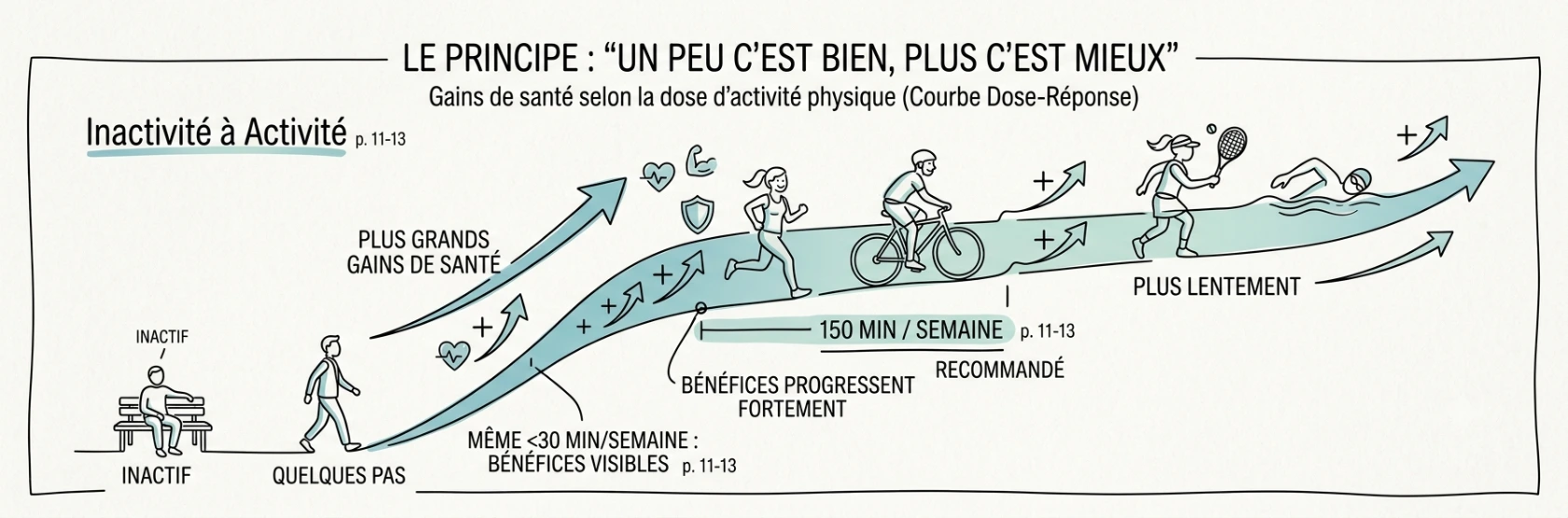
1️⃣ The guiding principle "some is good, more is better". The greatest health gains are found in the transition from inactivity to some activity (dose-response curve, p. 12); benefits exist even below 30 min/week and increase significantly up to ~150 min, then more slowly (p. 11-13). A major argument lever for inactive audiences.
2️⃣ Numerical guidelines by age, reaffirmed. Adults: ≥150 min/week of moderate activity, or 75 min vigorous, or combination; muscle strengthening ≥2 days/week (p. 7, p. 25). Children/young people 5-18 years: an average of at least 60 min/day of moderate to vigorous activity on average over the week (and not a strict daily threshold, p. 7, p. 21-22). Under 5 years: tummy time ≥30 min, toddlers/preschoolers ≥180 min/day (p. 6-7, p. 18-19).
3️⃣ Sedentary behaviour as an independent risk. Beyond 6-8 hours/day of sitting and 3-4 hours/day of television, increased risk of all-cause and cardiovascular mortality (p. 27); approximately +5% risk of cardiovascular event per additional hour of sedentary behaviour (p. 27-28). Prolonged sitting is even detrimental to those who meet activity thresholds (p. 5). No quantified threshold for sedentary behaviour is set, due to insufficient evidence (p. 5, p. 16).
4️⃣ New appreciation of light activity. For inactive individuals and seniors, low-intensity activity (slow walking, dusting, easy gardening) reduces mortality, cardiovascular risk, and type 2 diabetes, and can match the benefits of moderate activity if the duration is longer (p. 25-26, p. 31-32). For the most fragile transitioning to dependence, getting up regularly every hour already provides a functional benefit (p. 32).
5️⃣ Emerging issue: muscle strength and GLP-1 medications. Under weight management treatments like GLP-1, fat mass and muscle mass decreases; these medications are only authorised in conjunction with physical activity and behaviour changes, and muscle strengthening becomes crucial to preserve muscle (p. 16, p. 26). New subject, poorly equipped for the field. (Note: the next revision is scheduled for 2030, in collaboration with the WHO — p. 36.)
3️⃣ ACTION PATHWAYS FOR LOCAL ACTORS
1️⃣ Reformulate the entry objective. Replace the message "150 minutes" with "starting, even a little, already brings benefits" for inactive audiences: this is the strongest motivational lever in the document (p. 5, p. 12, p. 25-26).
2️⃣ Integrate active mobility and daily life. Promote walking, cycling, wheelchair use, stairs rather than lifts, active journeys — presented as the most accessible route to benchmarks (p. 3, p. 13). To be articulated locally with active mobility plans and development.
3️⃣ Systematically add muscle strengthening and balance in workshops, especially after 50 and for seniors: strength, balance, flexibility ≥2 days/week, integrable into aerobic sessions (p. 7-8, p. 33). Concrete examples for seniors: sit-to-stand, stair climbing, tai chi, dance (p. 34-35).
4️⃣ Target sedentary behaviour as an independent axis. Propose regular "breaks" (standing up, walking, standing) regardless of the activity goal — including for those already active (p. 5, p. 15-16, p. 27-28). In the workplace, to connect with employer initiatives.
5️⃣ Adapt for seniors according to 3 profiles. Use the typology "active / in transition / fragile" (p. 34-36) to calibrate intensity: aim for intensity in the active, confidence and stability in those in transition, and only a reduction in sedentary behaviour and small gains in the most fragile.
6️⃣ Anticipate the audience under GLP-1. Plan a dedicated message "preserve muscle" (strengthening + protein intake via competent professionals) for individuals taking or who have recently taken these medications (p. 16, p. 26). Unmet need: the document remains cautious ("emerging evidence") and does not provide a protocol; adaptation with an APA professional is necessary.
Adaptation necessary to the French context: these pathways must be linked to French systems (prescription of adapted physical activity, Sport-Health Houses, PNNS, National Sport-Health Strategy 2025-2030) — see §4 and §8.
4️⃣ ADDITIONAL REFERENCES
🔍➕ For more information, see the articles referenced by "Health Practices" on the topic of physical activity ➡️🔗https://pratiquesensante.odoo.com/blog/tag/activites-physiques-24
1️⃣ Public Health France — "Physical activity, sedentary behaviour and diet: results from the Public Health France Barometers" (BEH, 2025). Provides the French epidemiological data that is missing from the British document (in 2021, 73% of men and 59% of women met the PA benchmarks; 31%/20% for muscle strengthening; more than one in five adults sitting >7 h/day).
🔗 https://www.santepubliquefrance.fr/nutrition-et-activite-physique/activite-physique-sedentarite-et-alimentation-resultats-des-barometres-de-sante-publique-france (URL verified, active — page updated 17/12/2025)
2️⃣ Ministries of Sports and Health — National sport-health strategy (SNSS) 2025-2030 (presented on 4 September 2025, updated October 2025). French operational translation: 12 measures, 30 min of daily physical activity at school, sport in the workplace and public service, coordinated pathways for "adapted physical activity".
🔗 https://www.sports.gouv.fr/media/47417/download (verified strategic document, active)
3️⃣ Ministry of Health — file "Physical activity, sedentariness and health" (updated June 2026). Practical portal linking recommendations, self-assessment test (mangerbouger.fr), Sport-Health Houses and training — useful for the concrete orientation of the public.
🔗 https://sante.gouv.fr/prevention-en-sante/preserver-sa-sante/article/activite-physique-sedentarite-et-sante (verified URL, active)
5️⃣ FREQUENTLY ASKED QUESTIONS (FAQ)
1️⃣ Do you really need to reach 150 minutes for it to be effective?
No. Benefits exist both below and above this threshold; they are not absolute barriers. The most significant gains come from moving from inactivity to some activity (p. 5, p. 12-13).
2️⃣ Does light activity (slow walking, housework) count?
Yes, this is a reinforced novelty: light activity reduces mortality and cardiovascular risk, and can match the benefits of moderate activity if the duration is longer — particularly for the inactive and seniors (p. 13-14, p. 25-26, p. 31-32).
3️⃣ Are the 60 minutes for children mandatory every day?
No: it is now an average of at least 60 min/day over the week, as the evidence does not support a strict daily minimum threshold (p. 5, p. 21-22).
4️⃣ What to do about prolonged sitting?
Reduce it and break it up with at least light activity. Sitting >6-8 h/day and watching television >3-4 h/day are associated with increased mortality; the risk persists even among active individuals (p. 15-16, p. 27-28). No numerical threshold is set (p. 5).
5️⃣ Is physical activity risky for sick or disabled individuals?
The benefits far outweigh the risks, including for chronic diseases and disabilities; no evidence that adapted activity is dangerous for adults with disabilities. Misconceptions about danger must be challenged (p. 16-17, p. 26, p. 28).
6️⃣ What to say to people on GLP-1 type medications (weight loss)?
These treatments cause fat loss and muscle loss; they are only allowed when combined with physical activity. Muscle strengthening is particularly important to preserve muscle mass (p. 16, p. 26).
7️⃣ How many steps per day should seniors aim for?
About 7,000 to 10,000 steps/day is equivalent to 30 minutes of moderate to vigorous activity added to usual activities; 4,500-5,500 steps/day already improve quality of life, 8,000-10,000 affect metabolic syndrome (p. 33).
6️⃣ REWRITING IN EASY LANGUAGE
Moving is good for health
Moving protects your body and your head. It helps at any age. Even moving a little feels good. If you don't move, start slowly. If you already move, move a little more.
What to do according to age
- Adults: move for at least 2 hours and 30 minutes a week.
- Do muscle exercises 2 days a week.
- Children: move for about 1 hour a day.
- Older adults: move every day. Do balance exercises.
Sitting too long is not good
Do not sit for too long. Get up often. Walk a little. It feels good, even if you already move.
Moving lightly is already good
Walking slowly is activity. Doing housework is activity. These small activities help your health.
Moving is safe
Moving is good even if you are ill. Moving is good even if you have a disability. You need to choose an activity that suits you. Start slowly. Increase gradually.
7️⃣ CROSS-SECTIONAL ANALYSIS — VALUES OF HEALTH PRACTICES
- Literacy: partial — the document provides public infographics and the "talk test" as a simple benchmark, but remains written for professionals (p. 8, p. 14).
- Empowerment: present in spirit ("find the activity that suits you", responsibility for your health), but the beneficiaries are not described as co-designers of the document.
- Participation: limited to the document itself; a co-production with professionals and women is mentioned for pregnancy infographics (p. 28) and a co-development with families/schools for disabled children (p. 17).
- Community health: integrated — collective social benefits of walking, cycling, sport and play in a community setting (p. 17).
- Ethics: social health inequalities related to inactivity are explicitly recognised as guiding interventions (p. 8).
- Human rights: the approach is inclusive (reference to the UN Convention on the Rights of Persons with Disabilities, p. 37) and refuses to vary benchmarks based on gender or origin without compelling reason (p. 17).
- Intersectorality: strong — health professionals, decision-makers, sport, education, mobility/transport are engaged (p. 6, p. 9).
- Partnership: mentioned (professional networks of the 4 chief doctors, WHO collaboration announced for 2030) but without a formalised model of local collaboration.
- Combating discrimination: the document challenges stigmatizing misconceptions about disability and the dangers of activity, and asserts equality of benchmarks (p. 16-17, p. 26); it does not explicitly address weight-related discrimination.
8️⃣ EVALUATION OF RESOURCE RELIABILITY
Scientific relevance — high but needs nuance. Leading institutional source (chief doctors, DHSC), 133 references, GRADE methodology, international alignment (WHO). ⚠️ Important nuance of freshness to note: despite the wording "update 10 July 2026", only the part adults has been the subject of an updated evidence review in 2026 (based on the Australian recommendations 2026), without changing the recommendations (p. 25-26). The chapters for under 5 years, children/young people and seniors still rely on the evidence review "published from 2010 to 2018" inherited from the 2019 cycle (p. 19, p. 22, p. 32). The update is therefore partial.
Internal inconsistencies noted (reported, not corrected):
- Bibliographic reference errors: the reference to recommendations for disabled children refers to "reference 133" (p. 17), whereas 133 is Zhang et al. 2026 on muscle strengthening; the correct reference is 132 (Smith et al. 2022).
- Same inconsistency for GLP-1: the drug licence is cited as "reference 132" p. 16 (incorrect reference to disabled children) but "reference 131" (NICE 2025) p. 26 for the same statement.
- Confusing sentence in the under 5 years chapter ("Recommendations that were for 2019 include…", p. 19), presumably a drafting/extraction artifact.
Operational relevance — good, provided there is transposition. Clear benchmarks, directly usable senior typology, dedicated infographics. ⚠️ Transferability to the French context: the quantified substance transfers (benchmarks almost identical to WHO 2020 and the Anses 2016 / PNNS recommendations). Do not transfer: the institutional actors (chief medical officers, DHSC, Public Health England → in France: DGS, Santé publique France, Anses, HAS, ARS, Maisons Sport-Santé), the regulatory framework (prescription of adapted physical activity, sport on prescription), the surveillance data (UK vs Barometers/Esteban) and the GLP-1 framework (NICE reference ≠ HAS/ANSM). To be articulated with the SNSS 2025-2030 and the PNNS.
9️⃣ STRATEGIC HASHTAGS
#PhysicalActivity #SportHealth #SedentaryLifestyle #Prevention #ActiveAging #AdaptedPhysicalActivity #ActiveMobility #healthpractices
This article was developed in accordance with the Charter
of the use of artificial intelligence of Health Practices.
Click on the image