🔍💡 Health of caregivers: 46% report being ill over 3 months, 1 in 2 in professional burnout. A new national plan sets out 13 concrete measures to act within your teams. #healthpractices #CaregiverHealth
🧠⏰ Fatigue, sleep disorders, mental load: the health of caregivers is becoming an official priority with prevention minutes, the '3S' label, and regular assessments by the DREES. #Prevention #MentalHealth
📌 This file provides a synthetic but operational view of a recent inter-ministerial plan on caregiver health, with measures that can be activated immediately in healthcare establishments and structures.
A health framework, a quality/risk manager, an occupational physician, or a coordinator in the medico-social field can use this to integrate caregiver health into the DUERP, social/medico-social projects, prevention plans, and HAS approaches. The numerical data and key figures allow for local arguments to be made to management, elected officials, ARS, or employers to prioritise prevention actions particularly targeting mental health, sleep disorders, and occupational risks.
Source: 📒 Plan for the health of healthcare professionals
✍️ Ministry of Health, Families, Autonomy and Disabled Persons; in connection with the Ministry of Labour and Solidarity, and the Ministry of Higher Education
📜🔗LINK to the source
Number of pages: 16
1. Analytical summary
Context, findings and issues
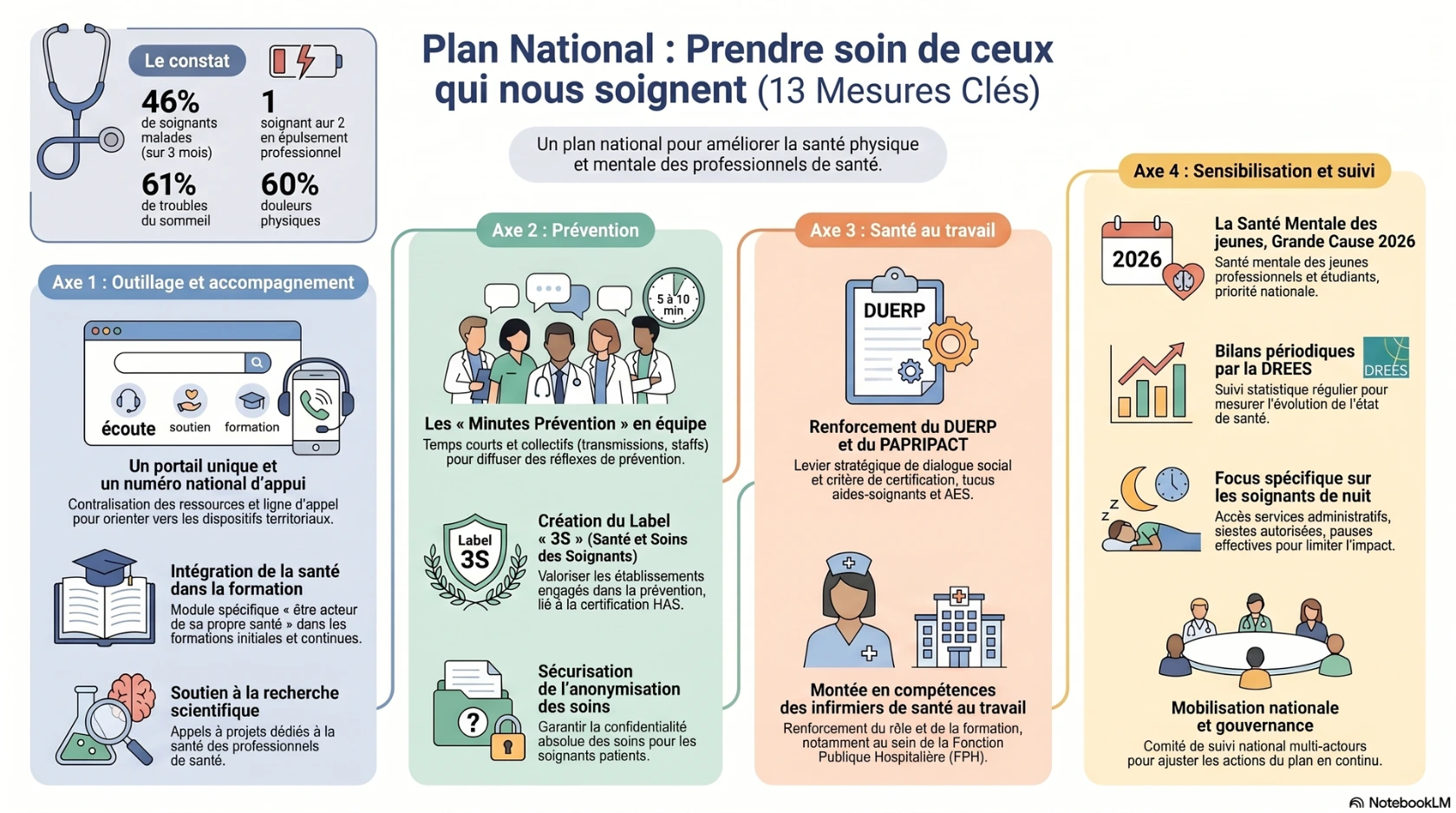
The report starts from a worrying observation: nearly 46% of healthcare workers report having fallen ill in the last three months (compared to 27% of other employees) and 61% have difficulties sleeping, with a high proportion of health-harming behaviours (alcohol, tobacco, anxiolytics) and worse mental health than the general population. It recalls previous milestones (national strategy 2016, workplace quality of life observatory) and the 2023 ministerial report on the health of healthcare professionals, deemed insufficient in light of the persistence of burnout, chronic pain, and concentration disorders. The document emphasises that "caring for those who care" is an ethical, organisational, and coherent requirement, and anchors the plan in a co-construction method with field actors, trade unions, professional orders, employer federations, and student associations. It sets four priorities: equipping and supporting professionals and students, strengthening prevention (particularly in mental health), reducing occupational risks through structured social dialogue, and establishing the health of caregivers as a sustainable institutional priority, beyond the cycle of this plan.
Operational contributions for field actors
The plan consists of 13 measures grouped into four areas: tools and support, prevention, occupational health, and awareness/follow-up, complemented by national governance through a monitoring committee and thematic working groups (students, addictions, parenting, medical devices, medico-social). Concrete contributions include the creation of a single information portal and a national support number, the integration of a module on 'being an actor in one's own health' in initial and continuing training, a call for research projects, 'prevention minutes' in structures, a '3S' label, the securing of the anonymisation of care for caregivers, the strengthening of the DUERP/PAPRIPACT as certification levers, and the upskilling of occupational health nurses in the FPH. The plan also provides for a national mobilisation, the designation of youth mental health as a major national cause for 2026, a periodic DREES assessment on the health of caregivers, and a specific focus on night professionals (break times, access to administrative services at atypical hours).
2. Key points of the document
The plan is based on an alarming quantitative diagnosis: 46% of caregivers report a recent illness, 64% say they are tired, 79% have concentration problems, 60% suffer from chronic pain, and 1 in 2 has experienced a burnout episode. These figures, presented in the 'key figures' boxes (p. 5, 8, 10, 12, 14), serve as a basis for legitimising a systemic approach and prioritising actions.
Axis 1 highlights a common information portal and a unique call number, aimed at centralising existing support systems (listening, support, guidance, training) and facilitating access to a local listening and support line for caregivers and students. This measure, detailed on p. 7, addresses the current fragmentation of support offers and aims to make resources more accessible for field professionals.
Prevention, particularly in mental health, is becoming a focus of work organisation with the establishment of 'prevention minutes' in all structures, short collective sessions to disseminate prevention reflexes in the daily routines of teams. This measure (p. 9) is complemented by support for the deployment of prevention actions aimed at caregivers, through better mapping of resources and financial support for prevention actors.
Axis 3 strengthens occupational health through the DUERP and PAPRIPACT, which must be developed, implemented, and discussed within a formalised social dialogue framework, and become criteria for HAS certification. The specific formalisation of risks for nursing assistants (AS) and educational and social support workers (AES) allows for the structuring of targeted actions to reduce risks related to manual handling, violence, and physical and psychosocial working conditions (p. 11–12).
Axis 4 places the health of caregivers in the long term: national mobilization, major cause of mental health for young people in 2026, periodic assessments by DREES, and specific measures for night professionals (effective breaks, possible naps, adaptation of administrative services). The appendix (p. 15) describes a multi-actor governance (central administrations, agencies, CNAM, CNSA, federations, orders, unions, student associations) and new thematic working groups, ensuring intersectoral monitoring and a gradual adaptation of measures.
3. Action points for local actors
Integrate the health of caregivers into the governance of the establishment and service projects: use data from the file (fatigue, sleep disorders, mental health) to explicitly include the health of professionals in the establishment project, CPOMs, internal objective contracts, and HAS certification processes. The points are present in the editorial, axis 2, and axis 3 (p. 5–6, 9–12).
Establish "prevention minutes" in team meetings, handovers, staff meetings, or shift changes: allocate 5–10 minutes dedicated to a prevention message (sleep, mental health, MSD, addictive behaviours, work-life balance) and a quick exchange on current difficulties. The general framework is described on p. 9 and can be adapted in hospitals, clinics, MSPs, EHPADs, and medico-social structures.
Enhance the quality of the DUERP and PAPRIPACT with a focus on night caregivers, AS and AES: use the findings from the file to update the risk mapping and systematically involve care teams, staff representatives, and occupational health nurses in risk analysis and prioritization of actions. The recommendations are on p. 11–12 and p. 14.
Mobilising national systems for students and young professionals: disseminating information about the CNAE, identifying or appointing local contacts that are easily visible to students, and organising links between the CNAE, university health services, training departments, and future systems like ONVS 2.0. Practical elements are on p. 8 (student focus).
Locally preparing the application for the future "3S" label (Health and Care of Caregivers): mapping existing actions (QVT, prevention, occupational health, psychological support), identifying gaps in relation to the likely requirements of the label, and articulating these actions with the DUERP, PAPRIPACT, CPOM, and continuous improvement processes. The guidelines are described on p. 9 (axis 2) and p. 11 (anchoring in HAS certification).
4. Additional References
🔍➕ For more information, see the articles referenced by "Pratiques en Santé" on the theme of health and work ➡️🔗https://pratiquesensante.odoo.com/4-3-sante-et-travail
Odoxa–MNH Observatory – "Health Status of Caregivers and Hospital Staff – Wave 3" (2023) and subsequent waves (waves 4–5, 2024–2025): regular barometers on physical and mental health, sleep, job satisfaction, and health behaviours of caregivers, useful for completing and updating the figures in the report.https://www.odoxa.fr/wp-content/uploads/2025/05/Observatoire-ODOXA-MNH-Mai-2025.pdf
Ministry of Health – "Report on the Health of Health Professionals" (PDF version published online on 9 October 2023, updated in the references in 2024–2025): detailed analysis of determinants, existing systems, and recommendations that structure the plan presented in the press release.- https://sante.gouv.fr/ministere/documentation-et-publications-officielles/rapports/sante/article/rapport-sur-la-sante-des-professionnels-de-sante
Summary article – WEKA, "Portal, helpline, label: measures to improve the health of caregivers" (21 May 2026): analysis of the measures in the plan, useful for cross-referencing information, situating this press release within the landscape of reforms, and identifying the implications for employers. https://www.weka.fr/actualite/professionnels-de-sante/article/portail-numero-d-appel-label-des-mesures-pour-ameliorer-la-sante-des-soignants-130552/
5. Frequently Asked Questions (FAQ)
Who is this plan on the health of healthcare professionals aimed at?
The plan targets all healthcare professionals (hospital, private, and social-medical), students and interns, as well as support staff (nursing assistants, AES, occupational health nurses), by mobilising governance that involves ministries, agencies, professional orders, unions, and student associations. This broad target is detailed in the editorial, the axes, and the annex on comitology (pp. 5–7, 11–13, 15).
What are the main health issues identified among caregivers?
The report highlights a high frequency of recent illness (46%), fatigue (64%), chronic pain (60%), concentration difficulties (79%), sleep disorders (6 out of 10), and poor mental health (29%), along with a high prevalence of harmful behaviours (54%). These findings are presented in the key figures boxes and are based on the 2023 report and the Odoxa–MNH observatory (pp. 5, 8, 10, 12, 14).
What does the common information portal consist of and what will the unique number be used for?
The portal will bring together, on a single site, all existing support mechanisms (listening, guidance, resources, training) and make them available to healthcare professionals and students, with a listing of available training and operational tools. The associated helpline will direct professionals to the appropriate local services and facilitate access to a listening and support line (p. 7).
What are the "prevention minutes" and how can they be implemented?
The "prevention minutes" are very short, collective and participatory moments to be integrated into the regular functioning of structures (staff meetings, transmissions) to spread the culture of prevention, remind simple reflexes, and promote everyday prevention. The report emphasises the need to deploy, promote, and embed these minutes within all care organisations to foster a cultural change (p. 9).
What does the national label "3S – Health and Care of Caregivers" cover?
The "3S" label aims to encourage and recognise establishments that are strongly committed to the health of caregivers, by acknowledging their initiatives around prevention, occupational health, and support for teams. It could be integrated into the CPOM and possibly into the HAS certification, thereby strengthening regional governance and the sustainable inclusion of caregiver health in institutional commitments (p. 9–11).
How does the plan take into account the specificities of night professionals?
Measure 13 recognises the specific constraints faced by night professionals (shift work, desynchronisation of biological rhythms, isolation) and recommends promoting effective breaks during service, recovery time after work, and even short naps, as well as adapting administrative services to their atypical hours. These guidelines, detailed on p. 14, aim to limit fatigue and facilitate access to rights and procedures.
How will the monitoring of the plan and the evolution of actions be ensured?
The monitoring is entrusted to a committee led by Philippe Denormandie and Nicolas Delmas, bringing together a plenary committee (employer federations, orders, unions, student associations, stakeholders) and a strategic committee with central administration directors, operators, agencies, and organisations (ANAP, ANACT, EHESP, SPF, HAS, CNAM, CNSA). New working groups (students/interns, addictions, parenthood/maternity, medical devices/preventive innovations, medico-social) will allow for the enrichment and adjustment of actions over time (p. 15).
6. Rewriting in Easy-to-Read Language
Title
Health of caregivers: a plan to better protect them.
Context and issues (Easy-to-Read Language)
Many caregivers are tired and often unwell.
They sleep poorly and sometimes have lasting pain.
Their mental health is worse than that of other people.
The State wants to better protect them at work and in their lives.
This plan concerns all caregivers and health students.
What the plan proposes (Easy-to-Read Language)
Create a unique website with a phone number to help caregivers.
Add a module in training to learn how to take care of oneself.
Support research on the health of caregivers.
Include small 'prevention minutes' in teams to discuss health.
Award a '3S' label to establishments that adequately protect their caregivers.
Make care for caregivers more confidential, so they are not afraid of being seen as patients.
Better utilise workplace prevention tools (DUERP, PAPRIPACT).
Better recognise the risks for nursing assistants and AES.
Take into account the needs of night caregivers: breaks, rest, simpler processes.
Key points in Easy-to-Read Language
Many caregivers feel very tired and stressed.
Caregivers are sometimes less well monitored in health than their patients.
The plan aims to change the organisation of work to protect the health of teams.
Establishment management must use prevention tools with the teams.
A national committee monitors the plan and creates working groups (students, addictions, parenting, medico-social).
7. Cross-sectional analysis — Values of Health Practices
Literacy: the document remains institutional and quite technical; it does not offer tools directly adapted to varying levels of literacy, but encourages prevention practices that can be implemented locally.
Empowerment: the plan emphasises the ability of caregivers to be "actors in their own health" through a training module, but the direct participation of beneficiaries in the design of measures remains unclear.
Participation: the measures are presented as resulting from consultation with stakeholders in the health system, but the concrete modalities of co-construction (workshops, consultations, co-design) are not detailed.
Community health: the collective dimension is present through "prevention minutes" in teams and national mobilisation, but the anchoring in local communities of caregivers (territories, networks, peer support) is only suggested.
Ethics: the editorial clearly sets an ethical requirement to "care for those who care" and the plan includes confidentiality of care for caregivers and the fight against violence, but does not address cultural or social biases in detail.
Human rights: the measures aim for better protection of the health and privacy of professionals, with attention to equity among professions, but without explicit reference to human rights frameworks or intersectionality.
Intersectorality: governance involves health, work, higher education, national agencies, insurance, and social care, which strengthens intersectorality in implementation.
Partnership: models of collaboration are outlined through the monitoring committee and multi-stakeholder working groups, but the practical modalities of local partnership (e.g. ARS–establishments–local authorities) remain to be clarified.
Fight against discrimination: discrimination is not treated as a central theme; the document mainly discusses violence and confidentiality, without explicitly addressing non-judgment, diversity, or discrimination within the profession.
8. Assessment of the reliability of the resource
Scientific relevance: the file relies on an official report from 2023 on the health of healthcare professionals, on data from the DREES, and on the results of the Odoxa–MNH observatory, which are recognised and updated sources. It does not detail the methodology of the surveys, which is normal for a press file, but implicitly refers to rigorous and published work; for a thorough scientific analysis, it is necessary to supplement with the full report and the Odoxa–MNH reports.
Operational relevance: the resource is very suitable for institutional decision-makers and health executives, as it clarifies axes, measures, and clear governance, with regulatory levers (DUERP, PAPRIPACT, certification, CPOM) that are directly actionable. However, it remains poorly equipped for direct appropriation by the caregivers themselves (few practical sheets, concrete tools, or examples of local actions), which will require work on translation and adaptation for field teams.