🚨 Precarious women: the health we do not see — and the resources to act
🔍💡 Health of women in precarious situations: a selection of recent resources to identify, orient and act — from the smear truck to the 'going towards' initiatives. A real time-saving resource for field teams.
📌 This document gathers, summarises and makes accessible a selection of recent resources on the health of women in precarious situations — a topic scattered across health, social issues, housing and rights. It saves considerable monitoring time: each entry indicates in a few lines what the resource offers and where to find it. It serves as a starting point for launching an action, arguing a project or enriching a training, without having to explore dozens of reports oneself. Its value lies in being a guidance tool, not a ready-made manual.
Source :📒 Promotion of women's health in precarious situations: Guidelines for practice and inspiring implementations
✍️ Author: BEC Emilie — CREAI-ORS Occitanie (the DOCcitanie catalogue also mentions Rolland Christine, coord.) Publisher: DRAPPS Occitanie — CREAI-ORS Occitanie / Promotion Santé Occitanie, a programme led by ARS Occitanie📜🔗LIEN vers la source
1️⃣ Analytical summary
A cumulative set of vulnerabilities still poorly equipped
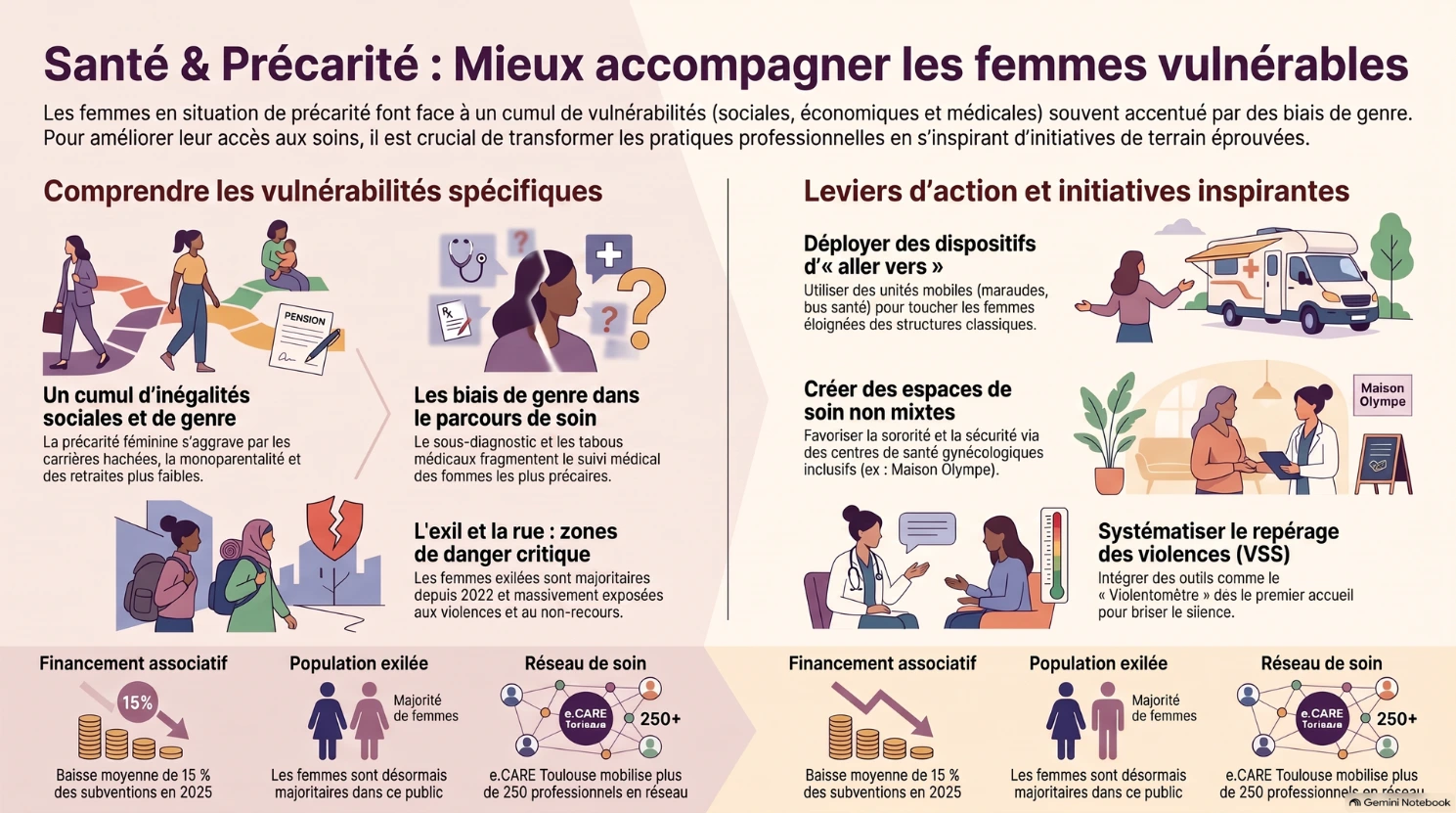
Precarity particularly affects women: single-parent families, involuntary part-time work, interrupted careers, lower pensions (p.3, p.6). Gender biases in care are added — under-diagnosis, taboos, fragmented pathways (p.12-17) — and extreme situations: homelessness, wandering, exile, where violence and non-access accumulate (p.18-22). The document targets health, social, medico-social, and associative actors confronted with these populations. It extends a 2025 bibliography on precarious populations, focusing this time on female specificities and on sexist and sexual violence (p.3, p.46).
A selection of resources to guide action
The document does not formulate its own recommendations: it selects and summarises resources — institutional reports, advocacy, experience sheets, tools — classified by theme and date (p.3). It highlights replicable field initiatives (outreach, non-mixed spaces, participatory health centres, p.35-45) and brings together framing data on VSS as well as prevention measures (p.46-63). A directory of resource sites completes the whole (p.64-66). Its strength is to make scattered works visible and accessible; its limitation is to leave the user with the task of operational translation.
2️⃣ Key points of the document
1️⃣ A nature to be well identified — it is a commented bibliography (“knowledge brokering”), not a guide. Each entry = a reference + a summary indicating the contribution and access. The value lies in the selection and direction, not in operational protocols (p.1-2).
2️⃣ The gender framing / precarity — the health inequalities of women intersect biology, social relations and gender bias, exacerbated by precariousness (part-time, single parenthood, caregiving, menopause at work). Sources: Women's Foundation on seniority (p.6), CESE on perinatality (p.12), FNORS / SCORE Health (p.13).
3️⃣ The most exposed populations — homeless women (senatorial report, 22 recommendations, p.26) and isolated exiled women "in the blind spot" of the systems, majority among the exiled population since 2022 (p.18, p.26-27). The street and exile rapidly degrade health and expose massively to violence.
4️⃣ Replicable and documented initiatives — e.CARE Toulouse and its "going towards" (network of 250+ professionals, p.35), Women's Pole of Autremonde (female team, sorority, Paris 20th, p.36), Maison Olympe (inclusive gynaecological health centre, Angers, p.36), menstrual health in the Elbeuf area (p.37). Inspir'action sheets from the Fabrique Territoires Santé (2024-12).
5️⃣ The VSS focus, a documented public health issue — recent framing data (funding for the fight, Senate 2025-07, p.47; prostitution system, ONVF 2025-04, p.47) and a budgetary alert signal — average decrease of 15% in subsidies to associations in 2025 (Women's Foundation, p.46). Prevention component: violentometer (p.57), INSPQ file (p.58), IFAS-IFAP programme Pays de la Loire (p.58), "Equality Field" kit JOP 2024 (p.58-59).
3️⃣ Action tracks for local actors
Reminder : the document does not make recommendations; the pathways below mobilise the resources it references.
1️⃣ Monitoring and argumentation tool — to draw from the notices (p.4-63) the data and examples to support a local diagnosis or a funding request, rather than exploring the reports one by one.
2️⃣ Deploy a « move towards » — to draw inspiration from the systems described p.35-37 (outreach, swab-truck, advanced consultations) to reach women distanced from care; cross-reference with the DGCS guide on mobile systems (see References) for regulatory framing and funding.
3️⃣ Equip the identification of violence — mobilise the violentometer (p.57) and the tools from the prevention section for initial reception; plan for training and associated orientation — tools alone are not sufficient.
4️⃣ Create an unconditional single-sex space — based on the model of the Women’s Pole of Autremonde or the Olympe House (p.36): co-construction with users, workshops, access to rights — while anticipating the reported budgetary fragility.
5️⃣ Structure a « women's health » axis in CLS — based on the model of the Elbeuf territory (p.37): menstrual insecurity, VSS, sexual health, in inter-institutional coordination.
6️⃣ Anticipate the most critical unmet need — suitable accommodation and sustainable funding are recurring barriers (p.26, p.46). Any field action must include a partnership section for accommodation / coordination.
4️⃣ Additional references
1. Guide "Health and social care establishments and services for access to care for people in situations of precarity", DGCS/DGOS/DGS/DIHAL, December 2024 — operational overview of the "going towards" devices (mobile LHSS and perinatal care, EMSP, PASS, health mediation). Link
2. " Health mediation: a tool to reduce social and territorial health inequalities?", Fabrique Territoires Santé / Cities and Territories, April 2025. Link
3. HAS, "Identification of women victims of violence within the couple" — a tool to assist identification for professionals (updated barometer 2025; note : the initial tool dates from 2019, the page is updated). Link
5️⃣ Frequently asked questions (FAQ)
1️⃣ Is this document a practical guide?
No. It is a commented bibliography: it directs to resources and summarises them, but does not provide protocols. Implementation requires consulting the referenced documents (preamble, p.1-2).
2️⃣ Who is it aimed at?
To professionals and volunteers in the health, social and medico-social fields working with women in situations of precarity, as well as project leaders and local decision-makers (p.1-3).
3️⃣ How is it organised?
In three parts — specifics / vulnerabilities (p.4-22), action / recommendations and initiatives (p.23-45), sexist and sexual violence (p.46-63) — plus a directory of sites (p.64-66). Clickable summary; entries sorted from most recent to most old.
4️⃣ Where can we find concrete examples to replicate?
In "Inspiring projects and initiatives" (p.35-45): moving towards, non-mixed spaces, participatory health centres, menstrual health in CLS.
5️⃣ What data on violence?
The VSS section (p.46-56) gathers recent framing reports (funding, prostitution system, Virage survey); the prevention section (p.57-63) presents tools and programmes. Note: some figures come from advocacy, to be cross-checked.
6️⃣ Are the links reliable?
They were verified by the author in October 2025. Given the instability of some links (ministerial reports, PDFs), a re-check at the time of use is recommended.
7️⃣ Can it be used for training?
Yes, as a documentary base and source of examples. For sensitive topics (violence, exile, prostitution), provide an appropriate facilitation framework (see Section H).
6️⃣ Rewriting in Easy to Read and Understand (FALC)
What is this document?
• It is a list of useful documents.
• The subject is the health of women who have little money.
• For each document, there is a short summary.
• It also states where to find the document.
This document is not a manual.
• It does not provide step-by-step instructions.
• It helps to find the right resources.
What it explains
• Poor women are often in poor health.
• They have less time and money to take care of themselves.
• Some live on the streets. Others come from another country.
• They often suffer from violence.
What it proposes
• Examples of actions that work.
• Reach out to women, where they are.
• Safe spaces just for women.
• Tools to identify violence.
How to use it
• Look for the theme that interests you.
• Read the brief summary.
• Open the full document if needed.
7️⃣ Cross-analysis — values of Health Practices
Literacy : The document does not provide literacy tools; it is written for professionals. Some resources it mentions (outreach, mediation) do aim at hard-to-reach audiences.
Empowerment : Several referenced initiatives involve women in the consultation in co-decision (Women’s Pole of Autremonde, Maison Olympe, p.36); the document itself does not describe a participatory approach.
Participation : Co-construction is described in the cited initiatives (paid staff / volunteers, associated users), not in the production of the bibliography.
Community health: The collective dimension is present through examples (participatory health centres, CLS), less so in the general framing.
Ethics : Gender biases in care are explicitly named (p.12-17); cultural and social biases are addressed through exiled populations.
Human rights : The approach is centred on equity and access to rights and care for the most vulnerable; inclusion (disability, exile) is present.
Intersectorality : Recommended recurrently — health / social / housing / justice articulation (p.26, p.47).
Partnership : Collaboration models are illustrated (local partnerships, CLS, networks) but not formalised in method.
Fight against discrimination : The document explicitly addresses gender discrimination and cumulative vulnerabilities (precarity, migration, disability); non-judgment and unconditional welcome are valued in the initiatives.
8️⃣ Assessment of the reliability of the resource
Scientific relevance : average to good for a monitoring tool. The corpus mixes grey literature, institutional reports, associative advocacy, and some recent research works (2024-2025). This is not a synthesis of evidence (no systematic review, no grading of data) — what the format does not claim to be. Dated and identified sources; some activist figures to cross-check.
Operational relevance : high as a documentary entry point and source of examples; low as a ready-made guide. The user must consult the resources and carry out the field translation themselves. Strengths: clickable summary, synthetic notices, directory of sites. Reservations: inconsistencies in pagination / metadata, links to be re-checked, heterogeneous vintages.
9️⃣ Strategic hashtags
#healthpractices #HealthPromotion #WomenHealth #HealthInequalities #GoingTowards #SexistAndSexualViolence #Precarity #CommunityHealth
This article was developed in accordance with the Charter
of the use of artificial intelligence of Health Practices.
Click on the image