🚨 🚨 5 skills, 4 levers, 10 indicators: the complete method for sustainable PS skills
🔍💡 Psychosocial skills: three international frameworks (CASEL, WHO, OECD) to move from isolated workshops to a whole school approach. Guidelines, levers and evaluation pathways — evidence-based, without overselling. 🧭📚 From definition to measurement: equipping a PS skills project from start to finish
📌📌These three texts form the international scientific foundation that underpins the psychosocial skills approach currently deployed in France. A field actor finds three operational things: a clear framework of what we seek to develop (the five skills), a method to transition from isolated workshops to a sustainable institutional approach, and guidelines for evaluating without self-deception. Practically useful for auditing an existing project, arguing with a hierarchy or a funder, and professionalising a stance beyond occasional activity.
Source :
📒 Compétences psychosociales : du référentiel à la démarche d'école entière — trois cadres de référence (CASEL, OMS, OCDE)
✍️ D'après CASEL (2020) ; Mahoney et al. (2021, American Psychologist) ; Cavioni, Broli & Grazzani (2024, Int. Journal of Emotional Education).📜🔗LINK to the 3 sources
- CASEL'S SEL Framework: What Are the Core Competence Areas and Where Are They Promoted? The CASEL SEL framework: what are the core competence areas, and where are they developed? Collaborative for Academic, Social, and Emotional Learning (CASEL) — November 2020. https://casel.org/casel-sel-framework-11-2020/?download=true/
- Systemic Social and Emotional Learning: Promoting Educational Success for All Preschool to High School Students - - L'apprentissage social et émotionnel systémique : favoriser la réussite éducative de tous les élèves, de la maternelle au lycée. » J. L. Mahoney, R. P. Weissberg, M. T. Greenberg, L. Dusenbury, R. J. Jagers, K. Niemi, M. Schlinger, J. Schlund, T. P. Shriver, K. VanAusdal, N. Yoder (CASEL et universités partenaires)- American Psychologist (American Psychological Associationssociation — octobre 2020.- https://casel.s3.us-east-2.amazonaws.com/Design-Systemic-SEL.pdf
- Bridging the SEL CASEL Framework with European educational policies and assessment approaches - Relier le cadre SEL du CASEL aux politiques éducatives et aux approches d'évaluation européennes. Valeria Cavioni (Université de Foggia), Luisa Broli (Lycée technique L. Casale, Vigevano), Ilaria Grazzani (Université de Milano-Bicocca).International Journal of Emotional Education, vol. 16, n° 1, avril 2024, pp. 6-25 (DOI 10.56300/ULTX1565)
1️⃣ ANALYTICAL SUMMARY
An international scientific foundation for a priority issue. SEL refers to the process by which children and adults acquire the skills to understand and regulate their emotions, set goals, demonstrate empathy, maintain relationships, and make responsible decisions. Formalised in the United States as early as 1994 (founding of CASEL), it has spread globally, with increased urgency following the COVID-19 crisis regarding the mental health of young people. The target audiences range from preschool to high school, including adult facilitators. The identified problem is recurrent: overly siloed approaches, centred on a single classroom programme, or designed as a 'one size fits all', produce fragile results. The three documents together cover the basic framework (Doc 1), the systemic implementation model (Doc 2), and the bridge with health policies and evaluation in Europe (Doc 3).
From the isolated programme to the whole school approach. The main operational contribution comes from Doc 2: a 'theory of action' articulating four families of practices coordinated at the levels of institution, territory, and educational authority, quality criteria (SAFE), ten indicators of a whole school approach, and the emphasis on the crucial role of guidance and family/community partnerships. Doc 3 complements by anchoring SEL in health promotion (alignment with the Ottawa Charter via the WHO Health Promoting Schools) and providing an evaluation framework with the OECD's 'Big Five' model (15 measurable competencies). The corpus thus offers a complete chain, from definition to evaluation.
2️⃣ KEY POINTS OF THE DOCUMENT
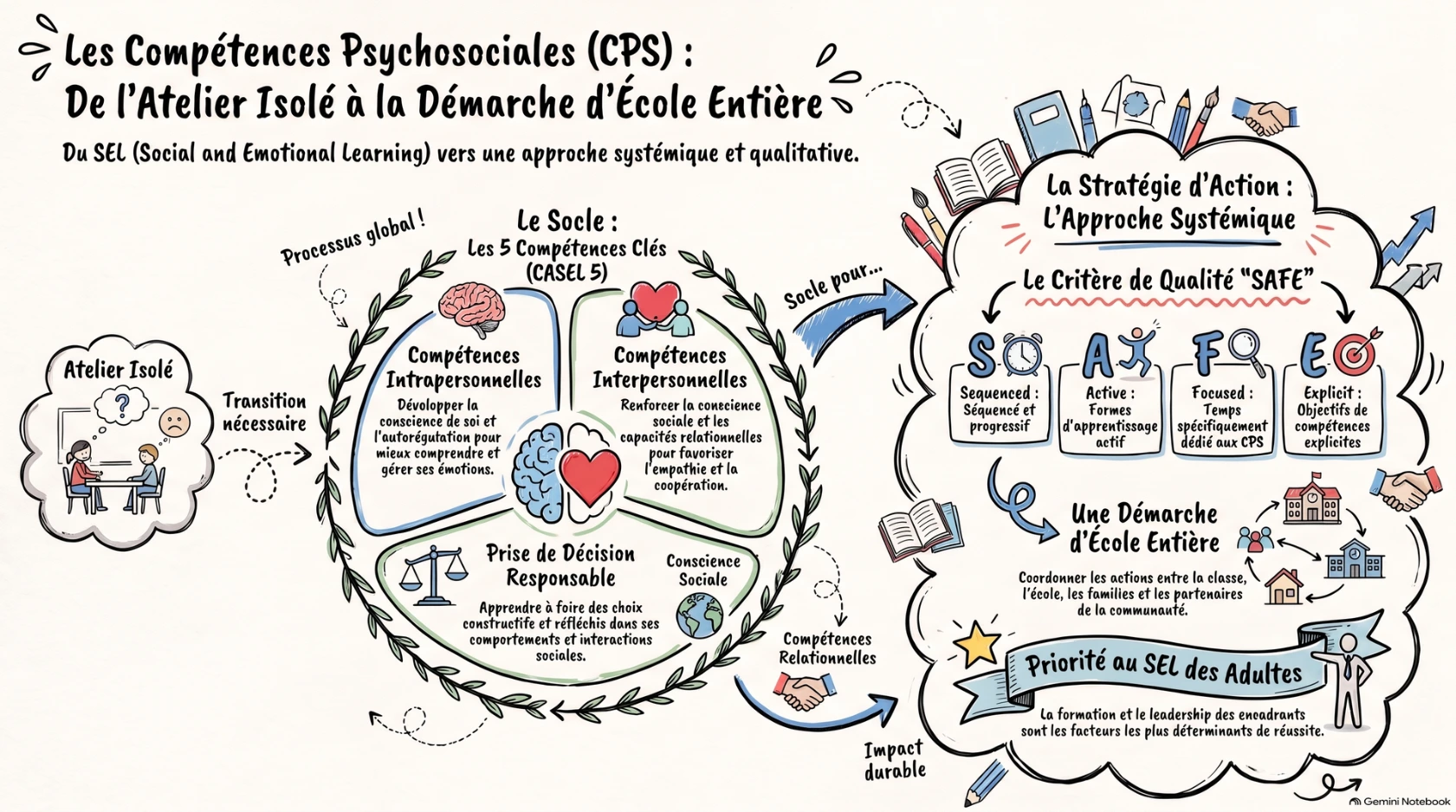
1️⃣ The five CASEL competencies ('CASEL 5'). Self-awareness, self-regulation, social awareness, relationship skills, responsible decision-making — organised into intrapersonal, interpersonal, and decision-making competencies (Doc 1, section "Core Competence Areas"; Doc 2, p. 5). They develop in four articulated environments: classroom, school, families, community.
2️⃣ The "systemic" SEL is not an isolated workshop. It relies on four families of coordinated practices and is broken down at three levels (establishment, territory, educational authority): building a foundation and planning; strengthening adults' SEL skills; developing students' SEL; practising continuous improvement (Doc 2, Table 1, p. 4).
3️⃣ Quality criteria that can be challenged: the SAFE benchmark. An effective programme is Sequenced (sequenced, progressive), Active (active learning), Focused (time dedicated to social-emotional skills) and Explicit (explicit objectives) (Doc 2, p. 2). The selected programmes must meet high levels of evidence (reference to levels 1-2 of the ESSA law, p. 6).
4️⃣ Ten indicators of a whole school approach. Notably: explicit teaching of SEL, integration into learning, student voice and engagement, supportive school climate, adults' SEL, restorative discipline, authentic partnerships with families and the community, continuous improvement systems (Doc 2, Box 3, p. 9).
5️⃣ Anchoring "health promotion" and starting evaluation. Doc 3 explicitly aligns the principles of SEL with the five strategies of the Ottawa Charter through Health Promoting Schools (Table I, p. 10), and proposes a measurement framework based on the OECD's Big Five model — 15 assessable competencies (pp. 13-15). The programme Life Skills Training is cited as adopted in several European countries, including France (p. 11).
3️⃣ ACTION TRACKS FOR LOCAL ACTORS
1️⃣ Map the existing against the 5 competencies. Scrutinise your workshops/actions against the “CASEL 5” to identify blind spots (e.g. a lot of emotional, little responsible decision-making) (Doc 1; Doc 2, p. 5).
2️⃣ Shift from one-off workshops to a whole school approach. Use the four levers from Table 1 (Doc 2, p. 4) as a roadmap: foundation/planning, adults, students, continuous improvement — rather than an isolated intervention.
3️⃣ Audit a programme before adopting it with the SAFE framework. Check sequencing, active learning, dedicated time, and explicit objectives, and prioritise programmes with a high level of evidence (Doc 2, p. 2 and p. 6).
4️⃣ Self-assess with the 10 indicators. Transform Box 3 (Doc 2, p. 9) into a school checklist, systematically including student voice, restorative discipline, and family/community partnerships.
5️⃣ Invest in adult SEL and support from management. Plan for professional development of practitioners (Doc 2, p. 8): leadership is identified as the most determining factor for success (p. 10).
6️⃣ Link the evaluation and talk about "health promotion". Rely on measurable dimensions (Big Five OECD, Doc 3, p. 14) and on alignment with the Ottawa Charter (Table I, p. 10) to engage in dialogue with health partners. Unmet need : the transposition to the French system (academy/rectorate ≠ "district/state" in the US) requires a local adaptation not provided by the documents.
4️⃣ ADDITIONAL REFERENCES
The thematic file : https://pratiquesensante.odoo.com/1-1-competences-psychosociales
- Public Health France — Psychosocial skills: an operational framework for expert trainers (2025). https://www.santepubliquefrance.fr/les-actualites/competences-psychosociales-un-referentiel-operationnel-destine-aux-formateurs-experts
- éduscol / Ministry of National Education — Developing psychosocial skills in students (2026, framework "Health-promoting school" / National priority mental health). https://eduscol.education.gouv.fr/4677/developper-les-competences-psychosociales-chez-les-eleves
- Réseau Canopé — How to promote the development of psychosocial skills in schools? (Jan 2025). https://www.reseau-canope.fr/actualites/article/comment-favoriser-le-developpement-des-competences-psychosociales-a-lecole
5️⃣ FREQUENTLY ASKED QUESTIONS (FAQ)
1️⃣ SEL, CPS: what are we talking about? The process of acquiring skills to manage emotions, set goals, cooperate, and make responsible decisions; in France, we talk about psychosocial skills (Doc 1, definition; Doc 3, p. 7).
2️⃣ What is the difference between a "SEL programme" and systemic SEL? The latter is not limited to classroom sessions: it coordinates policies, adults, students, and continuous improvement at the level of the institution and the territory (Doc 2, pp. 1-2 and Table 1, p. 4).
3️⃣ How to recognise a quality programme? SAFE marker (sequenced, active, focused, explicit) and high level of evidence (Doc 2, p. 2 and p. 6).
4️⃣ Should we train adults, not just young people? Yes: the development of the skills of practitioners and the support from management are crucial (Doc 2, p. 8 and p. 10; Doc 3, p. 19 on teacher training).
5️⃣ How to assess the skills developed? Doc 3 proposes a framework from the OECD SSES study: five main areas and 15 measurable skills (pp. 13-15). Caveat: this framework relies on self-assessments and a model similar to the 'Big Five' of personality — useful but debated.
6️⃣ Does SEL reduce inequalities? The documents suggest it as a potential, provided there is a 'lens of equity' and a 'transformative' SEL (examining the causes of inequalities) — this is a reasoned objective, not an automatic guarantee (Doc 2, pp. 5-6).
7️⃣ What is the link with health promotion? Strong: Doc 3 aligns SEL with the Ottawa Charter via the WHO Health Promoting Schools (p. 9 and Table I, p. 10).
6️⃣ REWRITING IN EASY LANGUAGE
What are psychosocial skills?
- They are useful abilities for life.
- They help manage emotions.
- They help communicate with others.
- They help solve problems.
- They help make good decisions.
There are five key skills.
- Knowing oneself.
- Controlling oneself.
- Understanding others.
- Getting along well with others.
- Deciding responsibly.
Where do we learn these skills?
- At school and in class.
- In the family.
- In the neighbourhood and social life.
A workshop alone is not enough.
- Action is needed throughout the school.
- Adults must also learn these skills.
- We need to work with families.
- We need to check if it works, and improve.
How do we know if a programme is good?
- Activities follow a clear order.
- Young people participate actively.
- Time is taken for these skills.
- The objectives are clearly stated.
7️⃣ CROSS-ANALYSIS — VALUES OF HEALTH PRACTICES
- Literacy: Doc 1 is a simple visual reference; Docs 2 and 3 remain expert academic texts, not easily accessible without mediation.
- Empowerment: the voice, agency and power to act of students are established as structuring principles (Doc 2, Box 3, p. 9; Doc 1).
- Participation: co-construction with students, families and the community is explicitly recommended (Doc 2, pp. 9-11).
- Community health: central collective dimension (articulated environments class/school/family/community; European SHE network, Doc 3, p. 10).
- Ethics: cultural biases and the "equity lens" identified and discussed, with a call for culturally appropriate practices (Doc 2, pp. 5-6).
- Human rights : educational equity and access for all to resources set as goals (Doc 2, p. 5 ; Doc 1, mention equity).
- Intersectorality : health / education / social articulation affirmed, notably via the Ottawa Charter and the SHE network (Doc 3, pp. 9-10).
- Partnership : formalised models of family-school-community partnerships and coordination between institution/territory/state (Doc 2, Table 1, p. 4 and pp. 9-11).
- Combating discrimination : the "transformative" SEL aims to examine the causes of inequality (culture, power, privilege) and the non-exclusive/restorative discipline (Doc 2, pp. 5-6, p. 9).
8️⃣ EVALUATION OF THE RELIABILITY OF THE RESOURCE
Scientific relevance — high, with reservations of nature. CASEL is the reference organisation on SEL; Doc 2 appears in a peer-reviewed journal (American Psychologist) and is based on ~25 years of action-research and meta-analyses (Durlak et al., 2011 ; Taylor et al., 2017); Doc 3 is published in 2024 in a peer-reviewed journal, with no declared conflict of interest. Reservations : (a) the file of Doc 2 is a preliminary version 2020 of an article published in 2021 — cite the reference version; (b) Doc 2 is co-written by members of CASEL based on the CASEL model (stakeholder posture); (c) Doc 3 is a conceptual article linking, not a systematic review nor an empirical study — its alignments are argued, not statistically tested (limit acknowledged p. 19).
Operational relevance — high for the tools, to be adapted for the context. The frameworks (CASEL 5), grids (SAFE), check-lists (10 indicators) and theories of action are directly mobilisable. Transfer limit: the governance described (school/district/state in the USA) does not mechanically correspond to the French organisation (establishment/circumscription/academy); a local adaptation is necessary and is not provided by the documents.
9️⃣ STRATEGIC HASHTAGS
#PsychosocialSkills #CPS #SocialEmotionalLearning #HealthPromotingSchool #MentalHealth #CPSAssessment #HealthPromotion #healthpractices
This article was developed in accordance with the Charter
of the use of artificial intelligence of Health Practices.
Click on the image