
🔍💡 Health inequalities: the same term, three opposing interpretations among policymakers! This confusion directs policies towards individual care rather than prevention. An enlightening analysis to rethink our strategies. #HealthInequalities #PublicHealth #SocialDeterminants #HealthPolicies
📌 This document is particularly useful for professionals and volunteers working in public health, prevention, and social care as it reveals how the term "health inequalities" is interpreted in three radically different ways by policymakers. This semantic confusion can lead to inappropriate actions: investing in reactive individual care rather than in population preventive policies.
Understanding these three frameworks allows field actors to better articulate their requests, identify ambiguities in official strategies, and advocate for approaches that truly address the social determinants of health.
Source: 📒 Reframing health inequalities? The rise, rise and fall of three competing policy frameworks
✍️ Reframing health inequality? The rise, rise and fall of three competing policy frames - Ally Brown, School of Social Work and Social Policy, University of Strathclyde, Glasgow, UK, March 2025 - Publication: Journal of Public Health, Vol. 48, No. 1, pp. 19–25
📜🔗LINK to the source
Number of pages: 7
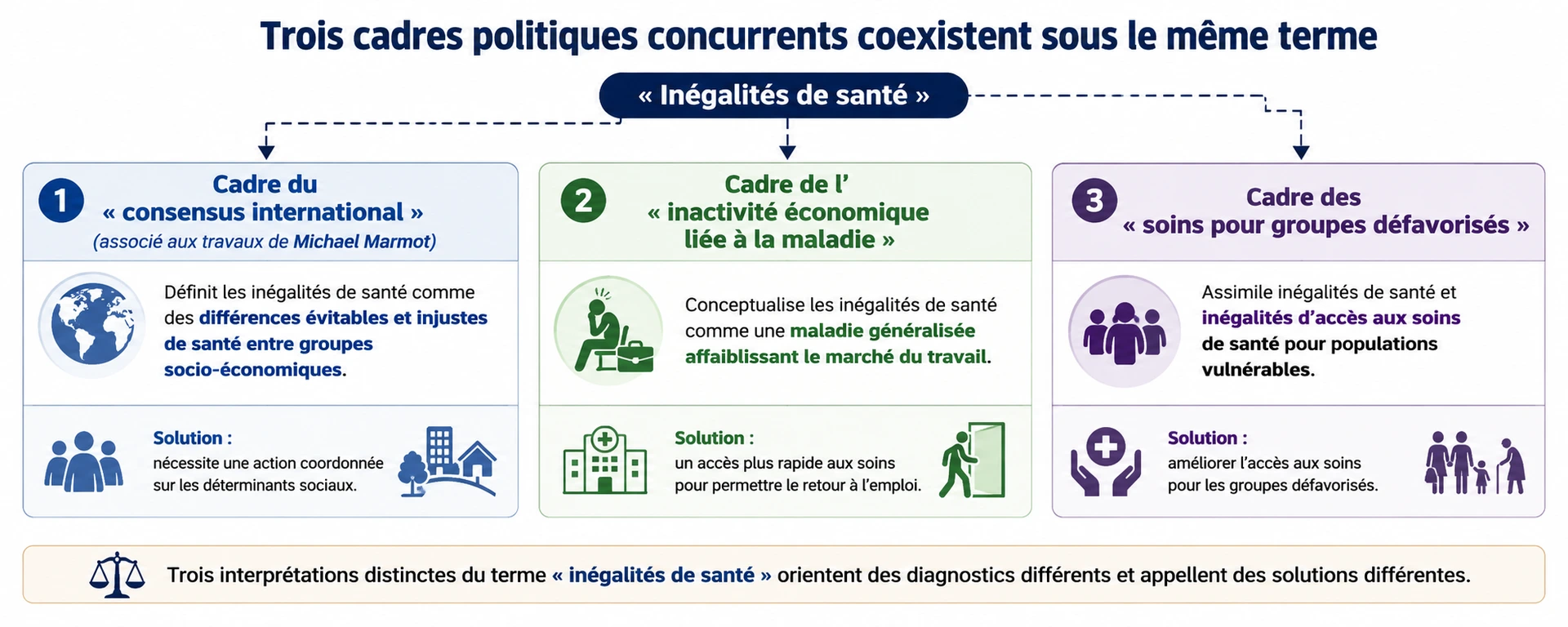
Three political frameworks, three realities to be distinctly recognised
The first fundamental point is to understand that the term "health inequalities" encompasses three radically different logics of action in your territory [file:1, p.21-23].
Framework 1 - Social justice: Health inequalities are a systematic injustice requiring action on social determinants (income, housing, employment, education) through coordinated public policies [file:1, p.21, Table A]. This is the framework of researchers and some public health professionals, but it is losing political ground [file:1, p.21-22].
Framework 2 - Economic productivity: Health inequalities are a barrier to economic activity that must be addressed through prompt care to return to work [file:1, p.22, Table B]. Predominant among economic decision-makers, this framework effectively excludes inactive individuals (children, retirees, severely disabled, caregivers) [file:1, p.22-23].
Framework 3 - Access to care: Health inequalities are inequalities in access to or quality of care for disadvantaged populations [file:1, p.23, Table C]. This framework conflates health and care, medicalising the social question [file:1, p.23-24].
1. ANALYTICAL SUMMARY
Context and identified issue
Since the end of the New Labour strategy on health inequalities in England, health disparities have widened in the UK. A recent critique suggests that the term "health inequalities", although derived from an international scientific consensus, has paradoxically directed policymakers towards individual medical solutions rather than economic redistribution policies. This research examines how Scottish and Greater Manchester political actors understand and use this term in their social, economic, and health policies between 2017 and 2022. The study is based on 34 interviews with policymakers and the analysis of 30 strategic documents.
Operational results and implications for the field
The study reveals three competing frameworks for interpreting "health inequalities". The first, termed "international consensus", carries a strong moral weight and denounces the social injustice of the systematic distribution of illness and death, but struggles to gain political support. The other two emerging frameworks receive more attention: "economic inactivity related to illness" which aims for a return to work through reactive care, and "care for disadvantaged groups" which conflates health inequalities with inequalities in access to care. These frameworks divert political action from social determinants towards individual health interventions. The author recommends using more precise terms such as "social health inequalities" and "care inequalities" to clarify intentions.
2. KEY POINTS OF THE DOCUMENT
1. Three competing political frameworks coexist under the same term
The analysis identifies three distinct interpretations of the term "health inequalities" used by policymakers. The framework of the "international consensus" (associated with the work of Michael Marmot) defines health inequalities as avoidable and unjust differences in health between socio-economic groups, requiring coordinated action on social determinants [file:1, p.21]. The framework of "economic inactivity due to illness" conceptualises health inequalities as a widespread illness weakening the labour market, with the solution being quicker access to care to enable a return to work [file:1, p.22]. The framework of "care for disadvantaged groups" equates health inequalities with inequalities in access to healthcare for vulnerable populations [file:1, p.23].
2. The moral framework is losing political ground despite its powerful language
The international consensus framework relies on strong moral language denouncing social injustice [file:1, p.21]. Strategic documents use expressions such as "deeply entrenched", "unacceptable", "scandal" to describe health disparities between neighbouring communities [file:1, p.21]. A Scottish policymaker interviewed states: "there are people who are systematically dying in their forties and fifties and it is a scandal" [file:1, p.21]. However, several officials acknowledge that this framing is "tired", "under the radar", and "almost out of steam" politically [file:1, p.21].
3. The economic approach prioritises a return to work through medical solutions
In economic policy teams, "health inequalities" are redefined as an obstacle to economic productivity [file:1, p.22]. A Scottish decision-maker in charge of child poverty explicitly reframes the issue: "if we have a healthier population, they will be more likely to be able to work" [file:1, p.22]. This interpretation has gained political importance, particularly in Greater Manchester after a 2019 report highlighting the impact of poor health on economic performance [file:1, p.22]. This prioritisation risks excluding inactive populations (children, severely disabled individuals, retirees, carers) [file:1, p.22-23].
4. The health/care confusion leads to poorly targeted actions
The common use of the word "health" as a shorthand for "health policy" (dominated by care) leads to a confusion between "health inequalities" and "care inequalities" [file:1, p.23]. In Scotland, two government teams illustrate this confusion: the Health Inequalities Unit includes a team for prisoner care, and a new team on "Racialised Health Inequalities" focuses exclusively on care inequalities, not on racism as a social determinant [file:1, p.23]. None of the 23 social or economic policy officials interviewed spontaneously mentioned "care inequalities" [file:1, p.23].
5. Terminological recommendations to clarify public action
The author recommends that researchers and policymakers opposed to social injustice use less ambiguous alternative terms [file:1, p.24]. She suggests "social inequalities in health" to refer to disparities related to social determinants, "widespread ill-health" for prevalence, and "healthcare inequality" for access to health services [file:1, p.24]. This terminological clarification could help differentiate policy frameworks and better communicate objectives, while challenging narratives that steer towards reactive individual solutions rather than population-based preventive ones [file:1, p.24].
3. ACTION POINTS FOR LOCAL ACTORS
1. Audit the local understanding of the term "health inequalities"
Organise workshops with local partners (elected officials, social services, employability, health) to identify which interpretative framework dominates in your area [file:1, p.21-23]. Use the three tables (A, B, C) from the document as an analytical framework to identify causal stories, problems, solutions, and actors involved in local discourses and strategies [file:1, p.21-23]. This mapping will help detect risks of excessive medicalisation or a focus on employability at the expense of other vulnerable populations.
2. Adopt precise terminology in your communications
Systematically replace "health inequalities" with more explicit terms in your strategic documents, funding requests, and advocacy [file:1, p.24]. Use "social health inequalities" when targeting social determinants, "access to care inequalities" for health system issues, and "burden of morbidity" for disease prevalence [file:1, p.24]. This clarification will strengthen the coherence of your discourse and avoid misunderstandings with funders and partners.
3. Challenge reductive narratives in governance bodies
When participating in local strategic committees (local health councils, poverty commissions, etc.), systematically question the proposed actions: do they target causes or symptoms? [file:1, p.22-24]. If a measure is limited to improving access to care or facilitating the return to work for the sick, explicitly ask what complementary actions are planned regarding social determinants (housing, income, environment) [file:1, p.22-23]. Rely on the strong moral language documented in the study to highlight the injustice of health disparities [file:1, p.21].
4. Document the needs of non-economically active populations
The framework of "economic inactivity due to illness" risks rendering invisible children, disabled individuals, caregivers, retirees, and incarcerated persons [file:1, p.22-23]. Produce local data on health inequalities affecting these groups and integrate them into your territorial diagnostics [file:1, p.22-23]. Ensure that local strategies do not condition access to preventive interventions on employability criteria.
5. Train field actors in the analysis of policy frameworks
Organising training sessions for professionals and volunteers using the five elements of a policy framework: causal stories, problems, solutions, actors, moral responsibility [file:1, p.20-21]. This skill will enable them to decode official strategies, identify blind spots, and formulate reasoned counter-proposals. Use quotes from the document as case studies to concretely illustrate how the same term can convey opposing political visions [file:1, p.21-23].
4. ADDITIONAL REFERENCES
🔍➕ For more information, see the articles referenced by "Health Practices" on the topic of inequalities ➡️🔗https://pratiquesensante.odoo.com/2-1-inegalies-sociales-territoriales
Marmot M, Allen J, Goldblatt P et al. (2024). Build Back Fairer: Tackling Health Inequalities at Scale - A Review of Strategies and Interventions.Institute of Health Equity.
https://www.instituteofhealthequity.org/resources-reports
Recent methodological guide on multi-level strategies to reduce social health inequalities, complementary to the frameworks identified in the article. -https://www.health.org.uk/reports-and-analysis/reports/health-equity-in-england-the-marmot-review-10-years-on-0
5. CROSS-SECTIONAL ANALYSIS — VALUES OF HEALTH PRACTICES
Literacy:The document does not provide tools suitable for varying literacy levels, but emphasises the importance of clarifying political vocabulary to avoid misunderstandings between researchers, policymakers, and the public [file:1, p.24].
Empowerment:Beneficiaries are not involved in the design or evaluation according to this research; the study focuses on policymakers and reveals that emerging frameworks (economy, care) do not question the origin of illness or the participation of populations [file:1, p.22-23].
Participation:No co-construction mechanism is described; on the contrary, the analysis shows that the dominant frameworks (employability, care) place solutions at the service level rather than in the living conditions of populations [file:1, p.22-24].
Community health:The collective dimension is absent from the two emerging frameworks that favour reactive individual approaches; only the "international consensus" framework recognises the systematic social distribution of disease [file:1, p.21-22].
Ethics:Biases are identified and addressed: the study reveals how the "economic inactivity" framework implicitly excludes non-active populations (children, disabled individuals, retirees) from political attention [file:1, p.22-23].
Human rights:The "international consensus" framework respects the principles of equity by denouncing the social injustice of health disparities as "unacceptable"; the other two frameworks do not address this normative dimension [file:1, p.21, 23].
Intersectorality:The "international consensus" framework explicitly recommends coordinated government action ("joined-up government") between social, economic, and health policies [file:1, p.21]; the "economic inactivity" framework mentions collaboration between health and employability services [file:1, p.22].
Partnership:Models of collaboration are mentioned between care providers and public employability services to target health interventions [file:1, p.22], but without formalisation described in this research document.
Combating discrimination:The document explicitly mentions the confusion in Scotland surrounding a team "Racialised Health Inequalities" that focuses on care rather than racism as a social determinant [file:1, p.23]; non-judgment and diversity are not addressed.
6. EVALUATION OF THE RELIABILITY OF THE RESOURCE
Scientific relevance:Excellent. Published in a peer-reviewed journal (Journal of Public Health, Oxford University Press) in open access [file:1, p.19]. Rigorous methodology combining 34 semi-structured interviews and frame analysis of 30 strategic documents via NVivo [file:1, p.20-21]. Ethical approval from the University of Strathclyde [file:1, p.21]. Updated and diverse references (2017-2025). Clearly acknowledged limitations (only two contexts, potential selection bias) [file:1, p.24]. Strong theoretical grounding based on Lynch's work and the literature on political framing [file:1, p.19-20].
Operational relevance:Very high. The analysis offers directly applicable terminological recommendations for field actors to clarify their strategic communications [file:1, p.24]. The three summary tables (A, B, C) serve as practical tools for analysing local political discourse [file:1, p.21-23]. Interview quotes concretely illustrate the ambiguities faced by professionals. The action pathways are transferable to contexts beyond Scotland and Greater Manchester. The document alerts to concrete drifts (medicalisation, employability focus) observable in current policies.
7. FREQUENTLY ASKED QUESTIONS (FAQ)
1. Why use the term "social health inequalities" rather than "health inequalities"?
Because the term "health inequalities" is interpreted in three different ways by policymakers, creating counterproductive ambiguities [file:1, p.24]. Some use it to refer to the social injustice of health disparities between socio-economic groups (international consensus), others to talk about widespread illness preventing employment (economic inactivity), and still others to evoke unequal access to care (care for disadvantaged groups) [file:1, p.21-23]. The expression "social health inequalities" explicitly clarifies that we are talking about social determinants and prevents political action from being solely redirected towards individual care [file:1, p.24].
2. What are the risks of the "economic inactivity related to illness" framework?
This framework presents three major risks identified in the study [file:1, p.22-23]. Firstly, many disabling illnesses cannot be quickly or easily improved, and an individual reactive approach cannot sustainably manage demand [file:1, p.22]. Secondly, this focus on employment reduces the political understanding of health to only the functions necessary for work, neglecting other dimensions of well-being [file:1, p.23]. Thirdly, it prioritises the potential workforce at the expense of other important groups: children, people with caregiving responsibilities, severely disabled individuals, prisoners, asylum seekers, and retirees [file:1, p.23].
3. How does the "care for disadvantaged groups" framework differ from the "international consensus"?
The fundamental difference lies in the attribution of moral responsibility [file:1, p.21-24]. The "international consensus" framework attributes the moral responsibility for the origin of disease to governments and unregulated economic forces that generate social inequality, thus creating a political narrative about systematic health variations [file:1, p.21]. In contrast, the "care for disadvantaged groups" framework only attributes responsibility to services for responding to disease, without addressing its origins, presenting these variations as apolitical issues of service delivery [file:1, p.22]. Furthermore, the former targets social determinants through coordinated policies, while the latter focuses solely on improving access and quality of care [file:1, p.23, Tables A and C].
4. Why is the "international consensus" framework losing political support despite its strong moral language?
Although strategic documents contain powerful moral language denouncing the injustice of health inequalities (described as "unacceptable", "scandalous", having "ruined individual lives"), several policymakers acknowledge that this framing is politically "fatigued" and "almost run out of steam" [file:1, p.21-22]. The officials interviewed note that "people do not talk in the political space about the decline in life expectancy, the widening gaps in healthy life expectancy, or the social gradient in health" [file:1, p.22]. Meanwhile, the two alternative frameworks are gaining ground because they align better with current economic priorities (productivity, employment) and the organisational modes of health systems (service delivery) [file:1, p.22-23].
5. How do economic policy teams understand "health inequalities"?
Participants in economic policy teams generally conceptualise health as the absence of disease and use "health inequalities" to signify widespread illness [file:1, p.22]. For them, "health inequalities" become a cause of economic problems rather than a problem in itself, as illness is an obstacle to work [file:1, p.22]. A Scottish official in child poverty policy explicitly reframes the issue by telling a health colleague: "actually no, it is what you do to tackle health inequalities that will help the work on child poverty. Because obviously, if we have a healthier population, they will be more likely to be able to work" [file:1, p.22]. This interpretation is not concerned with socio-economic groups, avoidable differences, or the role of social inequality as a key driver [file:1, p.22].
6. What methodology was used to identify these three policy frameworks?
The research combined two complementary approaches [file:1, p.20-21]. First, a frame analysis of 30 texts of social, economic, and health strategies published between 2017 and 2022 by the Scottish Government (18 documents) and the Greater Manchester Combined Authority (12 documents), conducted using NVivo software [file:1, p.20, Tables 1 and 2]. This analysis categorised the five key elements of each policy framework: causal stories, problems, solutions, actors, and moral language [file:1, p.21]. Then, 34 semi-structured interviews lasting 45 to 88 minutes were conducted online with decision-makers working in these contexts, addressing health, inequalities, and health inequalities [file:1, p.21]. The transcripts were anonymised and then coded deductively and inductively [file:1, p.21].
7. Which populations are at risk of being made invisible by the "economic inactivity" framework?
The document explicitly identifies several vulnerable groups that risk being excluded from political attention if the "economic inactivity related to illness" framework dominates [file:1, p.22-23]. These include children, caregivers, people with severe disabilities, prisoners, asylum seekers, and retirees [file:1, p.23]. Indeed, this framework prioritises the potential workforce and implicitly conditions public intervention on the ability to return to work [file:1, p.23]. The author notes that this orientation can be observed in the fact that in Scotland, the prisoner care team (a non-priority population for employability) is nonetheless placed within the Health Inequalities Unit, illustrating the confusion between the frameworks [file:1, p.23].
8. REWRITING IN EASY READ
What this document says
Words have several meanings
The document studies how policymakers understand the words "health inequalities".
Researchers have found 3 different meanings.
These 3 meanings lead to different actions.
The 1st meaning: social injustice
Some think that health inequalities are an injustice.
Poor people die younger than rich people.
This is not normal.
We need to change living conditions: work, housing, income.
The 2nd meaning: sick people cannot work
Others think that health inequalities are an economic problem.
Many people are ill.
They cannot work.
They need better care so that they can return to work.
The third meaning: access to care.
Others think that health inequalities are about access to doctors.
Poor people find it harder to see a doctor.
Access to care needs to be improved.
The problem.
These three meanings create confusion.
Politicians are not talking about the same thing.
The first meaning is losing importance.
The second and third meanings are becoming priorities.
As a result, we invest in care, not in societal changes.
The proposed solution.
Use clearer words.
Say "social health inequalities" when talking about living conditions.
Say "care inequalities" when talking about access to a doctor.
That way, everyone understands the same thing.
We can act in the right place.
Key points.
The same word can have three different meanings.
The first meaning states that it is a social injustice.
The second meaning wants the ill to return to work.
The third meaning aims to improve access to doctors.
Using precise words helps to act better.
Who conducted this study?
A Scottish researcher, Ally Brown.
She spoke with 34 politicians.
She read 30 official documents.
The study focuses on Scotland and Manchester (England).
It was published in March 2025.