
🔍💡 Young people and AI: nearly 1 in 2 confide in a chatbot for personal problems, often without realising the risks to their mental health and data. #YouthMentalHealth #ConversationalAI🤖🧠 When AI becomes a 'confidant' or 'therapist' for already very anxious teenagers, professionals must take back control: information, identification, secure speaking spaces. #YouthPrevention
📌 📌 The report quantifies and objectifies the alert 'anxiety + AI' to convince decision-makers and partners (28% suspicion of GAD, higher AI usage among struggling youth).
It helps to target priority audiences (19-25 years, students, young professionals, young people with GAD-7 score ≥ 10) and to justify this targeting in diagnostics, CPOM or project calls.It provides concrete hooks for communication and workshops (1 in 2 young people discuss intimate topics with AI, only 32% know what happens to their data, 85% want more information).It legitimises the systematic integration of a question about AI usage in educational, social or health interviews, particularly with anxious young people who find it easier to approach AI than an adult.It directs towards targeted workshops (studies, emotions, relationships, personal data) and towards alignment with national frameworks on AI in education and the protection of minors (CNIL, Ministry).
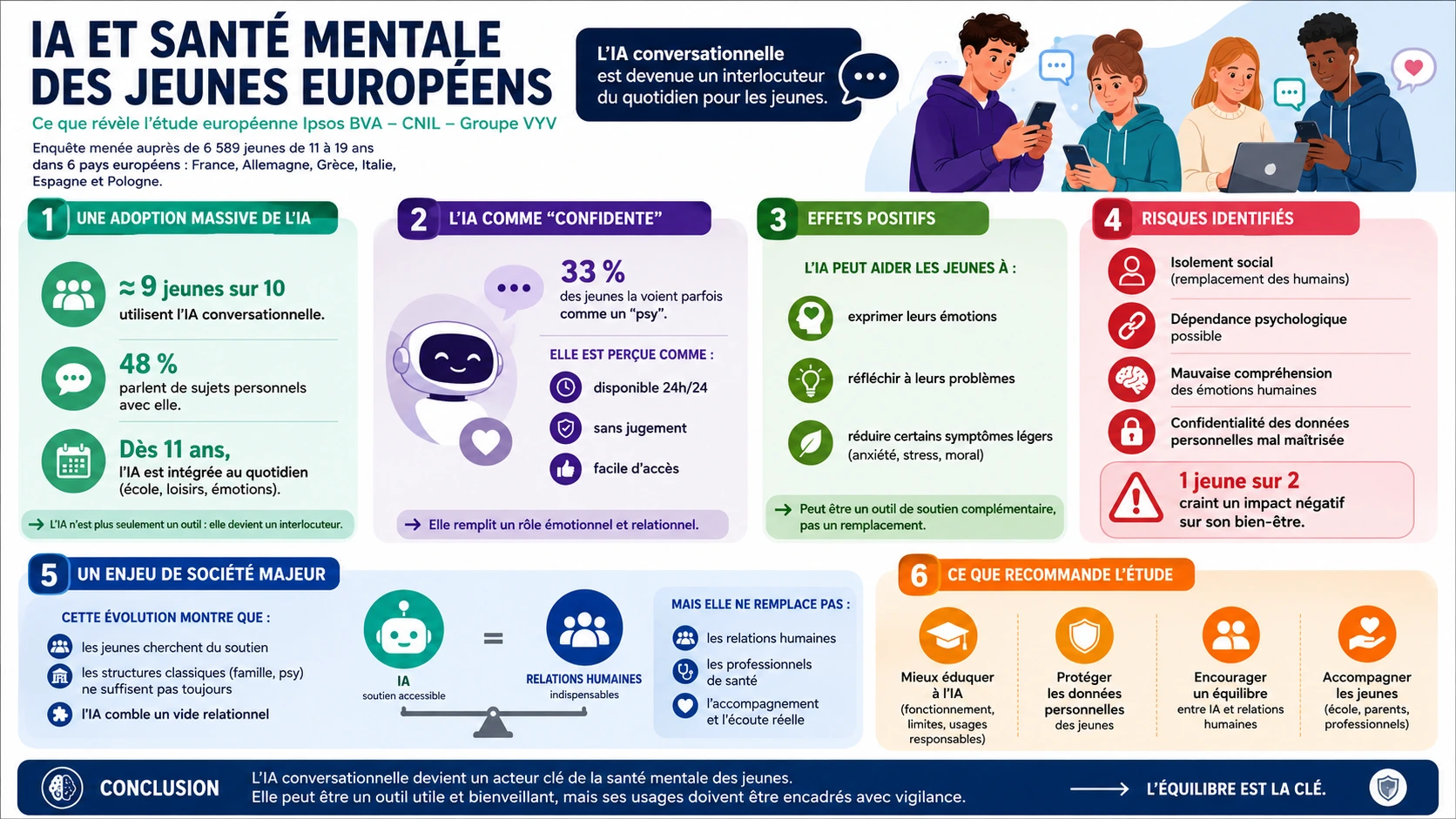
Source: 📒 Study - The impact of AI users on the mental health of young Europeans
📜🔗LINK to the source
Study:https://www.cnil.fr/sites/default/files/2026-05/ipsos_bva_les_jeunes_et_l_ia.pdf
Infographic: Survey results -https://www.cnil.fr/sites/default/files/2026-05/aime_infographie-enquete.pdf
Document the alert “anxiety + AI” to your decision-makers
In meetings with elected officials, management of organisations, ARS or the rectorate, you can say: “28% of 11-25 year olds in France are above the GAD-7 threshold for generalised anxiety disorder, and the proportion reaches 30 to 34% in Germany, Sweden and Ireland.”
You can also show thatyoung people who are struggling are those who use AI the most to confide, which justifies integrating AI into any mental health prevention strategy (quantitative, non-ideological argument).
Prioritise your target audiences
Based on the figures, you can decide to prioritise targeting:
the19-25 year olds, students and young professionals: they accumulate more anxiety symptoms, more difficulties in talking to their loved ones, and more use of AI for intimate topics.
theyoung people with suspected GAD (GAD-7 ≥ 10): 68% of them talk to AI about intimate subjects, and they trust AI more than humans for certain advice.
In a call for projects, a local diagnosis or a CPOM, you can justify this targeting very precisely.
Build digital education messages that “hook” young people
The data provides concrete hooks for your materials:
“You are not alone: 1 in 2 young people talk to AI about personal matters, but only 32% know what happens to their information.”
“Many think that AI helps to feel better, but nearly 1 in 2 young people also say that it can isolate or undermine well-being.”
These phrases can be used as they are in workshops, posters, podcasts, Instagram/TikTok campaigns, etc.
Equip your individual interviews (psychologist, nurse, educator, facilitator)
This report legitimises you to systematically ask the question:
“Do you also talk about all this to AIs (ChatGPT, Copilot, etc.)? How does that go?”
The figures show thattalking to AI is often easier for anxious young people than talking to an adult, which invites us not to judge, but to work from their experience: human/AI complementarity, identifying problematic advice received, etc.
Design very targeted workshops rather than “talking about AI in general”
The report provides four workshop themes that align with what young people are already using:
AI forstudies: how to use it without cheating or losing confidence in one’s own abilities.
AI foremotions: what can AI do when I am stressed, sad, angry… and what it should not do (replace human help, manage a suicidal crisis, etc.).
AI andrelationships: managing conflicts, harassment, disputes; when AI advice can worsen a situation.
AI andpersonal data: what AI does with information, what is better kept for a human, how to set privacy settings.
Each of these blocks is directly based on declared uses (homework, revisions, emotions, conflicts, social networks).
Calibrate your information actions: “do not start from scratch”
60% of young people say they are “well informed” about the risks of AI… but only 12% say they are “very well informed”, and 85% want to know more at least about one topic (data, risks, best practices).
In practical terms, this means:
not holding purely informative “basic” sessions,
but rather interactive formats that start from their real uses and questions: “what has made you uncomfortable with an AI before?”, “what information would you never share with a human but have already given to an AI?”.
Align your practices with national frameworks (and use them as leverage)
The fact that the CNIL is a co-producer provides a strong argument for negotiating with schools, local authorities, and associations: this is not just a “tech” issue, it is a matter ofprotection of minors and datarecognised by the regulatory authority.
You can align your actions with theframework for the use of AI in education(Ministry, 2025): awareness from the beginning of secondary school, supported use from Year 9, etc., while adding the often-missing dimension of mental health and privacy.
1. Analytical summary
Context, high anxiety, and the role of AI
The study surveys 3,800 young people aged 11 to 25 in France, Germany, Sweden, and Ireland about their mental well-being, their use of AI, and their perception of risks. In France, 84% report feeling 'well', but girls, those aged 19-25, students, and working individuals report more difficulties than average. The adapted GAD-7 for young people shows that 65% of 11-25 year olds in France exhibit symptoms of anxiety (mostly mild) and that 28% reach the threshold for suspected generalised anxiety disorder, with even higher proportions in Germany, Sweden, and Ireland (30 to 34%). Conversational AI is widely used: 86% of young French people use it from the age of 11, across all backgrounds. Beyond school and professional uses, more than a third use it to chat, seek advice when stressed, or when they are not feeling well.
Operational contributions for prevention and practices
The report details the hierarchy of interlocutors when facing problems: friends and family remain the first recourse, but AI is becoming the most "accessible" tool for young people with a GAD-7 score ≥ 10 or those receiving psychological support, with nearly 1 in 2 using it for intimate topics. The diversity of uses (an average of 7.2 uses out of 16 items) increases with anxiety, raising concerns about dependency and the replacement of human connections. Young people attribute calming, advisory, intelligent, and emotional understanding capabilities to AI, while simultaneously recognising that it can promote isolation and undermine well-being. The study also highlights a partial awareness of confidentiality risks (only a third know what happens to the data, but 85% want more information), providing a clear foundation for building actions in digital education, mental health literacy, and regulation of conversational AI usage.
2. Key points of the document
A high prevalence of anxiety: 65% of young French people exhibit symptoms of anxiety (GAD-7 ≥ 5) and 28% have a level compatible with a suspicion of generalised anxiety disorder, with comparable or higher levels in other European countries. (p.9, 12, 14-15)
A massive reliance on AI from the age of 11: 86% of young French people report using AI tools, with more than 7 different uses on average out of 16 proposed, and even higher levels among those receiving psychological support or experiencing high anxiety. (p.23-26)
AI, a new interlocutor for personal difficulties: 48% of young French people use AI to discuss intimate or personal topics, a proportion that rises to 68% among those suspected of having generalised anxiety disorder. (p.38)
Emotional attachment and trust in AI: among users for personal issues, 64% consider AI as a 'life coach', 61% as a 'confidant', and 46% as a 'therapist', with half of young people convinced that it can help them feel better or gain confidence. (p.43, 46‑47)
Perceived risks but little control: nearly one in two young people believe that AI can isolate them from others or undermine their well-being, while about 50‑70% say they trust it to provide reliable advice and protect their information, whereas only 32% claim to know what happens to the data they provide. (p.54, 57, 59, 62, 64, 66)
3. Action points for local stakeholders
Enhance early detection of anxiety by integrating simple tools inspired by the GAD-7 into school nursing interviews, youth health assessments, general medical consultations, or prevention activities in school and community settings, with particular attention to 19-25 year-olds, girls, students, and workers who accumulate higher scores. (p.9, 12, 14‑15)
Create alternative 'human' speaking spaces to AI (talking groups, psycho-social support sessions, peer mediation, chats moderated by trained professionals) specifically targeted at young people who report difficulties in talking to their parents, friends, or psychologists but turn to AI for its availability and non-judgmental qualities. (p.20‑22, 38‑40, 43)
Design educational modules on digital literacy and mental health around conversational AIs: explain what AI does with data, the types of information not to share, the limits of reliability, the risks of isolation, and best practices (double-checking, not substituting AI for care, confidentiality). (p.54, 62, 64, 66)
Co-construct charters for the use of AI with young people for studies, leisure, and personal life, incorporating screen time guidelines, rules for not replacing human contact in cases of distress, and explicit guidance towards professional services (psychologists, helplines, youth centres, local youth services). (p.24-28, 34, 38-40, 46-47)
Equip professionals (teachers, facilitators, social workers, school psychologists, teams from youth centres, local missions) with practical sheets and educational scenarios to work with young people on representations of AI as a 'friend' or 'therapist', deconstruct unrealistic expectations, and strengthen psychosocial skills. (p.43, 46-47, 51, 59-60, 66)
4. Additional References
🔍➕ For more information, see the articles referenced by "Pratiques en Santé" on the topic of digital technology and AI ➡️🔗https://pratiquesensante.odoo.com/2-6-intelligence-artificielle-numerique
5. Cross-Analysis – Values of Pratiques en Santé
Literacy: the document provides clear figures and examples of use but remains in expert language, without a directly usable educational tool for low literacy audiences.
Empowerment: the voice of young people is central through survey responses, but there is no involvement of beneficiaries in the design of recommendations or tools for empowerment.
Participation: no co-construction of actions is described; the study remains descriptive, without a participatory framework.
Community health: the collective dimension (school, peer groups, local communities) is indirectly mentioned through socialisation venues, but without a structured community strategy.
Ethics: the issues of confidentiality, non-judgment, and risks of isolation are identified, but few operational ethical responses (principles, concrete safeguards) are proposed.
Human rights: the report highlights the risks to data protection and access to care (cost, difficulty in seeing a psychologist) but does not explicitly use the rights framework (equity, non-discrimination).
Intersectorality: the collaboration between health and data protection (Group VYV – CNIL) is explicit, but the education, justice, youth, or local authority sectors are underrepresented as partners.
Partnership: the main model is that of a research partnership between a mutual insurance provider, a regulatory authority, and a research institute; there is no detailed model of local operational partnership.
Combating discrimination: disparities in gender, age, and status (students, working individuals, those receiving psychological support) are described, but explicit discrimination and stigmatization are not analysed, nor are the levers for non-judgment and diversity.
6. Assessment of the reliability of the resource
Scientific relevance:
Standardised quantitative methodology, compliance with ISO 20252 standards, sample of 3,800 young people aged 11-25 representative by quotas in 4 countries.
Use of a validated instrument (GAD-7) adapted for young people, with reminders of thresholds and reference literature (Spitzer et al. 2006).
Analysis is primarily descriptive (percentages, comparisons), without a causal model; inherent limitation (self-reporting, online sampling bias).
High relevance (fieldwork January 2026, publications 2026) and consistency with other recent sources (CNIL, WHO, studies on AI and youth).
Operational relevance:
Indicators that can be immediately mobilised to diagnose the extent of AI usage, the use of AI as emotional support, the prevalence of anxiety, and the low awareness of data risks.
The document does not directly offer educational tools or intervention protocols, but provides a solid foundation for arguing, prioritising, and co-constructing local actions (information, identification, support for usage).
7. MCQ – 5 questions
Part 1 — Questions (without answers)
Question 1 (p.12‑15)
According to the GAD-7 test, what proportion of young French people show signs of generalised anxiety disorder (score ≥ 10)?
a) 15%
b) 28%
c) 45%
d) 65%
Question 2 (p.24‑26)
Among the following statements, which best describes the use of AI by young French people?
a) Only students use AI regularly
b) AI is used only for school assignments
c) AI is used extensively from the age of 11, with more than 7 different uses on average
d) Less than 1 in 2 young people report using AI
Question 3 (p.38‑40)
Among these propositions, which corresponds to the proportion of young French people using AI for intimate or personal topics?
a) 18%
b) 32%
c) 48%
d) 72%
Question 4 (p.43, 46‑47)
Among the following statements, which best reflects the perception of AI by young people who use it for their personal problems?
a) The majority see it solely as a technical tool without an emotional dimension
b) More than 3 in 5 see it as a life coach or confidant
c) Less than 10% think it can help them feel better
d) Most believe it does not understand human emotions at all
Question 5 (p.54, 62, 64‑66)
Regarding the risks and confidentiality related to the use of AI to discuss personal life, which statement is correct?
a) 80% of young people know exactly what happens to the information entrusted to AI
b) The majority of young people state that they do not wish for more information on the risks associated with AI
c) About a third of young people know what happens to the information entrusted to AI and 85% want more information on at least one topic related to AI
d) Young people completely trust AI to keep information confidential
Part 2 — Commented correction
Question 1
✅ Correct answer: b) 28%
📝 Explanation: The GAD-7 shows that 28% of young French people reach the threshold of suspicion for generalised anxiety disorder (score ≥ 10), with higher rates among those aged 20-25. Source: p.14-15.
Question 2
✅ Correct answer: c) AI is used extensively from the age of 11, with more than 7 different uses on average
📝 Explanation: 86% of young French people report using AI tools, and the average number of uses, out of 16 proposed, is 7.2, with usage present in all age groups from 11 years old. Source: p.24‑26.
Question 3
✅ Correct answer: c) 48%
📝 Explanation: 48% of young French people report having used AI to solve personal or intimate problems, with more frequent use among young people suspected of having generalised anxiety disorder. Source: p.38‑40.
Question 4
✅ Correct answer: b) More than 3 out of 5 consider it a life coach or confidant
📝 Explanation: Among young people who have used AI for personal issues, 64% consider it a life coach and 61% a confidant, and nearly half consider it a therapist. Source: p.43, 46‑47.
Question 5
✅ Correct answer: c) About a third of young people know what happens to the information entrusted to AI, and 85% want more information on at least one topic related to AI
📝 Explanation: Only 32% of young people report knowing what happens to the information entrusted to AI, while 85% want more information on at least one theme (data, best practices, risks). Source: p.64‑66.
8. Frequently Asked Questions (FAQ)
Which countries and which young people were included in the survey?
The study concerns 3,800 young people aged 11 to 25, surveyed online in France, Germany, Sweden, and Ireland, with representative quota samples (gender, age, region, type of urban area, socio-professional category in France). (p.2)
What is the level of anxiety identified among young people?
The GAD-7 reveals that 65% of young French people exhibit symptoms of anxiety (mostly mild) and that 28% reach the threshold of suspicion for generalised anxiety disorder, with similar or higher levels in the other three countries. (p.9, 12, 14-15)
What is the daily use of AI for young people?
AI is primarily used for writing, summarising, analysing, and for homework or professional task assistance, but also for generating creative content, organising activities, playing, chatting, managing stress and conflicts. (p.25, 27-28)
In what situations do young people talk to AI about their personal lives?
Nearly half of young people use AI to discuss intimate topics, especially when they feel stressed, sad, in conflict with loved ones, or when they find it difficult to talk to their parents, friends, or a psychologist. (p.20-21, 28, 38-40)
How do young people perceive AI in emotional and relational terms?
Many attribute human qualities to it: life coach, confidant, friend, or even therapist, and half believe it can help them feel better or gain confidence, while also recognising that it can isolate and undermine well-being. (p.43, 46-47, 59)
Are young people aware of the risks to their personal data?
About one in two young people identify risks to privacy, but only a third know what happens to the data they provide, and 85% want more information on what AI does with the information, the types of data to avoid, and best practices. (p.54, 62, 64, 66)
What are the implications for health, social, and educational professionals?
The results show the need to identify anxiety, to offer human alternatives to AI for confiding, to develop actions for digital literacy and mental health, and to work with young people on their representations and uses of conversational AIs. (p.20‑22, 24‑28, 38‑40, 46‑47, 59‑60, 66)
9. Rewriting in Easy Language
Title
Young People, AI and Mental Health
Easy Language Summary
Many young people in Europe often feel anxious or stressed.
In France, nearly 3 out of 10 young people have a very high level of anxiety.
Almost all young people use AI tools like ChatGPT or Copilot.
They use them for school, work, leisure, and to talk about their problems.
Almost 1 in 2 young people talk to AI about intimate or very personal matters.
Many believe that AI can help them feel better, but also that it can isolate them.
Few young people really know what AI does with their information.
Most want to better understand the risks and best practices.
Key Points in Easy Language
1. Anxiety among Young People
Many young people feel anxious, tense, and sometimes distressed.
A significant number have a level of anxiety that requires professional help.
2. AI is Widely Used
Young people use AI from the age of 11.
They often use it for homework and studies.
They also use it to organise their time and create images, texts, or music.
3. Talking about Problems with AI
Many young people share their worries with AI.
They do this because AI is always there and does not judge.
Some talk to AI about things they don't tell anyone.
4. AI seen as a friend or a therapist
Some young people see AI as a life coach.
Others see it as a confidant or a therapist.
They believe that AI can help them feel better.
5. The risks and the data
Some young people are afraid that their data is not protected.
But many do not know what happens to their information.
Most want simple explanations about the risks and best practices.