🚨 Check an image in 3 clicks: the school method that saves prevention
🔍💡 Media literacy = health literacy: the methods for verifying sources and images from CLEMI adapt directly to your health info/disinfo workshops. 🧠 A toolkit designed for the classroom, deployable from tomorrow on the ground
📌Disinformation, generative AI, and the attention economy are not "school" subjects: they are concrete determinants of health, as a rumour, a manipulated image, or a chatbot's advice can influence care behaviours. This brochure offers ready-to-use methods — verify a source, conduct a reverse image search, identify a bias, decode an algorithm — directly transposable to health literacy workshops, patient education, or prevention among young people. It provides a common vocabulary (verified information, source, information disorder) useful for equipping an audience to sort through the health messages that bombard them.
Source:📒 The essentials — Media and Information Education — School | College | High School » (2026 edition, referenced by CLEMI in the 2026-2027 cycle)
✍️ LEMI (Centre for Media and Information Education), service associated with the Réseau Canopé, under the supervision of the Ministry of National Education. Publishing Director: Samuel Vitel (DG of Réseau Canopé). Director of CLEMI: Serge Barbet. Scientific and Educational Director: Isabelle Féroc Dumez. Coordination of the file: Sébastien Rochat. Publication with the support of GMF.📜🔗LIEN vers la source
1️⃣ Analytical summary
Context and issues — critical thinking as a democratic compass
The brochure starts from an observation: in an environment dominated by platforms, social networks, and generative AIs, knowing where information comes from has become a crucial skill. It is primarily aimed at teachers who are starting out or wish to get acquainted with media and information education (EMI), from nursery to high school, and positions EMI as a pillar of the civic journey. The target audiences are primarily students, but the offer is explicitly open to an expanded educational community including educators and social workers (p. 4). The issues addressed — sources, images, informational disorders, freedom of expression, economics of the media — directly intersect with the challenges of health misinformation.
Operational contributions — ready-to-use sheets
The document provides detailed educational sequences: objectives, duration, methods, materials, step-by-step process and complementary resources. Each sheet starts from a real case (AFP dispatches from the Louvre, publications from Hugo Décrypte, map of Reporters Without Borders, YouTube algorithm, media concentration) and equips a reproducible approach: questioning the source, describing an image via the 5Ws, conducting a reverse search, distinguishing misinformation and disinformation, identifying an editorial angle. For a field actor, the value is not in the "school" content but in these transferable facilitation protocols for a non-captive audience.
2️⃣ Key points of the document
1️⃣ A structured EMI progression, from nursery to high school (p. 5–52)
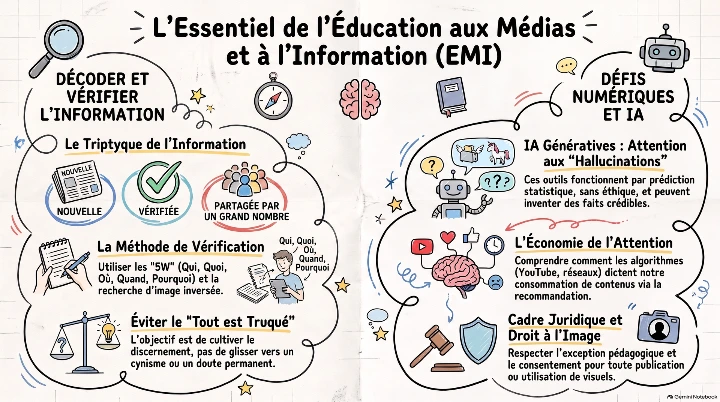
Six axes (construction of information, image analysis, informational chaos, freedom of expression, media economics, publishing) developed by cycle. The foundational notion — information is new, concerns many people and is verified — is introduced as early as the final nursery section (p. 6–7) and then reinvested.
2️⃣ Sources and press agencies based on real cases (p. 10–11)
Based on the AFP dispatches of the Louvre burglary (19 October 2025), the students reconstruct the information circuit: status of dispatches (alert, urgent, developed), photo credit, and the notion of journalistic angle (the same photo, three treatments: Le Monde, Nice-Matin, BFM Business).
3️⃣ Generative AI: a cautious and reasoned reading (p. 16–17)
A cross-cutting sheet explains that AI systems operate according to a "predictive" and non-ethical logic, produce " hallucinations", do not yet neutralise biases (sexist, discriminatory), and fall under a heterogeneous legal framework (AI Act). The stated challenge: a conscious and controlled use, without substituting for critical thinking.
4️⃣ Information disorders and image verification (p. 22, 25–29)
Distinction between disinformation/misinformation, reverse search, image manipulation (cropping, false caption, filter), deepfakes, and " fresco of foreign digital interference" co-designed with Viginum. Explicit educational safeguard: do not lead students to think that "everything is faked" (p. 26).
5️⃣ Media economy, attention and legal framework (p. 39–51)
Recommendation algorithm and attention economy (YouTube, p. 39–40), economic models (Le Canard enchaîné, Brut), media concentration, pressures on newsrooms and self-censorship (p. 45–46). Then a concrete legal framework for publishing: educational exception, students' right to image, freedom of expression (law of 1989) (p. 48–51).
3️⃣ Action points for local actors
Note on transposition (R3/R5). The document does not address health. The points below are adaptations proposed by the analyst; their relevance depends on the audience and must be tested. The main unmet need is noted at the end of the section.
1️⃣ Adapt the foundational definition of information (p. 6–7)
Reuse the triptych "new / concerns many people / verified" as a simple framework to help an adult audience sort health messages (social media, messaging). Designed for kindergarten, it translates well to an audience with low literacy.
2️⃣ Set up a workshop "health info/disinformation" (p. 25–26)
Take up the source verification and reverse image search approach to decode a viral photo or an anxiety-inducing screenshot on a health topic (vaccines, diet, treatments).
3️⃣ Raise awareness to the limits of a health chatbot (p. 16)
Transpose the generative AI sheet to explain, to an audience or peers, why a conversational agent consulted on a health question can "hallucinate" and does not replace a professional opinion.
4️⃣ Decode the prevention visuals (p. 25)
Use the current image analysis framework (5W, context, framing, emotion) to work on the reception of visuals from prevention campaigns or anxiety-inducing content with a group.
5️⃣ Address information bubbles and self-image (p. 39–40)
Draw inspiration from the YouTube sequence / attention economy to discuss, with young audiences, algorithmic exposure to sensitive health content (diet, body image, social comparison).
6️⃣ Legally secure your media productions (p. 49–51)
Mobilise the framework "educational exception / right to image" to frame a health promotion project involving photos, videos or user testimonials.
Unmet need. No sheet addresses health misinformation as such, nor vulnerable adult audiences. An adaptation of the materials (examples, language level, consent) is necessary before any use outside the classroom.
4️⃣ Additional references
External
UNESCO, CLEMI & Réseau Canopé — "Growing up in a connected world, it can be learned!", international family guide, June 2026. unesco.org — digital family guide
Mr. Molimard, D. Costagliola, H. Maisonneuve — "Recommendations for a national strategy for information and combating health misinformation", report to the Ministry of Health, made public on 12 January 2026. insei.fr — report presentation
" Challenges of health misinformation: issues, initiatives and strategies in the face of the infodemic", 7 November 2025. vih.org — misinformation & infodemic
In Health Practices
- White Paper: Educating about AI from school: an emergency plan - Version 1
- Other articles on digital - https://www.pratiquesensante.com/blog/tag/numerique-77
5️⃣ Frequently Asked Questions (FAQ)
1️⃣ To whom is this brochure addressed and is it necessary to be a teacher to use it?
It primarily targets beginner teachers or those starting to learn about media and information literacy (MIL), but the CLEMI offer is explicitly open to a wider educational community, including educators and social workers (p. 4). The methods can be used outside the classroom with adaptation.
2️⃣ How does the document define "information"?
By three cumulative criteria: something new, that concerns a large number of people, and that is verified. This foundational definition is introduced as early as kindergarten (p. 6–7).
3️⃣ What does it say about generative AIs and their reliability?
That they respond according to a « predictive » statistical logic, not ethical, can produce « hallucinations » and unneutralised biases, and fall under a heterogeneous legal framework (AI Act). The issue is a conscious use, without substituting for critical thinking (p. 16–17).
4️⃣ How do you verify an image or a photo found online?
By describing it (5W, framing, shots), formulating hypotheses, and then conducting a reverse search using keywords, and distinguishing media sites from others to assess the reliability (p. 25–26).
5️⃣ What do « informational disorders » and « foreign digital interference » cover?
The disorders include notably misinformation and disinformation, analyzed according to the intent of the sender and the interpretation of the receiver (p. 27). Foreign digital interferences (FDI) are worked through a « fresco » co-designed with Viginum, based on real cases (p. 29).
6️⃣ How does the document address the media economy and algorithms?
Through concrete cases: the recommendation algorithm and the attention economy (YouTube, p. 39–40), business models (Le Canard enchaîné, Brut, p. 41–44) and media concentration with its effects on newsrooms (self-censorship, pressures) (p. 45–46).
7️⃣ What legal framework is there for publishing or using images and sounds in an educational context?
The " educational exception" of the Intellectual Property Code regulates the use of excerpts from works for illustrative purposes, with thresholds by medium; the publication of a student media and the right to image are also detailed (pp. 49–51).
6️⃣ Rewriting in Easy to Read and Understand (FALC)
What the document says
The CLEMI helps teachers. It explains how to talk about the media in class.
A true piece of information has three signs. It is new. It concerns many people. It is verified.
A source is where the information comes from. You should always look for the source.
Artificial intelligence can make mistakes. It sometimes invents false answers.
An image can lie. It can be cropped. Its title can be changed. It needs to be verified.
Social media choose what we see. A program called algorithm decides for us.
What we can do with it (health)
We can learn to sort health messages. We check if the info is verified.
We can verify a photo before believing it.
We don't ask a robot to take care of us. We ask a professional.
7️⃣ Cross-analysis — values of Health Practices
Literacy — Yes : gradual progression and FALC-compatible sheet from kindergarten (pp. 6–7); language levels adapted by cycle.
Empowerment — Partial : students construct the information themselves (headlines, hierarchy, school media), but no approach involves "beneficiaries" in the health sense.
Participation — Yes, in a school context: co-construction of student media, elected editors-in-chief (p. 48); no co-construction with external audiences.
Community health — Absent : the collective dimension exists (class, institution) but is not linked to the health of populations.
Ethics — Yes : biases of the IAG reported, safeguard "not everything is rigged" (p. 26), caution regarding the YouTube algorithm not fully known (p. 40).
Human rights — Yes : freedom of the press and expression, protection of sources and journalists (RSF, Forbidden Stories, p. 34–37).
Intersectorality — Yes : press partnerships, AFP, RSF, Viginum, UNESCO, INSPÉ; openness to social workers (p. 4).
Partnership — Yes, formalised: academic network of coordinators, co-animations, delegation agreements for publication management (p. 48).
Fight against discrimination — Partial : ZeroCliché competition against stereotypes; discriminatory biases of the IAG mentioned. No transversal treatment of non-judgment in the health sense.
8️⃣ Evaluation of the reliability of the resource
Scientific relevance
Reliable institutional resource for what it is: a recognised public operator (CLEMI / Réseau Canopé), recent current events (2025), credible partners (AFP, RSF, Viginum, Forbidden Stories), and the mention of current normative frameworks (AI Act, educational exception, law of 1989). Not to be overinterpreted: this is not a study or an effectiveness evaluation; the pedagogical claims are not supported by internal empirical data. High editorial reliability; low empirical probative value (by nature).
Operational relevance
Very high for teachers: directly usable sheets (objectives, duration, materials, procedure). Indirect for health prevention: strong methodological value, but requires a transposition of examples and audiences. Usable as a facilitation toolkit, not as a health reference.
9️⃣ Strategic hashtags
#MediaEducation #MediaLiteracy #CriticalThinking #HealthMisinformation #EMI #HealthInfodemic #ResponsibleAI #healthpractices
This article was developed in accordance with the Charter
of the use of artificial intelligence of Health Practices.
Click on the image