
🚨 Changing the narrative to change inequalities: 10 key resources
🔍💡 Narratives & health equity: the way a problem is told shapes responsibilities, priorities… and funding. A tool selection to identify narratives that blame and reframe them towards structural causes. 🧭
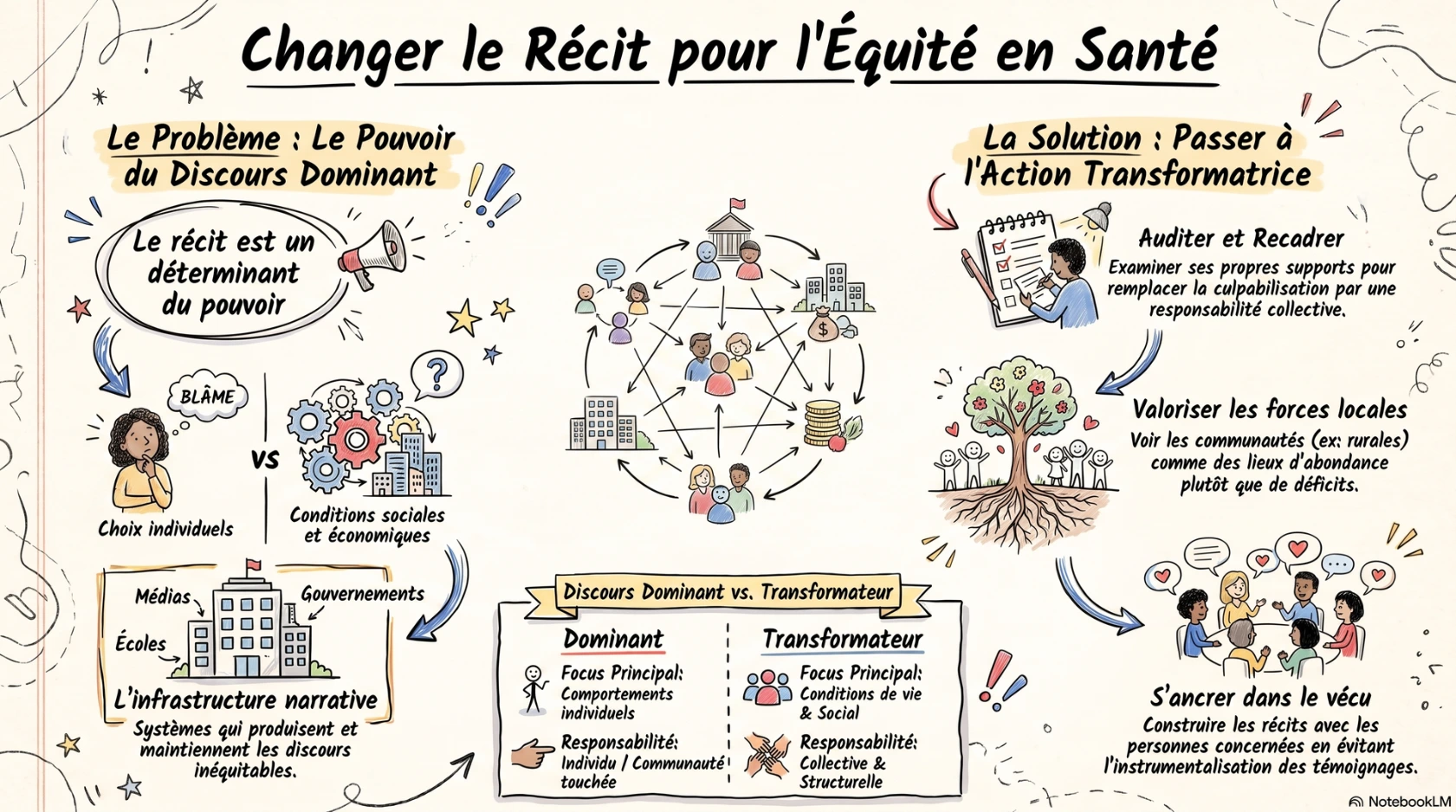
📌 This document starts from a fact that every field actor knows: the way we tell a health problem determines who is held responsible and what is deemed ‘feasible’. It provides a framework to identify narratives that place blame on individuals themselves and replace them with frames focused on living conditions. It includes directly usable resources — including a free course — to rework your posters, reports, and speeches. Useful for anyone wanting to stop ‘blaming the individual’ unintentionally.
Source :📒 Transforming the discourse on health equity: a list of essential readings
✍️ National Collaborating Centre for Determinants of Health (NCCDH), St. Francis Xavier University, Antigonish (Nova Scotia, Canada) — list prepared by Meriko Kubota. Production funded by the Public Health Agency of Canada.📜🔗LINK to the source
The 10 key resources
1️⃣ Stories for health equity — Human Impact Partners (now Health in Partnership) [2024]. Video (~5 min) showing how discourse shapes public perception and shifts responsibility onto affected communities (p. 2).
2️⃣ Changing the narrative on health and racial equity: why public health needs an infrastructure to build the power of stories — Lori Dorfman, Sarah E. Gollust, Makani Themba, Pritpal S. Tamber, Anthony Iton [2025]. Article (Milbank Quarterly), pivotal text defining the power of stories and the ‘narrative infrastructure’ (p. 2).
3️⃣ Stories for health — County Health Rankings & Roadmaps [n.d.]. Web platform : definitions, training and tools for discourse-based approaches (p. 3).
4️⃣ The power of storytelling: truth, trickery, and new fictions of a new era — Harold R. Johnson [2022]. Book : storytelling as a force that shapes identity and as a mechanism of power, from an indigenous perspective (p. 4).
5️⃣ Building the power of stories — National Association of County and City Health Officials (NACCHO) [2024]. Free online course (~2.5 h), from the series Roots of Health (Roots of Health) (p. 4).
6️⃣ LATENT//missing: missing values, the power of narratives and the politics of data in the discourse on COVID-19 — Ryan J. Petteway [2020]. Essay and Poem : what we measure or neglect to measure constructs a narrative (p. 5).
7️⃣ Science, Society and the Dismantling of Racism — Charmaine D. M. Royal [2023]. Article framing race as a social and political construct, not biological (p. 5).
Examples of shifts in discourse in particular contexts:
8️⃣ A Narrative of Rural Abundance: Case Study of the Land Stewardship Project's Narrative Strategy — Judith Barish [2019]. Case Study : thinking of rural communities as places of abundance rather than deficits (p. 6).
9️⃣ Counter-Narratives of Active Ageing: Disability, Trauma and Joy in the Age-Friendly City — Karine Côté-Boucher, Tamara Daly, Sally Chivers, Susan Braedley, Sean Hillier [2024]. Article : counter-narratives rooted in the experiences of older adults with disabilities (p. 6).
🔟 A Narrative to Change the Culture of Early Childhood in Australia — Nathaniel Kendall-Taylor, Annette Michaux, Donna Cross, Karen Forde [2023]. Article : repositioning early childhood as a collective responsibility rather than solely parental (p. 7).
1️⃣ ANALYTICAL SUMMARY
The narrative as an exercise of power
The document presents discourse — shared narratives and frames of reference — as a determinant of power, and therefore of health (p. 1). The dominant narrative in public health emphasises individual choices and behaviours while neglecting social, economic, and structural conditions. This framing reinforces stigma, obscures responsibilities, and limits the range of possible measures. The target audiences are professionals, managers, and partners in public health. The identified issue: to broaden what public health considers its legitimate work, to address the root causes of inequalities.
Ten resources to reframe and act
The document brings together ten readings, tools, and frames of reference aimed at evolving the discourse (p. 2 to 7). It includes definitions (dominant vs transformative discourse), the notion of "narrative infrastructure," and concrete examples of reframing by context: rural communities, ageing and disability, early childhood, racism, data policy. Several resources are directly usable (free online courses, web platform, short video). The overall aim is to equip actors to identify, question, and replace harmful narratives, and to strengthen the leadership of the most affected communities.
2️⃣ KEY POINTS OF THE DOCUMENT
1️⃣ Discourse is a determinant of power, and power is a determinant of health (p. 1). Narratives are not neutral: they determine which experiences matter, assign responsibilities, shape what appears "normal" or "inevitable," and guide the distribution of resources. The document is part of the continuity of the CCNDS's work on power as a driver of social health inequalities.
2️⃣ The distinction between dominant discourse / transformative discourse is made operational (p. 1 and p. 3). The dominant discourse approaches health from a narrow and individual perspective and often shifts responsibility onto the affected communities; the transformative discourse highlights social connections, collective responsibility, and equitable access to resources. The resource Narratives for Health provides strategies to identify, challenge, and replace harmful dominant narratives (p. 3).
3️⃣ The concept of 'narrative infrastructure' structures the strategy (p. 2). The article by Dorfman et al. (Milbank Quarterly, 2025) defines the power of narratives and the infrastructure — systems and networks (media, schools, government, cultural systems) — that produce and maintain discourses. It draws on Steven Lukes' three dimensions of power and Gramsci's cultural hegemony, with examples from the anti-tobacco struggle and structural racism.
4️⃣ Several resources are directly mobilisable, in various formats (p. 2 to 4). The free online course Building narrative power (NACCHO, series Roots of Health) lasts about 2.5 hours and equips participants to integrate narrative strategies into practice (p. 4). The platform Narratives for Health offers definitions, training, and support (p. 3), and a 5-minute video serves as an introduction (p. 2).
5️⃣ Examples of reframing are provided by context (p. 5 to 7). Rural communities thought of as places of abundance rather than deficits (p. 6); counter-narratives of “active ageing” rooted in the experiences of older people with disabilities (p. 6); early childhood repositioned as a collective rather than parental responsibility (p. 7); race framed as a social construct rather than biological (p. 5); data politics revealing what is chosen to be measured or not (p. 5).
3️⃣ ACTION PATHWAYS FOR LOCAL ACTORS
1️⃣ Train as a team at no cost by taking the free course Building narrative power (~2.5 h, p. 4) and exploring the platform Narratives for Health, which offers definitions, training, and support (p. 3). A concrete starting point for building collective skills.
2️⃣ Audit your own materials (posters, reports, publications, speeches) to identify formulations that centre responsibility on the individual or the affected community, then reframe them towards structural conditions (p. 1 and p. 3).
3️⃣ Reframe a local issue by focusing on strengths rather than deficits, in the manner of the rural case study (p. 6), and shift responsibility from the individual or parent to the collective, as with early childhood (p. 7).
4️⃣ Anchor narratives in the lived experiences of the people concerned — two life stories serve as anchor points in the analysis of ageing (p. 6) — ensuring co-construction and avoiding the instrumentalisation of testimonies.
5️⃣ Interrogating your data as a narrative : what we measure or neglect to measure constructs a story and can mask inequalities (Petteway, p. 5). Useful for any local diagnosis, observatory or activity report.
6️⃣ Initiate a local "narrative infrastructure" by engaging sustainable cross-sector partnerships (local media, schools, associations) to carry common narratives (p. 2). Unmet need / necessary adaptation : the document is North American and predominantly English-speaking; the examples, language, and institutional framework must be transposed to the French context before any field use.
4️⃣ ADDITIONAL REFERENCES
1️⃣ FrameWorks Institute — Communicating Now: Framing for Health Equity (toolkit, May 2025). Operational guide organised by scenarios ("When you need to…"), with concrete strategies to avoid frames that blame groups ("otherism", zero-sum logic) and favour unifying themes. A directly practical extension of this document.
🔗 https://www.frameworksinstitute.org/resources/communicating-now-framing-for-health-equity/
2️⃣ FrameWorks Institute — Narrative Change: Starting Strategically (May 2025). Methodological publication on how to initiate discourse change work strategically. Complements the "where to start" section of the CCNDS list.
🔗 https://www.frameworksinstitute.org/resources/narrative-change-starting-strategically/
3️⃣ CCNDS — Partnerships with community organising groups: practice guide (2025, French-speaking). Very practical guide (roles of public health, actions, examples, questions to guide action) that notably mobilises the “invisible face” of power — the narratives that change worldviews. A Francophone bridge between discourse and community action.
5️⃣ FAQ (Frequently Asked Questions)
1️⃣ What is the “power of discourse” and why does it concern public health?
Discourse refers to the shared narratives that explain problems: they define causes, assign responsibilities, and propose solutions. In doing so, they shape opinion, priorities, and the distribution of resources — making it a direct lever on health equity (p. 1).
2️⃣ How to distinguish a dominant discourse from a transformative discourse on the ground?
The dominant discourse explains health through individual behaviours and choices and tends to blame affected individuals; the transformative discourse highlights social connections, collective responsibility, and equitable access to resources. Strategies to identify and replace them are included in the resource Narratives for Health (p. 1 and p. 3).
3️⃣ What is the “narrative infrastructure”?
It is the set of systems and networks (media, schools, government, cultural systems) that produce and sustain narratives. Strengthening a narrative infrastructure means coordinating institutions to create and support new narratives of equity (p. 2).
4️⃣ Where to start without a budget?
With the free online course Building narrative power (~2.5 h, p. 4), by the platform Narratives for Health (definitions, training, support, p. 3) and by the 5-minute introductory video (p. 2).
5️⃣ How to address an issue marked by racism or marginalisation?
The document argues for framing race as a social and political construct, not as a biological reality, and to "tell the truth" about dominant narratives (Royal, p. 5). It also invites examination of what the data measures or omits, as incomplete data reinforces inequitable policies (Petteway, p. 5).
6️⃣ How to reframe according to the audiences?
Three contextual examples serve as models: valuing the strengths of rural communities rather than their deficits (p. 6); grounding counter-narratives of ageing in the experiences of older people with disabilities (p. 6); presenting early childhood as a collective responsibility and not just a parental one (p. 7).
7️⃣ Are these resources usable as they are in a French-speaking context?
Partially. This is a North American selection, predominantly English-speaking, aimed at guidance. The concepts are transferable, but the examples, language, and institutional framework need to be adapted to the French context before any direct use (notices p. 2 to 7).
6️⃣ REWRITING IN PLAIN LANGUAGE
What is this document about?
This document is about how to tell health stories.
The stories we tell are not neutral.
They indicate who is responsible for a problem.
They also indicate what solutions are possible.
Two ways to tell health
There are two main ways to tell.
The first says: "everyone is responsible for their health".
This way forgets living conditions.
It places the blame on people in difficulty.
The second way talks about living conditions.
It talks about housing, work, money, the connections between people.
It says that health is everyone's responsibility.
This way helps to reduce inequalities.
What the document proposes
The document proposes 10 resources to change these stories.
There is a free online course. It lasts about 2 and a half hours.
There is a website with tools.
There is also a short video and articles.
Important ideas to remember
- The way of telling empowers. This power affects health.
- We can identify stories that blame people. We can change them.
- We need to connect several actors to carry new stories. This is called a "narrative infrastructure".
- Tools are ready to use. Some are free.
- The document provides examples. It talks about villages, elderly people, disability, and young children.
Note: the resources are mainly in English. They need to be adapted to the French context.
7️⃣ CROSS-ANALYSIS — VALUES OF HEALTH PRACTICES
Literacy: partially — the document promotes frameworks that facilitate understanding and offers accessible formats (video, courses), but the list itself remains predominantly English-speaking and at an expert level.
Empowerment : central — the stated objective is to redistribute power and strengthen the leadership of the most affected communities (p. 1).
Participation : present — several resources call for co-creating narratives "in partnership with communities" and based on lived experiences (p. 4, p. 6).
Community health : strongly integrated — collective identity, community power, and community organisation are at the heart of the discussion (p. 1, p. 6).
Ethics : yes — the dominant narratives that stigmatise and blame are explicitly named, and the article on racism emphasises the need to avoid reproducing harmful prejudices (p. 3, p. 5).
Human rights : yes — equity, dignity, collective well-being, inclusion, and racial justice are established as guiding values (p. 1, p. 5).
Intersectorality : yes — the document recommends linking media, schools, government, and cultural systems to build a narrative infrastructure (p. 2).
Partnership : yes — models of collaborative projects (co-piloting of Narratives for Health, p. 3) and partnerships with communities and cultural organisers (p. 4), without a formalised contractual model.
Combating discrimination : yes, centrally — structural racism, ageism, ableism and colonialism are addressed; non-judgment involves replacing stigmatizing narratives and valuing a diversity of viewpoints (p. 3, p. 5, p. 6).
8️⃣ EVALUATION OF RESOURCE RELIABILITY
Scientific relevance: the list is a knowledge transfer product (grey literature), not a study. But it lists credible and recent sources: peer-reviewed article in Milbank Quarterly (2025), Health Education & Behavior (2020), Health Equity (2023), Journal of Aging Studies (2024), Children/MDPI (2023), supplemented by grey literature (case studies, courses, video, platform). The theoretical grounding is solid (Lukes, Gramsci). The publisher (CCNDS, funding from the Public Health Agency of Canada) is reliable. Currency of data: resources ranged from 2019 to 2026, pivotal article from 2025 — good freshness.
Operational relevance: high for self-training and guidance (free course and directly usable platform), moderate for direct transfer in the French-speaking field due to English dominance and the North American context. An adaptation is required.
9️⃣ STRATEGIC HASHTAGS
#HealthEquity #ChangeOfDiscourse #SocialDeterminants #CommunityHealth #Empowerment #Advocacy #HealthLiteracy #healthpractices
🔍➕ For more information, see the articles referenced by "Health Practices" on the theme of health and work ➡️🔗
This article has been developed in accordance with the Charter
of the use of artificial intelligence in Health Practices.
Click on the image