
J🔍💡 Young people, digital and AI: rather than cutting screens, learn to tame them with them, in their living spaces. #YouthPrevention #ResponsibleAI
📱🧠 Screens and AI shape the daily lives of young people: this text helps tomove from fear to action, from "less screens" to "better support". #YouthMentalHealth #healthpractices
The documentshifts the debateon young people's screens: it is no longer just aboutreducing, but aboutbetter framing and better equipping, with young people.
It isdirectly usableto build diagnostics, workshops, usage charters, and prevention actions on digital technology and AI in young people's living environments.
It is part of an approachthat is ethical, participatory, and intersectoral, linked to recent resources
You can respond in the comments of this article at the bottom of the page. Thank you

For young people, parents and professionals
We often talk about digital as a problem: too many screens, too many social networks, too many risks. These concerns are legitimate. But in trying too hard to protect young people from the digital world, we forget the essential: today, knowing how to use the Internet and artificial intelligence well has become a skill as important as reading, writing or counting.
The challenge is therefore no longer to do less, but to do better. And this concerns everyone.
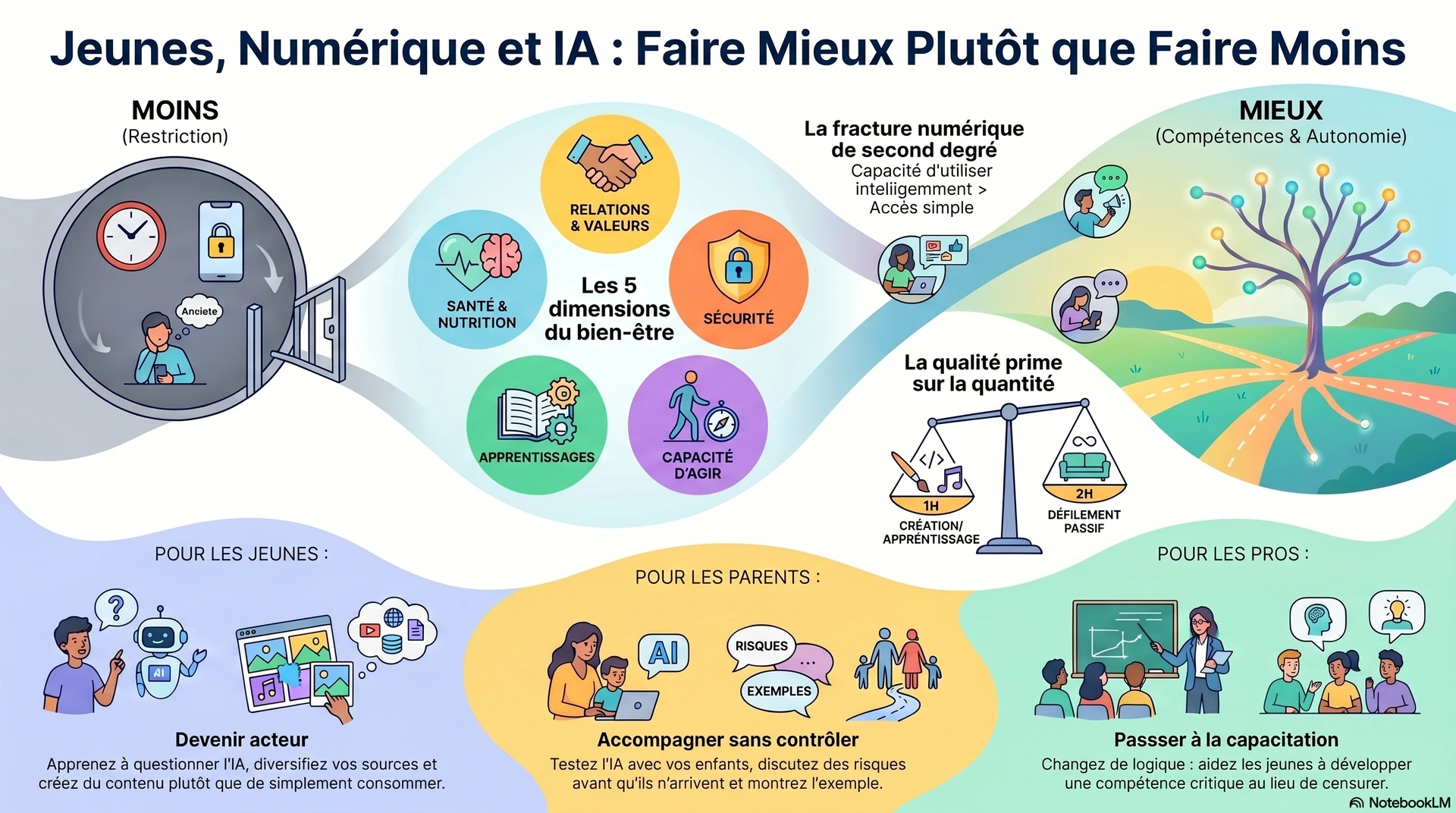
🔑 To enhance in 5 points ▸ Counting the hours of screen time is not enough.What young people do online matters more than the time spent. ▸ Generative AI changes the game.It can become a wonderful learning tool… or widen the inequalities. ▸ A new divide is emerging:it is no longer about access to equipment, but about the ability to use the tools well. ▸ The well-being of young people is played out across 5 dimensions:health, relations, security, learning, ability to act. ▸ The objective eis autonomy,not control. We support more than we prohibit. |
1. The observation: beyond "too much screen time"
The same hour of screen time, a thousand different experiences
Two teenagers can each spend two hours a day on their phones and have two completely opposite experiences.
The first passively scrolls through short videos selected by an algorithm. The second chats with friends, watches a tutorial to learn how to draw, asks an AI to explain a maths lesson, and publishes a short text on a blog.The screen time is the same. The impact on their lives is not at all.
That’s why the approach of "we need to reduce screen time" reaches its limits. It treats all digital activities as if they are equal. However, playing video games with friends, endless scrolling, researching for a presentation, or having a video call with a grandparent are not the same thing.
Artificial intelligence: a turning point
For the past two or three years, a new tool has invaded usage: generative artificial intelligence. Specifically, these are assistants like ChatGPT, Claude, Gemini, or Copilot, capable of dialoguing, explaining, summarising, translating, generating images or code.
The majority of 18-24 year olds are already using it — for their studies, their leisure, and sometimes even to ask questions about health or personal life. And this is where a less visible but equally deep divide appears compared to access to the internet twenty years ago.
" Some young people learn to engage with AI, to ask it good questions, to verify and utilise the answers. Others remain confined to recreational or passive uses, with no one to show them how to leverage it. " — The digital divide of the second degree |
2. The framework: 5 dimensions to consider well-being
To move beyond the debate of "for or against screens", the World Health Organisation (WHO) proposes a simple framework. It describes the well-being of adolescents according to five dimensions that influence one another.
" Adolescents thrive and are able to reach their full potential. " — Ross et al., WHO (2020) |
Digital and AI are not a separate "sixth dimension". They permeate the five, and can help each one… or weaken it.
# |
Dimension |
What it covers |
1 |
Health and nutrition |
Sleep, diet, physical activity, mental health. |
2 |
Relationships and values |
Family, friendship ties, sense of belonging, engagement. |
3 |
Safety and environment |
Protection against violence, respect for privacy. |
4 |
Learning and skills |
School, training, preparation for professional life. |
5 |
Capacity o act and resilience |
Self-confidence, autonomy, ability to cope. |
3. Digital technology in each of these 5 dimensions
Here is how digital technology and AI can play in each dimension, in a positive way… or in a negative way.
Dimension |
✓ What digital technology can bring |
⚠ The risks to anticipate |
1 Health and nutrition |
Access to quality health information, tracking apps, teleconsultation, support devices. |
Misleading advice, anxiety-inducing content, misinformation, disturbed sleep. |
2 Relationships and values |
Sense of belonging, civic engagement, long-distance connections, self expression. |
Cyberbullying, isolation, social comparison, polarization. |
3 Safety and environment |
Reporting tools, information about rights, moderated spaces. |
Online violence, privacy violations, commercial exploitation, targeted advertising. |
4 Learning and skills |
Self-learning, appropriate explanations, preparation for jobs, creativity. |
Cheating without learning, loss of critical thinking, widening employability gap. |
5 Capacity to act and resilience |
The ability to inform oneself, express oneself, create, participate, find support. |
Decrease in self-esteem, dependency, feeling of powerlessness in the face of the algorithms. |
4. What everyone can do, concretely
Here are three sets of guidelines, tailored to each audience. You can read the one that concerns you directly — or all three, to better understand others.
💡 FOR YOUNG PEOPLE Your phone can be a powerful tool — it's up to you to make something of it. ▸ Question your usage.After an hour online, do you feel better or worse? Have you learned something, created, exchanged — or have you just scrolled without realising it? ▸ Learn to talk to AI.The more precise your question, the more useful the answer will be. Ask for examples, rephrasings, counterarguments. And always check what it tells you: it can be wrong with a lot of confidence. ▸ AI is not a doctor or a therapist.It can provide leads, but for your physical or mental health, talk to a trusted adult or a professional. ▸ Keep control over your feed.Algorithms show you what keeps you engaged, not what does you good. Unsubscribe, pause, diversify your sources. ▸ Protect yourself and protect others.What you publish can be seen, recorded, misused. Do not share anything that resembles harassment. Report what makes you uncomfortable. ▸ Create, don't just consume.Writing, coding, drawing, filming, even poorly at first — that's how you become an active participant in the digital world instead of just being its product. |
👪 FOR PARENTS Accompanying is better than prohibiting. But accompanying requires you to be involved yourself. ▸ Take an interest in what they are doing online.Not to control, but to understand. Which accounts, which games, which creators? What do they find funny, useful, stressful? ▸ Move from 'how much time' to 'what for'.Two hours spent creating a video with friends and two hours spent passively scrolling are not equal. Screen time is just one indicator among others. ▸ Test AI with them.Ask it together to explain a lesson, correct a text, suggest a recipe. Observe its limitations together: it sometimes invents, it has biases, it doesn't know everything. ▸ Talk about awkward things before they happen.Harassment, intimate images, scams, deepfakes, violent content: it's better to have discussed these calmly than to discover a problem. ▸ Take care of your own usage.Children observe more than they listen. If the phone is everywhere at the table or in bed, the message is poorly received. ▸ Keep screen-free time for everyone.Meals, outings, family moments: these are not punishments, they are spaces where relationships can breathe. |
🧑⚕️ FOR PROFESSIONALS Health, education, prevention, social care: you are on the front line to support rather than censor. ▸ Change your approach: from control to empowerment.The goal is no longer to limit, but to help young people develop a true critical digital skill. ▸ Open real discussion spaces.Starting from their concrete uses, without judgment, is often more effective than a top-down prevention message. ▸ Run practical workshops with AI.Asking a health question to an AI, analysing the response, comparing it to a reliable source: this is a critical thinking exercise that makes an impact. ▸ Integrate digital technology as a health determinant.Just like housing, food, or social support, digital uses influence pathways. ▸ Identify the advanced usage gap.All young people have a phone. Not all know how to use it to learn, take care of themselves, or find their way. This is where tomorrow's inequalities are played out. ▸ Train yourself, among peers and with reliable resources.The HAS, CNIL, National Education, and WHO guidelines exist and are accessible. It is better to rely on them than to reinvent the wheel alone. |
5. A collective challenge
The well-being of adolescents is not just a family or individual matter. It is also a societal choice.
Public policies on health, youth, and education must now consider digital technology and AI as genuine health determinants: they influence access to information, prevention, care, as well as educational and professional pathways. This requires three areas of work.
Document:to measure really how digital technology affects every dimension of well-being, and for which young people.
To design :to build policies aimed at improving well-being — not just at reducing risks.
To associate :to involve young people themselves in defining priorities.
In summary
It is no longer about protecting young people from "too much digital", but about creating the conditions for them to thrive, exercise their rights and develop their full potential in a world where digital technology and AI are everywhere.
To do better, notto do less.
To go further
Resources from the section "Artificial Intelligence and Digital Technology in the Service of Health" of Health Practices.➡️🔗 - https://pratiquesensante.odoo.com/2-6-intelligence-artificielle-numerique
#prevention #healthpromotion #healtheducation #youth #digital #AI #psychosocialskills