
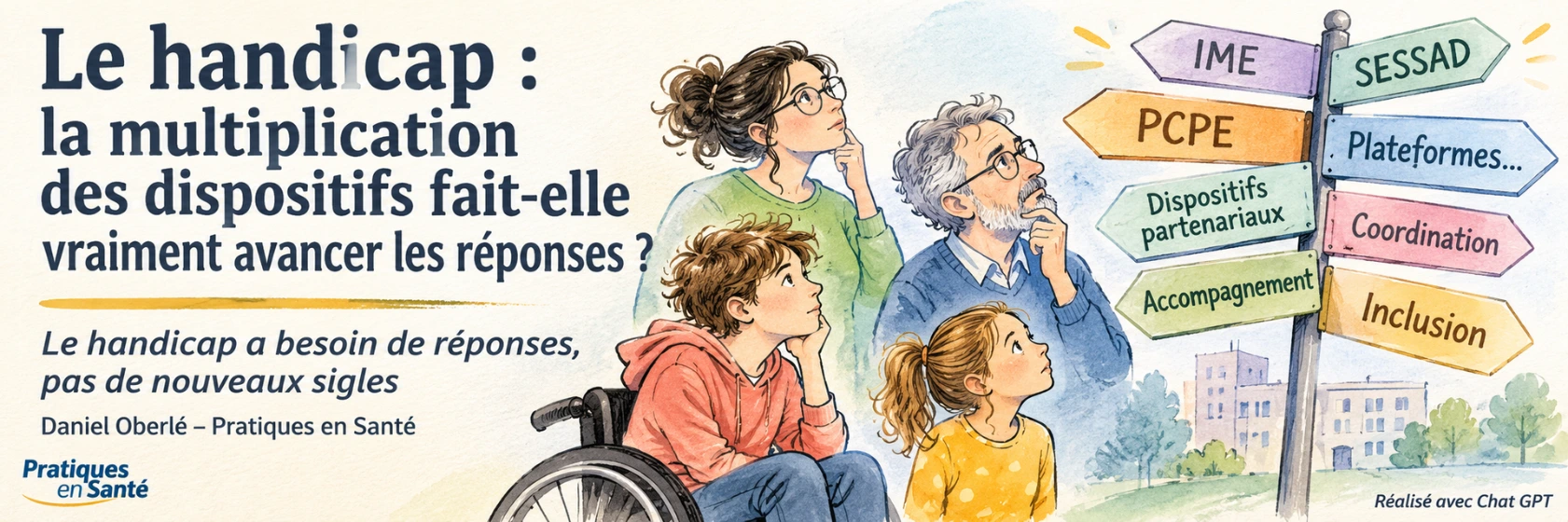
Disability: does the multiplication of systems really advance the responses?
4 November 2026 · @Daniel Oberlé – Health Practices
Disability needs responses, not new acronyms
We rely on your perspective to enrich this work. Thank you for sharing your comments and suggestions in the form at the bottom of the page, and for proposing other articles that deserve to be analysed and included in this synthesis.
Transforming the medico-social offer does not consist of multiplying structures, nor of systematically grouping them. The issue is elsewhere: to enable each person with a disability to access, in their territory and throughout their journey, a response tailored to their needs, choices and life project. However, the multiplication of systems does not guarantee either the complementarity of interventions or the effective coverage of needs.
IME, SESSAD, DITEP, PCPE, platforms, mobile teams, resource centres, communities 360: in fifteen years, acronyms have multiplied in the disability sector. In the same territory, several associations often offer similar services to the same audiences. At the same time, needs remain unanswered: complex situations, transitions between systems, access to care, support for families.
This file is based on an opinion piece by Malika Lamharfi. It distinguishes three levels: what public data establishes, what reports propose (IGAS, Court of Auditors, CNCPH) and what falls within the debate or hypothesis. It is addressed to management, executives and associative administrators, to the teams of ARS and Departments, as well as to the representatives of individuals and families.
The essentials in 6 points
An abundant offer, needs that remain unanswered. Approximately 13,000 ESMS dedicated to disability (550,000 places). However, for the IME alone, the IGAS estimates the waiting lists at "at least several thousand children, and more likely several tens of thousands." Between 7,700 and 10,200 young people over 20 years old remain in a children's structure due to lack of adult places (Court of Auditors).
An unequal distribution. For the IME, the average is 50 places for 10,000 young people, with fewer than 30 in densely urban areas and more than 110 in certain rural departments. This rate applies to the IME, not to the entire offer.
A historically constructed segmentation by authorisations. Many managers already have structures operating under different modalities; this is a potential for breaking down barriers, not proof of effective complementarity.
A new designation does not guarantee a transformation of practices. The cooperation tools already exist: integrated system, CPOM, GCSMS, agreements, 360 communities.
SERAFIN-PH does not reorganise the territories. The reform will finance differently, from 2027, the ESMS supporting children and young adults. The €90 million announced for 2027 does not appear in the initial PLFSS 2027; the parliamentary debate is ongoing.
The debate concerns the method : territorial coverage or free choice, consolidation or plurality, cooperation or additional resources. In under-equipped territories, it is necessary to both better articulate and create.
Guidelines: what are we talking about?
The vocabulary mixes legal categories (set by law), modes of operation (framed by decree) and free designations. Confusing them maintains unreadability. The reports from IGAS refer to ESSMS (establishments and social and medico-social services); the SERAFIN-PH texts refer to ESMS, as they only target the medico-social. The file uses the term from each source.
Term |
Nature |
In brief |
IME, IEM, ITEP, EEAP |
Categories of establishments (children) |
Reception within the walls, with or without accommodation, depending on the type of disability. |
SESSAD |
Category of service (children) |
Support at home, at school, in living environments. |
Integrated device (DITEP, DIME…) |
Mode of operation framed (decree of 2017 for ITEP and SESSAD, expanded by the decree of 5 July 2024 to ESMS supporting children, adolescents and young adults) |
Several establishments and services organise an integrated offer: the modalities of support can evolve without a new decision of orientation from the CDAPH at each change. This flexibility concerns the evolution of modalities provided for in the framework of integrated operation. It does not remove the rights of individuals, nor their consent, nor the formalisation of changes: agreement of the person or their legal representatives, liaison form, information from the MDPH. |
PCPE |
Hub of skills and outsourced services |
Organises and coordinates interventions from professionals and partners, particularly freelancers, to build tailored responses, especially when the person does not have sufficient medico-social support (for example, awaiting admission). |
Community 360 |
Territorial organisation |
Cooperation of actors in a department, reachable at 0 800 360 360, to find solutions for individuals and caregivers. |
« Platform », « coordinated service offer » |
« Coordinated service offer »: concept established by the CNH 2023 and defined in the 2026 instruction project, without a regulatory definition in force to date. « Platform »: free designation |
Cover different realities depending on the territories. |
Mobile team, resource centre |
Support functions |
Intervene on behalf of other actors (expertise, advice, training). |
Authorisation and service: the key distinction. The authorisation is the administrative act (ARS and/or Department) that sets a category, a public, a capacity. The service is what the structure actually does for a person: care, support for autonomy, social participation, coordination. Two structures with different authorisations can do the same thing; two structures of the same category can do very different things. Hence the importance of the nomenclatures of needs and services arising from SERAFIN-PH.
The IGAS indicates that it has chosen not to adopt the term "platform ", deemed a source of confusion. It prefers the expression " coordinated service offer", retained by the National Conference on Disability of 2023 (IGAS, report 2024-017R, January 2025, § 19).
The observation: an abundant offer, needs that remain unanswered
The number of structures is not sufficient to assess the actual capacity for response. Thousands of children are waiting for a place, while the sector counts several thousand establishments and services. The question also concerns the distribution, compartmentalisation and movement of people between the responses.
Reference |
Figure and perimeter |
Source |
ESMS dedicated to people with disabilities |
Approximately 13,000, of which 4,800 are specifically intended for young people; approximately 550,000 places (FINESS, 1 March 2024). The 9,400 home care services are counted separately. |
IGAS, rapport 2024-017R, January 2025, § 46 |
Share of the offer managed by associations |
Approximately 80% of the offer according to the summary of the study; in 2006, the associations represented 77.6% of the managing operators. Of approximately 1,800 managing associations, the 5.6% managing more than 20 establishments held 39% of the places. Old data, to be updated. |
Claveranne et al., University Lyon 3, 2011 (FINESS 2006) |
Structures operating in an integrated system or able to provide both reception within their walls and support in a mainstream environment |
25 % of establishments for young people; 3% of establishments for adults |
IGAS 2025, summary § 5 |
Systems recorded by 15 ARS out of 17 (2024) |
435 integrated systems, 36 coordinated service offers, 96 « other platforms». The IGAS indicates a probable overestimation, some sites of the same system being counted separately. |
IGAS 2025, § 27, according to ANAP |
Places in IME for 10,000 young people |
Average 50; less than 30 in densely populated urban areas (Île-de-France, Gironde); more than 110 in rural departments (Orne, Creuse, Territoire de Belfort, Indre); 4 in Mayotte. This rate concerns only IME. |
IGAS, report IME 2024-081R, § 34 (FINESS, INSEE) |
Children waiting for a place in IME |
Estimation from the Ministry of National Education: 11,000 in 2022. The IGAS cannot confirm it and mentions « at a minimum several thousand children, and more likely several tens of thousands ». |
IGAS IME, § 154 |
Duration of waiting before admission to IME |
21 months on average, from 1 month to 5 years depending on the establishments. Duration reported by the IME responding to the IGAS survey (389 IME, 27.5% participation): this is not a national comprehensive measure. |
IGAS IME, § 155 |
Young people over 20 years old kept in an ESMS for children (« Creton amendment ») |
Between 7,700 and 10,200 (estimate, all ESMS for children: IME, IEM, EEAP…), of which approximately 6,370 in IME in 2022; estimated cost of €500 million per year. |
Court of accounts, May 2026; IGAS IME, § 63 |
Three paradoxes emerge.
The proliferation is not the coverage. For IME, the disparities are considerable: from 28 places for 10,000 young people in Gironde to 137 in Orne, which is about 1 to 5 in the mainland, and only 4 in Mayotte (IGAS IME report, according to the FHF summary). The historical establishment of facilities outside major cities explains part of these disparities. Where the supply is dense, several nearby actors coexist; elsewhere, needs remain unmet.
A historically constructed segmentation by the authorisations. In 2021, 74% of the managing organisations of establishments for young people and 41% of those managing establishments primarily designed for adults also had at least one service operating in ordinary environments in the same department. A simulation by IGAS shows that the functional grouping of structures of the same managing organisation could increase the share of municipalities located less than 15 km from an offer providing all forms of support from 25% to 59% for young people, and from 8% to 67% for adults (IGAS 2025, § 55 and 58). This is neither an observed result nor an automatic gain: these figures illustrate a theoretical potential for unblocking, without prejudging its feasibility or the effective accessibility of services. IGAS itself reminds that the structures of the same manager can target very different audiences.
The blockages are at the transitions. Young adults without a place adult remain in children's places, which lengthens the waiting times upstream. Regarding the funding linked to the Creton amendment, the Court of Auditors notes "partial and poorly coordinated" controls between ARS and Departments.
What we do not know well. According to IGAS, it is currently impossible o establish an accurate picture of waiting lists, due to a reliable information system and due to various practices of MDPH. The same child can appear on several lists. No national base describes the services actually provided by each structure: hence the interest in "mapping the services, not just the authorisations." Associative surveys shed light on the situation without measuring it: Unapei counted in August 2025 4,410 children on a waiting list for an establishment (IME in particular) among the 38 associations surveyed. This is a partial data point, not a national figure.
The framework: ten years of "transformation of the offer"
Since the Piveteau report "Zero without a solution" (2014), public policy aims to shift from a logic of places to a logic of pathways. The National Conference on Disability in April 2023 set the target: by 2030, all ESSMS dedicated to disability must shift " from a logic of place to a logic of coordinated service offers ", starting with the children's sector.
Date |
Step |
Scope |
2014 |
Report Piveteau "Zero without a solution" |
Collective responsibility to find a solution for each person. |
End 2014 |
Launch of the SERAFIN-PH approach by the DGCS and the CNSA |
Preparatory work for the funding reform. |
January 2016 |
Validation of the SERAFIN-PH nomenclatures for needs and services |
Common language to describe needs and responses. |
April 2017 |
Decree on the integrated operation of ITEP and SESSAD (implemented under the 2016 health system modernisation law, after an experimental phase) |
Opens to ITEP and SESSAD the integrated operation, by agreement. |
May 2017 |
Simplified nomenclature of ESSMS |
Fewer subcategories of public and age in the new authorisations. |
2018 |
“ Accompanied response for all” in all departments |
Global accompaniment plans for situations without solutions. |
2020-2021 |
Communities 360 |
Unique number 0 800 360 360 and cooperation of actors by department. |
February 2022 (effective in February 2024) |
Law 3DS, article 135 |
Since 21 February 2024, according to IGAS (report 2025, § 52 and 74, note 37): lifting, in existing authorisations, of the restrictions “without associated disorders” and related to the severity of disability; in structures for young people, age ceilings between 16 and 20 years raised to 20 years; right recognised for ESSMS dedicated to disability to support in ordinary environments the individuals they usually accommodate. To be compared with the exact text of article 135. |
April 2023 |
CNH ; plan "50,000 solutions" 2024-2030 (€1.5 billion) |
Objective "coordinated service offer" for 2030. |
July 2024 |
Decree of 5 July 2024 on the integrated system; support fund for transformation (€250 million, 2024-2027) |
The operation of the system is open to all ESMS supporting children, adolescents and young adults. The generalisation in 2027 is a ministerial objective, not a requirement set by the decree. |
January 2025 |
Report IGAS on the transformation of the offer |
Proposes a single category "PSH Structures", territorial authorisations, a single ARS-Department scheme. These are proposals, not adopted to date. |
December 2025 |
LFSS for 2026 of 30 December 2025 (article 90) |
Records the first step of SERAFIN-PH for 1 January 2027. |
February 2026 |
Publication of the IGAS report on IME |
State of play, waiting lists, conditions of transformation. |
May 2026 |
Report from the Court of Auditors on the Creton amendment |
Costs, controls, preparation for exits. |
September 2026 |
Draft instruction on territorial implementation (children); unfavourable opinion from CNCPH on 24 September |
Text under discussion, not applicable to date. |
A project of territorialisation still under discussion: the reservations of the CNCPH
The project of instruction organises intervention areas covering the whole department for ESMS supporting children and young people, with priority to the structure of the area and centralisation of admission requests by an "operational lead". The CNCPH adheres to its objectives but has issued an unfavourable opinion. Its main reservations:
Free choice. The right to request a structure outside the area remains, but the CNCPH fears that in practice the area priority and the centralisation of admissions will produce a "de facto sectorisation". It requests that each notification recalls this right and that the preferences of families are tracked.
Reality of responses. The absence of a "white zone" on a map does not prove that a response exists. It requests diagnostics distinguishing absent, unavailable or unsuitable offers, delays and transport.
Participation. Representatives of individuals and families should sit by right in territorial governance bodies.
Resources and National Education. It requests budgetary visibility and regrets that no equivalent commitment is required from National Education.
As of the date of this file, we have not found a published version of the instruction: its final content remains to be verified.
The tools for cooperation already available
Managers do not need to wait for a law to cooperate:
CPOM (multi-year contract of objectives and means): the IGAS proposes to systematically include a "transformation" axis.
Convention of operation in an integrated system, including between different managers.
GCSMS (grouping of social and medico-social cooperation): pooling resources or, in its "delegated" form, providing a common offer without merging.
Partnership agreements with common law (school, health, housing, recreation), through the "resource function".
A new name does not guarantee a transformation of practices. The IGAS noted authorisations that use the terms "system" or "platform" without proposing all the support modalities (IGAS 2025, § 43).
SERAFIN-PH: what reform does, and what it does not do
From 1 January 2027, SERAFIN-PH changes the way of financing ESMS that support children and young adults with disabilities. It does not alone reorganise the offer of a territory, but cooperation is among the criteria of one of its compartments.
First a common language. Launched at the end of 2014 by the DGCS and the CNSA, the SERAFIN-PH approach ("Services and establishments: reform for aligning funding with the pathways of people with disabilities") first constructed nomenclatures of the needs of individuals and the services and benefits of establishments, validated in January 2016. These nomenclatures are the foundation of the funding reform. They also allow for "mapping services, not just authorisations".
The funding model, as described by the CNSA, forms a global allocation composed of several compartments:
a main part, calculated from the characteristics of the authorised places (types of care, supported public, days of opening). It is supplemented by a ‘care type’ bonus for the ESMS with at least three types of care (housing, day care, ordinary environment), in order to support the operation of the system. According to a presentation by the CNSA to the national technical group on 6 December 2024, this bonus would be 5 % (IGAS IME report, note of § 44); the amount remains to be confirmed in the final model;
a share for transport, which finances the cost of the structure's transport;
a modulation based on actual activity, which supplements in certain cases the main share taking into account the level of activity, the intensity and the modularity of the support;
a modulation based on objectives, which finances the commitment of the ESMS in the implementation of public policies in its territory. It is based on six criteria: complexity of situations, schooling in an ordinary environment, cooperation, support for the ordinary environment, self-determination, use of digital technology. The ESMS position themselves by levels (ministry, press release of 20 November 2025).
The ministry clarifies that this is not an activity-based pricing.
Three elements not to be confused.
The convergence : it spans eight years starting from 2027. According to the ministry, the reform is being implemented very gradually from 2027 to 2030, then fully takes effect from 2030 to 2034. The precise timetable for each ESMS remains to be confirmed.
The guarantee : from 2027 to 2030, the ESMS in negative convergence do not lose anything on their main allocation.
The accompanying measures : a package of new measures announced to enhance the commitment of the ESMS in the transformation (see below).
Where do we stand on 4 November 2026?
Step |
Status |
Legal basis |
LFSS for 2026 (article 90); 2026 is a "blank year" for preparation. |
Data collection (SIDOBA tool from CNSA) |
Opened on 30 March 2026. |
Theoretical allocations |
Announced for autumn 2026; their effective notification could not be verified. |
Accompanying credits |
The €90 million announced at the end of 2025 for the first year do not appear in the initial PLFSS 2027, presented on 1 October 2026. The Government's press release provides for €360 million over four years starting from 2028. |
Path of the PLFSS 2027 |
Examination interrupted in the National Assembly on 23 October 2026 by the rejection of the "revenue" part (115 votes against, 1 for): the "expenditure" part has not been examined, and no amendment on the €90 million could therefore be adopted by the deputies. The initial text is sent to the Senate, which will examine it from 9 November. Parliamentary arbitrations remain open. |
Position of the federations |
Thirteen associations and federations (including Uniopss, APF France handicap, the Apajh Federation, Gepso) requested by letter dated 9 October 2026 the €90 million from 2027; failing their request, they will demand a postponement of the reform. |
What SERAFIN-PH does not do. The reform does not merge structures and does not redraw the map. It does not create places where they are lacking. It does not yet concern ESMS for adults. This is the meaning of the warning from the platform: do not confuse funding reform with automatic reorganisation of territories. The IGAS also requested that the pricing equation fully recognise already modular structures and make the share based on objectives a real lever for transformation.
The criticisms. During the examination of the PLFSS 2026, deputies judged the reform as falling short of initial ambitions. An amendment criticised it for remaining focused on individual needs without questioning the transformation towards an inclusive society, and for not taking into account relational time, interprofessional cooperation or the shortage of staff. The establishments met by IGAS are also concerned about its technicality and the burden of data collection (IME report, § 44).
Controversies and debates
Everyone agrees on the objective of smoother pathways; disagreements concern the means to achieve this and what we risk losing along the way.
1. Associative plurality or rationalisation? Associations were born to fill the absence of public policy, often initiated by parents. Their diversity carries a capacity for innovation and a closeness to families. It also produces structures of very unequal sizes, each with its support functions. Researchers from Lyon 3 University described as early as 2011 a competition between large associations for a sector or a territory, and the absorption of small struggling associations. They warned against two risks: a sector withdrawn into itself, and the loss of attention to the everyday needs that gave rise to these associations.
2. Grouping without merging? The IGAS identifies the greatest potential within each managing organisation. It considers the mergers between distinct legal entities to be more complex and delicate. It proposes the GCSMS delegate to avoid mergers-absorptions without obvious contribution, and to ensure that territorial responsibility is not reserved for the largest structures.
3. Territorial coverage or free choice? Intervention zones ensure that no territory is forgotten. The draft instruction for 2026 maintains the right to request a structure outside the zone. But the CNCPH fears that in practice, the priority given to the zone and the centralisation of admissions by the operational lead will produce a "de facto sectorisation". The forum poses the same tension from another angle: diversity is a wealth provided it is complementary.
4. The " platform": real transformation or new label? The IGAS has chosen not to adopt the term « platform ». In an IME presented as a device, it has noted that the teams of the IME and the SESSAD remained distinct, without a common working group or pathways (IGAS 2025, § 32). For the IGAS, a coordinated service offer is judged by its practices: a single point of entry, all forms of support, change of modality without new orientation, formalised partnerships, resource function.
5. Inclusion or maintenance of specialised establishments? The debate is sometimes presented as a binary choice. The IGAS, in its report on the IME, rejects this opposition: successful inclusion requires the retention of IMEs, organised differently, for the most complex situations. It notes an increase in the profiles received and a 38% decrease over ten years in child psychiatrists in IMEs (report IME, § 18 and 94).
6. Can better cooperation compensate for the lack of resources? The federations fear a transformation with constant resources. According to the IME report from the IGAS, many stakeholders fear having to do more with insufficient resources, at the risk of professional burnout and a burden too heavy transferred to families (§ 17). Cooperation improves the use of existing resources; it does not create the places that are lacking in under-equipped departments.
7. Redundancy or complementarity? Two associations that offer similar services in the same area do not necessarily constitute a duplication. They may target different audiences, defend distinct approaches, or provide families with a real choice. Conversely, seemingly diverse offers may leave the same needs unanswered. Judging a redundancy therefore requires examining accessibility, quality, the methods of intervention, and the expectations of individuals, and not just the titles of authorisations. This is the condition for ensuring that the search for complementarity does not become a standardisation of responses.
What this implies for reading the forum. His diagnosis (juxtaposition, redundancies, unmet needs) is consistent with public reports. His hypothesis that the problem is "sometimes" not the lack of structures but the lack of articulation holds for certain areas. It does not hold everywhere: in the least resourced departments, both problems accumulate.
Levers: moving from juxtaposition to complementarity
The five proposals from the forum are based on tools that already exist. What is most often lacking is a shared method and verifiable commitments.
A proximity of services is not necessarily a redundancy. Two structures can offer neighbouring services with different approaches, skills, or target audiences. Before concluding that there is a duplication, one must examine accessibility, quality, the methods of intervention, the ability to meet specific needs, and the expectations of individuals. Complementarity should not lead to standardising responses.
Lever |
How to do this practically |
Tools and supports |
Example of the indicator |
1. Map the services actually offered |
Describe what each structure really does, with the nomenclatures SERAFIN-PH, and not just its authorisations |
Nomenclatures of needs and services; ROR, ViaTrajectoire; territorial observatories |
Part of the structures in the territory that have described their offer in services |
2. Identify redundancies, gaps, and emerging needs |
Cross the offer, the reassessed waiting lists and the delays; distinguish absent, unavailable, or unsuitable offers |
Shared territorial diagnosis ARS-Department-MDPH; priority intervention areas engaged by the ARS in Seine-et-Marne and in Eure-et-Loir (IGAS 2025, § 34-36) |
Median delay between MDPH orientation and first support |
3. Pool rare skills and support functions |
Share speech therapists, child psychiatrists, occupational therapists, mobile teams; consolidate payroll, purchasing, quality, information systems |
GCSMS of resources; agreements; PCPE |
Hours of rare skills accessible per accompanied child |
4. Cooperate with measurable commitments |
Write who does what, at what transitions, within what deadlines |
Agreements of integrated system; CPOM with transformation axis; GCSMS delegating; criterion "cooperations" of the modulation on objectives SERAFIN-PH |
Number of breaks in pathways at key ages (16-25 years) |
5. Place the experience and expectations of individuals at the heart of the evaluation |
Gather the opinions of individuals and families on the usefulness of responses ; involve them in the steering |
Independent facilitators; peer supporters; publication of HAS evaluations ; representation in governance (request from CNCPH) |
Part of individuals stating that services meet their needs, respect their choices and contribute to their life project |
The proposed indicators are examples to be adapted, not official standards.
Four levels of participation of individuals.Self-determination is not limited to the individual project. Participation can be distinguished as follows:
in the definition of one's own support project;
in the evaluation of the quality and usefulness of services;
in the governance of organisations (social life council, boards of directors);
in the definition of territorial policies (schemes, diagnostics, steering bodies).
Points of vigilance.
Start from within.Many managers already have establishments and services in the same department. Making their own structures operate as a single offer is often the first step, and the quickest.
A map is not an answer.A "covered" territory can hide waiting times of two years or impossible transport.
Transitions first. The breaks are concentrated at the transitions: entry (diagnosis, orientation), school and college, 16-25 years, aging.
Better coordinated does not mean better supported. A more readable organisation only improves the situation of individuals if the quality of responses follows. That is why the indicator of lever 5 focuses on their experience.
Common law first, but not by default. The CNCPH reminds us that support for common law should not become a default response to the absence of specialised provision.
Who does what?
Responsibility is shared: no actor can, alone, transform the provision of a territory.
Actor |
What it can do for complementarity |
ARS |
Authorize and fund (part health insurance); programme the provision (PRS); negotiate CPOMs with a transformation axis; organise the territorial programming of the provision and, within the framework of the instruction project under discussion, contribute to defining intervention areas; fund support for transformation (funds 2024-2027). |
Departments |
Authorize and fund homes, support services, part of medicalised structures; carry the autonomy scheme; ensure school transport; link with child protection. The IGAS proposes a unique ARS-Department scheme. |
MDPH / CDAPH |
The MDPH assesses needs and processes requests; the CDAPH decides on orientation, based on needs and not on known places. Both contribute to monitoring pathways and admissions with the available tools, notably ViaTrajectoire where it is deployed and filled in (the IGAS still considers it incomplete). They can also accept orientations "in system". |
CNSA, DGCS, ANAP |
Manage SERAFIN-PH and information systems; equip the ARS and managers (ANAP guides). |
Associative governance |
Define a project focused on the territory rather than on the perimeter; agree to share resources and responsibilities; involve families and individuals. |
Establishment and service management |
Evolve the establishment project (modularity, autodetermination); sign operational agreements; develop the resource function. |
National education and common law |
Welcome external units; engage in integrated arrangements. The CNCPH regrets that no equivalent obligation is imposed on them. |
Individuals and families |
Express their expectations; participate in evaluation and, according to the CNCPH, have the right to sit in territorial governance bodies. |
Action tracks and questions to consider
For an associative direction or governance
☐ List our actual services with the SERAFIN-PH nomenclature, and compare them to our authorisations.
☐ Identify, in our territory, the structures that offer services similar to ours.
☐ Identify a transition where breaks are frequent (16-25 years, entry into secondary school…) and propose a written cooperation on this particular point.
☐ Prepare our positioning on the criterion "cooperations" of the modulation on SERAFIN-PH objectives.
☐ Involve accompanied individuals and families in the evaluation of our responses.
For an ARS or a Department
☐ Conduct a shared diagnosis that distinguishes absent, unavailable and inappropriate offers.
☐ Publish regularly the reassessed waiting lists, as recommended by IGAS for IME.
☐ Condition new CPOM measures on measurable cooperation commitments.
☐ Guarantee free choice in intervention areas (information and recourse).
Questions for a team exchange time or territorial committee
What response do we provide that no one else provides in our territory?
What services do we duplicate with a neighbour, and for which audiences?
What requests do we leave unanswered, due to lack of competence or space?
What prevents us from sharing a rare skill with another structure?
How would families describe our place in their journey?
Our last name change (« platform », « device ») did it change anything for the people?
In conclusion: organise differently to respond better
The transformation of the medico-social offer is not limited to the number of structures, or to associative groupings or new names. It requires rethinking how responses are organised around the needs and choices of individuals.
The findings of IGAS and the Court of Auditors, as well as the reservations of CNCPH, show that the difficulties are due as much to the territorial allocation of resources as to the compartmentalisation of organisations, to breaks in pathways and to the inadequacy of certain responses.
Cooperation between managers is an important lever. It cannot replace the creation of responses where needs remain poorly covered. It must also not reduce the diversity of associative approaches or the free choice of individuals and families.
The challenge is to build a more readable, more accessible and more complementary offer. Establishments, services, actors of common law and supported individuals must be able to genuinely contribute to the continuity of pathways.
Success will not be measured by the number of devices created or grouped. It will be measured by the system's ability to provide each individual with an appropriate, accessible and respectful response to their life project.
FAQ
Does the transformation of the offer aim to eliminate IMEs? No. For IGAS, IMEs remain essential for the most complex situations. What changes is their functioning: more open to the school and the community, more adaptable.
Should we merge the associations? No text imposes it. The IGAS mainly proposes to group the structures of the same manager and, between different managers, to use agreements or a GCSMS rather than mergers. These are proposals, not rules in force.
Will SERAFIN-PH reorganise the territories? No, not automatically. From 2027, the reform changes the calculation of the funding for ESMS supporting children and young adults: main part, transport, modulation to activity and modulation on objectives. Cooperations are among the criteria for this last one. The reorganisation of the offer depends on the ARS, the Departments and the managers.
What is a "white zone"? A territory where no structure is responsible for addressing a type of need. The CNCPH reminds that a zone "covered" on paper can remain without real response (delays, transport, skills).
Will families still be able to choose their establishment? The draft instruction for 2026, still under discussion, maintains the right to request a structure outside the zone. However, the CNCPH fears that in practice, the priority given to the zone will reduce this choice. It requests that each notification reminds this right.
Where to start for a manager? By describing their actual services, then by a precise transition where breaks are frequent, with a partner and a few simple commitments.
In simple language
There are many structures to help people with disabilities. For example: IMEs, SESSADs, platforms.
Sometimes, many organisations do the same thing, in the same place. And sometimes, there is no one to help. Many children wait for a place for a long time.
The problem is not just the number of organisations. The problem is also that they do not work together enough.
To do better, the organisations can :
say clearly what they really do ;
look at what is missing in the area ;
share rare professionals, such as speech therapists ;
commit together, in writing ;
ask for the opinions of individuals and families.
A new way of funding organisations for children and young adults will start in 2027. It is called SERAFIN-PH. It does not change everything by itself. Everyone must work together : the State, the Department, associations and families.
Sources and resources
The chapters where each source is mobilised are indicated in brackets. Web pages consulted on 4 November 2026.
Institutional sources
IGAS (Guegan M., Le Guillou Y., Le Morvan F.), Disability: how to transform the social and medico-social offer to better meet the expectations of individuals ?, report 2024-017R, January 2025. https://igas.gouv.fr/sites/igas/files/2025-03/2024-017R%20rapport%20.pdf [References, Findings, Framework, Controversies, Levers]
IGAS (Chapelet C., Emmanuelli J., Itier C.), The medico-educational institutes facing the challenge of transforming the offer, report 2024-081R, September 2025, published in February 2026. https://www.vie-publique.fr/files/rapport/pdf/302173.pdf [Finding, SERAFIN-PH, Controversies]
CNSA, Tariff reform of establishments and services for people with disabilities (SERAFIN-PH), presentation page. https://www.cnsa.fr/budget-et-financement/serafin-PH [SERAFIN-PH]
Ministry responsible for Autonomy and People with Disabilities, Tariff reform of ESMS (SERAFIN-PH): strategic committee meeting, press release of 20 November 2025 (committee met on 18 November). https://handicap.gouv.fr/reforme-tarifaire-des-esms-serafin-ph-reunion-du-comite-strategique [SERAFIN-PH]
CNCPH, opinion on the draft instruction relating to the territorial implementation of the transformation of the offer (children), 24 September 2026. https://www.info.gouv.fr/upload/media/mixed/0001/17/e6c7207b9406dcb322952c78026ba36b79e0f873.pdf [Framework, Controversies]
Court of accounts, Young adults with disabilities welcomed in children's structures, May 2026. https://www.ccomptes.fr/fr/publications/les-jeunes-adultes-en-situation-de-handicap-accueillis-dans-les-structures-pour [Finding]
National Assembly, legislative file of the PLFSS for 2027. https://www.assemblee-nationale.fr/dyn/17/dossiers/PLFSS_2027 [SERAFIN-PH]
National Assembly, amendment AS1262 to the PLFSS for 2026 (deferment of SERAFIN-PH), 2025. https://www.assemblee-nationale.fr/dyn/17/amendements/1907/CION-SOC/AS1262.pdf ; report from the social affairs committee. https://questions.assemblee-nationale.fr/dyn/17/comptes-rendus/cion-soc/l17cion-soc2526028_compte-rendu.pdf [SERAFIN-PH]
Research
Claveranne J.-P., Cret B., Jaubert G., Piovesan D., Robelet M., The invention of the large managing association in the disability sector, Graphos-University Lyon 3, IReSP programme, April 2011 (data FINESS 2006). Link to be verified before dissemination. https://www.cnsa.fr/sites/default/files/2026-08/RESULT_RECH_021-CLAVERANNE-rapport-final.pdf [Findings, Controversies]
Professional and associative sources
FHF, Summary of the IGAS report "The medico-educational institutes facing the challenge of transforming the offer", February 2026. https://www.fhf.fr/sites/default/files/2026-03/Synth%C3%A8seFHF-RapportIGAS-IME_f%C3%A9v2026.pdf [Findings]
FHF, SERAFIN-PH: opening of the 2026 collection, 30 March 2026. https://www.fhf.fr/expertises/autonomie/handicap/serafin-ph-ouverture-du-recueil-2026 [SERAFIN-PH]
Unapei, back-to-school survey 2025 among 38 associations (partial associative data), reported by L'Info Durable, August 2025. https://www.linfodurable.fr/social/handicap-des-milliers-denfants-sans-scolarisation-adaptee-denoncent-les-associations-52614 [Findings]
Analyses, positions taken and specialised press
Lamharfi M., Medical-social: multiplying the devices, is it really diversifying the responses?, forum and infographic, 2026 (text sent). [Starting point]
Accens Lawyers, Transformation of the offer: the unfavourable opinion of the CNCPH on the draft instruction, 19 October 2026. https://accens-avocats.com/blog/2026/10/19/avis-cncph-transformation-offre/ [Framework]
The Social Media, Serafin-PH: no funding is planned in 2027 by the PLFSS, 5 October 2026. https://www.lemediasocial.fr/serafin-ph-aucune-enveloppe-n-est-prevue-en-2027-par-le-plfss_As7PMR [SERAFIN-PH]
The Social Media, Call for a budget for Serafin-PH: "It is a matter of the viability of the reform", 12 October 2026. https://www.lemediasocial.fr/appel-a-un-budget-pour-serafin-ph-il-en-va-de-la-viabilite-de-la-reforme_h1HbHR [SERAFIN-PH]
Localtis (Bank of Territories), Maintaining young adults with disabilities in children's structures: the Court of Auditors calls to simplify funding, 22 May 2026. https://www.banquedesterritoires.fr/maintien-de-jeunes-adultes-handicapes-dans-des-structures-pour-enfants-la-cour-des-comptes-appelle [Observation]
LCP, Budget of Social Security: the National Assembly rejects the "revenue " part, 23 October 2026. https://lcp.fr/actualites/budget-de-la-secu-l-assemblee-nationale-rejette-la-partie-recettes-l-ensemble-du-texte [SERAFIN-PH]
Reference texts to consult on Légifrance
Decree No. 2017-620 of 24 April 2017 (integrated system ITEP-SESSAD); decree No. 2017-982 of 9 May 2017 (nomenclature of ESSMS); law No. 2022-217 of 21 February 2022 known as 3DS, article 135; decree of 5 July 2024 relating to the operation of the integrated system; law on the financing of social security for 2026, article 90 (law of 30 December 2025). https://www.legifrance.gouv.fr
Points to check before dissemination: the possible publication of the instruction on territorialisation, the notification of theoretical SERAFIN-PH allocations and the outcome of PLFSS 2027 in the Senate.
========================================================================
To go further, order a research or documentary monitoring - Whether regarding this subject or any other public health, health prevention or medico-social topic
This article: An editorial production based on
experience enhanced by artificial intelligence - The English version of the site is an automatic translation: the French version is authoritative - Click on the image 
Comments
We rely on your input to enrich this work. Thank you for sharing your comments and suggestions in the form at the bottom of the page, and for proposing other articles that deserve to be analysed and included in this summary