
Une seule santé– One Health: from concept to field practices
Daniel Oberlé - Health Practices - 31 May 2026
This article is based on the resources progressively referenced in the Health Practices blog. This is a synthesis work, so it is necessary to consult all the sources in the bibliography to go further. Other publications on this subject may enrich this selection and contribute to the updating of this page. You can propose your own articles by clicking on "Contact" at the top of the page.
The list of articles on this theme in Health Practices is at the bottom of this article in the bibliography
Introduction
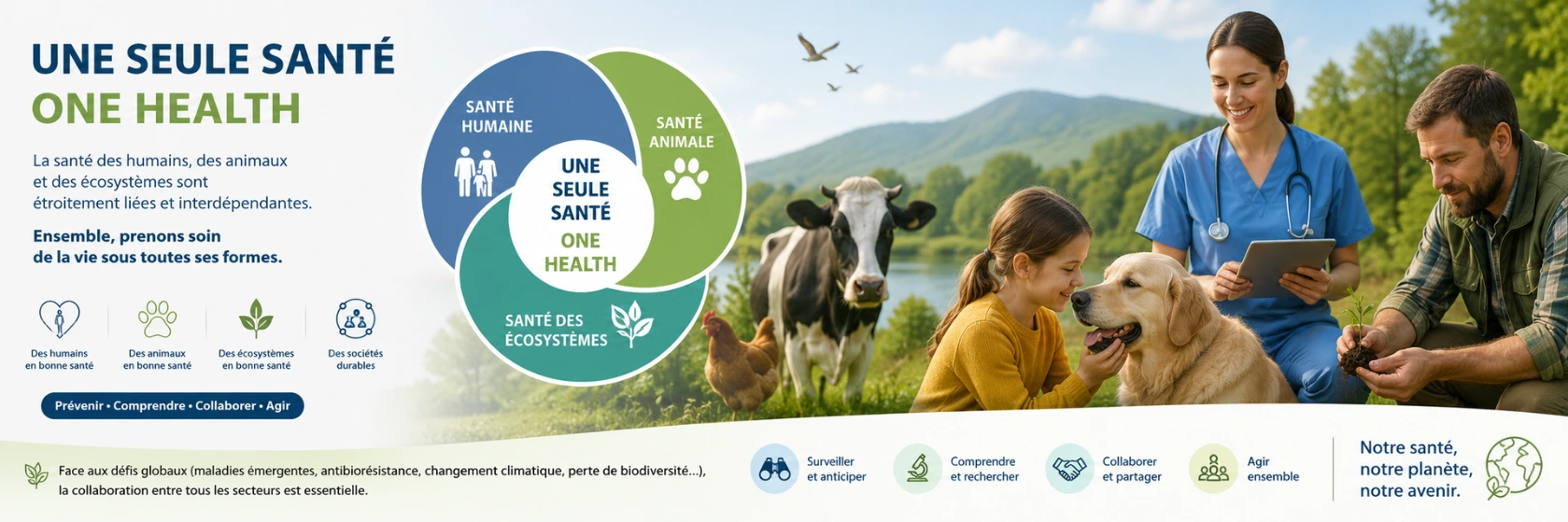
Recent health crises — the COVID-19 pandemic, outbreaks of highly pathogenic avian influenza (HPAI), the rise of antimicrobial resistance, and the accelerated degradation of ecosystems — have highlighted a reality that science has documented for decades: the health of humans, animals, and the environment are deeply interconnected.
It is in this context that the "One Health" approach is gradually establishing itself as a reference framework for rethinking practices in prevention, public health, and the medico-social sector. It is not just an additional concept, but a genuine paradigm shift: moving away from a compartmentalised and curative view of health to adopt a systemic, intersectoral, and preventive approach, rooted in local areas.
This article relies exclusively on the referenced resources on the Health Practices platform, dedicated to professionals in the field of prevention, public health and the medico-social.
Video presentation of the theme
Part 1 — Foundations and evolution of the concept: what are we talking about ?
1.1 An old idea, a concept in maturation
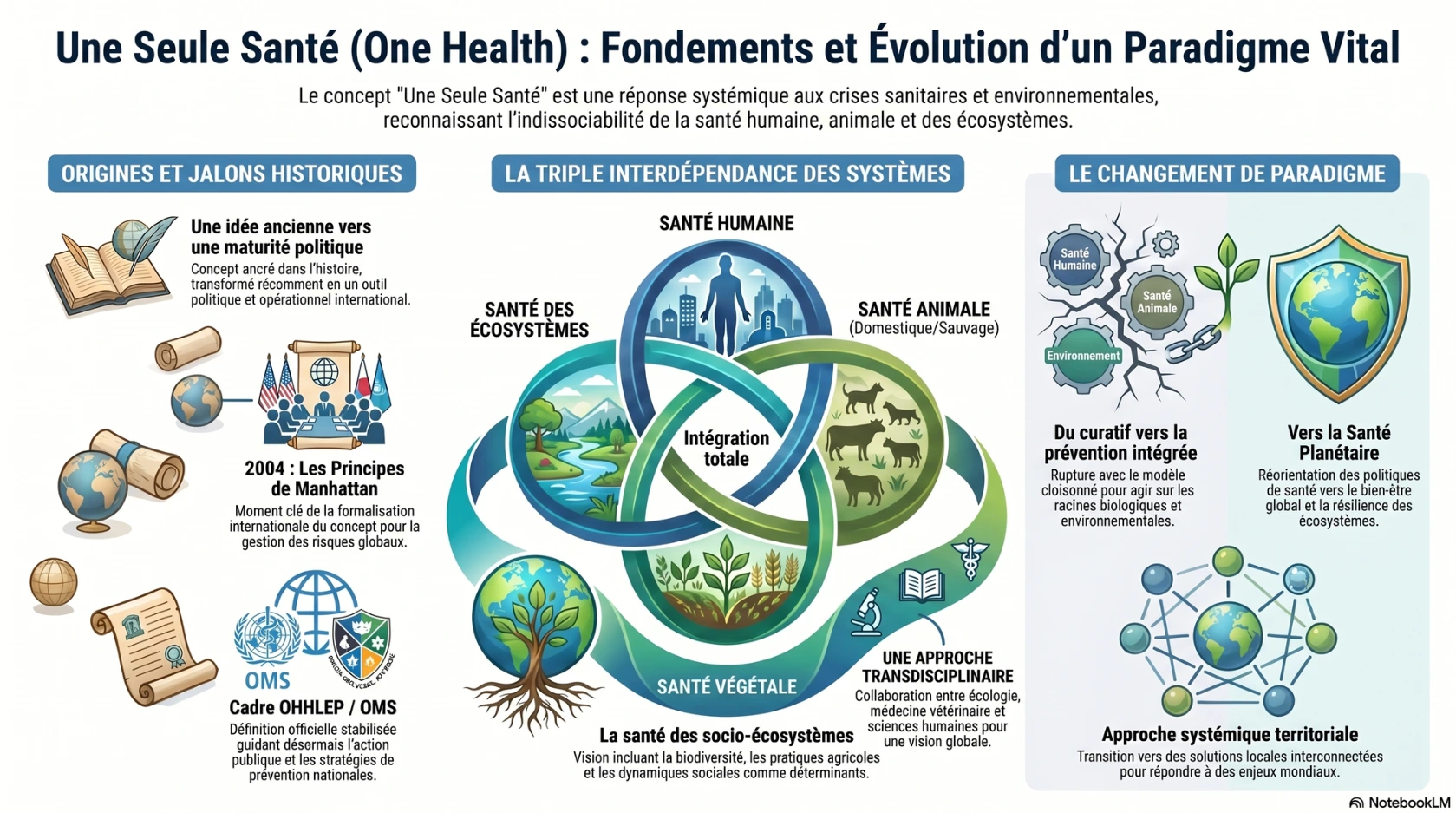
The One Health approach did not arise ex nihilo. The work of Patrick Giraudoux reminds us that the links between living environments and health were considered long before the formalisation of the concept. What is new is its crystallisation as a political and operational tool, and its international formalisation through notably the Manhattan Principles (2004) and the definition of the OHHLEP adopted by the WHO.
The methodological guide of the ARS Bourgogne-Franche-Comté (March 2026, 52 pages, produced with Promotion Santé BFC, the ORS BFC, the GRAINE BFC, the DRAAF and the CIMEOS laboratory) clearly anchors One Health in this dual heritage: a well-established international scientific framework, and an urgent field situation to which local actors are directly confronted. The introduction of the guide cites the COVID-19 crises and the socio-environmental determinants to justify that the concept is now sufficiently stabilised to guide action.
Sources : Giraudoux – One Health: a new concept in maturation or an old story? — https://pratiquesensante.odoo.com/blog/etudes-5/one-health-une-seule-sante-concept-nouveau-en-maturation-ou-vieille-histoire-patrick-giraudoux-3059 | Methodological guide ARS BFC (March 2026) — https://pratiquesensante.odoo.com/blog/outils-6/penser-global-pour-agir-local-guide-methodologique-une-seule-sante-5784
1.2 The triple interdependence: human, animal, environment
The definition retained by the founding texts is clear: One Health refers to an integrated approach that recognises the interdependence between the health of humans, domestic and wild animals, plants, and ecosystems. This is not an approach limited to human exposures alone, but a systemic vision encompassing four "healths".
The CIRAD has developed the concept of "socio-ecosystem health", which integrates biodiversity, agricultural practices, and social dynamics as determinants of health. The PREZODE initiatives, the Health 6 Territories project, and the OLOH project concretely illustrate this approach: the sustainable management of agrosystems can both prevent epidemics and promote resilient ecosystems.
Patrick Giraudoux, in his article on ecosystem health, emphasises that this definitional debate is itself fruitful for enriching prevention practices and going beyond single-entry approaches.
Sources : CIRAD – Socio-ecosystem Health (2025) — https://pratiquesensante.odoo.com/blog/pratiques-15/la-sante-des-socioecosystemes-promouvoir-des-liens-durables-entre-biodiversite-agriculture-et-sante-a-partir-des-territoires-4544 | Giraudoux – Ecosystem Health: what definition? — https://pratiquesensante.odoo.com/blog/etudes-5/la-sante-des-ecosystemes-quelle-definition-patrick-giraudoux-3058
1.3 An essential paradigm shift in public health
The One Health approach represents a break from the dominant sectoral and curative model. It invites a shift from a logic of response to diseases to a logic of integrated prevention, by acting on the root determinants, whether they are biological, ecological, dietary, environmental, or social.
The São Paulo Declaration on Planetary Health illustrates the global dimension of this issue: it calls for a reorientation of health policies towards planetary well-being. The document published by the International Council of Nurses (ICN, May 2025) defines planetary health as a transdisciplinary field aimed at understanding and mitigating the impacts of environmental disruptions on human health, and calls on health professions to integrate these principles into their daily practices.
The scientific symposium of the One Health Summit (“One Health – One Science”), organised as part of the French Presidency of the EU, confirms that this paradigm shift is now supported by a growing international scientific consensus.
Sources : São Paulo Declaration on Planetary Health — https://pratiquesensante.odoo.com/blog/politiques-10/la-declaration-de-sao-paulo-sur-la-sante-planetaire-4848 | ICN – Nursing for the health and well-being of the planet (May 2025) — https://pratiquesensante.odoo.com/blog/politiques-10/les-soins-infirmiers-pour-la-sante-et-le-bien-etre-de-la-planete-4849 | One Health Summit – Summary of recommendations (April 2026) — https://pratiquesensante.odoo.com/blog/pratiques-15/une-seule-sante-one-health-summit-colloque-scientifique-synthese-des-recommandations-5819
Part 2 — Strategic, policy and legal frameworks
2.1 The joint action plan “One Health” 2022–2026
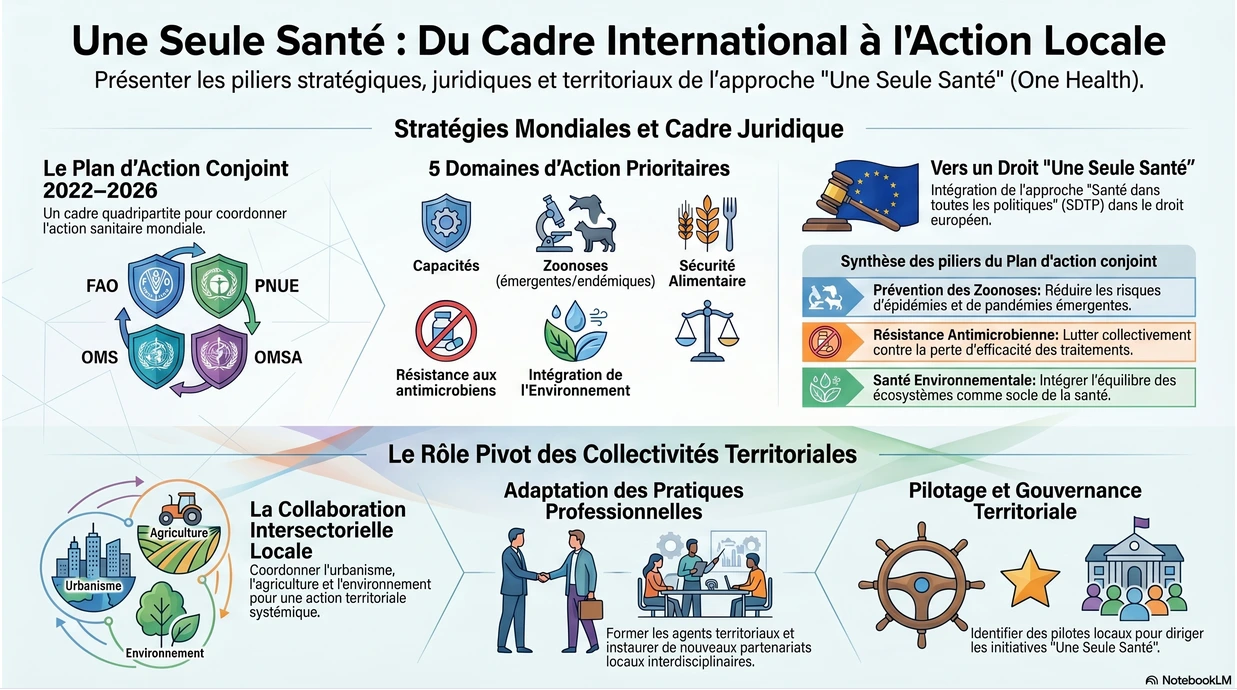
The joint action plan “One Health”, published in 2023 by FAO, UNEP, WHO and OIE, constitutes the international reference framework. It is structured around six interdependent areas of action:
Strengthening ‘One Health’ capacities in health systems
Reducing the risks associated with emerging and re-emerging zoonotic epidemics and pandemics
Controlling and eliminating endemic zoonoses, neglected tropical diseases and vector-borne diseases
Strengthening the food safety system
Fight against antimicrobial resistance (AMR)
Integration of the environment into the One Health approach
This plan is based on a "theory of change" aimed at eliminating barriers to effective implementation, by mobilising multiple sectors, disciplines, and communities. Its guiding principles include cooperation and shared responsibility, multisectoral action, gender equality, inclusion, and equity.
In addition, a National Implementation Guide was published in December 2024 (WHO/FAO/UNEP/OIE). It proposes a five-step process (analysis, coordination, planning, implementation, evaluation), diagnostic tools, check-lists, and a SWOT matrix that can be directly applied at the national level.
Sources : Joint One Health Action Plan 2022–2026 (FAO/UNEP/WHO/OIE) — https://pratiquesensante.odoo.com/blog/annonces-28/une-seule-sante-plan-d-action-conjoint-2022-2026-5023 | National Implementation Guide (December 2024) — https://pratiquesensante.odoo.com/blog/outils-6/guide-de-mise-en-oeuvre-du-plan-daction-conjoint-une-seule-sante-a-lechelon-national-5183
2.2 One Health in international and European law
The report coordinated by Éloïse Gennet (Aix Marseille Univ/CNRS) and Habib Badjinri Touré (Université de Grenoble Alpes), published in the journal "Confluence of Rights", provides an overview of the role of One Health in international and European law.
The starting observation is one of fragmentation: international and European law treats human, animal and environmental health in a compartmentalised manner. However, institutions such as the European Commission and certain international organisations are beginning to adopt One Health as a framework for action. The file explores the potential binding legal effects of One Health and the existing levers in European human rights law.
The approach "Health in All Policies" (SDTP), whose link to One Health is explained in the referenced resources, also constitutes a legal lever currently being consolidated in French and European law.
Sources : File One Health in international and European law (Confluence of rights, UMR 7318) — https://pratiquesensante.odoo.com/blog/etudes-5/dossier-one-health-en-droit-international-et-europeen-4576 | The approach "Health in All Policies" captured by law — https://pratiquesensante.odoo.com/blog/etudes-5/l-approche-sante-dans-toutes-les-politiques-saisie-par-le-droit-2794
2.3 The role of local authorities
The booklet published in April 2025 by the CNFPT – INSET Angers places local authorities at the heart of the implementation of One Health. Three webinars organised in 2024 allowed for the exploration of how to operationalise this concept in local policies, focusing on changes in the professional practices of local agents, the necessary partnerships and potential pilots.
The key points identified for practical application at the local level are :
Integrate a comprehensive vision of health including humans, animals and ecosystems into the community's policies
Work in collaboration with various sectors (urban planning, agriculture, environment, social, economy)
Adapt the working methods of agents to include the principles of One Health
Establish partnerships with local and regional stakeholders for effective implementation
Identify pilots to lead and coordinate local initiatives
Source : The communities concerned by the approach: One Health (CNFPT – INSET Angers, April 2025) — https://pratiquesensante.odoo.com/blog/politiques-10/les-collectivites-concernees-par-l-approche-une-seule-sante-4885
Part 3 — Implementing One Health on the ground: tools and methods
3.1 From global to local: thinking One Health at the territorial level
The guide "Think globally to act locally" (ARS BFC, March 2026, 52 pages) is currently one of the most comprehensive tools available in French to operationalise One Health at the territorial level. It is directly useful to CLS coordinators, PAT facilitators, health-environment technicians, local elected officials and heads of care structures.
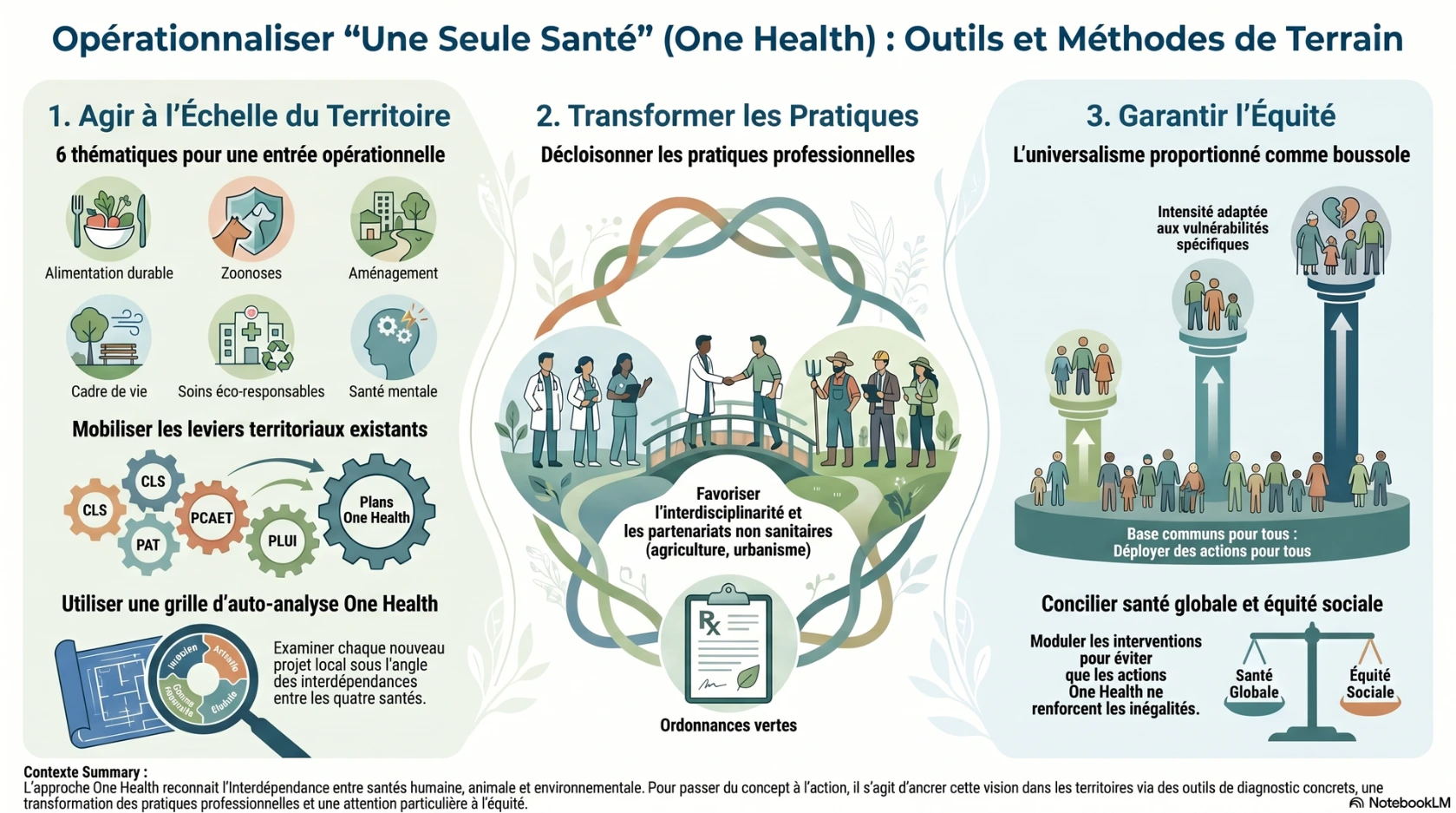
Its structure proposes six entry themes: healthy and sustainable food, zoonoses, land use planning, quality of living environments, eco-responsible care, well-being and mental health. For each theme, the guide details the interdependence mechanisms between the four health areas, the mobilisable territorial levers (PAT, CLS, PCAET, PTSM, CPTS, PLUi, etc.) and the expected co-benefits.
He proposes notably a self-analysis grid "One Health" to examine any new project, practical recommendations to map stakeholders, and a chapter dedicated to evaluation — which is rare in this type of tool. The illustration through the story of Lucie, a nursery manager, illustrates the shift from a health-environment approach focused on human exposures to a systemic project integrating biodiversity, economic circuits and agricultural practices.
Source : Methodological guide "One Health" – ARS BFC (March 2026, 52 pages) — https://pratiquesensante.odoo.com/blog/outils-6/penser-global-pour-agir-local-guide-methodologique-une-seule-sante-5784
3.2 Transforming professional practices
The guide "One Health for health practices and policies" (Sinonvirgule firm) proposes a complete overhaul of health practices through the One Health approach. Its main axes are :
Breaking down disciplinary silos: promoting cooperation between human, environmental and animal issues within the structures themselves
Interdisciplinarity in training and research: creation of mixed pathways, support for joint projects, hybridisation of knowledge
Global and community health: taking into account inequalities and ecological factors in health practice
Reorientation of public policies: embedding health in all institutional actions, experimenting with new forms of pricing (food social security, pricing based on patient population)
Active prevention: green prescriptions, interdisciplinary care centres, check-lists of territorialised preventive practices
The proposed action tracks are operational: carry out an One Health diagnosis of the structure; develop partnerships with non-health actors; adapt the training pathways; organise interdisciplinary workshops.
Source : One Health for health practices and policies. Implementation guide (Sinonvirgule, 2025) — https://pratiquesensante.odoo.com/blog/outils-6/one-health-pour-les-pratiques-et-politiques-de-sante-guide-de-mise-en-application-5167
3.3 Proportional universalism as a principle of equity
One of the conditions for One Health not to reproduce existing health inequalities is to articulate the approach with proportional universalism. This concept, presented in the resource selection published by UCLouvain (Institute of Health and Society Research – RESO, May 2024), refers to a strategy that offers universal interventions while adapting their intensity to the specific needs of different population groups.
In practical terms, One Health prevention actions must be designed to reach the entire population, while modulating their intensity according to the level of social, environmental or health vulnerability. The proposed evaluation tools and the principles for adapting actions are directly applicable in medico-social structures, CPTS, MSP or PMI services.
Source : Resource selection: Proportional universalism (UCLouvain-RESO, May 2024) — https://pratiquesensante.odoo.com/blog/outils-6/selection-de-ressources-l-universalisme-proportionne-4935
Part 4 — Challenges, actors and governance
4.1 In the face of emerging issues: a necessary dialogue between State – science – society
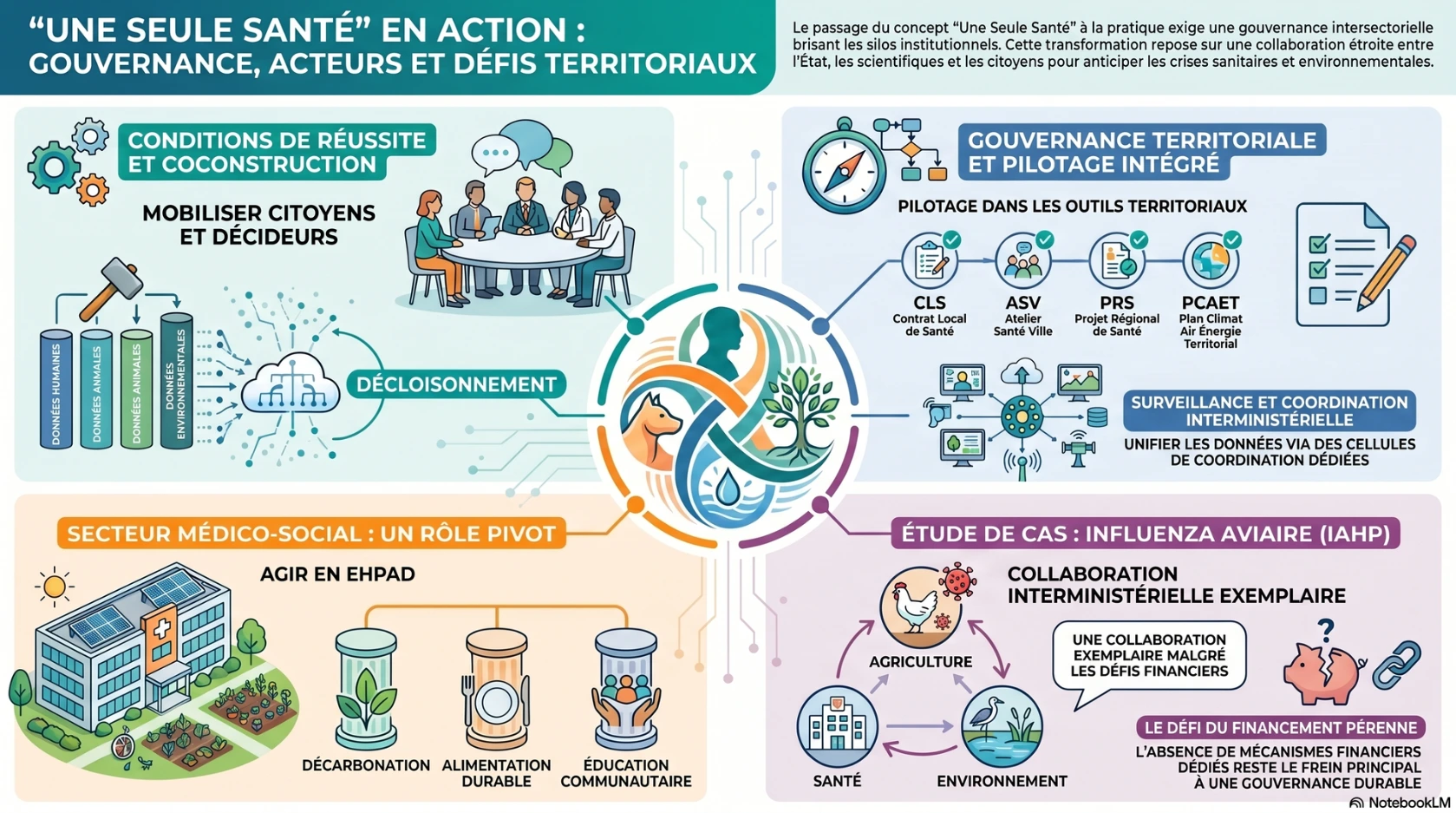
In March 2021, Montpellier University of Excellence (MUSE) and Agropolis International brought together decision-makers, operational actors and scientists to share their experiences of integrated health approaches. Four success conditions are identified to make One Health more effective against emerging health threats :
Co-construct integrated projects with all relevant stakeholders (citizens, political decision-makers, researchers, local services)
Develop evaluation methods for their impacts
Train the actors
Institutionalise and coordinate actions from the local to the global level
This document also highlights the persistent obstacles : compartmentalisation of surveillance systems, insufficient sharing of data, lack of anticipation, weakness of intersectoral governance. These obstacles are confirmed by the Summary of recommendations from the One Health Summit (April 2026).
Sources : The One Health approaches to address emergencies (CIRAD, 2024) — https://pratiquesensante.odoo.com/blog/etudes-5/les-approches-one-health-pour-faire-face-aux-emergences-un-necessaire-dialogue-etat-sciences-societes-3878 | One Health Summit – Summary of recommendations (April 2026) — https://pratiquesensante.odoo.com/blog/pratiques-15/une-seule-sante-one-health-summit-colloque-scientifique-synthese-des-recommandations-5819
4.2 The concrete case of avian influenza : One Health in action
The report on the management of AIHP in France (jointly signed by the ministries of Agriculture, Health and Environment, in response to the European Commission's questionnaire, June 2025) constitutes a case study in the implementation of One Health. It describes inter-ministerial governance, shared surveillance protocols between veterinary services, ARS, Public Health France, Anses, OFB and MSA, and suitable communication tools. However, it identifies a significant limitation: the absence of a dedicated financial mechanism for the governance of One Health.
This document is directly useful for veterinary health professionals, DDecPP agents, ARS and occupational health (MSA) staff, as well as for associations working with farmers, hunters, naturalists or wildlife rehabilitation centres.
Source : Management of animal diseases under a One Health approach – The case of AIHP (DGAL/DGS/DEB, 2026) — https://pratiquesensante.odoo.com/blog/politiques-10/la-gestion-des-maladies-animales-sous-une-approche-une-seule-santeone-health-le-cas-de-linfluenza-aviaire-hautement-pathogene-iahp-en-questionsreponses-5764
4.3 Interdisciplinary governance and territorial management
The Summary of recommendations from the One Health Summit (April 2026, 16 pages) provides a structured framework for organising One Health governance. Five families of recommendations emerge:
Establish integrated surveillance systems (human, veterinary, environmental and socio-economic data)
Strengthen the capacities for transdisciplinary research (modelling, ecology, social sciences, veterinary sciences)
Establish coordinated mechanisms between ministries, agencies and local authorities, with One Health steering bodies
Integrate One Health into university programmes and continuing education
Develop communication tools tailored to the public to promote citizen ownership
For local stakeholders, these recommendations translate to: integrating One Health into territorial diagnostics (CLS, ASV, PRS, PCAET); establishing coordination cells involving ARS, departmental councils, veterinary services, local authorities, water agencies, environmental-health associations and social actors.
Source : One Health Summit – Summary of recommendations (scientific committee, French Presidency of the EU, April 2026) — https://pratiquesensante.odoo.com/blog/pratiques-15/une-seule-sante-one-health-summit-colloque-scientifique-synthese-des-recommandations-5819
4.4 The professionals in the medico-social sector: a place to build
The document from the International Council of Nurses (ICN, May 2025) defines planetary health as a transdisciplinary field aiming to mitigate the impacts of environmental disruptions on human health. The main identified threats are climate change, pollution, loss of biodiversity and deforestation. The proposed action levers for nurses are:
Reduction of waste and decarbonisation in healthcare facilities
Promotion of sustainable food
Education and raising community awareness of environmental impacts on health
Transdisciplinary collaboration
Political advocacy for measures to protect the environment and human health
Integration of indigenous knowledge in care
Preparation of health systems for the impacts of climate change
This approach is applicable to the entire medico-social sector : EHPAD, rehabilitation structures, home help services, institutions for people with disabilities.
Source : Nursing care for the health and well-being of the planet (ICN, May 2025) — https://pratiquesensante.odoo.com/blog/politiques-10/les-soins-infirmiers-pour-la-sante-et-le-bien-etre-de-la-planete-4849
Part 5 — Evaluation, indicators and perspectives
5.1 Measuring impact : multidimensional indicators
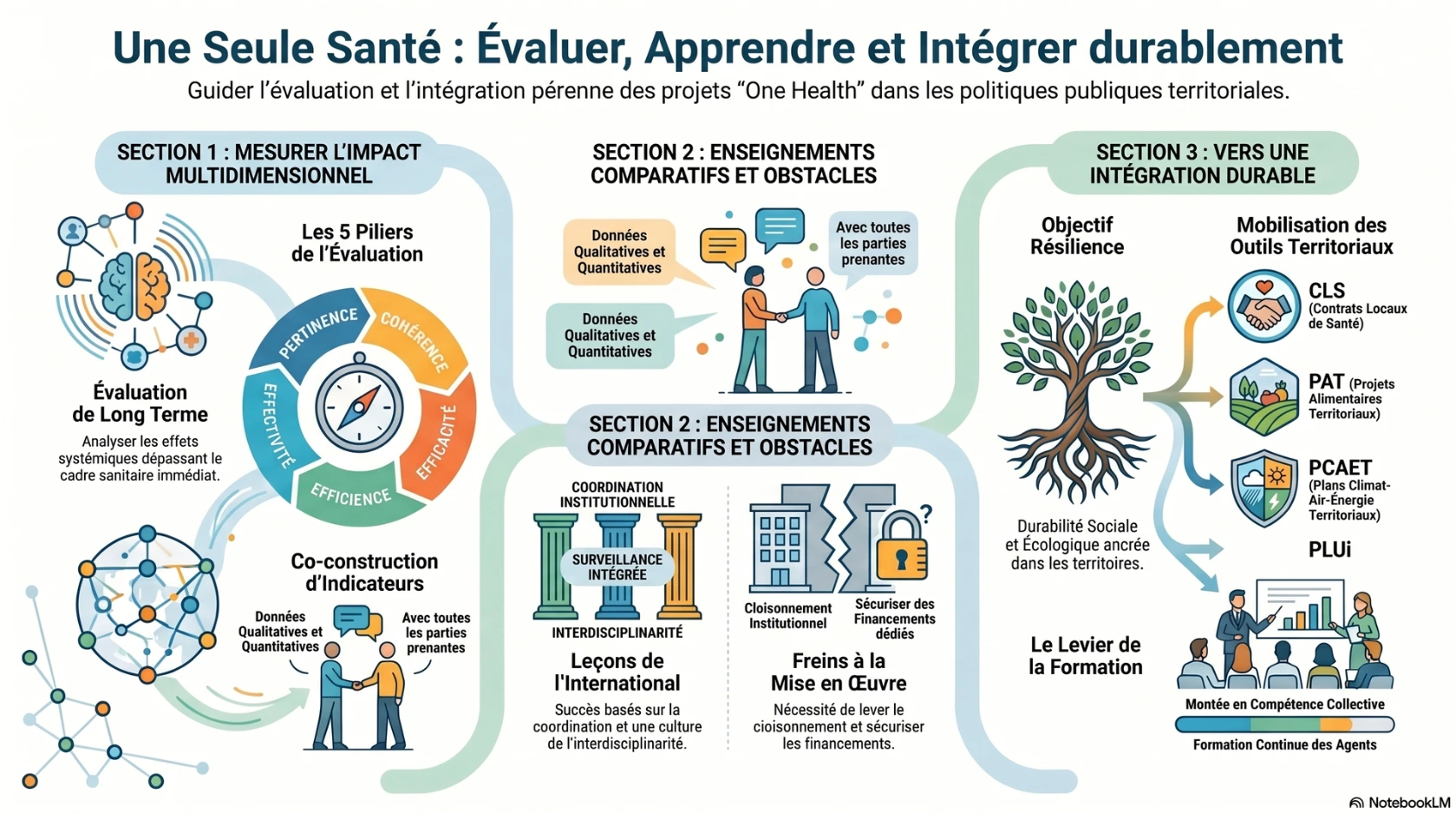
The evaluation of One Health projects is a specific challenge, as the effects sought are multidimensional and occur over the long term. The methodological guide from ARS BFC dedicates an entire chapter to it, including a pedagogical clarification of the concepts of diagnosis, assessment, audit and evaluation, and presenting the criteria specific to the One Health context : relevance, coherence, effectiveness, efficiency, and efficacy.
The example of Lucie's project illustrates how to formulate evaluative questions, choose indicators (quantitative and qualitative) and build a feasible evaluation protocol in co-construction. The National Implementation Guide (December 2024) complements this approach by proposing management through feedback with monitoring indicators allowing for adjustments to priorities and ensuring the sustainability of actions.
Sources : Methodological guide ARS BFC (March 2026) — https://pratiquesensante.odoo.com/blog/outils-6/penser-global-pour-agir-local-guide-methodologique-une-seule-sante-5784 | National Implementation Guide (December 2024) — https://pratiquesensante.odoo.com/blog/outils-6/guide-de-mise-en-oeuvre-du-plan-daction-conjoint-une-seule-sante-a-lechelon-national-5183
5.2 One Health in Switzerland and around the world : comparative lessons
The document on the evolution and impact of the One Health approach in Switzerland and around the world provides useful comparative insights. The most advanced countries share common points: a formalised institutional coordination between human, veterinary and environmental health; investments in integrated surveillance; a professional culture promoting interdisciplinarity.
These lessons are valuable for French stakeholders, who have a political framework (PNSE4, PRS, national strategy for biodiversity) but still face identified organisational obstacles: institutional silos, lack of dedicated funding, insufficient training of professionals.
Source : Evolution and impact of the One Health approach in Switzerland and around the world — https://pratiquesensante.odoo.com/blog/etudes-5/evolution-et-impact-de-lapproche-une-seule-sante-one-health-en-suisse-et-dans-le-monde-4230
5.3 Towards sustainable integration in all public policies
The horizon sought by One Health goes beyond health: it also aims at social, ecological and territorial resilience. The ARS BFC guide identifies the frameworks in which this integration is most operational: CLS, PAT, PCAET, PLUi, SCOT, CRTE, PTSM, CPTS, MSP. For each, it is possible to review the objectives in terms of co-benefits and to include One Health in the upcoming contractual cycles.
The reference to the training course "Getting to grips with the One Health approach in health promotion in 180 minutes (or almost)" illustrates that accessible pedagogical tools already exist to accelerate this collective skill enhancement.
Sources : Methodological guide ARS BFC (March 2026) — https://pratiquesensante.odoo.com/blog/outils-6/penser-global-pour-agir-local-guide-methodologique-une-seule-sante-5784 | Getting to grips with the One Health approach in 180 minutes — https://pratiquesensante.odoo.com/blog/outils-6/faire-le-tour-de-lapproche-une-seule-sante-en-promotion-de-la-sante-en-180-minutes-ou-presque-5165
Conclusion
One Health is not an additional tool. It is an invitation to rebuild cooperation between sectors, professions and territories around a common vision of life, and to embed preventive action within the complexity of interdependencies that structure our relationship with health.
The resources referenced on Pratiques en Santé converge towards several essential messages: One Health is scientifically based and politically supported at the international level; solid methodological tools exist for its territorial implementation; the communities, the ARS, the CPTS, the medical-social structures and health professionals have a key role to play; and proportionate universalism is the key for this approach to reduce inequalities rather than reproduce them.
The conditions for success are however demanding: formalised interdisciplinary governance, training of professionals, data sharing, dedicated funding, and an organisational culture willing to work outside its usual boundaries. It is at this price that One Health will cease to be an inspired concept to become an ordinary practice.
Resources used
All the resources below are referenced on pratiquesensante.odoo.com/2-5-one-health-une-seul-sante
Foundations and evolution
One Health Summit – Summary of recommendations (April 2026) — https://pratiquesensante.odoo.com/blog/pratiques-15/une-seule-sante-one-health-summit-colloque-scientifique-synthese-des-recommandations-5819
Giraudoux – One Health: new concept in maturation or old history? — https://pratiquesensante.odoo.com/blog/etudes-5/one-health-une-seule-sante-concept-nouveau-en-maturation-ou-vieille-histoire-patrick-giraudoux-3059
Giraudoux – The health of ecosystems: what definition? — https://pratiquesensante.odoo.com/blog/etudes-5/la-sante-des-ecosystemes-quelle-definition-patrick-giraudoux-3058
Introduction to the concept of "One Health" in environmental public health — https://pratiquesensante.odoo.com/blog/etudes-5/introduction-au-concept-une-seule-sante-en-sante-publique-environnementale-1502
The approach One Health: an essential paradigm shift in public health — https://pratiquesensante.odoo.com/blog/etudes-5/lapproche-one-health-un-changement-de-paradigme-indispensable-en-sante-publique-243
Evolution and impact of the One Health approach in Switzerland and worldwide — https://pratiquesensante.odoo.com/blog/etudes-5/evolution-et-impact-de-lapproche-une-seule-sante-one-health-en-suisse-et-dans-le-monde-4230
Understanding the concept One Health. Caring for living beings and environments to take action — https://pratiquesensante.odoo.com/blog/etudes-5/comprendre-le-concept-une-seule-sante-prendre-soin-des-vivants-et-des-milieux-pour-passer-a-laction-5632
Viruses do not need visas — https://pratiquesensante.odoo.com/blog/politiques-10/les-virus-nont-pas-besoin-de-visas-5450
Strategies, practical guides and policies
Joint action plan "One Health" 2022–2026 (FAO/UNEP/WHO/OIE) — https://pratiquesensante.odoo.com/blog/annonces-28/une-seule-sante-plan-d-action-conjoint-2022-2026-5023
Guide for implementing the joint action plan at the national level (December 2024) — https://pratiquesensante.odoo.com/blog/outils-6/guide-de-mise-en-oeuvre-du-plan-daction-conjoint-une-seule-sante-a-lechelon-national-5183
Thinking globally to act locally. Methodological guide "One Health" (ARS BFC, March 2026) — https://pratiquesensante.odoo.com/blog/outils-6/penser-global-pour-agir-local-guide-methodologique-une-seule-sante-5784
One Health for health practices and policies. Implementation guide (Sinonvirgule, 2025) — https://pratiquesensante.odoo.com/blog/outils-6/one-health-pour-les-pratiques-et-politiques-de-sante-guide-de-mise-en-application-5167
The communities involved in the approach: One Health (CNFPT – INSET Angers, April 2025) — https://pratiquesensante.odoo.com/blog/politiques-10/les-collectivites-concernees-par-l-approche-une-seule-sante-4885
Selection of resources: Proportional universalism (UCLouvain-RESO, May 2024) — https://pratiquesensante.odoo.com/blog/outils-6/selection-de-ressources-l-universalisme-proportionne-4935
Overview of the One Health approach in health promotion on 180 minutes — https://pratiquesensante.odoo.com/blog/outils-6/faire-le-tour-de-lapproche-une-seule-sante-en-promotion-de-la-sante-en-180-minutes-ou-presque-5165
Interdisciplinary approaches, cases and law
Management of animal diseases under a One Health approach – The case of the AIHP (DGAL/DGS/DEB, 2026) — https://pratiquesensante.odoo.com/blog/politiques-10/la-gestion-des-maladies-animales-sous-une-approche-une-seule-santeone-health-le-cas-de-linfluenza-aviaire-hautement-pathogene-iahp-en-questionsreponses-5764
One Health dossier in international and European law (Confluence of rights, UMR 7318) — https://pratiquesensante.odoo.com/blog/etudes-5/dossier-one-health-en-droit-international-et-europeen-4576
The health of socio-ecosystems: biodiversity, agriculture and health (CIRAD, 2025) — https://pratiquesensante.odoo.com/blog/pratiques-15/la-sante-des-socioecosystemes-promouvoir-des-liens-durables-entre-biodiversite-agriculture-et-sante-a-partir-des-territoires-4544
The São Paulo Declaration on Planetary Health — https://pratiquesensante.odoo.com/blog/politiques-10/la-declaration-de-sao-paulo-sur-la-sante-planetaire-4848
Nursing care for the health and well-being of the planet (ICN, May 2025) — https://pratiquesensante.odoo.com/blog/politiques-10/les-soins-infirmiers-pour-la-sante-et-le-bien-etre-de-la-planete-4849
The One Health approaches to address emerging issues (CIRAD, 2024) — https://pratiquesensante.odoo.com/blog/etudes-5/les-approches-one-health-pour-faire-face-aux-emergences-un-necessaire-dialogue-etat-sciences-societes-3878
The approach "Health in all policies" captured by the law — https://pratiquesensante.odoo.com/blog/etudes-5/l-approche-sante-dans-toutes-les-politiques-saisie-par-le-droit-2794
N.B. : Each article is produced from my field experience, combining critical reading and processing by artificial intelligence (Perplexity, NotebookLM and Claude). The prompts are specifically constructed for each type of use, and the models operate only from the transmitted source (that of the blog) — without recourse to external knowledge or extrapolation.