
Learning with,
learning digital
The keys to digital education to reconcile success, well-being and equality of opportunity.
Daniel Oberlé - Practices in Health - 15 July 2026
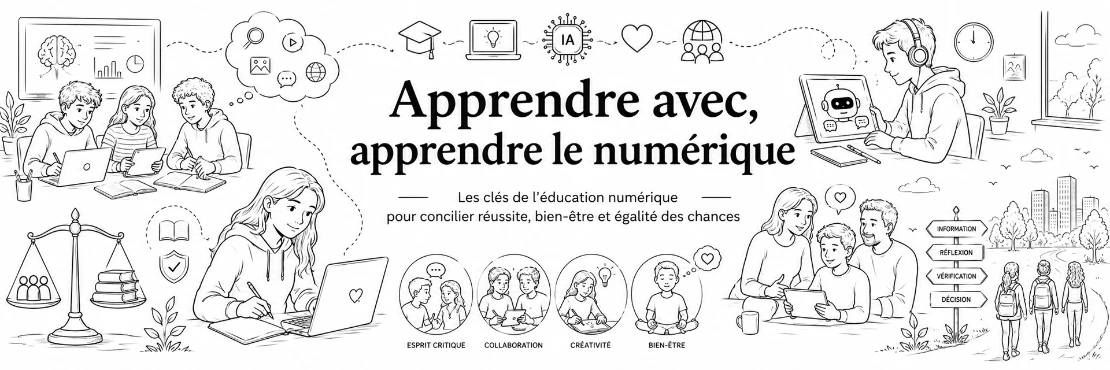
In brief The european and OECD corpus published between 2020 and 2026 documents a shift: digital ceases to be merely a means of teaching to become an object of learning, a measurement object and an object of ethical governance. Four pieces fit together: a political strategy (the Union of competences), a skills framework (the AILit framework), an international measurement system (PISA 2029) and a toolkit for teachers (the 2026 guidelines package). What the corpus says little : well-being, mental health and social inequalities in literacy. It is precisely here that the actors of prevention and health promotion have something to contribute. |
The Audio Capsules of Practices in Health -
- Version 2 minutes - https://www.youtube.com/watch?v=0dE4rLI1yX8
- Version 7 minutes - https://www.youtube.com/watch?v=WOofs33HKQw
Introduction : the window has shifted
For twenty years, the question of educational digital technology has been posed in terms of equipment: how many computers, what bandwidth, which platforms, which digital textbooks. The corpus gathered here shows that the question has changed in nature. It now concerns what students must understand about these technologies, what they must be able to do — and what they must be able to refuse to do.
The figure that triggers the entire sequence is simple: 68% of teenagers are already using artificial intelligence, whereas educational systems often lack the frameworks necessary to integrate it. 2
In other words, the use has preceded pedagogy, by a long way. Institutions are chasing after an established practice. This asymmetry explains the unusual density of publications in 2025 and 2026, and it also explains their tone: it is no longer about promoting digital technology, but about trying to regain pedagogical control over it.
This file follows the logic of nesting of the corpus: first the political framework (I), then the skills reference (II), then the measurement system (III), then the tools for teachers (IV). It then offers a critical reading (V) and, finally, what all this changes for the actors in health prevention and promotion (VI).
I. The political framework: from the digital decade to the Union of skills
1.1 "A Europe adapted to the digital age" and the digital compass 2030
The matrix is old. Digital is one of the major priorities of the Commission since 2019, with three public policy objectives regarding skills: to enable all citizens to develop digital skills, to support advanced and specialised skills, and to accompany the digital transition of education and training systems. 9
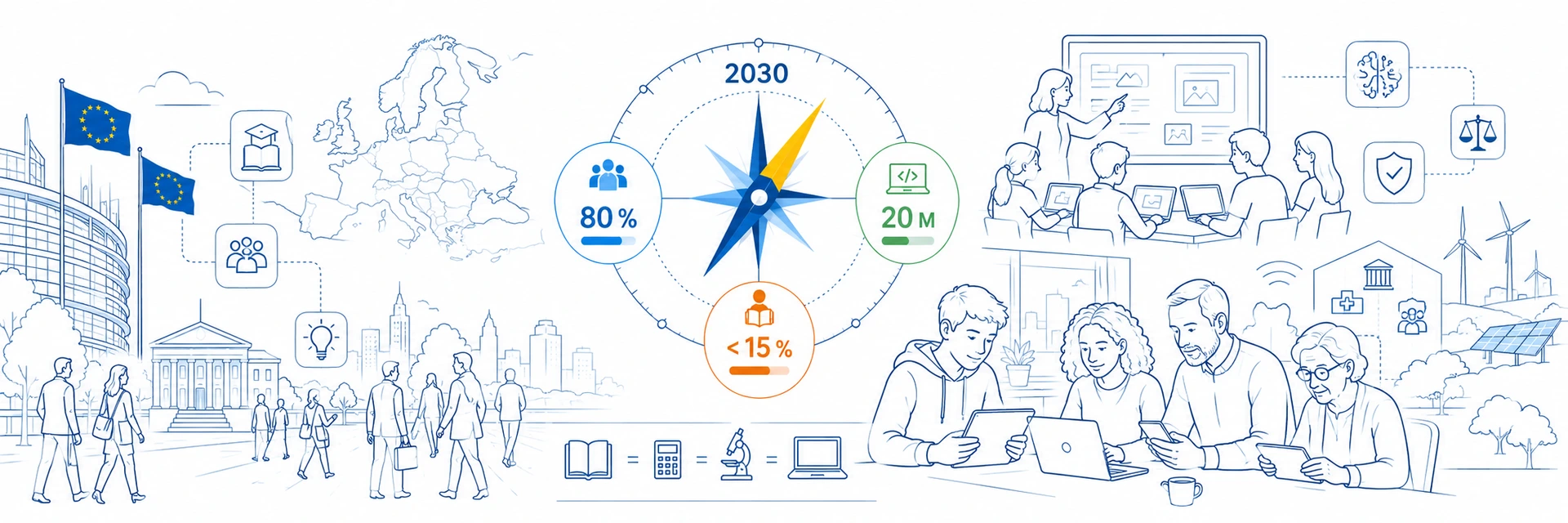
The digital compass 2030 translates this ambition into numerical targets. Two of them directly concern education: at least 80 % of the population aged 16 to 74 with basic digital skills, and 20 million ICT specialists in employment in the Union by 2030, with a goal of rebalancing between women and men. 10
A complementary target, from the European education area, aims to reduce to less than 15 % the proportion of fourth-year students struggling with digital and information literacy. 10
These targets are not being met, and the current trajectory does not allow for them to be achieved. The latest report on the state of the digital decade indicates that just over 60 % of the population has basic digital skills, with ICT specialists representing about 5 % of European employment for a target of 10 %, and a share of women below 20 % in these professions — a figure that is not changing.
The corpus explains little about this dropout. Three factors are however regularly put forward and deserve to be stated, if only as working hypotheses. Firstly, the continuous training of adults remains far below the needs: the targets for digital skills cover the entire population aged 16 to 74 years, but the bulk of public effort is focused on students. Secondly, the ageing of the population mechanically increases the share of people distanced from usage, without adequate mediation measures being deployed. Finally — and this is the most problematic point for our field — the dematerialisation of public services has progressed faster than the digital literacy of their users: counters were removed before people were trained, resulting in a non-access to rights that has become a full-fledged determinant of health.
Why this point matters The rest of the corpus — competency frameworks, international evaluation, guidelines — is primarily understood as a response to a persistent gap between the stated targets and the measured reality. This is not a movement of technological enthusiasm; it is a catch-up movement. |
1.2 The action plan for digital education 2021-2027
Adopted on 30 September 2020, in the immediate wake of the school closures related to the pandemic, the action plan sets two strategic priorities: to promote the development of a high-performing digital education ecosystem, and to strengthen the digital skills necessary for digital transformation. Fourteen actions detail these. 8
Two of these actions directly explain the existence of several pieces of the present corpus: under the first priority, a group of experts was tasked with developing ethical guidelines on AI and data usage, based on the guidelines of the high-level expert group on trustworthy AI; under the second, another group was tasked with producing common guidelines to combat misinformation and develop digital literacy. 8
The plan is due to expire. The next steps are announced: a 2030 roadmap on the future of education and digital skills, built from the assessment of the action plan, and presented as a deliverable of the Skills Union. 8
1.3 The Skills Union (March 2025)
Presented on the 5th of March 2025, the Skills Union is a overarching strategy that aims to be the counterpart, for human capital, of the competitiveness compass. It relies on the European education area, the European research area and the European skills strategy. 1
It sets targets for 2030, including this one, which is crucial for our topic: the proportion of students struggling with literacy, mathematics, science and digital skills must fall below 15%. Digital literacy is thus explicitly classified among the basic skills — on the same level as reading, counting and scientific reasoning. 1
This semantic shift is the major political fact of the corpus. As long as the digital was considered as "transversal skills" or " skills of the 21st century", it could remain an option, a matter for specialists or institutional projects. Classified among the core skills, it becomes a given: not mastering it becomes a form of illiteracy.
However, it should be noted the framing: the Union of Skills is based on competitiveness and, now, on technological sovereignty. The dominant argument is not one of emancipation nor one of health — it is economic and geopolitical. We will return to this.
Chronology of the corpus 2020 — Action plan for digital education 2021-2027 (COM(2020) 624). 2021 — Digital Compass 2030: targets of 80% basic digital skills and 20 million ICT specialists. 2022 — First edition of the ethical guidelines on AI and data for teachers. 2023 — Council recommendation on the factors conducive to the success of digital education; work on the quality of digital educational content. March 2025 — Communication "The Union of Skills" (COM(2025) 90). May 2025 — Preliminary version of the AILit framework submitted to consultation. End 2025 / beginning 2026 — First draft of the PISA 2029 MAIL assessment framework, "Navigating an Evolving Digital World". March 2026 — Joint publication of four sets of guidelines for teachers. June 2026 — Publication of the finalised AILit framework, "Empowering Learners for the Age of AI". 2029 — Administration of PISA (major domain: reading; innovative domain: MAIL). 2031 — Expected publication of the results of the MAIL domain. |
II. Digital and AI as learning objects: the AILit framework
2.1 Genesis and status
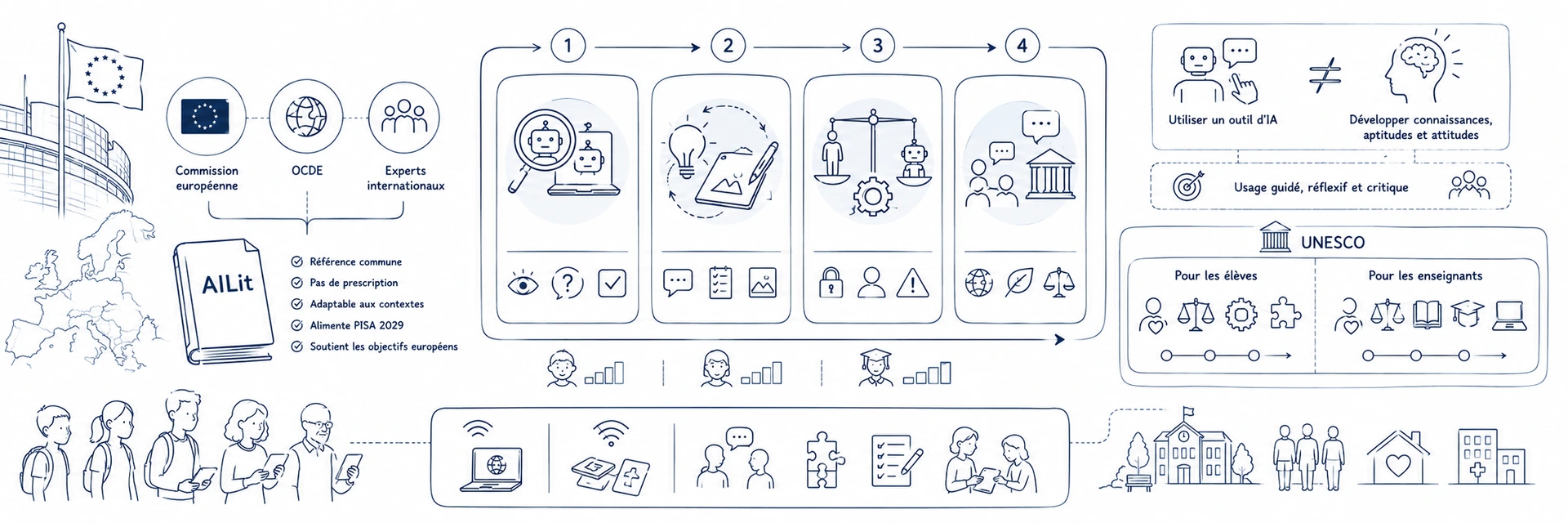
"Empowering Learners for the Age of AI" is a framework for artificial intelligence literacy for primary and secondary education, co-produced by the European Commission and the OECD, with the support of CodeAI (formerly Code.org) and a group of international experts. A preliminary version circulated in May 2025; the finalised version was published in June 2026 and presented in Brussels at the flagship event of the European digital education hub. 2
Its status is that of a common reference, not a prescription: it does not define a curriculum, does not recommend any products, and indicates the intention to be adapted to national contexts. It feeds into the innovative domain of PISA 2029 and serves as a foundation for European objectives in digital education. 2
2.2 Four domains, nineteen competencies
The framework organises AI literacy into four domains, presented in an order that suggests a learning pathway, and into nineteen competencies articulating each of knowledge, skills, and attitudes. 2
Domain |
What it covers |
Engage with AI — engage with AI |
Field founder: recognise the presence of AI in everyday tools, roughly understand how it works, evaluate its outputs with a critical eye. |
Create with AI — create with AI |
Active and iterative use: the student first designs, then mobilises AI, and then analyses what has changed. The framework insists: AI must serve the creative intention of the student, not substitute for it. Associated skills: formulation of instructions, evaluation, source verification. |
Manage AI — manage AI |
Decide when to delegate a task — and when not to. Break down a problem, distribute between human judgement and algorithmic assistance, maintain supervision. Data, privacy, responsible use. |
Shape AI — shape AI |
Understand that AI systems are the product of human choices and values, and be able to act on these choices: design, adaptation, governance, participation in public debate. |
Two characteristics deserve to be highlighted. On the one hand, the learning expectations are broken down into three levels — elementary, intermediate, advanced — which allows for working on the same skill from primary to secondary school. On the other hand, ethical considerations do not form a separate chapter: equity, bias, transparency, privacy, responsibility and environmental impact are integrated into each field, on the grounds that ethical judgement is inseparable from learning with and about AI. 2
The framework includes furthermore learning scenarios usable offline or with little technology, which teach AI concepts without access to AI tools. This detail is not anecdotal: it opens the door to literacy work in poorly equipped contexts — including outside of school. 2
2.3 What the framework is not
The text takes care to establish a distinction that should be reiterated everywhere: AI literacy is not the use of AI. Using a tool does not, in itself, develop the knowledge, skills or attitudes described. What develops them is a guided, reflective and critical use.
To sustain for our audiences The quadriptych “ engage / create / manage / shape” is directly transposable outside the school context. It constitutes a grid of reading usable in adult training, in popular education, in health mediation — everywhere one wants to work on the relationship with AI tools without limiting oneself to usage guidelines. |
2.4 An international counterpoint: UNESCO's competency frameworks
The AILit framework is not the only available reference, and it is not the first. As early as 2024, UNESCO published two competency frameworks in artificial intelligence: one for students, the other for teachers. Comparing them with the European framework sheds light on what this one chooses — and what it leaves aside.
The framework intended for students describes twelve competencies divided into four dimensions — a human-centred mindset, AI ethics, the techniques and applications of AI, the design of AI systems — broken down into three levels of progression: understand, apply, create. 17
The framework intended for teachers describes fifteen competencies across five dimensions: human-centred mindset, AI ethics, foundations and applications, AI pedagogy, and the use of AI for professional development — according to three levels: acquire, delve deeper, create. 18
Three differences that matter 1. The order of factors. At UNESCO, the human-centred mindset and ethics come first, before technology: they underpin learning rather than accompany it. The European framework, on the other hand, integrates ethics into every area — an elegant solution, but one that makes it less visible and easier to sidestep in implementation. 2. A reference framework for teachers. UNESCO defines what teachers need to know and be able to do. The AILit framework addresses teachers, but does not describe their specific competencies. This is a shortcoming, at a time when teacher training is the main bottleneck. 3. The scope. UNESCO addresses educational systems that are very unevenly equipped; the European Union and the OECD primarily address wealthy countries. The UN framework therefore more explicitly integrates inclusion, sustainability, and the issue of resources. |
For a field actor, the best practice probably involves crossing both : the pedagogical granularity and class scenarios of the European framework, the ethical framework and the ‘teachers’ aspect of the UN framework.
III. Measuring: PISA 2029 and media and AI literacy
3.1 An “innovative domain”
Since 2012, every PISA cycle includes, alongside the major domains, an innovative domain focusing on interdisciplinary skills: creative problem solving, collaborative resolution, global competence, creative thinking, learning in the digital world. For the 2029 cycle — where the major domain will be reading — the innovative domain will be media literacy and artificial intelligence (Media and Artificial Intelligence Literacy, MAIL). 3
The first draft of the assessment framework, titled "Navigating an Evolving Digital World", has been made public and is still subject to revisions before the official version. Results are expected around 2031. 3, 4
3.2 What will be assessed, and how
The stated issue is to determine whether students have had the opportunity to learn to engage proactively and critically in a world where production, participation, and social connection increasingly rely on digital and algorithmic tools. 3
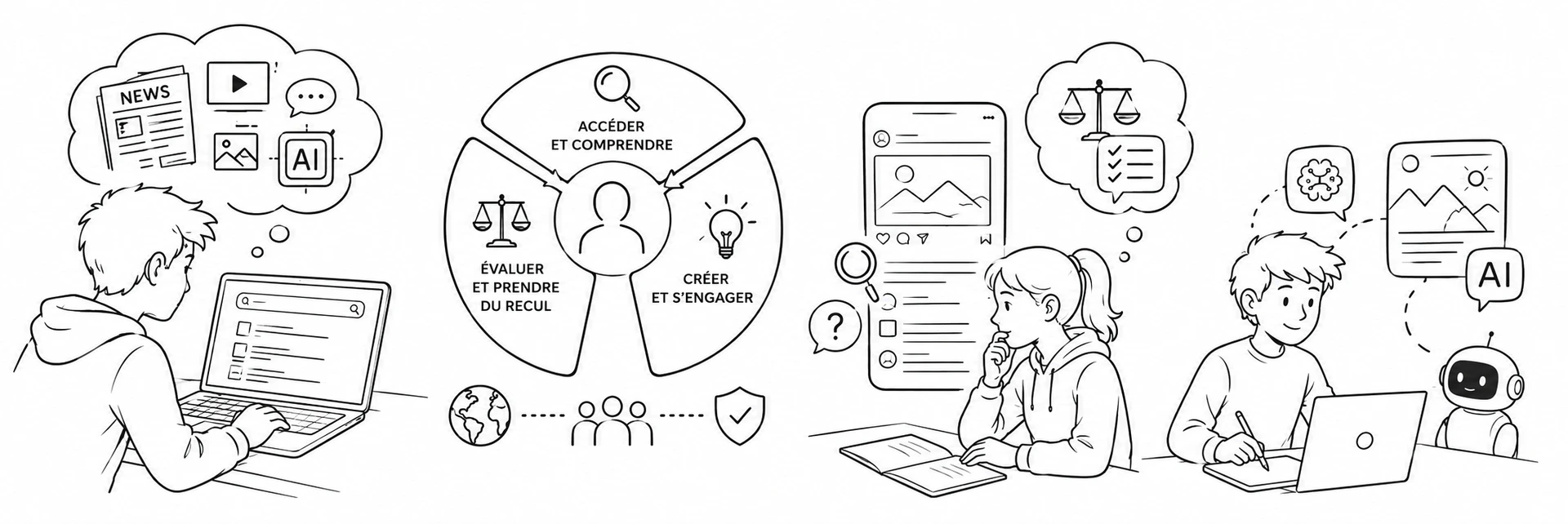
Specifically, the assessment should measure students' ability to evaluate the credibility, quality, and intent of digital content, in order to act in an informed and ethical manner. Three main axes structure the framework: accessing and understanding; evaluating and reflecting; creating and engaging. 3, 4
The method is novel: alongside traditional questions, simulated environments — functional reproductions of a search engine, social networks, generative AI tools — in which the student acts are included. Therefore, it does not only ask what he knows about the digital, but what he does when it is put in situation. 3
3.3 AILit and MAIL: two complementary instruments
The two frameworks partially overlap and have mutually informed each other. The AILit framework adopts a more targeted approach to AI, including a more technical understanding of the different types of systems and their applications outside the media field; it feeds into the AI-related skills in MAIL. The MAIL framework, on the other hand, takes a broader approach to media literacy in a landscape transformed by AI, and must also meet the requirements of an international data collection. 4
|
Framework AILit |
PISA 2029 MAIL |
Nature |
Skills framework |
Framework for international assessment |
Stakeholders |
European Commission + OECD |
OECD (implementation entrusted to ACER) |
Object |
AI literacy |
Media literacy and AI |
Audience |
Primary and secondary |
Students aged 15 |
Structure |
4 domains, 19 skills |
3 axes: access/understanding, evaluation/reflection, creation/engagement |
Usage |
Design lessons and training |
Compare educational systems |
Timeline |
Published on June 2026 |
Administration 2029, results around 2031 |
3.4 The feedback effect: what is measured ends up being taught
This is the point that deserves the most attention, and it is rarely made explicit in official documents. PISA is not just a thermometer: it is a spur. The experience of previous cycles shows that an internationally assessed area eventually rises in ministerial priorities, then in programmes, and then in teacher training.
By choosing to assess in 2029 the ability of adolescents to navigate an information environment mediated by AI, the OECD mechanically creates an incentive to teach this ability by then. The window 2026-2029 is therefore, for all those who work with young people, a window of opportunity: curricula will shift, and it is better to be present in the discussion than to discover it in 2030.
This effect has its reverse. What is assessable takes precedence over what is not. Dimensions that are difficult to measure with a standardised test of 15 years — the relationship to the body, mental health, the quality of sleep, self-esteem mediated by networks, sociability — risk remaining outside the framework, and therefore outside the curriculum.
IV. Equipping teachers: the package of guidelines
4.1 Four sets of guidelines published together
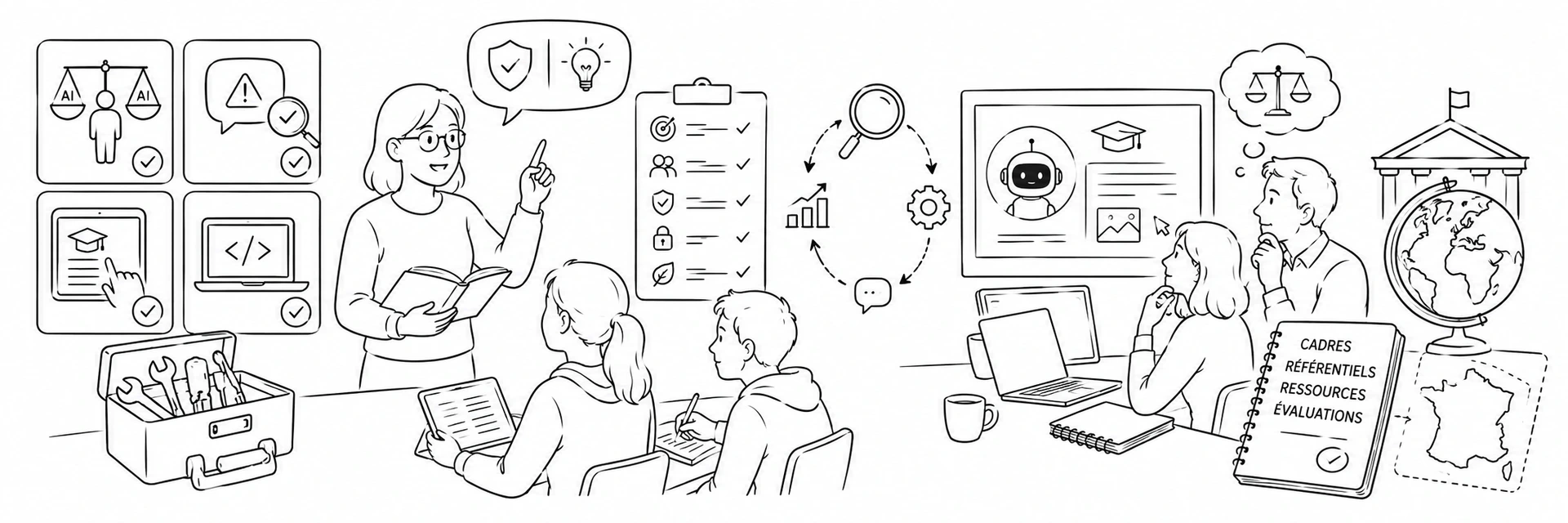
In March 2026, the Commission simultaneously published four sets of guidelines designed for teachers and educational teams, developed within the framework of the 2021-2027 action plan with the participation of teacher organisations: the ethical and responsible use of AI and data; the fight against misinformation and the strengthening of digital literacy; the informed choice of digital educational content; the teaching of computing. 5, 6, 7
The set proposes practical tools, directly usable class examples, and explicit quality criteria. The stated intention is to enable teachers to make informed decisions rather than to endure the technological offer. 5, 6, 7
4.2 The ethical use of AI and data
The first edition of these guidelines, in 2022, identified four foundational ethical considerations: human action (human agency), fairness, humanity, and justified choice. They aligned with the requirements of the European guidelines for trustworthy AI: human oversight, transparency, diversity and non-discrimination, societal and environmental well-being, privacy protection and data governance, technical robustness and security. 6, 7
The updated edition of 2026 — available in French — draws the consequences of two major developments. Firstly, the explosion in the use of generative AI by both teachers and students since these tools were made public. Secondly, the entry into force of the European regulation on artificial intelligence, which, along with the GDPR, forms a legal framework based on a classification of risks that institutions must take into account when introducing an AI tool. 6, 7
This classification deserves to be clarified, as it is rarely known by educational teams. The European regulation on artificial intelligence categorises among the systems high risk several central uses of the school: the systems used to decide on access or admission to an institution, those that assess students' achievements, those that help determine the level of teaching or guidance, and those that monitor or detect prohibited behaviours during exams. The regulation also prohibits the use of emotion recognition systems in educational institutions. 11
In other words, what European law considers to be the most dangerous is not the spectacular uses of generative AI, but the ordinary and administrative uses: grading, guiding, monitoring. It is precisely here that algorithmic bias produces lasting effects on trajectories — and thus, in the long term, on social health inequalities.
The new version provides guiding questions and concrete scenarios, an explanation of the legal context, an updated glossary and in-depth resources. It recommends an approach to internal examination that is collaborative and reflective, and a progressive introduction of tools, with constant monitoring of effects and the acknowledged possibility of going back when unintended consequences arise. 6, 7
The most transferable principle The "incremental introduction with the possibility of withdrawal" is a rare stance within technological policies, and directly applicable to the health and social field: we deploy small, we observe the real effects, we keep control to stop. It is, word for word, the logic of a process evaluation. |
4.3 Choosing digital educational content
The guidelines "Making informed choices on digital education content" very broadly define digital educational content: any pedagogical resource in digital format, from video to interactive quiz up to structured digital textbook, used for teaching, learning or assessment. 5
They are aimed at overloaded teams, and are designed modularly: one can enter the document through the useful section without reading it in full. Six key activities, presented as a cycle, describe what teachers actually do around these contents. 5
Notable point: generative AI is addressed not only as a risk, but as a means of producing suitable resources for a specific context. The underlying observation is that teachers struggle to find resources tailored to their situation and end up creating them themselves, at the cost of a considerable amount of time. 5
4.4 The assumed limit: curricula remain national
The guidelines explicitly state that they do not address the definition of programmes — what should be taught and how — which is solely the responsibility of the member states. 5
This legal reservation explains the form of the entire corpus: frameworks, references, resources, assessments — but no obligation. Europe acts here through measurement, reference and incentive. It is a soft governance, whose effectiveness will depend entirely on national uptake — and, in France, on the articulation with the reference framework for digital competences and existing systems.
V. Points of vigilance
A report that merely reproduces the corpus would miss the essential. Eight blind spots or tensions deserve to be raised.
5.1 The gap between ambition and reality
The basic skills of young Europeans are declining — in literacy, in mathematics, in sciences and in digital skills —, which the Skills Union explicitly recognises as a threat. 1
Thus, the level of requirement is raised at the precise moment when the base is crumbling. Adding AI literacy to an already fragile foundation will not yield anything good if the foundation is not consolidated. There is a risk of widening, not catching up.
5.2 Literacy ≠ usage: the risk of solutionism
The AILit framework itself makes the distinction. But nothing guarantees that it will survive its local translation. The predictable scenario is known: a European reference serves as a guarantee for a policy of equipment, the purchase of tools acts as a literacy policy, and success is measured by the number of licenses deployed.
The question to systematically ask of any project claiming the framework is: does it develop the student’s ability to do without the tool, to evaluate its outputs, to refuse to use it when it is relevant? If the answer is no, it is about equipment, not literacy.
This critique is not new. Evgeny Morozov named this reflex the technological solutionism: the tendency to reframe complex social problems as simple technical problems, because there is a technical solution to sell. 12 Applied to schools, the critique has been made in France by Philippe Bihouix and Karine Mauvilly, who question the cost — material, ecological, cognitive and attentional — of digital equipment whose pedagogical benefits remain unevenly demonstrated. 13
One may not share the radicality of these positions. However, invoking them remains necessary: a documentary file that relies only on institutional sources would reproduce the discourse it claims to analyse.
5.3 Equity, the blind spot of competency frameworks
The frameworks describe skills; they say almost nothing about the social conditions of their acquisition. However, the digital divide is no longer primarily a divide of access: it is a divide of usage and literacy. The students who are furthest away from writing are also those for whom the critical evaluation of generated content is the most difficult — and those who are most exposed to degraded informational environments.
The risk is therefore that educational AI primarily benefits those who needed it the least. This hypothesis, familiar in the field of health promotion under the name of the inverse care law, deserves to be stated as it is here.
5.4 The second-degree divide: imposed uses, chosen uses
The point deserves to be pushed further, as it conditions everything else. For the last fifteen years, the sociology of digital uses has established a distinction that competency frameworks ignore: what separates social environments is no longer access to equipment — smartphones are everywhere — but the nature of the usage that is made.
On one side, mainly imposed uses: passive consumption of content recommended by algorithms optimised for attention capture, continuous entertainment, exposure without adult mediation. On the other, chosen uses: production, experimentation, creation, family guidance, verbalisation of the rules. The difference is not one of intensity — screen time in popular environments is often higher — but of nature.
The AILit framework describes a progression from engagement to creation and then to design. Without a proactive policy, this progression risks exactly mirroring the social gradient: some will remain confined to the first domain, in the position of consumers; others will access the next three, in the position of authors. The European reference framework would then become, despite itself, a lens for understanding the inequalities it claims to reduce.
A question to ask of any local project Does this system allow students from the most digitally distant backgrounds to move from the status of user to that of producer — or does it merely teach them to consume better what is served to them? |
5.5 The great absent: well-being and health
This is the most striking lack in the gathered corpus. The documents on "skills" — Skills Union, AILit, PISA MAIL — address the subject from the perspective of cognitive and ethical capacities. Digital well-being, mental health, sleep, exposure to substandard content, online harassment, body norms conveyed by recommendation algorithms: all of this exists in European policies, but in other texts — the strategy for a better internet for children in particular — and it circulates only imperfectly towards educational frameworks.
The MAIL framework does indeed mention the risks to privacy and well-being, misinformation, and cyberbullying among the challenges of a media environment transformed by AI. But it treats them as a context, not as a standalone competency.
A risk, in particular, is completely absent from these cognitive frameworks: the one of the emotional relationship with AI systems. The conversational agents integrated into the platforms that adolescents are already using, and even more so the "virtual companions" designed to maintain a continuous relationship, do not only raise a question of information verification. They raise a question of attachment: constant availability, absence of judgment, absence of friction, absence of real otherness. For an isolated adolescent, substitution is tempting — and it is precisely what adolescence needs the least, at an age when the ability to endure conflict, boredom, disagreement, and solitude is being developed.
The scientific debate on the effects of screens and networks on the mental health of adolescents is open and lively. The work of Jonathan Haidt identifies a shift in the years 2010-2015, with a childhood progressively "experienced through screens" and massive effects on sleep, anxiety, and depression, particularly among girls. 14 His causal conclusions are contested by part of the scientific community, which highlights the weakness of effect sizes and the limitations of correlational data. It would be dishonest to make a definitive statement here. It would be just as dishonest not to point out that in France, the EnCLASS data document, over the recent period, a deterioration in the mental health and well-being of middle and high school students, more pronounced among girls, as well as a shortening of sleep time. 15
What can be asserted without forcing: these questions do not fall under any of the four areas of the AILit framework or any of the three axes of MAIL. A student can achieve an excellent score in the PISA 2029 assessment and still do very poorly.
The opening is there The separation between digital literacy (treated as a school skill) and youth health (treated as a prevention policy) is an administrative separation, not a lived reality. For a teenager, seeking information about their body, comparing themselves, being exposed to generated content, and managing their sleep are part of the same continuum of use. It is very exactly the working space of health promotion actors. |
5.6 Teachers: between the stacking of frameworks and real time
Four sets of guidelines, a framework of skills in AI, a reference framework for digital skills, a European regulation on AI, the GDPR, an upcoming international assessment. The intellectual coherence of the whole is real; its acceptability by a secondary school teacher, however, depends entirely on the mediation offered to them.
Teachers’ organizations, involved in the development, emphasize this point: for digitization and AI to support a quality education, they must empower professionals, not overload them. This is an evaluation criterion to remember.
5.7 The governance of school data
The establishments handle substantial volumes of personal data — students, parents, staff, suppliers. The amount of data required to train the systems, the automating nature of the algorithms, and the scalability of the applications raise major questions of protection and privacy. 6, 7
This point is addressed by the ethical guidelines. However, in practice, the negotiation takes place between an establishment and a supplier, with a considerable asymmetry of expertise. It is a matter of collective vigilance, not an individual affair of the head of establishment.
5.8 Two policies that ignore each other: the logic of skills and the logic of exposure
This may be the most revealing tension, and it becomes apparent as soon as one compares the European corpus with the French debate.
In April 2024, an expert commission set up by the President of the Republic — co-chaired by a neurologist and an addiction psychiatrist — submitted a report titled "Children and Screens: in search of lost time." After three months of hearings, the meeting of about one hundred and fifty young people and a review of the scientific literature, it formulates twenty-nine proposals. 19
Its most commented proposal organises a gradual takeover of the equipment: no exposure to screens before 3 years and use disrecommended until 6 years; no phone before 11 years; from 11 years, a phone without internet connection; from 13 years, a connected phone without access to social networks; from 15 years only, a limited access to ethically designed networks. 19, 20
Let’s put the two discourses side by side. Brussels says: these technologies are here, it is necessary to learn to understand them, to evaluate them and to shape them — it’s a logic of skills. Paris says: these technologies expose developing organisms, it is necessary to delay, frame and protect — it’s a logic of exposure, borrowed from environmental health.
The two logics are not contradictory. They are simply produced by institutions that are not reading each other. The European corpus does not mention the question of exposure; the French report does not mobilise either the AILit framework nor PISA. Each ignores the other, and the school finds itself having to hold both ends without a framework for articulation.
A point of support does exist on the French side, and it should be known to all those who deploy educational digital tools: the commission recommends systematically associating the deployment of programmes and digital resources in the school environment with an experiment, a prior impact study and training for teachers before any wide dissemination. 19
The articulation to be built The European corpus says how to teach AI. The French report says under what health conditions to introduce screens. Neither says what happens when a 12-year-old child, to whom a connected phone has not been recommended, uses a conversational agent every evening for their homework, to reassure themselves, or to look for information about their body. This blind spot is, very exactly, the terrain of health promotion. |
VI. What this changes for health prevention and promotion
6.1 An under-exploited convergence: digital literacy and health literacy
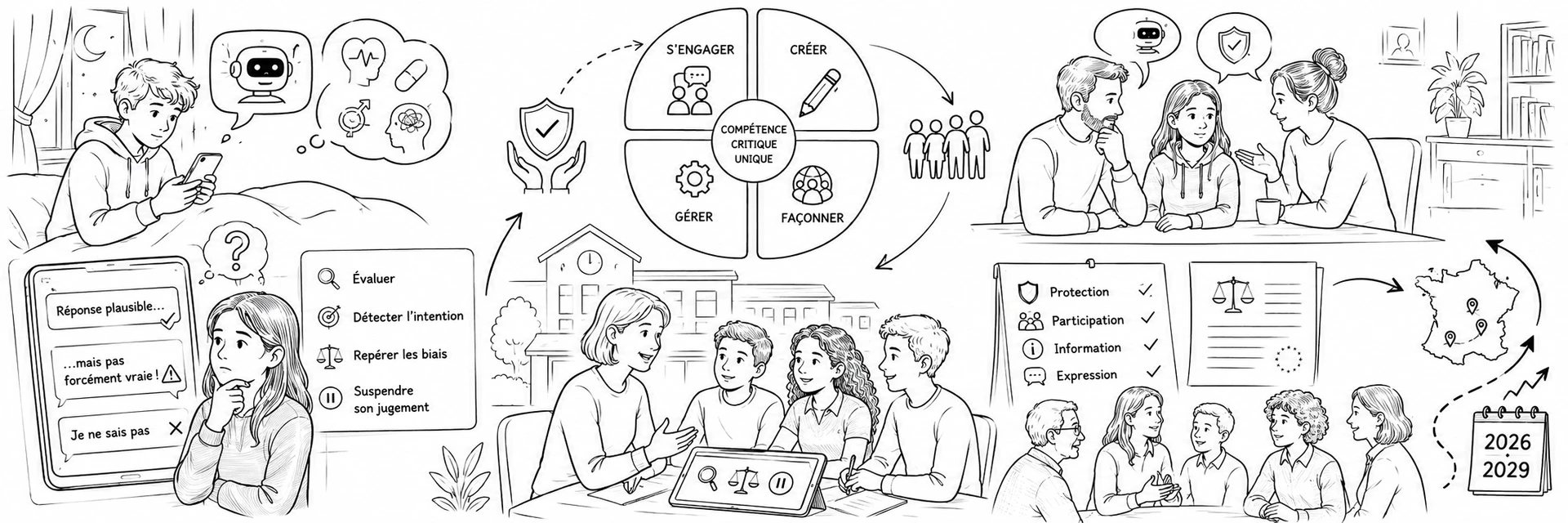
Assessing the credibility of a source, identifying a persuasive intent, detecting a bias, understanding that content has been produced to capture attention rather than to inform, knowing when to suspend judgment: these are the skills described by the MAIL framework. They are also, word for word, the skills that health literacy seeks to develop in response to health information.
There are not two distinct literacies that should be articulated afterwards: there is a unique critical competence, applied to different objects. The European corpus provides this intuition with what it lacked — an institutional framing, a reference framework, and soon international comparative data.
6.2 AI, a new mediation of health information among teenagers
The starting figure merits being re-read from our field: two teenagers out of three already use AI. They also use it for what concerns them — the body, nutrition, sexuality, well-being, and relationships. Conversational agents have become, without any policy deciding it, a gateway to health information, available at any time, without apparent judgment, and without any of the safeguards we have patiently built for health information.
Three operational consequences:
Education on health information can no longer afford to ignore work on generative systems: how they produce a plausible rather than true response, why they never say “I don’t know,” what they do with what is entrusted to them.
Les professionnels de prévention doivent être formés eux-mêmes — la posture de l’adulte qui ignore ce que les jeunes utilisent quotidiennement est intenable, et disqualifiante.
Les ressources de prévention doivent être pensées pour un environnement où elles seront reformulées, résumées et parfois déformées par un intermédiaire algorithmique.
Le point aveugle : la réponse plausible Un système génératif ne restitue pas une information : il produit l’enchaînement de mots le plus probable. Il peut donc énoncer, avec la même assurance tranquille, une posologie erronée, une contre-indication inventée, un délai de contraception d’urgence faux, une réassurance rassurante face à des idées suicidaires, ou un conseil nutritionnel qui reprend la logique d’un régime restrictif. Il ne dit presque jamais « je ne sais pas ». Pour un adolescent, cette assurance est indiscernable d’une compétence. C’est exactement le point où la littératie de l’IA et la littératie en santé se rejoignent : savoir qu’une réponse fluide, structurée et polie n’est pas, en soi, une réponse vraie. |
6.3 L’école comme milieu, et non comme canal
Le corpus européen raisonne en termes de compétences à transmettre. La tradition de la promotion de la santé raisonne en termes de milieux à transformer. Les deux approches ne s’opposent pas, mais la seconde manque au premier.
A school that deploys AI tools without working on its school climate, without involving students in decisions that concern them, without questioning what digitisation does to time, attention and relationships, will perfectly apply the AILit framework while missing the essential. The approach of a “health-promoting school” — global, participative, attentive to the environment — offers the complement that these frameworks need.
6.4 Digital parenting and educational community
The European corpus is a school corpus: it speaks to teachers, to headteachers, to programme designers. This is its coherence, and this is its limit. For two-thirds of adolescents who already use AI do not primarily use it in class: they use it in the evening, in their room, on their phone, without mediation.
A literacy policy that would stop at the school gates would therefore leave out of scope the main place of use. Three consequences:
Parents are the first educational community concerned — and the most deprived. Many discover their children's uses with a time lag, and most of the resources offered to them oscillate between alarmism and technical control (filters, screen time), without ever equipping the conversation.
The AILit framework explicitly includes parents and relatives among its audiences, alongside teachers, educational leaders, decision-makers and training designers. It is an underutilised entry point: there exists a free, translated and legitimate support to build actions to support digital parenting.
A legal anchor exists elsewhere: the guidelines of the Council of Europe on children's rights in the digital environment affirm the right of children to protection, but also — and this is what is most often forgotten — their right to participation, information and expression. This text establishes the legitimacy of an approach that involves young people in decisions affecting them, rather than treating them as objects of protection. 16
The French report is in the same vein and states it plainly: it calls for the deployment of a genuine policy of assistance and support to parenting regarding screens and the digital world. 19 The recommendation therefore exists, and it is public. It awaits operators. Health promotion actors are, in this area, better placed than the school institution: they are used to reaching out to families, working without judgment, and holding together the register of protection and that of the power to act.
6.5 Action points
Translate the quadriptych AILit (engage / create / manage / shape) into a grid usable by prevention stakeholders, applied o health information.
Train the professionals of prevention and health promotion in AI literacy — not as a technical skill, but as a critical skill.
Co-construct with young people rather than prescribe: European frameworks describe what students should know; they say little about what young people already know, their actual uses and their own verification strategies. This is an inquiry o be conducted.
Relying on the guidelines "disinformation" and "AI ethics" as continuous training supports, including outside of school — they are free, translated, and designed for non-specialists.
Bringing, in the consultation bodies, the absent question: where is the well-being of students addressed in the digital transformation of school?
Building, locally, the articulation that is missing at the national level: intersecting the European logic of skills and the French logic of exposure, within the same establishment project or the same territorial programme.
Opening a digital parenting section: equipping the family conversation on AI rather than just controlling screen time, relying on the "parents" section of the AILit framework.
Investing in the 2026-2029 window. Curricula will change under the influence of PISA. Stakeholders in school health and health promotion have three years to make themselves indispensable in this discussion.
Conclusion
The gathered corpus tells a coherent story: Europe has understood that educational technology cannot be resolved by equipment alone, and it has equipped itself, in five years, with a complete set — a strategy, a framework, a measure, a toolkit. This is considerable, and generally well done.
But this story is told in a language — that of competitiveness, skills and technological sovereignty — which leaves in the shadows what, for our audiences, constitutes the heart of the problem: what screens and generative systems do to health, sleep, self-esteem and relationships of teenagers, and what they do, differently, according to social origin.
The challenge, for those involved in health prevention and promotion, is therefore not to comment on these frameworks from the outside. It is to enter them, to use their institutional legitimacy, and to introduce what they lack. The window is open until 2029.
The Audio Capsules of Practices in Health -
- Version 2 minutes - https://www.youtube.com/watch?v=0dE4rLI1yX8
- Version 7 minutes - https://www.youtube.com/watch?v=WOofs33HKQw
References
The numbers in brackets refer to the footnote calls in the text.
[1] European Commission, The Union of Skills, communication COM(2025) 90 final, 5 March 2025.
https://eur-lex.europa.eu/legal-content/EN/TXT/HTML/?uri=CELEX:52025DC0090
[2] European Commission & OECD, Empowering Learners for the Age of AI — An AI Literacy Framework for Primary and Secondary Education (AILit framework), final version, June 2026.
https://ailiteracyframework.org/pdfs/framework_pdf/AILF_en.pdf — framework site : https://ailiteracyframework.org/
[3] OECD, PISA 2029 Media and Artificial Intelligence Literacy (MAIL) — project presentation page.
https://www.oecd.org/en/about/projects/pisa-2029-media-and-artificial-intelligence-literacy.html
[4] OECD, Navigating an Evolving Digital World — PISA 2029 MAIL Assessment Framework, First Draft.
[5] European Commission, DG Education, Youth, Sport and Culture, Making informed choices on digital education content — EU guidelines for teachers and educators, updated edition 2026.
https://op.europa.eu/en/publication-detail/-/publication/c6f8de23-63a8-11f1-9b18-01aa75ed71a1/
[6] European Commission, Guidelines on the ethical use of artificial intelligence and data in teaching and learning for educators, updated edition 2026 (1st edition: 2022).
https://op.europa.eu/en/publication-detail/-/publication/f692aa0b-17a7-11f1-8870-01aa75ed71a1/
[7] European Commission, Guidelines on the ethical use of artificial intelligence and data in teaching and learning — presentation page (European Education Area).
[8] European Commission, Digital Education Action Plan (2021-2027): policy background — digital education action plan, COM(2020) 624 final.
https://education.ec.europa.eu/focus-topics/digital-education/actions/plan
[9] European Commission, A Europe fit for the digital age — Empowering people with a new generation of technologies.
https://commission.europa.eu/strategy-and-policy/priorities-2019-2024/europe-fit-digital-age_en
[10] European Commission, Digital Compass 2030: the European way of the digital decade — action programme for the digital decade.
https://digital-strategy.ec.europa.eu/fr/policies/digital-decade-policy-programme
[11] European Parliament and the Council of the European Union, Regulation (EU) 2024/1689 of 13 June 2024 establishing harmonised rules concerning artificial intelligence (regulation on artificial intelligence).
https://eur-lex.europa.eu/legal-content/FR/TXT/HTML/?uri=CELEX:32024R1689
[12] MOROZOV Evgeny, To Solve Everything, Click Here — The Aberration of Technological Solutionism, FYP editions, 2014 (original ed.: To Save Everything, Click Here, 2013).
Work — not available online
[13] BIHOUIX Philippe, MAUVILLY Karine, The Disaster of the Digital School — A Plea for a School Without Screens, Seuil, 2016.
Work — not available online
[14] HAIDT Jonathan, The Anxious Generation, Penguin Press, 2024 (fr. trans.: Anxious Generation, Les Arènes, 2024). A reference work in the public debate, whose causal conclusions are the subject of documented scientific controversies.
Work — not available online
[15] Public Health France, OFDT, EHESP, Inserm — EnCLASS Survey (National Survey in Colleges and High Schools among Adolescents on Health and Substances): mental health, well-being, sleep of middle and high school students.
https://enclass.fr/resultats-enquetes/ — https://www.santepubliquefrance.fr/etudes-et-enquetes/enquete-enclass
[16] Council of Europe, Recommendation CM/Rec(2018)7 of the Committee of Ministers to Member States on guidelines regarding the respect, protection and realisation of children's rights in the digital environment, adopted on 4 July 2018.
https://www.coe.int/fr/web/children/the-digital-environment
[17] UNESCO, AI competency framework for students, 2024 — 12 competencies, 4 dimensions, 3 levels of progression.
https://unesdoc.unesco.org/ark:/48223/pf0000391105 — presentation : https://www.unesco.org/en/articles/ai-competency-framework-students
[18] UNESCO, AI competency framework for teachers (AI competency framework for teachers), 2024 — 15 competencies, 5 dimensions, 3 levels of progression.
https://unesdoc.unesco.org/ark:/48223/pf0000391104 — summary in French : https://www.unesco.org/fr/articles/ce-quil-faut-savoir-sur-les-nouveaux-referentiels-de-competences-en-ia-de-lunesco-pour-les-eleves-et
[19] Commission of experts on children's exposure to screens, Children and screens: in search of lost time, report submitted to the President of the Republic, April 2024 (29 proposals).
https://www.elysee.fr/admin/upload/default/0001/16/fbec6abe9d9cc1bff3043d87b9f7951e62779b09.pdf
[20] French government, "No screens before three years" — summary of recommendations by age from the report of the commission of experts.
https://www.info.gouv.fr/actualite/pas-decran-avant-trois-ans
[21] AILit Framework, "Shaping future success: the AI mastery framework and the MAIL assessment of PISA 2029" — summary article on the complementarity of the two frameworks.
https://ailiteracyframework.org/blog/shaping-future-success-ai-literacy-framework-pisa-2029/
Glossary
AILit (framework) — Framework for artificial intelligence literacy for primary and secondary education, co-produced by the European Commission and the OECD; four areas, nineteen competencies.
Basic digital skills — According to the digital compass 2030, the minimum skills threshold expected of 80% of the population aged 16 to 74 by 2030.
Digital educational content (DEC) — Any educational resource in digital format — video, interactive quiz, digital textbook — used for teaching, learning or assessment.
Innovative area (PISA) — Domain of interdisciplinary assessment added to each PISA cycle since 2012, alongside the major domains (reading, mathematics, science).
AI Literacy — Set of knowledge, skills and attitudes enabling one to understand how AI systems work, to critically assess their outputs and to use them in an ethical and creative manner. To be distinguished from the use of AI tools.
MAIL — Media and Artificial Intelligence Literacy — innovative domain of the PISA 2029 cycle.
European regulation on AI — Legal framework based on a risk classification; applies to AI tools introduced in educational settings, in conjunction with the GDPR.
Second-degree fracture — Social gap not concerning access to equipment — now almost universal — but regarding the nature of usage: passive consumption of recommended content on one side, structured production and creation on the other.
Hallucination (generative AI) — Production of a false but formally plausible statement by a generative system, which returns the most probable sequence of words and not verified information.
High-risk system (AI regulation) — Legal category that encompasses, in the educational field, systems for admission, assessment of learning outcomes, guidance and monitoring of exams; the recognition of emotions in educational settings is prohibited.
Technoférence — Interference of screens in the relationship between the adult and the child: use of the phone by the parent or the professional in the presence of the young child, which alters the quantity and quality of interactions.
Union of skills — Framework strategy of the European Commission (March 2025) placing digital literacy among the basic skills, alongside literacy, mathematics and science.