🚨 🚨 Your data is going into the national study — and the right to object no longer applies
🔍💡 Costs of home care: a decree from August 2026 creates the data processing that feeds the first major national survey of home care costs — and redefines what you need to tell the individuals supported about their rights. 📊 Voluntary participation of services, but the right to object is excluded: to be integrated now into your GDPR notices.
📌 This decree is the legal basis that authorises the national cost study taking place in 2026 in the autonomy support services: it precisely defines what data will be collected on the individuals supported, the interveners, and the structures, who has access to it, and how long it is retained. For any structure likely to participate, it sets two concrete and immediate obligations: to inform the individuals supported of their rights — and to clearly state that the right to object does not apply — and to specifically authorise the staff responsible for data entry. It is also the instrument that will produce, for the first time in over ten years, objective data on the actual cost of home support: the raw material for future pricing decisions.
Source :📒 Survey on home care costs: what the August 2026 decree creates
✍️ 11 August 2026, published in the Official Journal no. 0188 of 13 August 2026, text no. 16 of 83. NOR: SFHA2618542D. CNIL opinion of 28 May 2026.
Decree No. 2026-769 of 11 August 2026 establishing the creation of a personal data processing aimed at conducting a study related to the costs of the assistance and support activities of the home autonomy services mentioned in Article L. 313-1-3 of the Social Action and Families Code.📜🔗LIEN vers la source
1️⃣ ANALYTICAL SUMMARY
Context and issues — the home is coming out of the statistical blind spot. The home sector has long been poorly documented regarding its actual costs, unlike establishments. Following the reform creating home autonomy services (SAD, Decree No. 2023-608 of 13 July 2023, merger SAAD/SSIAD/SPASAD) and the 'Well Ageing' law of 8 April 2024, an experiment with new funding models did not gather enough willing departments; a large-scale cost survey took over (source: CNSA). Decree 2026-769 constitutes the legal basis: it creates the personal data processing allowing this study. The concerned audiences are the SAD, their staff, and the individuals supported — elderly people losing autonomy, disabled people, people with chronic pathologies.
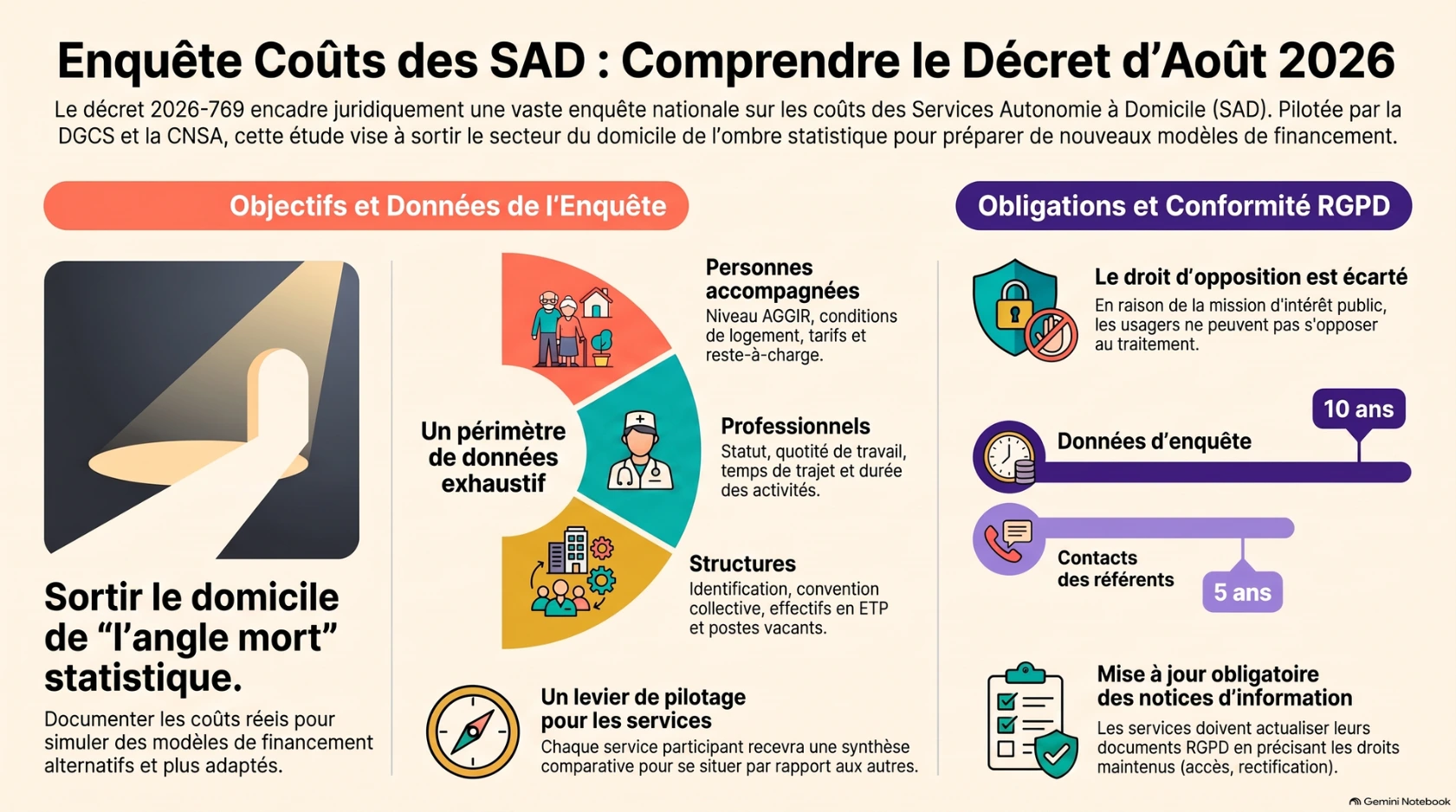
Operational contributions — a complete GDPR framework, not a field tool. The decree sets the objectives (national overview of costs, simulation of alternative funding models, comparative feedback to participating services, support for public policies — Art. 1). It details the categories of data on the individuals supported, the professionals, and the structures, as well as the reuse of the "Performance Dashboard in the medico-social sector" (Art. 2). It organizes access and pseudonymisation (Art. 3), retention periods — ten years, five years, one year depending on the data (Art. 4) — and the rights of individuals, of which the right to object is excluded (Art. 5). It does not provide any practical support (collection framework, FALC notice, calendar): these are the responsibility of the study operator.
2️⃣ KEY POINTS OF THE DOCUMENT
1️⃣ A dual-headed process, for a public interest mission. The process is under the joint responsibility of the DGCS and the CNSA, based on e of 1 of article 6 and i of 2 of article 9 of the GDPR. Four objectives are assigned to the survey (Art. 1).
2️⃣ Two combined data sources. The study is based on a survey of a sample of voluntary SADs, over a period set by the data controllers, and on the reuse of the data from the "Performance Dashboard in the medico-social sector" (decree n° 2022-1496 of 30 November 2022) (Art. 1 II).
3️⃣ A broad and detailed data scope. Three categories are targeted (Art. 2): the individuals supported (including assessed loss of autonomy, AGGIR level, housing conditions, rates, out-of-pocket expenses), the professionals (status, share, duration of activities, journeys; contact details of survey referents), and the structures (identification, collective agreement, full-time equivalent staff, vacant positions), to which are added the data from the dashboard.
4️⃣ Controlled access and a return to the services. Named authorisations, pseudonymisation, exclusion of internal identification codes; successive recipients: CNSA and DGCS, then DSS and DREES solely for the purpose of supporting public policies (Art. 3). The participating services receive summary documents allowing them to position themselves in relation to others (Art. 3 IV).
5️⃣ Long-term retention and partially open rights. Retention of ten years (five years for the contact details of the referring professionals, one year for technical traceability) — Art. 4. The rights of access, rectification and limitation are maintained, exercisable with the service, but the right to object is excluded (art. 23 GDPR and art. 56 of the 1978 law) — Art. 5.
3️⃣ ACTION TRACKS FOR LOCAL ACTORS
1️⃣ Check your inclusion in the sample and frame the workload. Identify whether the service is among the structures selected for the national cost study and anticipate the collection periods (activity data in cuts, then analytical accounting). The decree establishes the principle (Art. 1 II); the operational calendar is the responsibility of the operator (ATIH) — to be confirmed with the CNSA.
2️⃣ Update the GDPR information notice for the individuals supported. Explicitly integrate the fact that the right to object does not apply, and remind of the rights that remain (access, rectification, limitation), exercisable with the service to which the person belongs (Art. 5). The information must also refer to the DGCS and CNSA websites.
3️⃣ Authorize and track. Specifically designate the staff responsible for the sole recording of data concerning their service, and document these authorizations (Art. 3 I 1°); verify the compliance of any subcontractors (Art. 28 GDPR, exclusion of internal codes) — Art. 3 I 2°.
4️⃣ Ensure the reliability of the collection of heavy data. Organize in advance the production of staffing data (occupied positions, absentees, vacancies, FTE), journeys and out-of-pocket expenses, which require demanding collection (Art. 2). An internal control point avoids incomplete data that would weaken the restitution.
5️⃣ Use comparative restitution as a management lever. The summary documents provided to the participating services (Art. 3 IV) allow for positioning and can support a management dialogue with the funder or better-argued requests for revaluation.
6️⃣ Fill in the gaps of the text internally. The decree does not provide either a collection framework, or FALC information support for users, or a detailed timetable. Necessary adaptation: to create or take over an accessible information support intended for the people being supported and their legal representatives (legal protection measures referred to in the text).
4️⃣ ADDITIONAL REFERENCES
- CNSA — National study of the costs of home autonomy services 2026 (presentation, method, timetable). Direct operational counterpart of the decree. 🔗 https://www.cnsa.fr/appels-projets/etude-nationale-de-couts-des-services-autonomie-domicile-2026 (verified)
- ATIH — ENC SAD (technical operator of the national cost study, scope L. 313-1-3, data 2026). 🔗 https://www.atih.sante.fr/enc-sad (verified)
- ILEX Training & Consulting — D. Dupré-Lévêque, "Costs of home autonomy services: what changes with decree no. 2026-769" (19/08/2026). Sectoral analysis of the same decree, aimed at structure management. 🔗 https://ilexfc.com/article/93 (verified)
- Costs of home autonomy services: what changes with decree no. 2026-769 - https://ilexfc.com/article/93
5️⃣ FREQUENTLY ASKED QUESTIONS (FAQ)
1️⃣ Who is responsible for this data processing? The DGCS and the CNSA, jointly responsible in the context of a public interest mission (Art. 1 I)., dans le cadre d'une mission d'intérêt public (Art. 1 I).
2️⃣ Is our service obliged to participate in the survey? No: the survey is conducted with a sample of voluntary services (Art. 1 II). The reuse of data from the "Performance Dashboard" falls under a distinct pre-existing framework (decree of 2022).
3️⃣ What data is collected on the individuals supported? In particular: internal identifier, year of birth, gender, municipality; loss of autonomy and level AGGIR; complexity factors; housing conditions; benefits and aids received; duration of care; rates and out-of-pocket expenses (Art. 2 1°).
4️⃣ Does the right to object apply? What rights remain open? The right to object does not apply (Art. 5 III). The rights of access, rectification and limitation of processing remain exercisable with the service (Art. 5 II).
5️⃣ How long are the data retained? Ten years maximum in principle; five years for the contact details of the referring professionals; one year for technical traceability data (Art. 4).
6️⃣ Who can access the data, and what does the service receive in return? Authorized and pseudonymised access for the CNSA and the DGCS, then the DSS and the DREES for support to public policies (Art. 3 I to III). The participating service receives comparative summary documents (Art. 3 IV).
7️⃣ What will the study concretely be used for? To establish a national overview of costs, simulate alternative funding models, provide the services with a comparison, and support public policies for home autonomy (Art. 1 II) — thus preparing for future pricing developments.
6️⃣ REWRITING IN EASY TO READ AND UNDERSTAND (FALC)
What is this text about?
- It is an official decision of the State. This is called a decree.
- The decree authorises a large study on the cost of home care.
- Home care helps elderly or disabled people live in their own homes.
- These services are called SAD : home autonomy services.
What the decree does
- It allows for collecting information.
- We collect information about the people receiving help.
- We also collect information about the professionals and the services.
- The aim is to know how much home care costs.
- Two State bodies are leading this work: the DGCS and the CNSA.
How the study is conducted
- Services agree to participate. It is a free choice.
- We also use data that has already been collected before.
- Participating services receive a report to compare themselves to others.
Your data and your rights
- Your data is protected. Your name is hidden: this is pseudonymisation.
- You can view your data.
- You can correct your data.
- You can request to limit their use.
- Attention : you cannot refuse that your data be used for this study.
- For your rights, contact your home help service.
- Data is kept for up to ten years.
7️⃣ CROSS-SECTIONAL ANALYSIS — VALUES OF HEALTH PRACTICES
- Literacy : low. The decree imposes information for individuals (Art. 5) but provides no suitable support ; readability relies entirely on the services.
- Empowerment : limited and indirect. The services involved are equipped to position themselves (Art. 3 IV) ; no empowerment of the supported individuals is provided for in the text.
- Participation : voluntary participation of the services (Art. 1 II). The study was designed in consultation with the sector federations (source CNSA), but the decree describes no co-construction with users.
- Community health : absent. National, statistical and tariff logic; no territorial collective dimension in the text.
- Ethics : safeguards are in place (pseudonymisation, authorisations, minimisation by exclusion of internal codes). The representativeness of the voluntary sample is not addressed in the decree — limit raised by the ILEX commentary.
- Human rights : GDPR rights partially preserved (access, rectification, limitation), right of opposition excluded (Art. 5 III). Equity of access is not thematised. Point to be explicitly noted.
- Intersectorality : present at the institutional level — DGCS, CNSA, DSS, DREES, operator ATIH (Art. 3) ; articulation of aid/care in the background (SAD reform).
- Partnership : formalised at the top (joint responsibility DGCS/CNSA, Art. 1 ; subcontracting framed, Art. 3 I 2°). No model of field collaboration is described.
- Fight against discrimination : not addressed ; the text mentions neither anti-discrimination measures, nor non-judgment, nor diversity — this is not its purpose.
8️⃣ EVALUATION OF THE RELIABILITY OF THE RESOURCE
Scientific relevance. Official primary source : text authenticated in the JORF, available on Legifrance, dated, signed, in force, preceded by the CNIL opinion of 28 May 2026. Maximum legal reliability. Important reservation : this decree does not produce data or results — it only creates the legal framework for processing. Cost results will come from the national cost study (ENC SAD) conducted by the ATIH ; not to be confused. Note : a comparable, more limited study was conducted in 2011-2013 (source CNSA), which nuances the qualification of “first” national study used by some press comments.
Operational relevance. Direct for the directions and compliance functions of home services (participation, authorisations, information for users, preservation). Low and indirect for the actors of prevention and health promotion in the field sense: no practical tool, no clinical or educational content. The gap between the legal nature of the text and a use of "health promotion" is real and acknowledged in this analysis.
9️⃣ STRATEGIC HASHTAGS
#HomeCareAutonomy #HCA #GDPR #HomeAutonomy #MedicoSocialFunding #HomeShift #HealthData #healthpractices
This article was developed in accordance with the Charter
of the use of artificial intelligence of Health Practices.
Click on the image