
🚨 Decree of 1 August: what really changes for your training organisation
🔍 Qualiopi evolves: Decree No. 2026-728 brings the national quality reference framework to 33 indicators, applicable from 1 November 2026. 📌 Any structure that provides training and aims for public funding is concerned — compliance to be anticipated, particularly regarding violence, discrimination, and disability.
📌 This decree sets the reference framework that any structure delivering training — including in health, social, and medico-social sectors — must comply with to access public or pooled funds. From 1 November 2026, Qualiopi audits will rely on these 33 indicators. The practical use: mapping gaps, updating evidence and communication, securing the next audit. The reinforced requirements — violence, discrimination, disability, minor apprentices — directly intersect with issues of prevention and inclusion
Source :📒 Decree No. 2026-728 of 1 August 2026 updates the national Qualiopi reference framework.
✍️ Ministry of Labour and Solidarity / Prime Minister — published in the Official Journal of the French Republic (JORF No. 0180 of 4 August 2026, text No. 11). NOR: TRSD2619632D
Decree No. 2026-728 of 1 August 2026 concerning the national reference framework on the quality of actions contributing to the development of skills. It comes into force on 1 November 2026📜🔗LIEN vers la source
1️⃣ ANALYTICAL SUMMARY
An updated regulatory framework, not a complete overhaul
The national quality reference framework (RNQ) is the regulatory basis for the Qualiopi certification, mandatory since 2022 for any provider — training organisation, CFA, skills assessment centre, VAE operator — seeking public or pooled funds. Unchanged since the founding decree n° 2019-565 of 6 June 2019, the text is here replaced in the regulatory annex of article R. 6316-1 of the labour code. The seven criteria are maintained; the number of indicators increases from 32 to 33. Target audiences: providers, funders, certifying bodies and labelling bodies. Comes into effect on 1 November 2026, for any audit conducted from that date.
A targeted strengthening of requirements
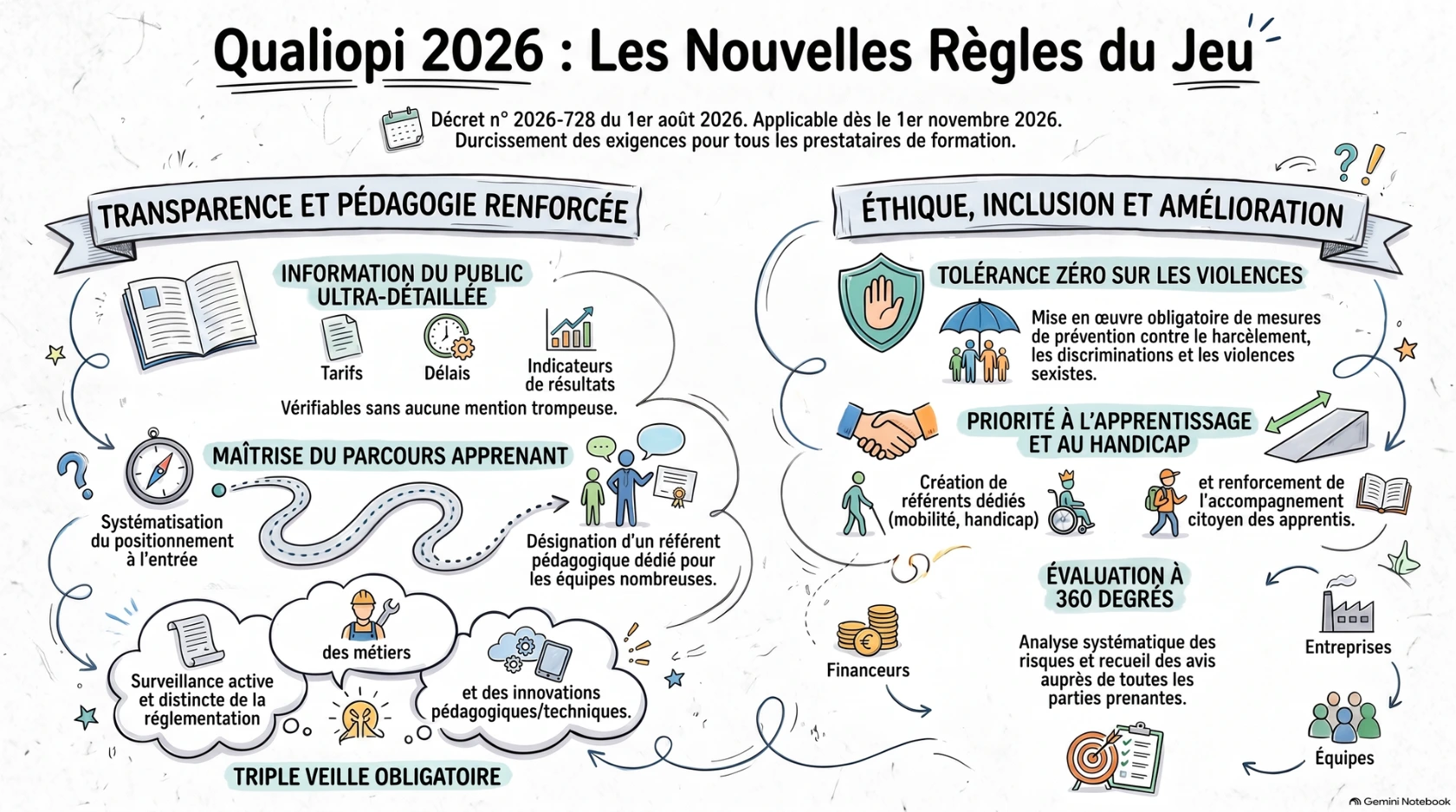
The decree specifies and tightens several indicators rather than upsetting the architecture. It enhances the transparency of information to the public (indicators 1 and 2), the definition of objectives and the evaluation at entry (5 and 8), the prevention and treatment of violence — including sexist and sexual violence —, harassment and discrimination (12, 14, 15), the consideration of handicap (20 and 26) and continuous improvement linked to a risk analysis (32). It creates an indicator 33, specific to CFAs, on the evaluation of teachings by the learners. The audit interpretation — expected level, evidence — falls under the reading guide, of which version 10 has not yet been published.
2️⃣ KEY POINTS OF THE DOCUMENT
1️⃣ Seven unchanged criteria, 33 indicators instead of 32, applicable from 1 November 2026 for any initial, monitoring or renewal audit (criterion 1, p. 1; article 2, p. 4).
2️⃣ An indicator 33 is created, specific to training through apprenticeship (CFA): evaluation of content and teaching by learners, distinct from the general satisfaction survey, with sharing of results with the educational teams and a continuous improvement process whose effectiveness is measured periodically (p. 4).
3️⃣ The prevention and treatment of violence, including sexist and sexual violence, harassment and discrimination are integrated into the monitoring of beneficiaries (indicator 12) and reinforced in apprenticeship — immediate processing procedure and information for apprentices, with enhanced measures for minors (indicators 14 and 15, p. 2).
4️⃣ Public information must be accessible, detailed, verifiable and without misleading statements, with accessibility for people with disabilities (indicator 1); the result indicators must specify their calculation methods (indicator 2, p. 1).
5️⃣ Disability and continuous improvement are consolidated: disability referent and governance (indicator 20), mobilization of expertise and networks for people with disabilities (indicator 26), risk analysis on the quality of training (indicator 32) (p. 3-4).
This decree no. 2026-728 of 1 August 2026 updates the national Qualiopi reference framework. It comes into effect on 1 November 2026. Here are the main changes and enhancements for training organisations :
1. Public information (Criterion 1)
- Requirement for accessible and verifiable information : prerequisites, objectives, type of recognition, duration, pedagogical and funding methods, access times, fees, methods, evaluation methods, and now explicitly accessibility for people with disabilities.
- Strengthened prohibition of any mention likely to mislead the public (on access conditions, content, funding, rights to continue studies).
- Outcome indicators : requirement to publish indicators adapted to the nature of the services and the audiences, with transparency on the calculation methods.
- Specific certification : information on pass rates, validation of skill blocks, equivalences, pathways, course continuations and job prospects.
2. Design of services (Criterion 2)
- Needs analysis in connection with the company and/or the funder.
- Strengthened positioning : procedures for positioning and assessing prior learning at the start of the service.
- Specific certification : alignment of content with the requirements of the targeted certification and the ability to ensure it (including as an accredited organisation).
3. Delivery of the service (Criterion 3) — Significant reinforcements
- Violence, harassment and discrimination : the provider must describe and implement measures for the prevention and management of situations of violence (including sexist and sexual violence), harassment or discrimination.
Learning : numerous specific obligations :
- Anticipation of missions with the learner and coordination between centre/company.
- Socio-professional support, education and citizenship.
- Immediate processing procedure for disruptions related to difficulties, violence or discrimination.
- Enhanced information for apprentices about their rights, health/safety, reporting systems, the contact details of the apprenticeship mediator, and the obligation to report malfunctions to the labour inspectorate.
- Compliance with the formal requirements of the certification authority for the presentation of beneficiaries.
4. Educational and technical resources (Criterion 4)
- Educational referent : obligation of an educational referent per training when the number of participants exceeds a threshold set by decree, responsible for ensuring coordination between participants.
- Distance modules : verification of the effectiveness of follow-up by learners.
- Specific learning : staff dedicated to national and international mobility, disability referent, advisory board, governance involving apprentices, trainers and companies. If the proportion of hours provided by permanent staff is below a threshold: enhanced pedagogical supervision.
5. Skills of the stakeholders (Criterion 5)
- Determination, mobilisation and evaluation of the skills of the stakeholders (internal and external).
- Maintenance and development of employee skills.
6. Monitoring and innovation (Criterion 6)
- Three mandatory and distinct monitoring activities : legal/regulatory monitoring, monitoring of the evolution of skills/jobs/employment, monitoring of pedagogical and technological innovations.
- Disability : mobilisation of expertise, tools and networks to welcome, support or guide people with disabilities.
- Subcontracting and wage portage : obligation to ensure compliance with the reference framework and traceability in contracts.
- Periods in work situations : mobilisation of the network to co-construct training engineering and promote welcoming in companies.
7. Collection of feedback (Criterion 7)
- Wider stakeholders : beneficiaries, funders, teaching teams and companies.
- Continuous improvement : structured approach based on feedback, complaints, and a risk analysis on the quality of training.
- Specific to learning : dispositif d'évaluation des contenus et enseignements par les apprenants, distinct du simple recueil de satisfaction, avec partage des résultats avec les équipes pédagogiques et mesure périodique de l'efficacité.
En résumé, cette révision renforce particulièrement :
- La prévention des violences et discriminations en formation,
- Les obligations spécifiques à l'apprentissage (médiateur, inspection du travail, gouvernance),
- L'accessibilité des publics handicapés,
- La transparence sur les résultats et les certifications,
- La traçabilité de la sous-traitance,
- L'analyse des risques dans la démarche qualité.
3️⃣ ACTION POINTS FOR LOCAL ACTORS
1️⃣ Conduct a review indicator by indicator to isolate the six to seven indicators that have actually changed and measure the gap with the evidence already in place, without redoing the entire documentary system (criteria 1, 2, 3 and 6, p. 1-3).
2️⃣ Update public communication (website, catalogue, quotes): prerequisites, outcomes, funding methods, accessibility for people with disabilities, by removing any formulation that could be misleading (indicator 1, p. 1).
3️⃣ Formalise or update the reporting and immediate handling procedure for situations of violence, harassment and discrimination, and verify that the interlocutors and systems are made known to the beneficiaries (indicators 12, 14 and 15, p. 2).
4️⃣ For the CFA: build the evaluation system for the teaching by the learners, distinct from the satisfaction survey, with feedback to the teaching teams and a loop of improvement (indicator 33, p. 4).
5️⃣ Consolidate the disability aspect: specify the role of the referent, trace the mobilization of networks and expertise, document the proposed adaptations (indicators 20 and 26, p. 3).
6️⃣ Integrate a quality risk analysis into the continuous improvement approach and plan for compliance before the first audit after 1st November 2026 (indicator 32, p. 4).
Unmet need: the decree sets the requirements but not the expected level or the acceptable evidence, which depend on the reading guide (V10 expected, not published to date). Plan for an update as soon as it is published.
4️⃣ ADDITIONAL REFERENCES
External references
1. Légifrance — full text of decree no. 2026-728 (primary source, 2026) : https://www.legifrance.gouv.fr/jorf/id/JORFTEXT000054608509
2. Ministry of Labour and Solidarity — page "National quality reference | Qualiopi reading guide" (reference page kept up to date; to be monitored for V10) : https://travail-emploi.gouv.fr/referentiel-national-qualite-guide-de-lecture-qualiopi
3. Reading guide of the RNQ, version 9 of 8 January 2024 : latest official version of the expected level and examples of evidence, applicable up to V10; accessible in PDF from the page of the ministry above. Note: dated January 2024 (and not " after 2024" in the strict sense), but remains the current methodological reference.
5️⃣ FREQUENTLY ASKED QUESTIONS (FAQ)
1️⃣ Who is affected by this decree? All providers of actions contributing to the development of skills: training organisations, CFA, skills assessment centres, VAE operators, as well as funders, certifiers and labelling bodies (concerned public, p. 1).
2️⃣ From when does it apply? From 1st November 2026; any audit conducted from this date will rely on the updated reference framework (article 2, p. 4).
3️⃣ How many indicators, and what is changing? Seven unchanged criteria and 33 indicators (compared to 32), meaning one new indicator created and several indicators strengthened (p. 1 to 4).
4️⃣ What is the new indicator? Indicator 33, reserved for CFA: an evaluation system of content and teaching by learners, distinct from satisfaction, with sharing of results and continuous improvement (p. 4).
5️⃣ What does the text provide regarding violence and discrimination? The prevention and handling of violence (including sexist and sexual violence), harassment and discrimination, with a procedure for immediate handling and enhanced information for minor apprentices on reporting mechanisms (indicators 12, 14 and 15, p. 2).
6️⃣ What should be included in the public information? Accessible, detailed and verifiable information (prerequisites, objectives, duration, prices, funding, accessibility for people with disabilities, outcomes), without misleading mention (indicator 1, p. 1).
7️⃣ Does the decree specify the evidence expected for the audit? No. It sets the requirements; the expected level and examples of evidence are part of the reading guide (V9 from January 2024 in force, V10 expected). To be checked upon its publication.
6️⃣ REWRITING IN EASY TO READ AND UNDERSTAND (FALC)
What is this document?
It is a new rule from the State. It is called a decree.
It talks about the quality of training.
A training is when you learn a trade or new things.
Who must follow this rule?
The organisations that provide training.
They must follow this rule to receive public money.
This rule is called Qualiopi.
What changes?
Before, there were 32 points to comply with.
Now, there are 33 points.
The 7 main themes do not change.
The rule starts on 1st November 2026.
The important points
A new point concerns learning centres. Apprentices can evaluate the courses.
The organisations must better protect people against violence and discrimination.
The organisations must provide clear and truthful information about their training.
The organisations must properly welcome people with disabilities.
What should organisations do?
They must check what is changing.
They must update their documents.
They must be ready before 1st November 2026.
7️⃣ CROSS-ANALYSIS — VALUES OF HEALTH PRACTICES
Literacy : partially present — indicator 1 requires information to be "accessible" and "verifiable", but the decree does not define appropriate levels of readability (p. 1).
Empowerment : marginal — the logic is one of provider compliance; beneficiaries are not involved in the design, except through the evaluation of teaching by learners in apprenticeships (indicator 33, p. 4).
Participation : low — co-construction mechanisms are absent, apart from the advisory board and governance involving apprentices, trainers and companies in apprenticeships (indicator 20, p. 3).
Community health: not addressed — the text relates to the individual quality of training services, without a collective or territorial health dimension.
Ethics : present from the perspective of information loyalty (no misleading mention, indicator 1) and the handling of situations of violence and discrimination (indicators 12, 14, 15); cultural biases are not explicitly addressed.
Human rights: present through the accessibility of people with disabilities (indicators 1, 20, 26) and protection against violence and discrimination (p. 1-3).
Intersectorality : évoquée pour l'apprentissage — coordination centre de formation / entreprise et réseau de partenaires socio-économiques (indicateurs 13 et 28, p. 2-3).
Partenariat : formalisé de façon limitée — mobilisation de partenaires pour la formation en situation de travail et l'accueil en entreprise (indicateur 28, p. 3), traçabilité en cas de sous-traitance (indicateur 27, p. 3).
Lutte contre les discriminations : explicitement présente — prévention, signalement et traitement des discriminations et des agissements sexistes exigés (indicateurs 12, 14, 15, p. 2) ; le non-jugement et la diversité ne sont pas nommés en tant que tels.
8️⃣ ÉVALUATION DE LA FIABILITÉ DE LA RESSOURCE
Pertinence scientifique : without subject in the sense of producing evidence — this is a legal standard, not a study. As a source, reliability is maximal: primary text, published in the Official Journal, dated and enforceable. Current status: very recent (August 2026), in effect from 1st November 2026. Existence and content confirmed on Légifrance and on the website of the Ministry of Labour.
Operational relevance: high for structures subject to Qualiopi — the reference framework is directly usable for an internal audit of discrepancies. Important caveat: the decree does not set the expected level or the admissible evidence; full usability depends on the reading guide (V10 not published). The above analysis strictly relies on the text provided.
9️⃣ STRATEGIC HASHTAGS
#healthpractices #Qualiopi #ProfessionalTraining #NationalQualityReference #TrainingQuality #Apprenticeship #VSSPrevention #Accessibility
This article was developed in accordance with the Charter
of the use of artificial intelligence of Health Practices.
Click on the image