
🚨 A convention and a position are not enough: the truth about health-community partnerships
🔍💡 Health-community partnerships: four Australian cases reveal that the convention and dedicated position are starting points, not guarantees. Without sustainable political support or stable funding, the link weakens. 🧩 Lessons directly transposable to Local Health Networks and intersectoral approaches.
📌 This document dissects, based on four real partnerships, what sustains — or undermines — a structured collaboration between a community and a health service. It does not stop at "we need to work together": it shows that a formalised convention and a dedicated position are necessary but insufficient without hierarchical support, shared work plans, and long-term commitment. For anyone leading a Local Health Network, a Health and Social Care project, or a project "health in all policies", it is an accurate mirror of the concrete mechanisms (cross-funding, position status, turnover, sectoral silos) and a solid argument for sustaining coordination functions.
Source :📒 Effective partnerships between local councils and health services: lessons from a disadvantaged region of Sydney, Australia
✍️ Effective Partnerships Between Local Councils and Health Departments: Lessons From a Disadvantaged Region of Sydney, Australia - International Journal of Health Policy and Management (IJHPM), Kerman University of Medical Sciences - March 2026
Authors : Karla Jaques, Raquiba Jahan Khan, Christopher Browne, Maria Beer, Karen Wardle, Jennie Pry, Susan Gibbeson, Edith Barnes, Tim Hayes, Patrick Harris — team primarily attached to the Centre for Health Equity Training, Research and Evaluation (UNSW) and the South Western Sydney Local Health District (SWSLHD).📜🔗LIEN vers la source
1️⃣ ANALYTICAL SUMMARY
Context and issues — Disadvantaged areas, fragmented skills. The study focuses on South Western Sydney (SWS), an area accumulating social and health disadvantages: diabetes at 14.5% compared to 11.3% in NSW, homelessness rates up to 75.1 per 10,000 in Fairfield, summer temperatures 8 to 10.5 °C higher than central Sydney (p. 3). In this context, Australian communities are acting on the determinants (urban planning, built environment, planning) while health services remain focused on care and prevention. Four out of seven communities have signed a memorandum of understanding (MoU) with the local health service, each jointly funding a “joint position” (p. 2). The study, based on 25 interviews (16 communities, 6 health, 3 external), analyses success factors at four levels: functional, organisational, individual, external (p. 3).
Operational contributions — Structures + actors + organisational support. The document establishes that the agreement and the co-funded position are necessary but insufficient: effectiveness comes from broader supports (governance, management, work plans) provided by each organisation (p. 10). It finely documents the levers (communication, trust, collaborative advantage, "bi-cultural" acculturation) and the barriers (non-sustainable funding, triennial renewal of the agreement in tension with the sustainable embedding of health, turnover, institutional sectoral silos). The central recommendation is to sustain the positions to anchor health in local policies over the long term (p. 10-11).
2️⃣ KEY POINTS OF THE DOCUMENT
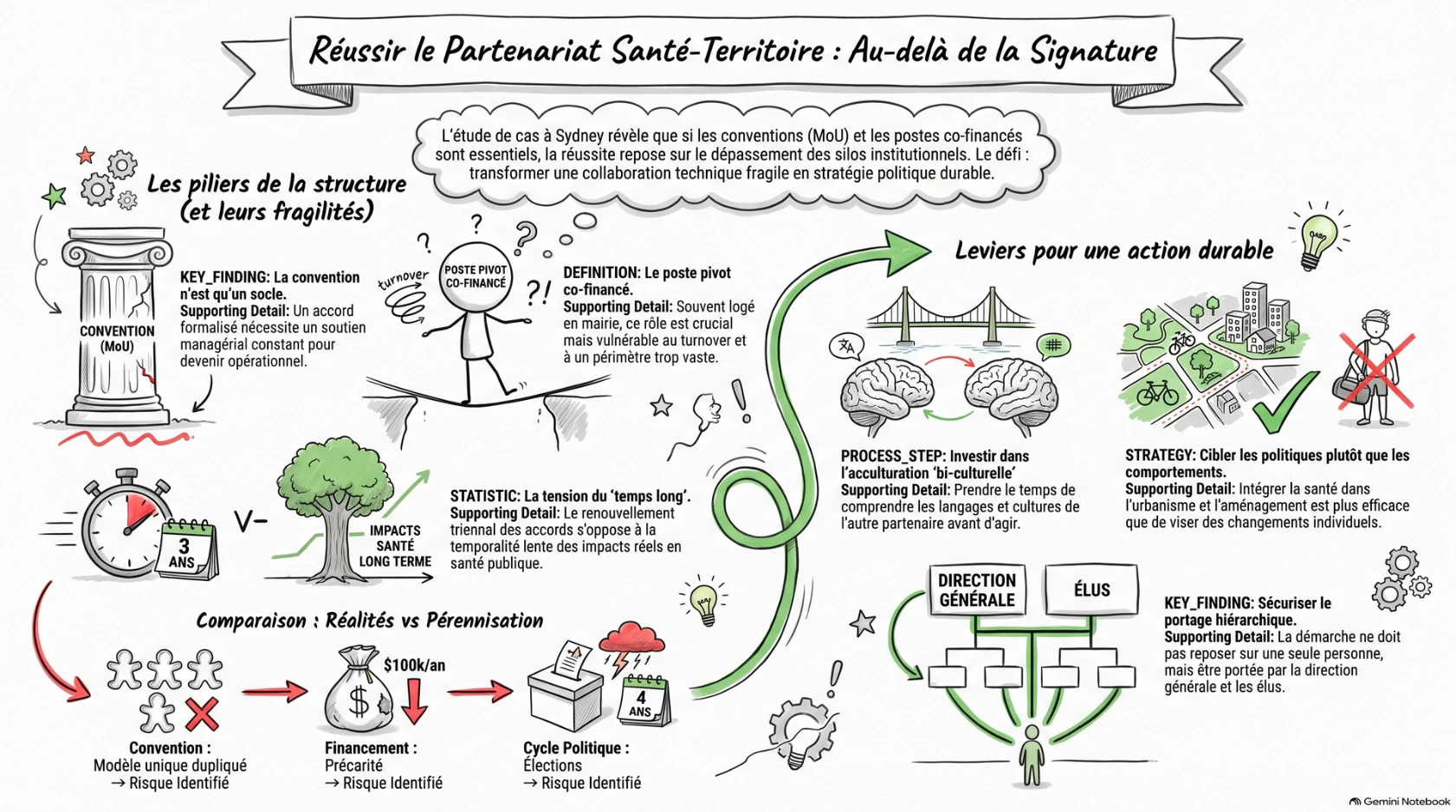
1️⃣ The formalised agreement is a foundation, but insufficient on its own. Each partnership relies on a convention (MoU) tailored to the relevant community, offering the "structural imprimatur"; but the structures require actors to act, and above all, broader organisational support (governance, work plans, objectives) (p. 10).
2️⃣ The co-funded position is the pivot — and the fragile link. A shared position, generally housed within the community, is deemed critical in each case. But it relies on a single person with a scope that is too vast, with funding of around $100,000 considered unattractive in the face of competition to recruit urban planners and designers (p. 6, p. 8).
3️⃣ The triennial renewal of the agreement is in tension with the long term. The stakeholders emphasise that renegotiating the agreement every three years contradicts the objective of sustainably embedding health in policies; hence the recommendation to make the positions permanent (p. 7, p. 10-11).
4️⃣ Local policy structurally weakens. The municipal elections every four years shift attention towards short-term local concerns; no community can commit funding beyond its mandate (p. 7).
5️⃣ Target the ‘political’ level rather than behaviour change. Counterintuitively, stakeholders consider it more sustainable to embed health as a strategic issue in community policies than to aim for distal health outcomes or behaviour change programmes (p. 6). Three of the four partnerships actually focus on health-promoting urban planning (p. 7-8).
3️⃣ ACTION PATHWAYS FOR LOCAL STAKEHOLDERS
1️⃣ Formalise a suitable written framework, not standardised. Draw inspiration from the principle of tailored agreements: one participant warns against the ‘one-size-fits-all model’ — it is the process (defining priorities, vision, local data) that matters, not the imported model (p. 5). For France: apply this logic in the construction of a CLS or a co-signed action sheet.
2️⃣ Secure hierarchical support beyond the dedicated person. Do not rely solely on the coordination position: organise visibility with senior management and elected officials, even if they are not involved in the ‘doing’ (p. 7). Prevent the ‘fragility’ related to the departure of an individual (p. 8).
3️⃣ Explicitly prioritise the scope of the position. A too broad remit disperses; the function must be directed towards targeted initiatives with high added value to avoid the situation where "one person cannot solve all the problems" (p. 6, p. 8).
4️⃣ Invest in cross-cultural acculturation ("bi-culturality"). Allow time, at the beginning of the process, for each partner to understand how the other operates (languages, organisational cultures) rather than "spending time explaining" later (p. 6).
5️⃣ Anchor health in local strategic documents. Align partnership activity with community strategic plans: integrating health upstream in the planning cycle subsequently reduces the need for corrections on planning files (p. 7, p. 9).
6️⃣ Make equity explicit in governance. Health equity, if not formally included in the bodies, is "simply not considered"; the "Healthy Streets" approach (weighting according to disadvantage) is cited as an implicit lever to formalise (p. 10). Identified unmet need: equity remains largely implicit in the studied agreements — a necessary adaptation is to include it as an explicit evaluation criterion.
4️⃣ ADDITIONAL REFERENCES
1️⃣ [Internal — Health Practices]
Bridging systems for health equity: a review of the scope of municipal-public health partnerships - Bridging systems for health equity: a scoping review of municipal–public health partnerships (August 2026). Scope review of 105 studies — the 'literature' counterpart of the Sydney case study. Direct methodological and conceptual complement. 🔗 https://www.pratiquesensante.com/blog/pratiques-15/systemes-de-transition-pour-l-equite-en-sante-un-examen-de-la-portee-des-partenariats-municipal-sante-publique-6108
2️⃣ [External] Health Territories Factory — The coordination of territorial health approaches (September 2024). Direct French transposition: status, management and fragility of coordination posts (CLS, ASV, CLSM). 🔗 https://www.fabrique-territoires-sante.org/wp-content/uploads/2024/10/DR_les-coordinations-des-DTS-_2024_VF-1.pdf
3️⃣ [External] 7Est Network & ARS Grand Est — Health-friendly urban planning (February 2025). Levers for local authorities, echoing the 3 Australian cases focused on urban planning. 🔗 https://www.aguram.org/wp-content/uploads/2025/02/20250207_UFS_VF_web.pdf
5️⃣ FREQUENTLY ASKED QUESTIONS (FAQ)
1️⃣ On which territories and what method does the study rely?
Four local authorities in the south-west of Sydney (Campbelltown, Fairfield, Liverpool, Wollondilly), through 25 semi-structured interviews analysed under NVivo according to an abductive realistic approach (p. 3, table 2 p. 4).
2️⃣ Since when have these partnerships existed?
Three have been established recently (Campbelltown 2018, Liverpool 2020, Wollondilly 2018); the one in Fairfield dates back to 1994, representing a history of three decades (p. 2, table 2 p. 4).
3️⃣ How is the shared position funded and why is it problematic?
It is co-funded by local authority/health, with a budget of around $100,000 deemed uncompetitive for recruiting rare profiles (urban planning + health), in non-permanent contracts (p. 8).
4️⃣ Why is the renewal of the agreement being criticised?
The three-year cycle contradicts the ambition to sustainably embed health in policies: this impact is a long-term effort, hence the demand for permanent positions (p. 7, p. 10-11).
5️⃣ Should we aim for behaviour change or policy change?
Stakeholders consider it more effective and sustainable to integrate health at the strategic level of community policies than to target distal health outcomes or behavioural programmes (p. 6).
6️⃣ Is health equity taken into account?
Rarely explicitly: it is generally considered but not formally included in agreements or bodies, except for implicit approaches like "Healthy Streets" (p. 10).
7️⃣ What most threatens the continuity of partnerships?
Dependence on individuals (departure = loss of knowledge), high turnover in two of the four communities, unplanned vacancy periods in the agreement, and institutional sectoral silos (p. 8).
6️⃣ REWRITING IN EASY LANGUAGE
What is this document about?
Researchers studied 4 cities near Sydney, Australia.
In these cities, the council and health services work together.
They want to improve the health of residents.
How do they work together?
They sign a written agreement. This agreement is called a convention.
They jointly pay one person. This person acts as a link between the council and health.
What did the researchers find?
- The convention is useful. But it is not enough.
- One person cannot do everything. Their work is too great.
- Leaders must also support the project.
- It takes time. Health changes slowly.
What are the problems?
- Money is not secure in the long term.
- The convention is redone every 3 years. It is too short.
- Every 4 years, there are elections. This changes the priorities.
- If the key person leaves, the project becomes fragile.
What needs to be done?
- Keep this person for a long time. A stable position is needed.
- Incorporate health into the major decisions of the council.
- Carefully consider equality among residents.
7️⃣ CROSS-ANALYSIS — VALUES OF HEALTH PRACTICES
Literacy: not directly addressed; the document deals with acculturation between organisations (“bi-culturality”) rather than levels of understanding among the public (p. 6).
Empowerment: partially addressed; stakeholders regret that the lack of resources prevents working “with” the community rather than “for” it, co-design being deemed costly (p. 7).
Participation: community co-construction is recognised as ideal but insufficiently funded in the current model (p. 7).
Community health: central collective dimension, through the anchoring of health in urban planning and the built environment for the benefit of disadvantaged populations (p. 3, p. 7-8).
Ethics: biases are not analysed as such; the document honestly acknowledges the limitations of its sample and the inherent subjectivity of qualitative research (p. 11).
Human rights / equity : equity is identified as insufficiently explicit in the conventions, which is presented as a gap to be addressed in governance (p. 10).
Intersectorality : core of the document — the whole point is about crossing the health/community sector boundaries and the ‘bridging’ of silos (p. 8, p. 10-11).
Partnership : formalised collaboration models (agreement + shared position + steering committees) documented in detail as central mechanisms (p. 2, p. 10).
Combating discrimination : not addressed as such; the document discusses territorial and social equity (disadvantaged populations, relative disadvantage) without a theme of direct discrimination (p. 3, p. 10).
8️⃣ EVALUATION OF THE RELIABILITY OF THE RESOURCE
Scientific relevance — high. Study published in a peer-reviewed journal, in Open Access; explicit methodology (critical realism, Yin design, double coding on 50% of the sample for quality assurance, p. 3). 54 references. The authors declare no conflicts of interest and report the use of an AI tool (Microsoft Copilot) solely for formatting the references. Assumed limitations : limited sample, descriptive approach (not explanatory), self-reported perceptions, restricted generalisation (p. 11).
Internal coherence — to be noted. Table 3 (p. 5) explicitly indicates, via an asterisk, that some maintenance findings were the opposite of the literature (e.g. “de-siloing” and “organisational context of the 4-year cycle”). This is a transparent methodological choice, not an inconsistency — but the reader must read the footnote at the bottom of the table to interpret it correctly.
Operational relevance — strong but to be transposed. Australian context (local authorities “councils”, LHD, SEIFA) distant from the French framework; the mechanisms (co-funded position, political sponsorship, electoral cycle, silos) are nonetheless directly transposable to CLS, ASV, CLSM and “health in all policies” approaches. The transposition goes through the levers of ARS, local health contracts, local authorities and intercommunalities.
9️⃣ STRATEGIC HASHTAGS
#Intersectorality #HealthInAllPolicies #LocalHealthContract #HealthDeterminants #HealthFriendlyUrbanPlanning #TerritorialGovernance #HealthEquity #healthpractices
This article was developed in accordance with the Charter
of the use of artificial intelligence of Health Practices.
Click on the image