
🚨 Prevention: what Germany, England and Quebec are doing — and what France could borrow from them
🔍💡 Health prevention: three systems (Germany, England, Quebec) scrutinised — legal framework, funding, targeting of audiences. Enough to compare, argue and draw inspiration to anchor prevention in the long term. 📊 Everywhere, it still accounts for 3 to 5% of health expenditure.
📌The document provides international comparison benchmarks (governance, funding, targeting) that can be directly mobilised to argue, build an advocacy or design a project inspired by documented foreign models. It particularly highlights what sustains a long-term prevention policy: a legislative foundation, inter-institutional coordination and territorial anchoring. It is a useful international mirror for situating French practices and feeding strategic reflection, rather than a ready-to-use toolbox.
Source:📒 Health prevention policies — Germany – United Kingdom (England) – Canada (Quebec)
✍️ Senate (France), Directorate of Parliamentary Initiative and Delegations, Division of Comparative Legislation. July 2025📜🔗LINK to the source
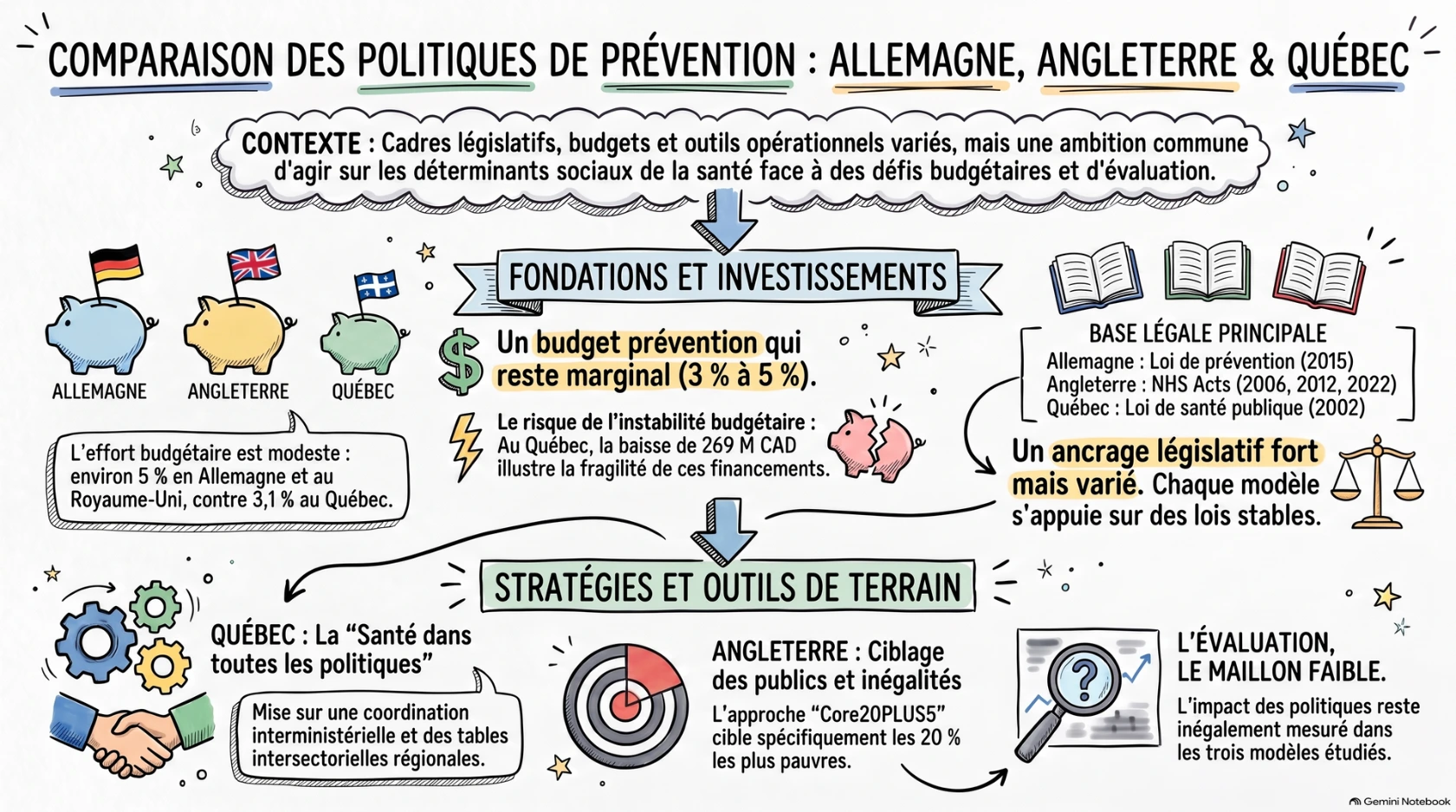
1️⃣ Analytical summary
Three models, one shared structuring ambition
The note compares Germany, England and Quebec, all of which anchor the prevention in stable legislation: prevention law of 2015 integrated into the social security code in Germany, NHS Acts of 2006, 2012 and 2022 in England, public health law of 2002 supplemented by the Government Policy for Health Prevention (PGPS) of 2016 in Quebec. Governance differs: shared between the federal state and Länder in Germany, centralized via the NHS and the UKHSA in England, centralized but strongly interministerial in Quebec. Three constants: interinstitutional coordination, mobilization of multiple actors and territorial anchoring, around a life cycle approach (children, working-age, elderly) acting on social determinants. The budgetary effort remains modest: according to the cited sources, about 5% in Germany and the United Kingdom, about 3% in Quebec.
What the note shows to the actors
Beyond the overview, the note documents concrete and transferable mechanisms: National Conference on Prevention, network of health cities (WHO) and free courses from the funds in Germany; health assessment for ages 40-74, diabetes prevention programme and "Core20PLUS5" approach on inequalities in England; "Health in all policies" approach, interministerial action plans and regional intersectoral tables in Quebec. It also highlights shared vulnerabilities: budgetary instability (in Quebec, non-renewal of the PGPS and a decrease of 269 M CAD in public health for 2024-2026) and impact assessment unevenly developed. For a field actor, it is a basis for argumentation and inspiration, not an operating mode.
2️⃣ Key points of the document
1️⃣ A legislative anchoring everywhere, but distinct legal vehicles.Prevention Law 2015 integrated into the social security code (Germany); three NHS Acts 2006/2012/2022 (England); Public Health Act 2002 + PGPS 2016 (Quebec) (summary table p. 6 ; p. 7, 18, 30).
2️⃣ Prevention remains a minority and exposed area for trade-offs. According to the national sources cited: about 5% in Germany (25 billion € out of 501 billion € in 2023, half of which is for health security); about 5.2% of public health spending in the United Kingdom (13 billion £, 2023); about 3.1% in Quebec (p. 6, 11-12, 24-25, 34).
3️⃣ Operational tools are described and potentially transferable. Free health check for ages 40-74 and “Diabetes Prevention Programme” — reduction of type 2 diabetes risk estimated at nearly 40% according to the Darzi survey (p. 26-27); “Prevention Chains” and WHO Healthy Cities network (p. 15); regional intersectoral tables TIR-SHV in Quebec (p. 34).
4️⃣ Targeting vulnerable populations is explicit. Life cycle approach and 48% of German measures in 2023 targeted at specific groups (Prevention Report 2024, p. 16); “Core20PLUS5” strategy on inequalities (England, p. 28); measures dedicated to First Nations/Inuit, children in poverty, elderly (MADA approach) and refugees/immigrants (Quebec, p. 39).
5️⃣ Impact assessment is the weak and heterogeneous link. Four-year report of the National Conference (Germany, p. 17); ad hoc evaluations by local authorities and the NHS (England, p. 29); monitoring by indicators from the Coordination and Support Office, evaluation of the PGPS still ongoing (Quebec, p. 40).
3️⃣ Action points for local actors
Reporting V4: concerning a note on comparative policy, these avenues focus on the strategic use of the document (advocacy, project design, benchmarking), not on field protocols directly extracted.
1️⃣ Build a quantified advocacy argument on the under-investment in prevention, based on the comparative data from the summary table (p. 6) and the observation of budgetary fragility.
2️⃣ Draw inspiration from the governance "Health in all policies" in Quebec (p. 30-31) and its intersectoral tandems and regional tables (p. 33-34) to structure local intersectoral consultation.
3️⃣ Adapt the "Core20PLUS5" logic and the example of Lambeth on hypertension among patients from minorities (p. 28-29) to concretely target disadvantaged populations in a territory.
4️⃣ Map its levers in "living environments" (schools, businesses, municipalities) based on the German systems described (p. 15-16), particularly the health equality networks.
5️⃣ Document the risk of budgetary discontinuity based on the Quebec case (halt of the PGPS, −269 M CAD, p. 34) to advocate for earmarked multi-year funding rather than unstable envelopes.
6️⃣ Integrate evaluation from the design stage (indicators, accountability) by drawing inspiration from the monitoring framework of the Quebec BCS (p. 40). Unmet need not covered uniformly: the note does not address France, nor does it finely address the integration of primary care/prevention — to be supplemented by other sources.
4️⃣ Additional references
• OECD, Health Panorama 2025 (November 2025) — international comparison of prevention spending (returns at ~3% on average OECD, 2.3% for France). oecd.org — Health Panorama 2025
• Ministry of Health and Social Services of Quebec, National Health Prevention Strategy 2025-2035 / National Public Health Programme 2025-2035 (2025) — directly updates the Quebec section of the note. publications.msss.gouv.qc.ca (PDF)
• WHO, Tackling NCDs: 'best buys' and other recommended interventions, 2nd ed. (April 2024) — menu of cost-effective interventions on the same risk factors (tobacco, alcohol, diet, diabetes, cancer). who.int — Best buys (2nd ed.)
Internal references Health Practices :
« Health Panorama 2025 – OECD indicators – What place does France have? » — Health Practices blog. https://www.pratiquesensante.com/blog/annonces-28/panorama-de-la-sante-2025-les-indicateurs-de-l-ocde-quelle-place-a-la-france-5370
« Analysis of the Regional Intervention Fund (FIR): actions, doctrine employment, steering and management by the ARS » — Health Practices blog (relevant to the funding of prevention in France). https://www.pratiquesensante.com/blog/pratiques-15/analyse-du-fonds-d-intervention-regional-actions-doctrine-d-emploi-pilotage-et-gestion-par-les-ars-5982
5️⃣ Frequently Asked Questions (FAQ)
1. Which countries does the note compare and why?
Germany, United Kingdom (England) and Canada (Quebec), at the request of the Social Affairs Committee, to clarify the choices of legal framework, funding and prevention measures (introduction, p. 5).
2. What share of health spending goes to prevention in each country?
According to the cited sources: ~5% in Germany (25 billion €/501 billion €, 2023), ~5.2% of public health spending in the United Kingdom (13 billion £, 2023), ~3.1% in Quebec (p. 6, 11-12, 24-25, 34). To be read as orders of magnitude, the statistical scopes differ from one country to another.
3. Who leads prevention in each system?
Germany : federal ministry of health + Länder, with the National Conference on Prevention (p. 8-10). England: Secretary of State for Health, NHS and UKHSA (p. 21-22). Quebec: Ministry of Health and Social Services, with the Coordination and Support Office of the PGPS (p. 31-33).
4. What is the ‘Health in All Policies’ approach?
An intersectoral approach promoted by the WHO, which integrates health considerations into all public decisions, regardless of the sector. It underpins the Quebec PGPS (p. 30-31).
5. What concrete measures can we look closely at?
Free courses from health insurance funds and city-health networks in Germany (p. 9, 15); health assessments for ages 40-74, diabetes programme and ‘Core20PLUS5’ in England (p. 26-28); regional intersectoral tables and interventions in living environments in Quebec (p. 34, 36).
6. How are vulnerable populations targeted?
By life stages and priority groups (Germany, p. 16); by combating socio-economic inequalities (England, p. 28); by measures dedicated to First Nations/Inuit, children in precarity, seniors and migrant people (Quebec, p. 39).
7. How is the impact of policies evaluated?
Four-year report in Germany (p. 17) ; spot evaluations in the United Kingdom (p. 29) ; monitoring by BCS indicators in Quebec, the full evaluation of the PGPS still ongoing (p. 40). The evaluation is the common weak point in the three countries.
6️⃣ Rewriting in Easy to Read and Understand (FALC)
What is this document about?
This document compares three countries: Germany, England and Quebec (Canada).
It looks at how each country works to prevent diseases. This is called prevention.
It looks at three things: laws, money, and actions on the ground.
What the document shows
The three countries have laws for prevention. But the laws are not the same.
The three countries spend little on prevention. It is between 3 and 5 % of health money.
Many actors work together: the state, regions, cities, and associations.
The countries mainly help children, working adults and the elderly.
The countries also help vulnerable people: poor people, migrants, indigenous peoples.
Key points
A strong law helps prevention to last.
When money decreases, actions stop. This happened in Quebec.
There are useful tools: free health check-ups, help against diabetes, actions in schools.
The countries poorly measure the results of their actions. This is a problem in all three countries.
7️⃣ Cross-sectional analysis — values of Health Practices
Health literacy — Quebec describes a strategy dedicated to literacy and the communication of professionals (p. 36); the note itself does not propose graduated comprehension tools.
Empowerment — Present mainly on the English side (patient autonomy, prevention portal via the NHS App) and German (Selbsthilfe), more as a stated objective than as an evaluated approach.
Participation — NHS public consultations (220,000 contributions, p. 20) and Quebec inter-ministerial consultation; co-construction with beneficiaries remains poorly detailed.
Community health — Marked collective dimension: WHO healthy cities network (Germany), interventions in living environments and regional tables (Quebec).
Ethics — Biases are not subject to specific treatment; the note remains descriptive and neutral (preliminary warning).
Human rights / equity — Equity is an explicit axis: Core20PLUS5 (England), equality of opportunity in health (Germany), reduction of social inequalities (Quebec).
Intersectorality — Heart of the three models, particularly in Quebec via "Health in all policies" and intersectoral tandems.
Partnership — Formalised models: regional framework agreements (Germany), ICS (England), >200 non-governmental partners and PAI (Quebec).
Fight against discrimination — Addressed through cultural adaptation (First Nations/Inuit), access for migrant people and the example of Lambeth (ethnic minorities) ; the non-judgment is not thematised as such.
8️⃣ Assessment of the reliability of the resource
Scientific relevance — high for an institutional reference document: official sources, transparent and traceable citations, explicit comparative methodology. Limitations: this is not peer-reviewed research; some 2024 data are estimates; two major elements have been outdated since July 2025 (NHS ten-year plan now published; Quebec strategy 2025-2035 now adopted). Overall reliability: solid as a basis for comparison, to be updated on these two points.
Operational relevance — indirect. Strong strategic and argumentative value (advocacy, design of devices, benchmark); low direct applicability on the field, due to lack of ready-to-use tools. To be combined with operational French resources.
9️⃣ Strategic hashtags
#HealthPrevention #HealthPromotion #PublicPolicies #HealthInAllPolicies #SocialDeterminants #HealthInequalities #ComparativeLegislation #healthpractices
This article was developed in accordance with the Charter
of the use of artificial intelligence of Health Practices.
Click on the image