
👀US estimates: Netflix would account for $32 billion in annual health expenditures; Burger King, nearly $5 billion. Two researchers propose calculating what each company's products cost public health, so that companies bear a share.

Source :
🎙️🎥
1. Summary
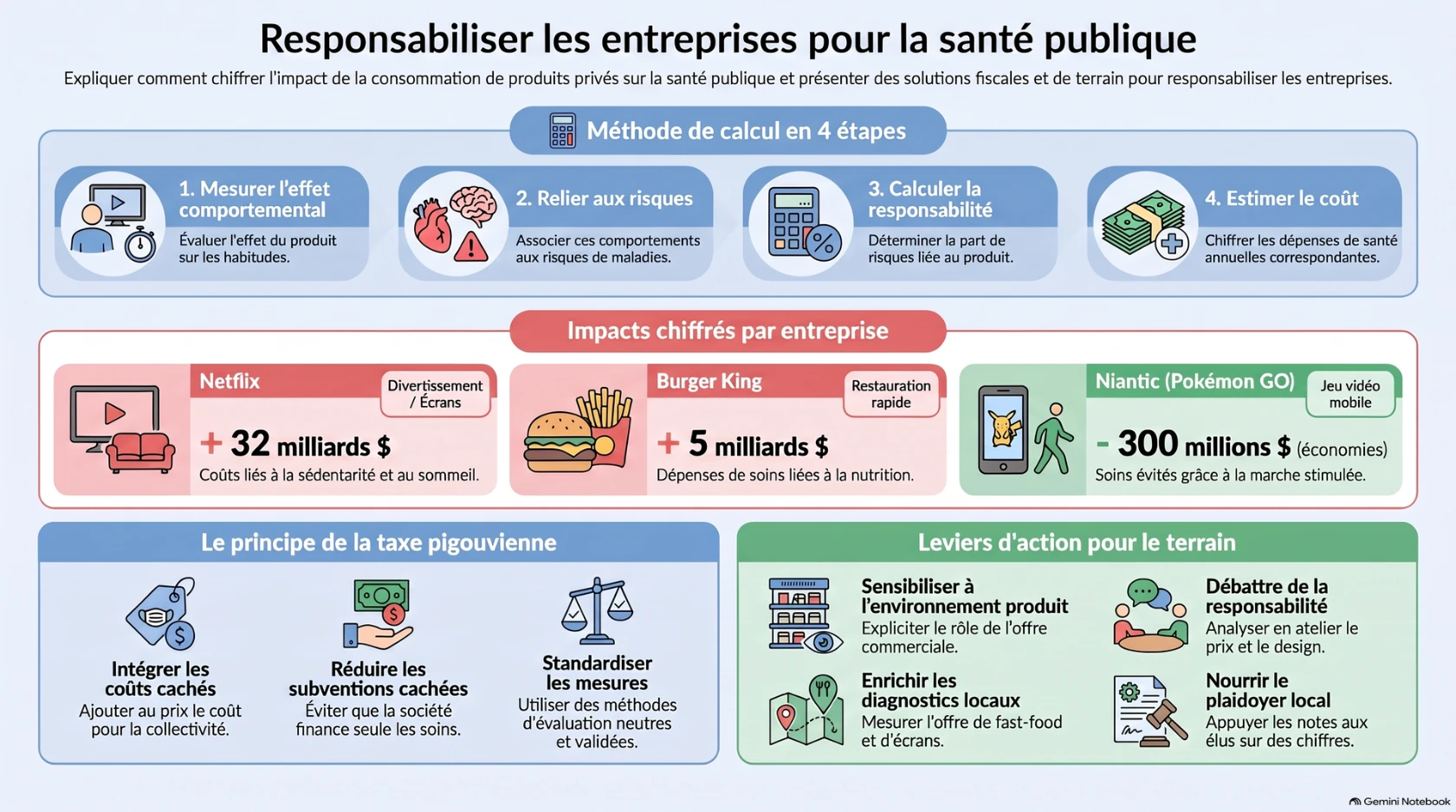
According to the authors, products from food, transport or entertainment influence diet, physical activity and sleep. These behaviours contribute to chronic diseases: cardiovascular diseases, type 2 diabetes, obesity, depression. The relevant costs are not included in the prices of the products: the authors refer to this as "externalities". The authors have developed a 4-step method to calculate the annual health costs that can be attributed to the products of a company. They tested it on three different companies: Netflix, Burger King and Niantic, the publisher of the game Pokémon GO. They present this work as a first attempt ("prototyping"), but the magnitude of the results shows, according to them, the potential scale of these effects.
The article draws lessons from this test and examines the public policies that these calculations would make possible. The authors consider taxation (taxes, or subsidies when the effect is positive) as the most promising lever. The article also discusses several issues: the responsibility of consumers, the choice of the point of comparison, the data to require from companies and the quality of scientific evidence. The authors expect lengthy political debates. In the short term, they recommend advancing the arguments in favour of this responsibility and preparing the tools (methods, data, studies) for the moment when political will exists.
2. The 5 main ideas
Costs paid by society as a whole
When a product encourages harmful behaviours, the cost of care is neither included in its production cost nor in its price. According to the authors, it amounts to subsidising products that are bad for health and making them more attractive. In the United States, 70% of health spending is paid for by public authorities (federal, state and local), employers, and other private sources. (p. 1, 4)
A method in 4 steps and some spectacular initial results
The method first estimates the effect of the product on the behaviours of its users. It then links these behaviours to the risk of disease, based on published studies. It deduces the share of disease cases that can be attributed to the product, and then the annual cost of the corresponding care. Estimates in the United States: 32 billion dollars per year attributed to Netflix and nearly 5 billion to Burger King. Conversely, over 300 million dollars in care would be avoided thanks to Niantic. (p. 1-2)
Measure company by company, and not just by sector
The effect on health often depends on what each company does: the composition of Burger King's menus, the design of the Pokémon GO game. For Netflix, the effect depends on the time spent in front of the screen. This time does not follow revenue, as the subscription is at a fixed price. The number of users weighs heavily in the calculation: for Netflix, a relative increase of 10% in its share of total television viewing increases the attributed annual costs by 10%. (p. 2)
The tax, a lever considered the most promising
The so-called "Pigovian" tax (named after the economist Pigou) adds to the price the cost that the product imposes on society. Example from the article: a product sold for £10 that costs £5 to society would be taxed £5. A perfectly calibrated tax is rare in practice. The authors consider using estimates to inform which products to tax, without directly deriving the amount of the tax. The calculations must be perceived as fair, which requires standardised methods. (p. 3-4)
Questions to resolve before acting
The consumer bears some responsibility, but it is diluted by the design of products, infrastructure, and social norms. One must also choose the point of comparison: healthy eating for Burger King, no television for Netflix. The authors advocate for this choice of a healthy reference, which measures the company's contribution to an unhealthy environment. It will also be necessary to require companies to provide data and set standards for scientific evidence, for example using expert panels. (p. 3, 4, 5)
3. What surprises
Costs of health higher than revenues. The costs attributed to Netflix exceed its annual revenues. For Burger King, they represent over 40% of its turnover. If these costs were integrated into the price, services would be much more expensive. (p. 2)
A game that saves money. According to the calculation of the authors, Pokémon GO would avoid more than 300 million dollars in health costs per year. The game indeed encourages its players to walk, which impacts cardiovascular diseases and depression. In this case, the logic of the article would allow for a subsidy, without explicitly recommending this measure. (p. 2, 3)
A tax on tobacco unrelated to its harms. In the United States, the current amount of the federal tax on tobacco was set to fill a budget gap, related to the funding in 2009 of a children's health insurance programme (CHIP). It was not calculated based on the damage caused to health. (p. 3)
4. Ideas for action on the ground
These avenues adapt the findings and recommendations of the report. Each adjusts them to their skills, their structure and local protocols.
Raise awareness of the concept of ‘product environment’
The authors recommend advancing the arguments and familiarising the idea of measuring the effect of companies on health. In your trainings, networking meetings or exchange times with partners, present the central idea of the article: the products of companies together form an environment that shapes our behaviours. The figures on Netflix, Burger King and Pokémon GO can open the discussion. Specify that these are American data and a first attempt.
Open the debate on individual responsibility with the public
According to the article, the responsibility of the consumer exists, but it is diluted by the design of products, infrastructures and social norms. In health education workshops, with young people or adults, propose a time for discussion on what drives consumption: price, design, availability, screen time. The aim is to reduce guilt by showing the role of the environment, without denying the part of personal choice.
Integrate the influence of products into local diagnostics
The article reminds us that public health has the mission to monitor the factors that influence health. During a local health diagnosis, with the relevant communities and partners, add questions about the commercial offer in the area: fast food, screens, mobility. Table 2 of the article indicates which information is useful depending on the type of product: volume of sales and nutritional profile for food, time spent on screens, frequency of use for transport. (p. 5, 6)
Feed the advocacy with quantified arguments
The authors cite several levers: legal actions, impact studies commissioned by health agencies, hearings by elected officials. For organisations that engage in advocacy, this article provides an economic rationale (the “externalities”) that complements the health arguments. It can be used to prepare a note for elected officials or a briefing on behavioural taxation, relying on the Francophone references below. (p. 5)
5. To go further
WHO Europe, Commercial Determinants of Noncommunicable Diseases in the WHO European Region, 2024. The report eis in English, with a press release in French : https://www.who.int/europe/fr/news/item/12-06-2024-just-four-industries-cause-2.7-million-deaths-in-the-european-region-every-year. It targets four major sectors (tobacco, ultra-processed foods, fossil fuels, alcohol), which would be fully or partially responsible for 2.7 million deaths per year in Europe.
Karine Gallopel-Morvan, " When the marketing of alcohol producers shapes behaviours and public policies ", Health in action, 2026, no. 473. The author explains that the commercial determinants of health remain poorly understood by health professionals. https://www.santepubliquefrance.fr/alcool/article/quand-le-marketing-des-alcooliers-faconne-les-comportements-et-les-politiques-publiques
European economic and social committee (EESC), opinion " The commercial determinants of health ". It supports the creation of a European observatory on the commercial determinants of health and a European label " Responsible business for health ". https://www.eesc.europa.eu/fr/our-work/opinions-information-reports/opinions/les-determinants-commerciaux-de-la-sante
On the blog Practices in Health :
A health under influence : the strategy of the industries behind the avoidable harm to health in Scotland. https://www.pratiquesensante.com/blog/pratiques-15/une-sante-sous-influence-la-strategie-des-industries-derriere-les-atteintes-evitables-a-la-sante-en-ecosse-6215
Reverse the balance of power against industry narratives : a health communication manual to promote health. https://www.pratiquesensante.com/blog/pratiques-15/inverser-le-rapport-de-force-face-aux-discours-de-l-industrie-un-manuel-de-communication-en-sante-pour-promouvoir-la-sante-6182
and others - https://www.pratiquesensante.com/blog/tag/industries-privees-606
6. Limitations highlighted by the document
The authors present their work as a first attempt at "prototyping" (p. 2) and their method as still recent, therefore easy to criticise on a technical level (p. 6). They acknowledge that their approach is based on assumptions about the number of users and their usage habits. It also depends on the available scientific studies and their accuracy, and it simplifies complex biological links between environment, behaviours and diseases (p. 2). Not all the studies used prove a causal link, even if all take into account the main confounding factors. Therefore, it is necessary to speak of a contribution to an increased risk rather than strict liability (p. 3). Finally, the methods still need to be refined and tested on other companies (p. 5).
7. Hashtags
#CommercialDeterminants #PublicHealth #Industry #Prevention #ChronicDiseases #BehaviouralTaxation #Nutrition #Screens #HealthAdvocacy #HealthPromotingEnvironment
🔎 Need to delve deeper into a topic?
The articles from Pratiques en Santé provide an initial insight into publications and resources useful for professionals and field actors.
To go further, answer a specific question or explore a topic in depth, I also offer documentary research and personalised monitoring, tailored to your needs and projects. Feel free to contact me: pratiquesensante@pm.me - To find out more
To go further, order a research or documentary monitoring
This article: An editorial production based on
experience enhanced by artificial intelligence - The English version of the site is an automatic translation: the French version prevails - Click on the image