🔍 Anses publishes a framework to integrate health determinants into its expertise: models, decision tree, grid in 5 categories, glossary.
🧩 A methodological tool, non-mandatory, also useful for structuring a local diagnosis.

🎙️🎥 Audio/Video Capsules of Health Practices 🎙️🎥 https://www.youtube.com/watch?v=9RBGYeKVZ4g
1️⃣ SUMMARY
The report on action 1.5 of the 2018-2022 performance and objectives contract of Anses highlighted the need to integrate socio-economic determinants into expertise; expertise on bed bugs, flame retardants in upholstered furniture, and mould in buildings has demonstrated their contribution (Ref. p. 6). The framework therefore proposes to enrich the assessment of health risks through an analysis of the determinants that may explain why a risk arises (Ref. p. 5). It adopts the definition of health determinants from INSPQ (Ref. p. 7) and presents several models: Dahlgren and Whitehead, the map of the Ministry of Health and Social Services of Quebec, the explanatory model of health inequalities by Weber (Ref. p. 9-12), and in the annex, the models of Diderichsen and Hallqvist, Mackenbach and Stronks, and Life course (Ref. p. 34-36). It is part of the continuation of the work of the Scientific Council on the exposome and refers to the "social exposome" and "socioexposome" (Ref. p. 6, 13). It targets scientific expertise coordinators, experts from the CES ASE and the experts in charge of assessments at Anses (Ref. p. 8). It provides a tree "when to mobilise" (Ref. p. 15), categories of determinants illustrated by assessments from Anses (Ref. p. 16-24), classification pathways (Ref. p. 24-26) and a glossary (Ref. p. 27-29). The preamble places it among nine references for socio-economic analysis published on 1st October 2026 (Preamble p. 3-4).
2️⃣ WHAT TO REMEMBER
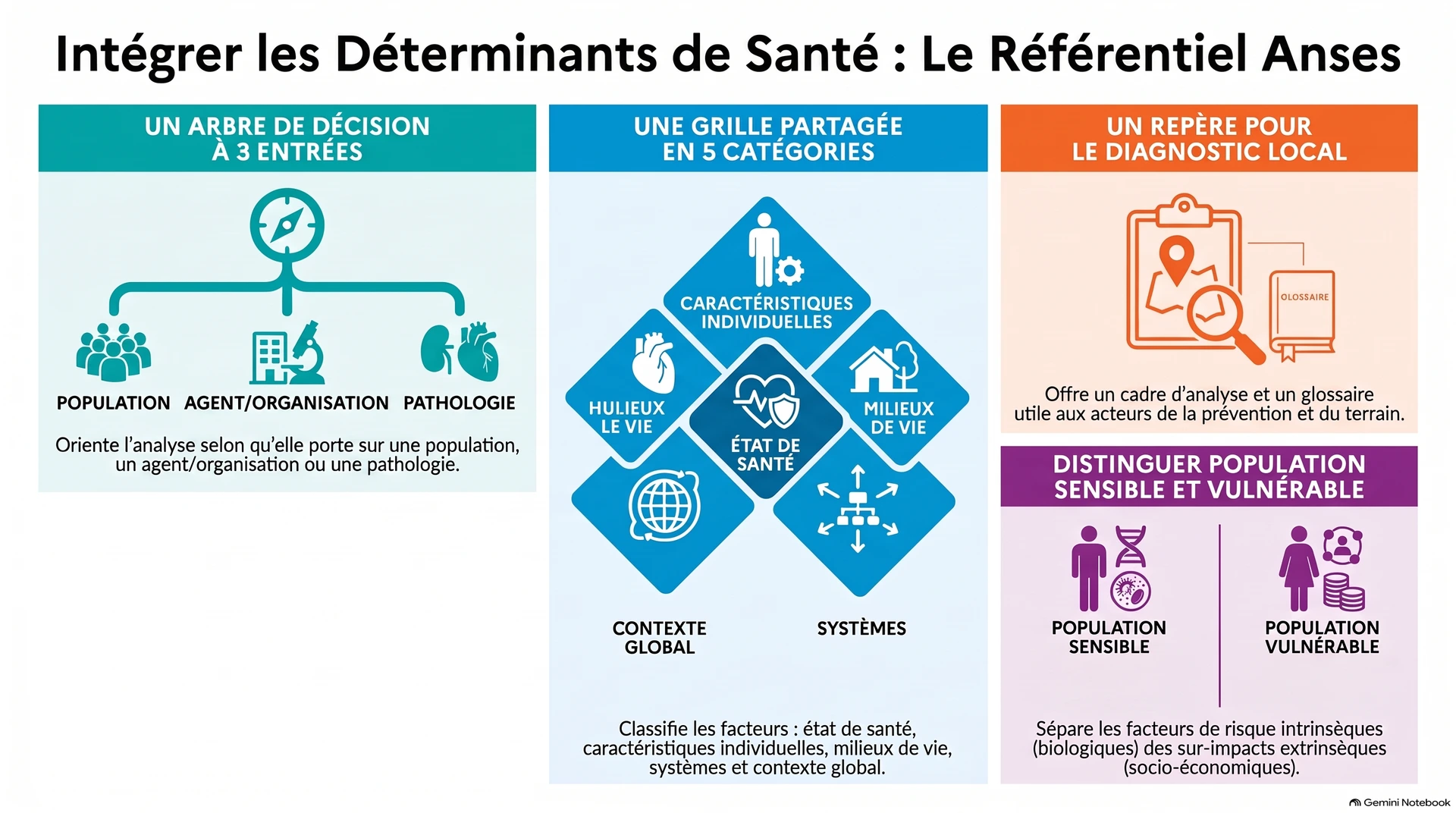
1️⃣ A three-entry decision tree. If the expertise concerns a population, the analysis of determinants is recommended when it is necessary to identify the mechanisms favouring or limiting an exposure, or what modulates the consequences or distribution of an effect. If it concerns an agent or an organisation: "why is it used?" refers to an analysis of uses, "who is exposed?" to an analysis of determinants, which can be complemented by a supply chain study. If it concerns a pathology: "who are the patients?" refers to an analysis of determinants (Ref. p. 15).
2️⃣ Five categories of determinants, each illustrated by an assessment from Anses: state of health (arboviruses), individual characteristics (sewer workers), living environments (digital social networks and adolescents), systems (arboviruses), global context (delivery workers of digital platforms) (Ref. p. 17-24). Several levels of detail are possible, to be chosen according to expertise (Ref. p. 16). The document considers an exhaustive list to be illusory and highlights the interdependence of determinants (Ref. p. 24).
3️⃣ Caution regarding the "weight" of determinants. The figure from CNFPT (45% socio-economic factors, 25% environmental, 15% healthcare system, 10% individual behaviours, 5% genetic heritage) is presented with a strong inherent uncertainty: these results must be at a minimum socially, geographically and temporally situated (Ref. p. 25). According to Alla (2016), other classification logics exist: action capacity of policies, considered health indicators, proximity to health status (Ref. p. 25-26). The choice of method remains constrained by data, skills, and the timeline (Ref. p. 26).
3️⃣ TO ACT
The document does not call for direct action from prevention actors; the pathways below rely on tools it cites and on an invitation it formulates.
1️⃣ [Existing tool cited] The tree "When to mobilise health determinants in expertise" (Figure 5) poses preliminary questions depending on whether one is interested in a population, an agent or an organisation, or a pathology (Ref. p. 15). Practical Suggestions in Health: draw inspiration from it to frame the preliminary questions of a local diagnosis, keeping in mind that it was designed for assessments by Anses.
2️⃣ [Existing tool cited] The health map and its determinants of Quebec (Figure 3) (Ref. p. 10) and the tables of elements to document, from health status to the global context (Ref. p. 17-24). To inform them, the document cites the data portal of the DREES, a mapping of health-work databases, the Portal of health inequalities and Géodes from Public Health France (Ref. p. 16). Status: a tool for centralising sources specific to Anses remains a goal, whose architecture is only proposed (Ref. p. 16, 37).
3️⃣ [Action requested by the document] Readers and users external to Anses are invited to send their comments or feedback, which will inform the revisions: referentiels-ase@anses.fr (Preamble p. 5). Anses also expresses interest in feedback from other organisations and institutions in related fields (Preamble p. 5).
4️⃣ 3 PRACTICAL QUESTIONS
1️⃣ Does the document impose a model of determinants? No. The models from the Quebec Ministry of Health and Weber (2020) "seem to be solid foundations"; the choice of a model must be justified and a combination may be considered (Ref. p. 8). The document notes that the Dahlgren and Whitehead model does not account for interactions or a hierarchy among determinants (Ref. p. 9), while the map of Quebec shows interactions, time and space (Ref. p. 10).
2️⃣ Can we revisit the percentages of the "weight of determinants"? The document presents them with a high inherent uncertainty and requests that they be at a minimum socially, geographically and temporally situated (Ref. p. 25). It invites not to base the ranking solely on causal impact and recalls a proposal from the CDC in three classes: determinant, direct factor, indirect factor (Ref. p. 25-26).
3️⃣ Sensitive population or population in a situation of vulnerability? Sensitive : response to an agent at a lower level of exposure, due to intrinsic factors (for example children, pregnant women, asthmatic individuals). In a situation of vulnerability: over-impact due to extrinsic characteristics (social, economic, living environments). The "at-risk population" encompasses both (Ref. p. 29).
5️⃣ TO GO FURTHER
1️⃣ Health Practices — "Social and territorial health inequalities". Thematic page grouping blog articles (and not a single article), undated. https://www.pratiquesensante.com/2-1-inegalies-sociales-territoriales — consulted on 19 October 2026.
2️⃣ WHO — Global report on the social determinants of health equity: orientation summary (6 May 2025, external source). https://www.who.int/fr/publications/i/item/B09387 — consulted on 19 October 2026.
6️⃣ #️⃣ HASHTAGS
#healthpractices #HealthDeterminants #HealthSocialInequalities #Anses #SocioEconomicAnalysis #Exposome #EnvironmentalHealth #RiskAssessment
To go further, order a research or a documentary watch
This article : An editorial production based on
experience enhanced by artificial intelligence - The English version of the site is an automatic translation: the French version prevails - Click on the image