🧭🛡️ Health misinformation: understanding the four pillars of the national strategy presented in January 2026. Review the initial commitments, identify the documented follow-ups and distinguish announcements from verified achievements

🎙️🎥 Capsules Audio/Vidéo de Pratiques en Santé 🎙️🎥 https://www.youtube.com/watch?v=lCrbjX7Q2uk
Pensez à vous abonner à la chaîne :https://youtube.com/@danieloberle-s2h
1️⃣ SUMMARY
The ministry presents the fight against health misinformation as a public health priority, in a context of distrust towards science and health institutions. The approach, initiated as of 2025, aims to ensure reliable, accessible, and understandable health information. It relies on a steering committee bringing together experts and qualified individuals as well as on an independent expertise mission entrusted on 27 August 2025 to Prof. Mathieu Molimard, Prof. Dominique Costagliola, and Dr. Hervé Maisonneuve. This mission conducted 156 interviews.
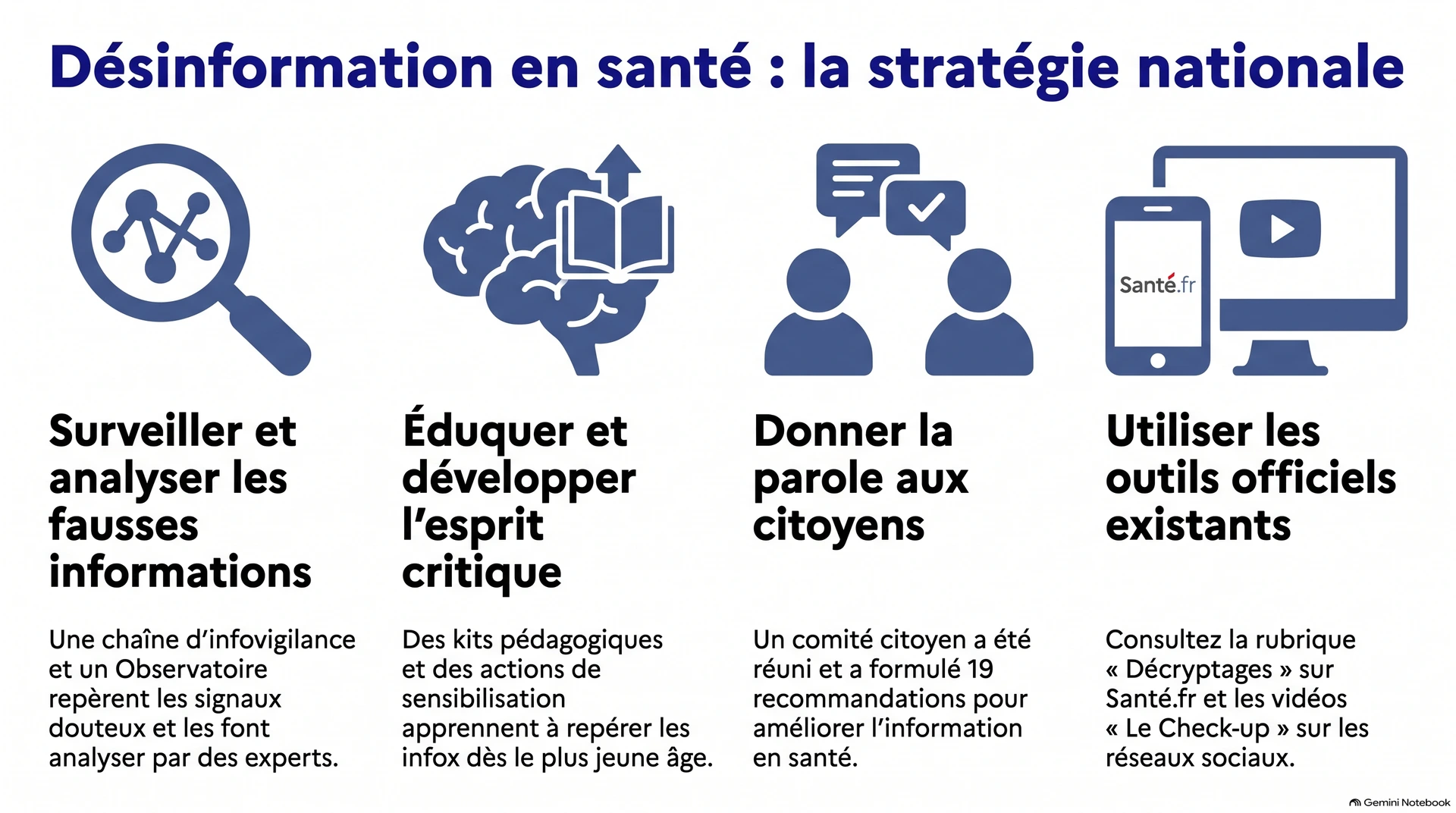
The document organises the strategy into four axes :
Listening to citizens and organising their participation.
Establishing an Observatory for health misinformation.
Setting up an infovigilance system combining monitoring, analysis and dissemination of responses.
Building a foundation of trust through critical education, the accountability of platforms, and research
The final timeline presents milestones from January to April 2026. It does not cover the entire duration of the actions: citizen consultations had begun in December 2025 and an online community was planned for six months. These deadlines describe the initial programme; they do not prove, on their own, that the actions have been carried out.
A follow-up is now documented: the report of the Citizen Committee has been published and presents 19 recommendations. The article from the Order of Pharmacists dated 9 April 2026 also reports on this publication and describes a strategy still being deployed. These elements constitute initial tracking markers, and not a comprehensive evaluation of its effectiveness.
2️⃣ WHAT TO REMEMBER
1. An infovigilance chain announced in three stages
The system was to be implemented "from late January" 2026. It includes :
monitoring and detection, with a first assessment of signals according to their virality and credibility ;
analysis by the Public Service for health information — SPIS — using a matrix of criteria and the mobilization of experts ;
the dissemination of responses and tools for counteraction.
A "community of allies", including notably ARS, research organisations, experts, journalists and influencers, is mobilised at all three stages. The document from January describes this planned operation, without providing indicators on its subsequent activity.
2. An Observatory announced, whose guarantees remained to be defined
In January, the Observatory for health misinformation was presented as "under construction". Its purpose went beyond observation: to inform, alert, raise awareness and share knowledge with the ministry's partners, the media and professionals. Its governance and the modalities for ensuring its independence were still "under consideration".
The April article reiterates its missions, but provides no activity report or sufficient details to establish its operational status as of 21 October 2026.
3. Citizen participation leading to a report
The initial programming included :
an exploratory survey: 18 individual interviews and three triads, with results announced at the end of January ;
a national online barometer with 2 000 respondents, with results announced in early April ;
an online community of 70 participants, planned for six months ;
a citizen committee announced of 27 people, reunited over three weekends between December 2025 and February 2026.
The final report of the citizen committee presents 19 recommendations concerning information and communication, awareness and training, as well as the legal framework. Its editorial and introduction mention 26 citizens, compared to 27 in the launch document; however, some composition data in the report total 27 people. This discrepancy calls for clarification from the editor.
4. A foundation of trust that is not limited to correcting rumours
The fourth axis associates educational kits designed for teachers and children, cooperation with National Education and CLEMI, work on platform accountability and the integration of health misinformation into research programmes. These measures were being prepared in January.
The citizen report then provides additional insight: making reliable information more visible, adapting materials for the public, mobilising local relays and explaining scientific uncertainties. These recommendations must not be confused with measures already adopted or implemented.
3️⃣ TO ACT
1️⃣ Tool explicitly cited. The "Decryptions" space of Santé.fr provides answers to false information circulating and allows users to question experts about health information considered dubious (p. 6). Suggestion Health Practices: indicate it to the supported public as a verification point.
2️⃣ Tool explicitly cited. Content "The Check-up" on TikTok and YouTube Shorts; topics covered include: finding one's way through health information, flu and HPV vaccination, dietary supplements, risks of screens on children, winter viruses and barrier gestures (additional topics will be added, such as abortion or menopause) (p. 5-6). Health Practices Suggestion : use it as a discussion support in sessions, as well as the educational modules on how algorithms work and the creation of false information (p. 5-6).
3️⃣ Preparation for an announced action. Educational kits on health information "in the process of being drafted", aimed at teachers and children; a joint event announced for Press and Media Week in schools, from 23 to 28 March 2026 (p. 6). Health Practices Suggestion: check their publication, not confirmed as of today.
4️⃣ 3 PRACTICAL QUESTIONS
Who was supposed to analyse the identified information?
The Public Health Information Service, at stage 2 of the announced system, was to analyse the signals using a criteria matrix and consult the experts from the network. This distribution of roles is described on page 5; it does not provide information on the number of reports actually processed since.
What do we know about the outcomes of the citizen consultation?
A final report has been published. It presents 19 recommendations and particularly emphasises the visibility of reliable information, coordination of stakeholders, training and accessibility. The publication of these recommendations constitutes a concrete follow-up; it does not prove their adoption or implementation.
https://sante.gouv.fr/IMG/pdf/260218_rapport_comite_citoyen_saison_4-2.pdf
Do we have an initial assessment of the strategy?
The article from the National Council of the Order of Pharmacists dated 9 April 2026 constitutes an initial professional status report. It describes a plan in deployment, mentions the publication of citizen conclusions and presents resources and courses of action for pharmacists. However, it does not provide a comprehensive table of achievements, a budget report, or a global evaluation of the effects of the strategy. https://www.ordre.pharmacien.fr/les-communications/focus-sur/la-revue/tous-pharmaciens-la-revue-n-30-avril-2026/desinformation-en-sante-un-combat-pour-defendre-la-sante-publique
5️⃣ TO GO FURTHER
1️⃣ Blog Health Practices — "Rethinking communication in public health in the face of the infodemic" (26 January 2026, news from the UNESCO Chair "EducationS & Health"). Presents an editorial from the European Journal of Public Health on the infodemic and trust.
and the file on Health Literacy: https://www.pratiquesensante.com/litteratie
1. An article for an initial status report
National Council of the Order of Pharmacists — "Misinformation in health: a fight to defend public health", 9 April 2026, All Pharmacists, no. 30.
This article revisits the expert report and the four axes of the strategy. It mentions the publication of the conclusions of the Citizen Committee, presents tools and clarifies the role of pharmacists. It is useful for an initial perspective after the launch, but should not be presented as a national execution or impact report.https://www.ordre.pharmacien.fr/les-communications/focus-sur/la-revue/tous-pharmaciens-la-revue-n-30-avril-2026/desinformation-en-sante-un-combat-pour-defendre-la-sante-publique
2. A documented achievement: the report of the Citizen Committee
Delegation to digital health — "Citizen Committee, season 04, December 2025-February 2026".
The report presents 19 recommendations divided into three sets: strengthening information and communication; developing awareness and training; consolidating the legal framework. It usefully complements the January document on accessibility, vulnerable audiences, local intermediaries and the role of dialogue. It outlines the proposals of citizens, not a summary of the decisions made in their wake. An internal discrepancy regarding the committee's membership should be noted.
https://sante.gouv.fr/IMG/pdf/260218_rapport_comite_citoyen_saison_4-2.pdf
3. The expert report to be distinguished from the ministerial strategy
Mathieu Molimard, Dominique Costagliola and Hervé Maisonneuve — « Health Information. Assessment of strengths and weaknesses. Recommendations for a national information strategy and combatting misinformation in health », submitted on 12 January 2026.
This report develops nine recommendations and notably contains a template for health information in annex 6. It helps to understand the diagnosis and the proposals of the experts. Despite the words « assessment of strengths and weaknesses » in its title, it is not an assessment of the implementation of the strategy launched on the same day.https://www.vie-publique.fr/files/rapport/pdf/301678.pdf
6️⃣ #️⃣ HASHTAGS
#healthpractices #HealthMisinformation #Infovigilance #HealthFakeNews #CriticalThinking #MediaEducation #CitizenParticipation #PublicHealth
To go further, order a research or documentary watch
This article: An editorial production based on
experience enhanced by artificial intelligence - The English version of the site is an automatic translation: the French version prevails - Click on the image