🚨🚨 Decline in level: digital technology, the ideal scapegoat — but not the only one
🔍💡 PISA 2025: the decline in results has more than one cause. Screens, sleep, school climate, social inequalities, and parent-child relationships accumulate.
For the field: an additional environmental determinant to work on — without making it the scapegoat.
📌 This file is not a health guide, but a recent quantified snapshot of determinants affecting the development of young people: digital usage, sleep, attention, school climate, parent-child relationships, and the weight of social origin. It provides benchmarks to argue for a workshop on "screens and sleep", work on parenting, or a well-being initiative in schools — provided it is read as an institutional viewpoint, not as causal evidence. Its interest: to equip a local advocacy without reducing drop-out rates to screens alone.
Source:📒 PISA 2025: a decline in results common to the OECD
✍️ Ministry of National Education (France) — file presented by Minister Édouard Geffray - Publication: September 2026 (online release on 8 Sept. 2026, the day of the international publication of PISA 2025 results by the OECD)📜🔗LINK to the source - press release from France
1️⃣ ANALYTICAL SUMMARY
An international dropout with a French signature
PISA 2025 (major: sciences) confirms a decline in the achievements of 15-year-olds in almost all of the OECD, accelerated since 2022 (p. 5). France participates: 483 in sciences (almost stable, −4 since 2022), 458 in mathematics (−16) and 456 in reading comprehension (−18) (p. 5). Its decline in maths exceeds the OECD average, while sciences and writing remain within the average (p. 5). Two French markers persist: about one in three students below level 2 in writing, and only 4% of students very high-performing (p. 6). The generation tested went through the health crisis at the start of secondary school and the explosion of digital usage (p. 4).
A ministerial reading: ‘external’ determinants and already engaged responses
The dossier attributes a significant part of the decline to ‘external’ factors to the school: screens and social networks, leisure phone use in establishments, decline in parental monitoring (p. 7). It documents associations — not causalities — between recreational use of digital technology at school and lower results (−24 points in sciences after controlling for social background, p. 8), and between parental involvement and results (+26 points, p. 9). It then presents the government measures (ban on phones in secondary schools, annual objectives, teacher training, support for parenting) as responses (p. 11-17). To be read with caution: the narrative should not reduce the problem to screens, at the risk of obscuring teaching conditions and social inequalities.
2️⃣ KEY POINTS OF THE DOCUMENT
1️⃣ A nearly universal decline, more pronounced in maths for France. Between 2022 and 2025, the OECD (24 countries, constant scope) declines by 11 pts in maths and 16 in writing; France loses 16 pts in maths and 18 in writing, while remaining at the OECD average in science and writing (p. 5). Benchmark put forward by the document: 20-30 points ≈ one year of learning (p. 8) — indicative heuristic, not a law.
2️⃣ Recreational digital: a strong correlation, not proof of a single cause. In the OECD, 2-3 hours/day of digital leisure at school are associated with −24 pts in science vs ≤1 hour, after controlling for social background (p. 8). In France, 26% of students report being distracted by devices during science classes (p. 8) — self-reported data. The document speaks of 'association': not to be transformed into a single cause.
3️⃣ The school climate, a blind spot in health. 47 % of French students report frequent noise or disorder in science classes, compared to 31% in the OECD (+16 pts difference, p. 10). Cognitive fatigue and weakened attention: an issue of teaching conditions and well-being, not just discipline.
4️⃣ The parent-child connection is declining — and matters. 49 % of French students state that their parents are interested every week in what they are learning (58% OECD), down from 63% in 2022 (p. 9). A simple 'what did you do at school?' is associated with +26 pts in science in the OECD, after controlling for social background (p. 9).
5️⃣ Social origin remains decisive — and the 'good news' should be nuanced. In France, social origin heavily influences results (p. 9). The report sees it as a point of support (reduced effect in maths, 2012-2022). But the OECD source specifies that the gap between privileged / disadvantaged has narrowed mainly because the privileged students have decreased, not because the disadvantaged have progressed — a nuance absent from the report.
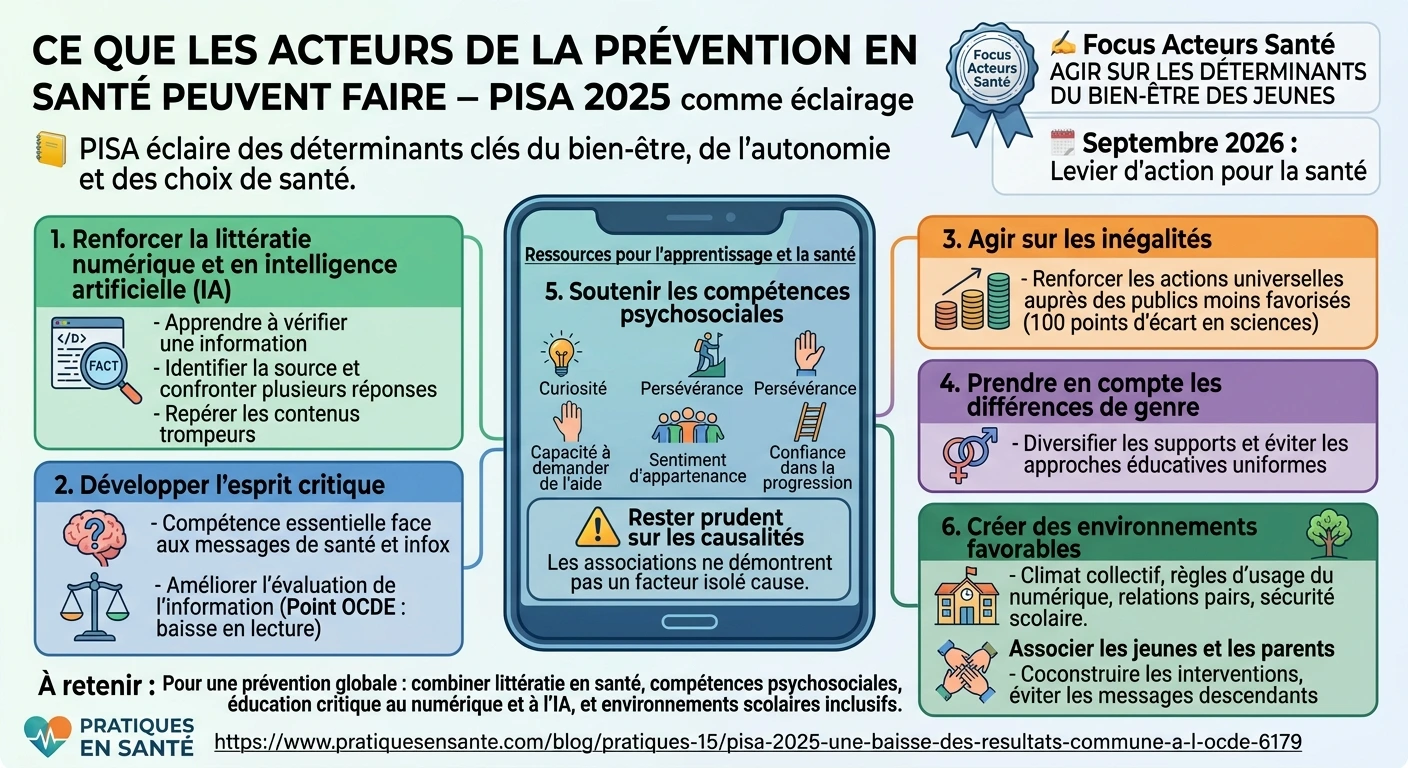
3️⃣ ACTIONS FOR LOCAL ACTORS
1️⃣ Digital hygiene and sleep, without demonisation. Set up young family workshops on screen time, evening disconnection and sleep, relying on the guidelines of the document (recreational use at school, p. 7-8) and on the suspension of ENT 8 pm-7 am (p. 12). Position the screen as a determinant among others.
2️⃣ Strengthen parenting through dialogue, not guilt-tripping. Co-construct School-family spaces focused on fundamental needs (listening, routines, sleep), echoing the decline in parental monitoring (p. 9) and the Parents-School charter (p. 14). First target the families most distant from the school (issue of social health inequalities).
3️⃣ Act on the school climate as a factor of mental health. Propose actions for teams on noise management, stress regulation and compassionate communication, based on the observation of 47 % (p. 10). Work on "daring to ask for help", a weak point identified among French students (p. 10).
4️⃣ Promote the use of help and early detection. Relying on the perceived support of adults (teacher support index, +7 pts, p. 10) to equip the identification and referral to local mental health resources (to be confirmed locally — CLS, CPTS, youth houses, PMI according to age).
5️⃣ Focusing on alternatives for flourishing. Mobilising physical activity (school sports, "2 hours of extra sport", p. 12) and cultural practices / reading (p. 12, 17) as levers for overall health and attentional regulation — and not just as substitutes for screens.
6️⃣ Carrying out a multifactorial local advocacy. Using these figures, with local authorities, CLS and CPTS, to advocate for a reading that articulates digital, social health inequalities and teaching conditions. Unmet need in the document: the structural causes internal to the school (recruitment, teaching conditions) — not to be left in the blind spot.
4️⃣ ADDITIONAL REFERENCES
OECD, PISA 2025 Results (Volume I): Future-Ready Students, 8 Sept. 2026 — the primary source (data, equity, "learning in the digital world") — https://www.oecd.org/en/publications/pisa-2025-results-volume-i_73451bc5-en/full-report.html
CESE, Opinion "Mental health and well-being of children and young people: a social issue", 14 Oct. 2025 — places social, family, environmental AND digital determinants on the same level — https://www.lecese.fr/sites/default/files/pdf/Avis/2025/2025_18_sante_mentale.pdf
HCSP, "Thirty years of adolescent health evolution", 23 Sept. 2025 — reminds that the link between social networks / mental health is "complex and bidirectional" — https://anmda.fr/sites/default/files/2025-10/hcspr20250923_santdesadolescdepuisans.pdf
5️⃣ FREQUENTLY ASKED QUESTIONS (FAQ)
1️⃣ What does PISA measure, and what changes in 2025? PISA tests, every 3 years, the ability of 15-year-olds to mobilise reading, maths and science in real-life situations. In 2025, the major focus is science; for the first time, an assessment "learning in a digital world" is added (p. 3).
2️⃣ Is France declining everywhere? No. Science scores are almost stable (483, −4), but there is a significant decline in maths (458, −16) and writing (456, −18) since 2022. France remains at the OECD average in science and writing, but declines more than the OECD in maths (p. 5).
3️⃣ Are screens THE cause of dropout? The document shows a correlation (−24 points in science for 2-3 hours/day of digital leisure at school, after controlling for social background) but does not demonstrate a unique causality (p. 8). Other determinants weigh in: social inequalities, school climate, parental involvement (p. 9-10).
4️⃣ What does the report say about social inequalities? In France, social origin remains strongly linked to results (p. 9). A slight tightening observed in maths (2012-2022) is presented as a point of support — but the OECD source indicates that it is mainly due to the decline of advantaged students.
5️⃣ What role for parents? Parental involvement has decreased (49% vs 63% in 2022). Simple and regular actions are associated with better results (+26 points in science in the OECD), even in comparable social backgrounds (p. 9).
6️⃣ Is the classroom climate a health issue? Yes. 47% of French students report frequent noise/disorder (vs 31% OECD), which undermines attention and well-being (p. 10). French students also ask for little help (p. 10), which hinders identification.
7️⃣ What responses are announced, and with what status? Prohibition of mobile phones extended to high school (start of 2026), disconnection of ENTs in the evening, annual objectives, support for parenting, training for teachers (p. 11-17). These are announced political measures, not interventions that have already been evaluated.
6️⃣ REWRITING IN EASY TO READ AND UNDERSTAND (FALC)
What is PISA?
PISA is an international test.
It measures the knowledge of 15-year-olds.
It looks at science, maths, and reading.
This test takes place every 3 years.
What the test shows
The results of young people are declining in almost all countries.
In France, maths and reading are declining significantly.
Science remains almost at the same level.
Many students have great difficulties in reading.
Why are the results declining?
There are several causes, not just one.
Screens and social media take up a lot of time.
Too many screens in class hinder attention.
But screens are not the only cause.
Noise in class also disrupts students.
Parents are less involved with the school than before.
Poor families often have more difficulties.
What can help
Better manage screen time and sleep.
Talk each day with your child about school.
Make the class calmer.
Dare to ask for help when you don't understand.
Do sport and cultural activities.
7️⃣ CROSS-SECTIONAL ANALYSIS — VALUES OF HEALTH PRACTICES
Literacy : the document does not provide public literacy tools; it targets an institutional readership but includes a "simple language" for the objectives given to families (p. 15).
Empowerment : little present; students and families are mainly recipients of measures, not involved in their design.
Participation : no mechanism for co-construction with young people or families is described; top-down approach (objectives set at national level, p. 16).
Community health: collective dimension poorly addressed; the entry remains school-based and individual, without connection to local health actors.
Ethics : biases are not discussed; the shift from correlation → causality (screens) and the weight of self-reported data are not questioned by the document.
Human rights / equity: equity is mentioned through academic difficulty and social background (p. 9-10), without an explicit approach in terms of rights.
Intersectorality : weak; partnerships mainly within the National Education (Inspé, academies) and research/engineering (Chams, p. 13). Little link between health/social.
Partnership : formalised models on the school side (Parents-School charter, p. 14; Progressing Colleges, p. 13), not on the health side.
Fight against discrimination: the document mentions inequalities social and parity (Chams, competition, p. 13), but not explicitly discrimination; non-judgment and diversity are little addressed.
8️⃣ EVALUATION OF THE RELIABILITY OF THE RESOURCE
Scientific relevance
Solid data at the source (OECD, DEPP) and recent (2025). But the dossier is a selective ministerial reading: it highlights external determinants (screens, parents) and downplays internal factors (teaching conditions, recruitment). Some correlations are presented with an implicit causal shift; several figures are declarative. Note: OECD gaps vary according to the scope (24 constant countries in the dossier; the OECD mentions, at full scope, −28 pts in reading 2015-2025). Data reliability: high. Interpretation reliability: to be contextualised.
Operational relevance
Indirect for prevention, social and medico-social (template misalignment). Useful as a numerical basis and as an advocacy object, not as a guide for action. The "responses" presented are announced political measures, not evaluated interventions.
9️⃣ STRATEGIC HASHTAGS
#healthpractices #HealthPrevention #DigitalLiteracy #YouthMentalHealth #SocialInequalities #SchoolClimate #Parenting #HealthDeterminants
This article was developed in accordance with the Charter
of the use of artificial intelligence of Health Practices.
Click on the image